
How to Vet Influencers: Review a Shortlist Before Booking

Here’s the shortcut that makes influencer marketing look easy: go to Instagram, search your category, and scroll. Find someone with a good number of views. Look through a few posts. There are likes, there are comments, and the product seems to fit. Send the brief. Then wait for the sales.
But here’s the part that gets skipped: those numbers haven’t told you who you’re actually paying to reach. Likes and comments can be bought or traded. Some audience figures are estimates built from public signals. Even genuine attention can come from people who will never need your product.
Before you send that brief, check five things: the customer you need to reach, the work that makes this creator relevant, the audience evidence, the deal you’re actually buying, and what the first test should teach you. At QuickAds, we use AI-assisted research and human review to connect those checks. Here’s how to do it.
By Nitin Mahajan · Last updated 19 November 2026
A quick distinction before the method: an estimate is not automatically fake. Modash describes using public profile information and machine-learning models to derive creator and audience insights. Its engagement guide also explains how bought interactions and engagement pods can inflate a rate. Treat those as different questions: how was this figure produced, and what evidence supports the audience behind it?
The mistake is treating “looks relevant” as “worth booking.” A category match tells you very little about the customer question a creator can answer, the audience they reach, or the work their fee covers.
Imagine you’re launching walking shoes in the U.S. You find a fashion creator with an attractive feed and a reviewer who explains shoes to people who spend all day on their feet. The fashion creator might help someone picture an outfit. The reviewer might help a commuter understand sizing and comfort. Both could be useful, but you need to choose the buying question before comparing their follower counts.
To approve an influencer shortlist, define the buyer and the job first. Search for relevant work, check the audience behind it, agree what you’re buying, and run a pilot you can learn from. Use AI to help organise the search and prepare the questions. Keep a person responsible for checking the evidence and approving the booking.
That matters because attention and useful persuasion don’t automatically arrive together. Kantar assessed over 15,000 branded creator assets; 6% combined strong platform engagement with strong brand-building potential. This measures content effectiveness, not the percentage of creators who generated a profit. Kantar’s findings
1. Decide what you need the creator to do
Before opening a search tool, write down who you need to reach and what they need to understand.
For the shoe launch, a useful starting brief is: “U.S. everyday walkers who need help assessing fit. We want a creator who can explain sizing and show the shoe in normal use.” “Fashion influencer” leaves too much undecided.
Separate two purchases. If you need footage for ads on your own accounts, assess the person’s production and explanation skills. If you also want a post on their account, their audience becomes part of what you’re buying. Paid use through their identity is another permission to agree. A strong video portfolio doesn’t establish the value of that audience.
Leave this step with: a buyer, a market, a customer question, a platform and a clear content-versus-distribution requirement. This is your search brief.
2. Keep the work behind every shortlist entry
For each candidate, save a relevant content link, the exact reason for the match and the observation date. Open the work: can this person explain or demonstrate the customer question in your brief? A category label is not enough.
If you still need to build a list, use the influencer discovery guide. This review starts with the candidates you already have. Classify each one as ready for a scope discussion, missing evidence, or unsuitable for this brief.
3. Check the person, their audience and the unknowns separately
Watch several recent pieces of relevant work. Can the creator explain the product clearly? Do they show the detail a buyer needs? Can you point to the exact moment that makes them a plausible fit?
Then check audience delivery if it’s part of the purchase. Review recent comparable posts, typical views, audience location and the discussion underneath. Separate formats and unrelated viral posts. A creator’s location doesn’t tell you where their followers live.
If a discovery report estimates audience quality or geography, record its date and limitations. Ask for recent platform Insights when the decision depends on that information. Investigate unusual patterns; a score or a quiet comment section alone doesn’t prove fraud. “Not confirmed” belongs in the record when the answer is missing.
Product credibility needs its own conversation. Has the person used the product? Can they demonstrate it honestly? Will they describe limitations as well as strengths? Relevant followers cannot fix a recommendation the creator can’t stand behind.
Use three outcomes: progress to a scope discussion, request missing evidence, or set aside. A candidate with an unanswered geography question may need a follow-up, rather than an inflated score to fill the cell.
Leave this step with: a shorter list and a named next action for every candidate.
4. Send a specific first message and compare the same purchase
A useful message shows why you picked the person and makes it easy to respond. Here’s a fictional example:
Hi [name], your video explaining [specific fit question] is why I’m reaching out. We’re planning a U.S. walking-shoe campaign for everyday walkers. Would you be interested in showing how the shoe fits and works in normal use? We’d like to discuss one Instagram video and an organic post. Could you share your availability, quote, recent audience-location Insights and any relevant category conflicts? Please quote paid usage separately so we can agree the scope before booking.
Adapt that to the actual work and channel. Don’t claim you watched a video you haven’t seen. The message is a conversation starter, not a finished contract.
Compare quotes only after clarifying deliverables, posting, revisions, editing, approval dates, usage and payment terms. Keep content-only offers separate from offers that include distribution. Clarify any paid use through the creator’s identity before treating it as included.
Leave this step with: comparable offers and a written scope, rather than the cheapest number in the inbox.
5. Book a pilot that improves the next search
Choose one customer question and a demonstration the creator can honestly deliver. Agree what the buyer should understand after watching, which claims are supported and what action you want them to take.
Decide what would justify another booking before launch. For a shoe brand, that might include purchases at an acceptable acquisition cost, alongside whether the video explained fit clearly. Record the full cost, including creator fees, rights, editing, internal time and media. Keep the offer, destination and conversion event comparable where possible; note differences where they aren’t.
A weak result doesn’t tell you the creator was wrong. It could point to the message, offer, landing page or audience. Put the lesson back into the search brief: “Find someone who can demonstrate sizing more clearly” gives the next search a purpose. “Find more influencers” starts the whole guessing game again.
Leave this step with: a booking decision and a better brief for the next round.
Compare three creators before the booking
Illustrative brief: a US walking-shoe brand wants an Instagram creator post and a product demonstration for everyday walkers. The goal is to learn whether the creator can explain the fit and show the shoe clearly. The first booking is a bounded pilot, not a sales forecast.
The offers, creators and figures in this table are fictional teaching examples.
Quote
Creator A: $1,200
Creator B: $800
Creator C: $450Scope
Creator A: Content + one post
Creator B: Content + one post
Creator C: Content onlyFollowers
Creator A: 120,000
Creator B: 45,000
Creator C: Not used for this comparisonMedian views, last 12 comparable posts
Creator A: 9,000
Creator B: 15,000
Creator C: Not applicable to purchased distributionQuote per 1,000 historical median views
Creator A: $133.33
Creator B: $53.33
Creator C: Not comparableRelevant content
Creator A: General fitness
Creator B: Footwear explanations
Creator C: Strong product close-upsBuyer geography
Creator A: Not confirmed
Creator B: Not confirmed
Creator C: Not relevant to a content-only purchaseUsage / permissions
Creator A: Confirm
Creator B: Confirm
Creator C: ConfirmNext decision
Creator A: Ask for audience evidence
Creator B: First candidate to verify for a distribution pilot
Creator C: Consider separately for production
Calculation: (quote ÷ median historical views) × 1,000. This is a scope-dependent historical cost comparison, not actual campaign CPM or predicted reach. It allocates the full quote to historical views for a simple first comparison, although the quote may include production. A and B must have matched deliverables before using it. A median is not an expected future result.
Keep the content-only candidate in a production lane. Verify audience evidence and matched scope before ranking distribution offers.
Copy the full worked example and blank comparison.
How QuickAds does this differently
I founded QuickAds. Our approach connects the search to the booking decision: describe the customer and the demonstration you need, inspect why a creator matches, check the audience separately, then prepare the scope questions before contacting them.
The captures below show that difference. The search reason describes sneaker and footwear content tied to basketball and fashion. It gives you a candidate to investigate; it does not establish expertise in walking comfort.
Now read the audience report: it estimates 96% of the sampled audience is in the United States, while separately showing “Real followers: 38 of 100. Weak.” The report is sample-based and dated 17 November 2026. Location looks relevant to the U.S. brief, but the quality warning still needs investigation. Neither number is a booking recommendation, and the 38/100 label is not proof that 62% of the account is fake.
The next action is to inspect the relevant videos and ask for recent platform Insights before deciding whether to progress. The unsent outreach draft prepares those audience questions alongside rates and conflicts. That is the practical value of keeping the search and screening evidence together.
The business goal is a better return on the money and effort you put into creator marketing. The practical change you can inspect here is a shortlist with reasons, unresolved questions and a next action. Campaign results still need to be measured after the work runs.
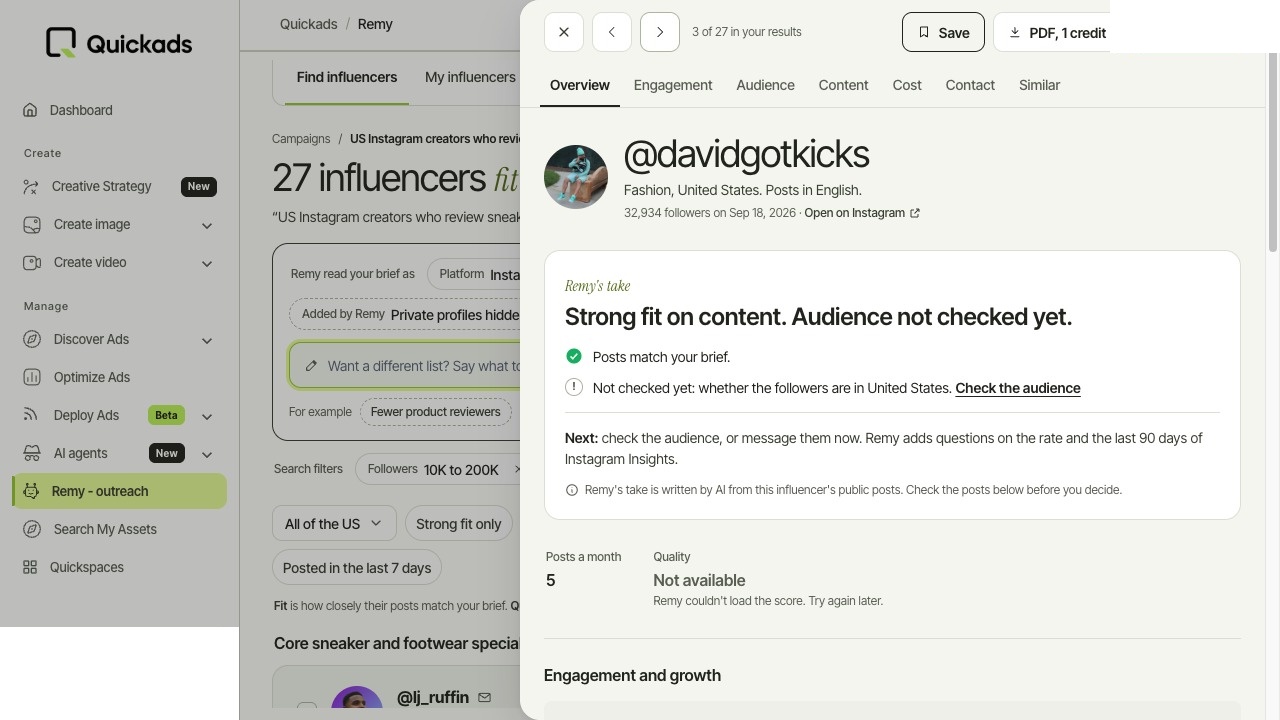
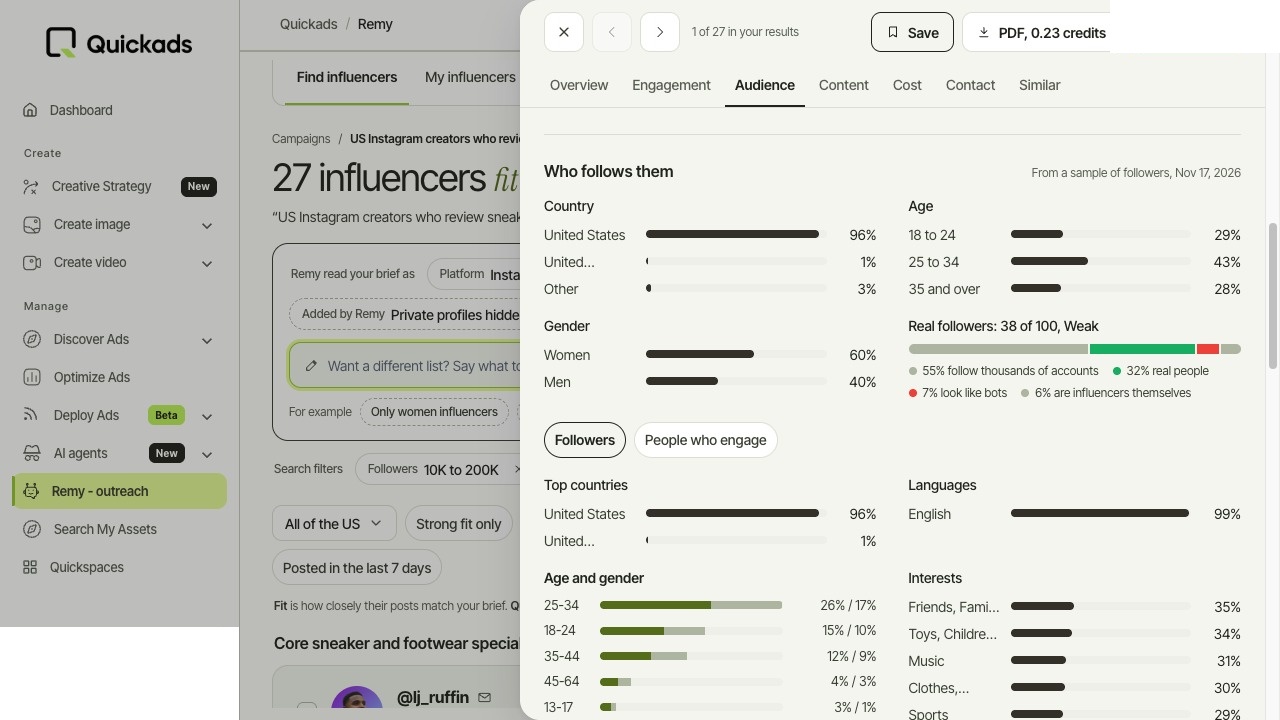

The 18 November recording shows real navigation, brief entry, a fresh search still processing, an explicit switch to saved results, three reports and selection. Provider estimates need checking; verified quotes and comparable campaign outcomes remain missing. No outreach was sent. The ending comparison is editorial teaching.
If this would help your team, request a creator shortlist, or check a creator you are considering. Use the result as a starting point for your own review.
Continue with the related guides
influencer campaign brief template · ad creative testing
Questions before the next decision
Does an audience-quality score prove an influencer is fake?
No. Record the method, sample and date, inspect the underlying evidence and request recent platform Insights when the booking depends on it. A warning flag is a reason to investigate, not a fraud verdict.
When is a shortlisted creator ready to book?
When the relevant work, audience evidence where distribution is purchased, deliverables, usage, timing and approval responsibilities are clear enough for a bounded pilot. Keep unresolved checks visible.
Keep the next decision connected
Continue with the broader influencer discovery guide and the creator workflow · creative testing.
About the author

Nitin Mahajan is the founder of QuickAds. His work focuses on connecting creative research, creator selection, production and campaign decisions. QuickAds publishes this guide and sells related software and services.







Privacy is important to us, so you have the option of disabling certain types of storage that may not be necessary for the basic functioning of the website. Blocking categories may impact your experience on the website. View Our Privacy Policy


