 V/S
V/S
Design Pickle quotes. Quickads publishes.
One sells a design queue by the month. The other sells ad creative at volume, priced in public.
V/SOne sells a design queue by the month. The other sells ad creative at volume, priced in public.
Design Pickle sells subscription design capacity across twelve published creative categories at a flat rate, sized on a 30-minute consultation call. Quickads sells performance creative for paid media, from intelligence through campaign management. The deciding difference is what each one writes down. Design Pickle publishes no price and no output number. Quickads publishes both.

What it sells
Performance creative across five links, software or managed service
Subscription graphic design, motion and illustration
Published price
From $299/mo software; $5,000/mo managed; 5% of ad spend option
None published; flat rate set on a 30-minute consultation call
Published weekly output
1,200+ creatives a week
None; "We do not guarantee the amount of work" (ToS s.4.3)
Turnaround
5 to 7 days per batch, statics, video and motion together
Average 24-hour first drafts; motion and video run longer
Creative strategy and ad-performance data
Included; models trained on 32M+ ads, $200M+ spend managed
No ongoing strategy service or performance reporting published
Billing terms
Monthly on software; six-month term on the productized plan
Quarterly or annual, non-refundable; file access ends with the plan
Design Pickle does subscription design properly. First drafts on standard design work come back in 24 hours, and that speed is what its customers praise most. One plan covers twelve published creative categories. Files arrive editable in Adobe, Canva and Google Slides, revisions carry no per-change fee, and full rights transfer on delivery. It is an official Canva partner.
Quickads sells performance creative, not design hours. One contract covers intelligence, strategy, production, influencer marketing at scale and campaign management. Computer-vision models trained on 32M+ ads pick the angle, a human strategist signs it off, and 1,200+ creatives a week land in 5 to 7 day batches carrying statics, video and motion together.
Ad performance data inside the product
You learn which creative earned its spend instead of guessing at the next brief.
Models trained on 32M+ ads inform the next batch
None published on designpickle.com
Ad account connection
Live results close the loop automatically rather than through a manual retelling.
Campaign management included
No ad-platform integration published
Scale behind the model
Pattern recognition comes from paid media outcomes, not design volume alone.
$200M+ in ad spend managed
Design Pickle says 3m designs created
Stated hit-rate effect
One vendor states an effect on winners, the other on units produced.
~3x hit-rate lift, stated service characteristic
Design Pickle says 3x creative production
Who decides the angle
Removes the hardest, least outsourced part of the job from your team's plate.
AI agents plus human strategists own angle
You write the brief; they design to it
Ongoing strategy service
Angle development continues past onboarding instead of ending at the sales call.
Ongoing strategy in managed plans
Consultation is pre-sale scoping only
Ad copy, hooks and headlines
You are not writing every headline and hook yourself before production starts.
Ad copy and hooks in scope
Not stated on the pricing or scope pages
Format range
Design Pickle wins on breadth; Quickads is deliberately narrow on paid media.
Paid media creative only, no print or packaging
12 published categories incl. print, packaging
Influencer creative at scale
UGC-style creative comes from the same pipeline as your statics and video.
Influencer marketing at scale included
Not published as a service
Regulated categories
Supplements, skincare, finance and health copy gets a claims pass before it ships.
Claims-Safe Volume Creative product
No claims-review service published
Large catalogs and many SKUs
Hundreds of SKUs get creative without hundreds of individual briefs.
Enriched Catalog for many listings/SKUs
No catalog-scale product published
Editable native file delivery
If your team edits files in-house, Design Pickle's delivery formats are proven.
Not published
Adobe, Canva and Google Slides
Published weekly volume
You can plan a quarter of testing against a number instead of an estimate.
1,200+ creatives a week, published
No monthly output figure published
Output guarantee
Volume risk sits with the vendor rather than with your test calendar.
1,200+ creatives a week is the stated commitment
"We do not guarantee the amount of work" (ToS 4.3)
First draft on a single static
For one urgent banner tomorrow morning, Design Pickle is the faster option.
Batched on the 5 to 7 day cycle
Average 24-hour first drafts, their own wording
Video and motion turnaround
Video does not sit in a slower second queue behind your static work.
5 to 7 days, same batch as statics
2-5 days video, 2-7 days motion
Parallel variants for testing
Enough variants land at once to read a paid-social test rather than a sample.
Batch of variants shipped per cycle
Concurrency rises with design hours bought
Published starting price
You can budget and compare today without entering a sales cycle.
From $299/mo software, $5,000/mo managed
No price published; quoted on a 30-min call
Billing cycle
Smaller first commitment when you are still testing the vendor.
Monthly on software; 6-month productized term
Quarterly or annual billing, per pricing FAQ
Running the media
One team owns creative and spend, so the feedback loop has no handoff in it.
Campaign management included
Not published as a service
1
Their limit
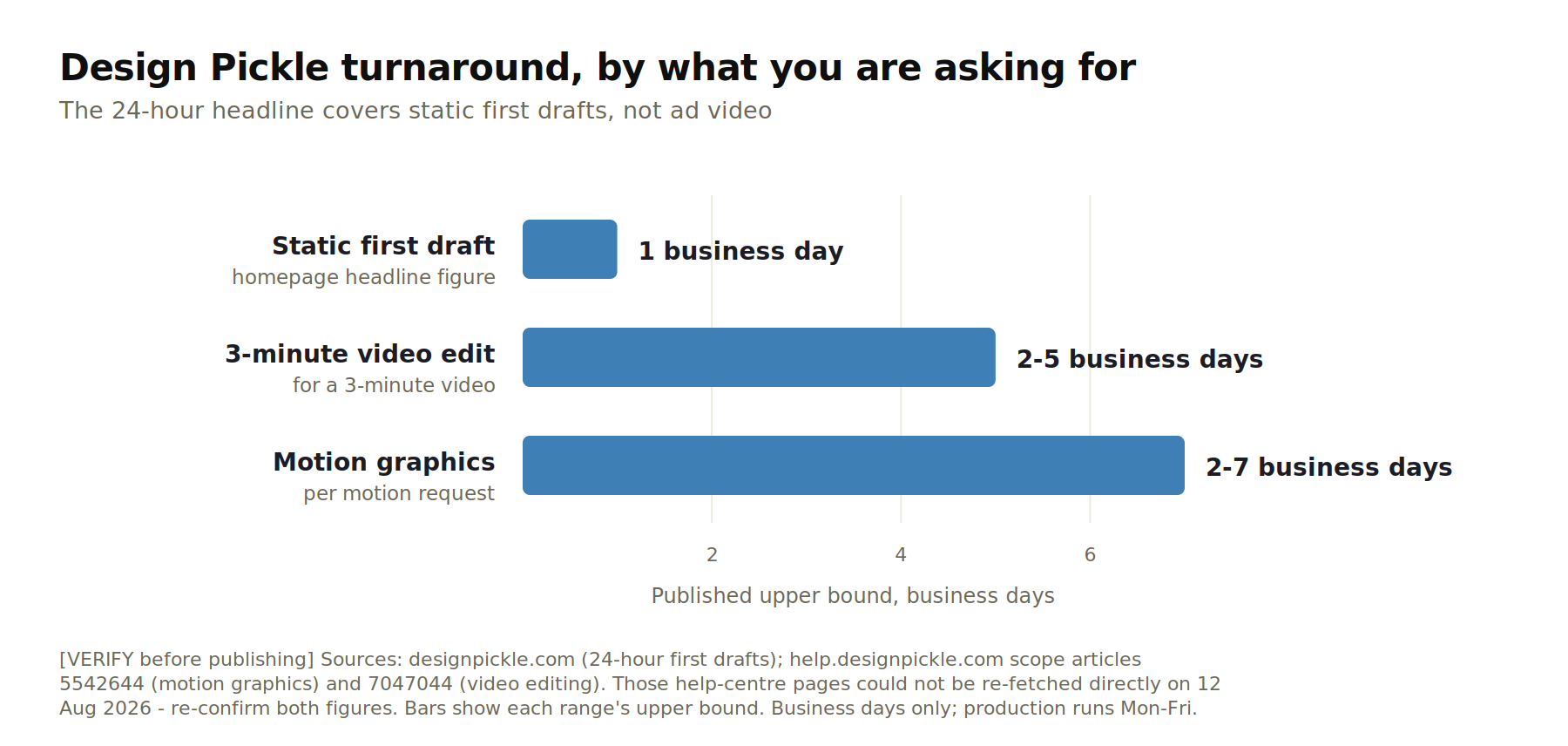
Design Pickle covers one link of the chain, and covers it well: production. Twelve published categories, brand-trained teams matched to your account, human review on every deliverable (designpickle.com/pricing). What it does not publish is the rest of the chain. There is no ad-platform integration and no creative-performance reporting anywhere on the site, so nothing carries live campaign results back into the next brief. The only creative strategy offering published is the pre-sale 30-minute consultation used to scope and price a plan. Angle, hooks and the read on what actually worked stay on your side of the wall.
QuickAds advantage
Quickads runs all five links with one team. Creative intelligence comes from computer-vision models trained on 32M+ ads across $200M+ in managed ad spend, and that is what sets the angle before anything gets designed. Strategy sits with human experts. Production ships statics, video and motion. Influencer marketing runs at scale. Campaign management closes the loop, so what the ads did last week decides what gets built this week. Buy it as self-serve software from $299 a month, or as a managed pod from $5,000 a month. AI handles form, humans own substance.
You stop being the missing link between your ad data and your design queue.
2
Their limit
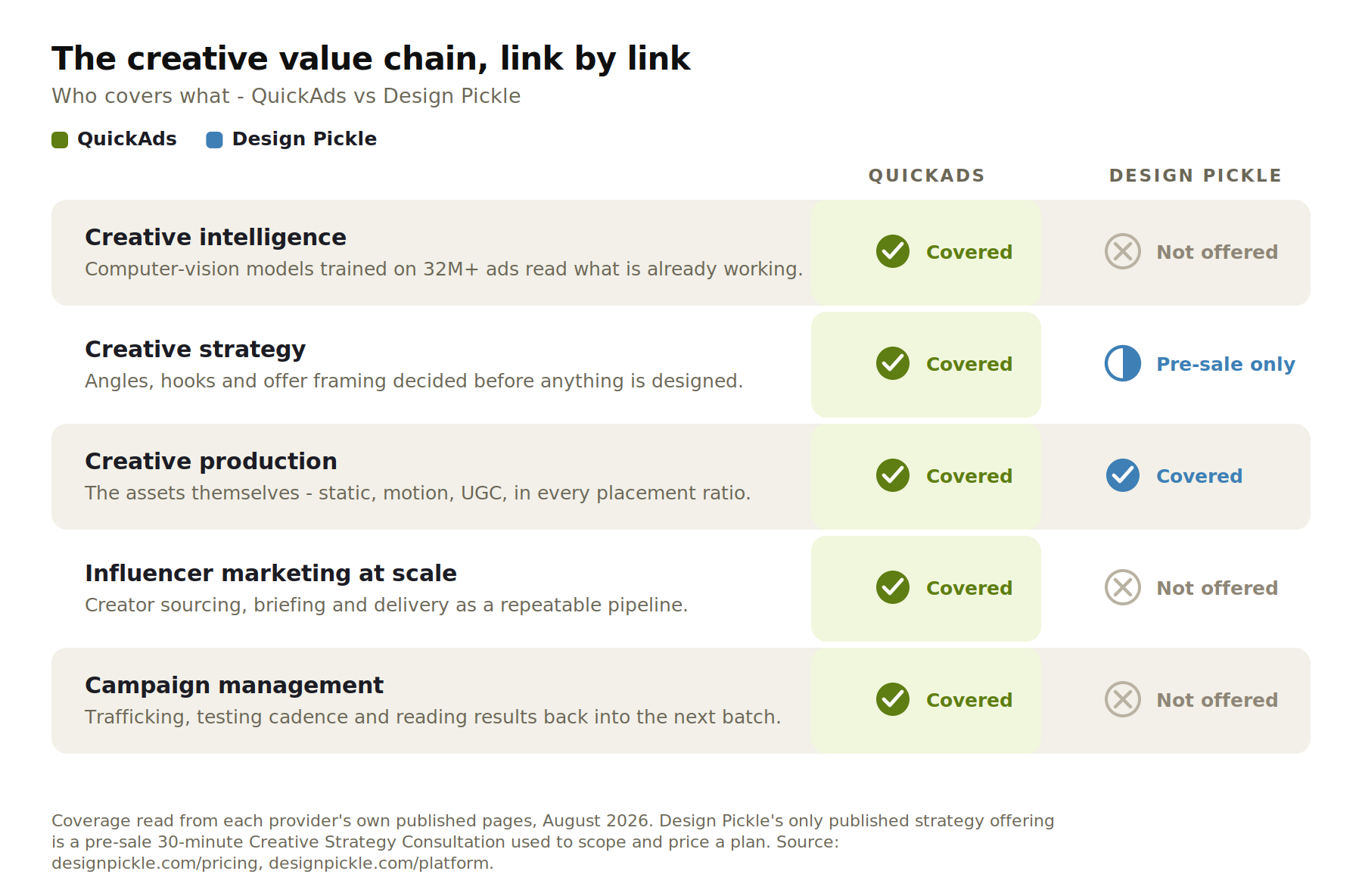
Design Pickle sells design hours, not asset counts, and says so plainly. Its terms read: "We do not guarantee the amount of work that we can create with a single subscription" (Terms of Service, s.4.3). The help centre adds that "the exact number of designs delivered per business day can't be guaranteed" and that its per-day figures are "examples only" (turnaround estimates). Larger plans genuinely produce more, and that same article references 8-hour and 10-hour plans. But no monthly number exists on any page, so a test calendar has nothing firm to plan against.
QuickAds advantage
Quickads publishes the number. 1,200+ creatives a week, shipped in batches on a 5 to 7 day turnaround. That is a commitment, not an illustration. It is also the volume a paid-social test actually needs, because reading a test requires many variants live at once rather than one asset back per day. You can build a quarter of testing against it before you sign anything. Pricing is published on the same terms: software from $299 a month, managed from $5,000 a month, or 5% of ad spend with a $5,000 monthly minimum on a six-month term.
Your test calendar is built on a committed number instead of a per-day example.
3
Their limit
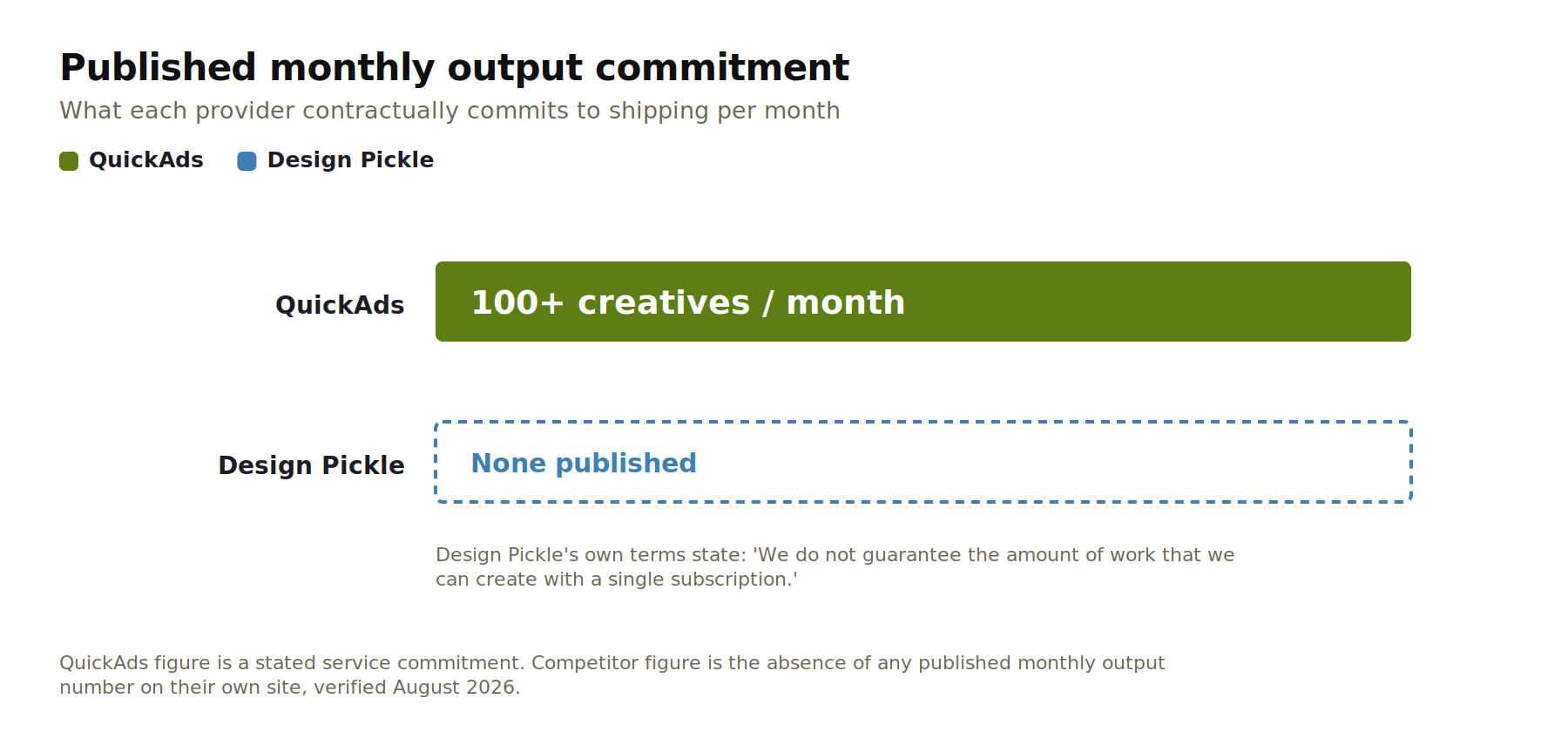
The 24-hour headline is real, and Design Pickle hedges it themselves. The homepage promises "reliable 24-hour turnaround times for initial first drafts" and elsewhere "Average 24-hour first drafts", while the pricing FAQ says "Most requests come back within one to two business days, depending on scope" (pricing FAQ). For a static ad, that is genuinely fast. Video sits on a different curve. Their help centre puts a three-minute video edit at 2-5 business days and motion graphics at 2-7 business days, so the headline number does not describe video ad creative.
QuickAds advantage
Quickads runs one cycle for everything: 5 to 7 days per batch, with statics, video and motion produced together. We do not claim a next-day single asset, and if you need one banner resized by tomorrow morning, Design Pickle will beat us on that job. What the 5 to 7 day cycle buys is a whole batch, concepted and produced, with the angle already chosen from ad performance data rather than from a brief you had to write yourself. Video is not a slower second queue inside the service. It ships in the same batch as the statics.
Video stops being the thing that arrives two weeks after the campaign launched.
Choose Design Pickle if breadth is the problem. A trade-show booth, a pitch deck, packaging and a few social posts suit a flat-rate queue. It is also right for a team that already employs a creative strategist and a media buyer and only needs hands on production.
Choose Quickads if the constraint is paid-media volume: how many concepts get live this week, and whether anyone reads the ad data before the next batch is built. Design breadth goes one way, published throughput the other.
Design Pickle is a subscription creative-as-a-service platform operated by Design Pickle, LLC. It pairs a brand-trained creative team with a request-and-tracking platform, and describes itself as delivering graphic design, motion and illustration. You submit a brief, the team returns a first draft, and revisions are included with no per-change fees. Plans are flat-rate and scoped on a 30-minute consultation rather than sold at a published price (designpickle.com/pricing).
Design Pickle does not publish a price. As of August 2026 its pricing page carries no dollar figure at any tier. The page states: "Flat-rate, not hourly. No retainers. We size your plan to what you need. You get the number on the call." Billing runs quarterly or annually, and fees are non-cancelable and non-refundable with no credit for unused time. Older prices circulating on review sites do not appear on Design Pickle's own site.
Design Pickle publishes no monthly figure. Its help centre gives per-day examples by plan size, such as 1-3 customized social media graphics or 5-6 templated ones on a 2hr plan, then states those are "examples only" and that "the exact number of designs delivered per business day can't be guaranteed". Larger plans produce more. Quickads publishes a committed 1,200+ creatives a week on a 5 to 7 day batch turnaround.
With Design Pickle, unlimited describes requests and revisions, not output. You can submit endless requests, and the queue works through them in order. Their turnaround article notes that with enough design hours in your subscription the team can work on multiple requests simultaneously, so concurrency is bought with hours. The terms are explicit that volume is not guaranteed: "We do not guarantee the amount of work that we can create with a single subscription."
Design Pickle's terms say you may cancel at any time in the application or by contacting support, and the pricing FAQ adds that you cancel before your next renewal date, with the account staying active through the end of the current billing period. There are no refunds for partial months, downgrades or unused time. Download everything first: when the subscription expires you lose access to the service and to the design files associated with it (Terms of Service, s.6.3).
Split the work by job. Keep a design subscription for brand, print, decks and business-as-usual assets, where Design Pickle is strong. Move paid-social volume to a performance creative provider that owns angle, production and campaign data together. Export your files before the subscription lapses, since access ends with it. Our Quickads vs Penji and Quickads vs 99designs pages compare the other subscription design options on the same criteria.
The Core Difference

You get a fast video. The angle is still your problem.
Creatify turns a product URL into a finished short-form video fast — script, AI avatar, voiceover, 75+ languages, and a batch mode for variations. But it starts after the hard question: deciding what to make. Its ad intelligence and competitor tracking sit on higher plans, and its focus is short-form video, not static or image ads.
You see the whole market. Then you build the ad.
QuickAds discovers what is already winning across five ad platforms, scores every creative on hook, message, quality, and performance before you spend, then builds the ad — image, video, or UGC — and publishes it in one click. One platform for the whole loop. No gaps.
The Bottom Line
How Each One Works
URLAI avatar videoExport adDiscoverScoreCreatePublish