
How to Choose the Right Marketing Strategy Based on Your Budget

Marketing offers no shortage of options. You can invest in search engine optimisation, paid ads, content, link building, social media, email, or a combination of several approaches. The challenge is deciding which strategy makes sense when your resources are not unlimited.
In this guide, we will look at which strategies make sense at different spending levels and how to choose between them.
Which Marketing Strategies Work Well on a Smaller Budget?
A smaller budget means you need to be more selective about where you invest your time and money. Instead of choosing strategies that require continuous spending to maintain visibility, it often makes sense to focus on approaches that can build value over time.
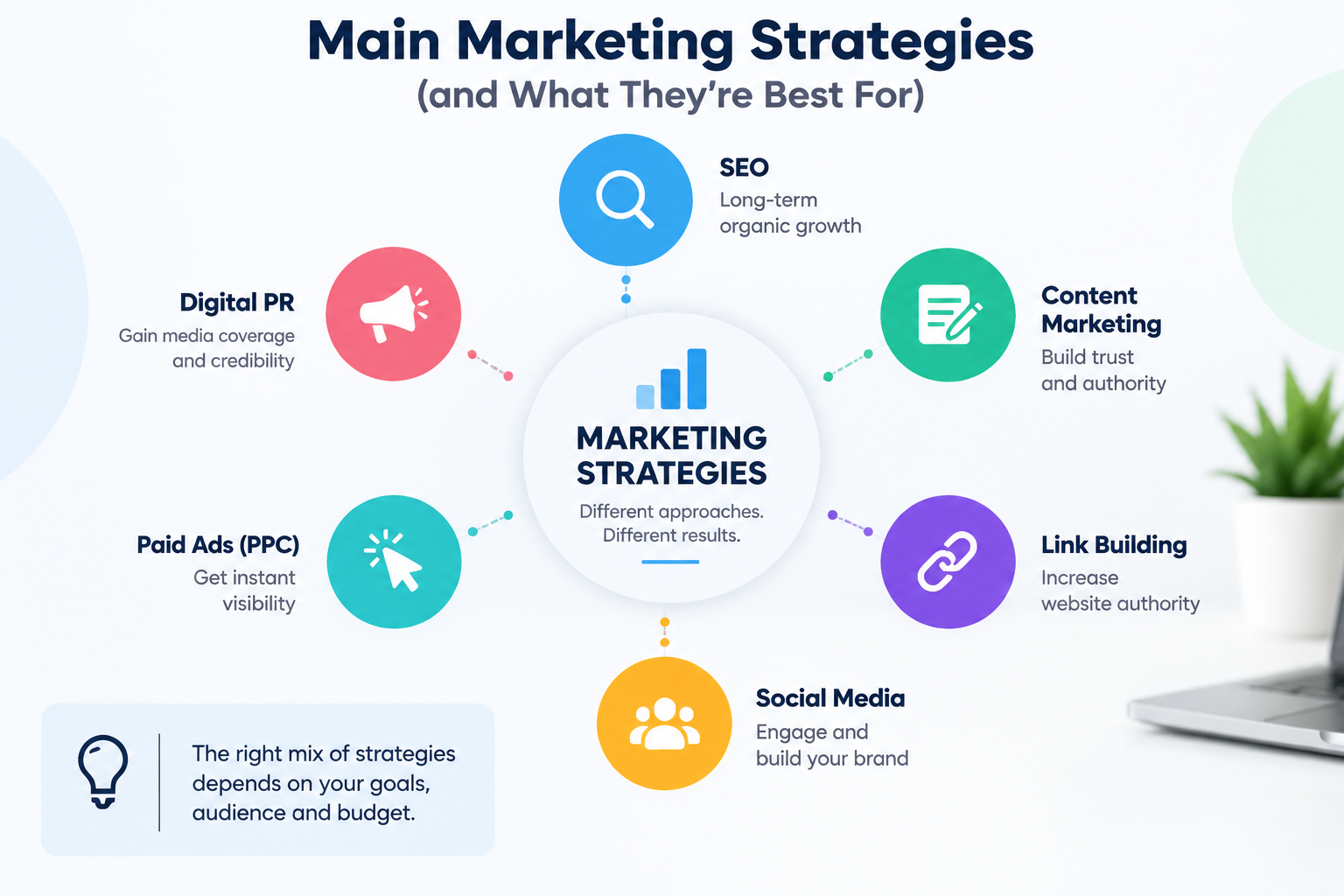
Here are some approaches worth considering.
Search Engine Optimisation
SEO can be a practical starting point because improvements to your website can continue supporting organic visibility after the initial work is complete.
Start with the fundamentals. Make sure important pages answer the searches your potential customers are making. Titles, internal links, page structure, and technical performance should also be addressed before investing heavily in more advanced SEO.
The trade-off is time. Organic rankings rarely change overnight, so SEO makes more sense when gradual growth fits your objectives.
Content Marketing
Content marketing works particularly well alongside SEO. Instead of publishing simply to keep a blog active, create resources around questions potential customers genuinely need answered.
A software company, for example, might produce comparison pages or practical guides related to problems its product solves. A service business could explain complicated processes that customers research before making contact.
Useful content can attract search traffic while giving potential customers a reason to trust your expertise.
Link Building
Once a website has useful pages worth discovering, link building can help strengthen its organic search strategy.
The important consideration on a smaller budget is selectivity. Rather than committing to a large campaign, businesses can start with cheap link building packages offered by Get Pro Links that fit their resources and focus on securing relevant placements from credible websites.
Rather than chasing volume, consider whether placements are contextually relevant and come from genuine websites. Link building should strengthen an existing SEO strategy, not compensate for weak content or a poorly structured site.
Email Marketing
Email can be cost-effective when you already have people to communicate with.
Instead of repeatedly paying to reach existing leads or customers through advertising, you can use email to share useful content, announce relevant updates, or nurture people who are not yet ready to buy.
However, email is less useful as a standalone acquisition strategy when you have no meaningful subscriber or customer base. Its value depends heavily on the audience you have already built.
Organic Social Media
Organic social media can work with relatively modest financial investment, although it often demands considerable time.
The key is choosing platforms strategically. A B2B company may find its audience on LinkedIn, while a visually driven consumer brand might prioritise a completely different platform.
Trying to publish everywhere usually stretches limited resources. A consistent presence where your customers are actually active is generally more manageable.
Which Marketing Strategies Become More Practical With a Bigger Budget?
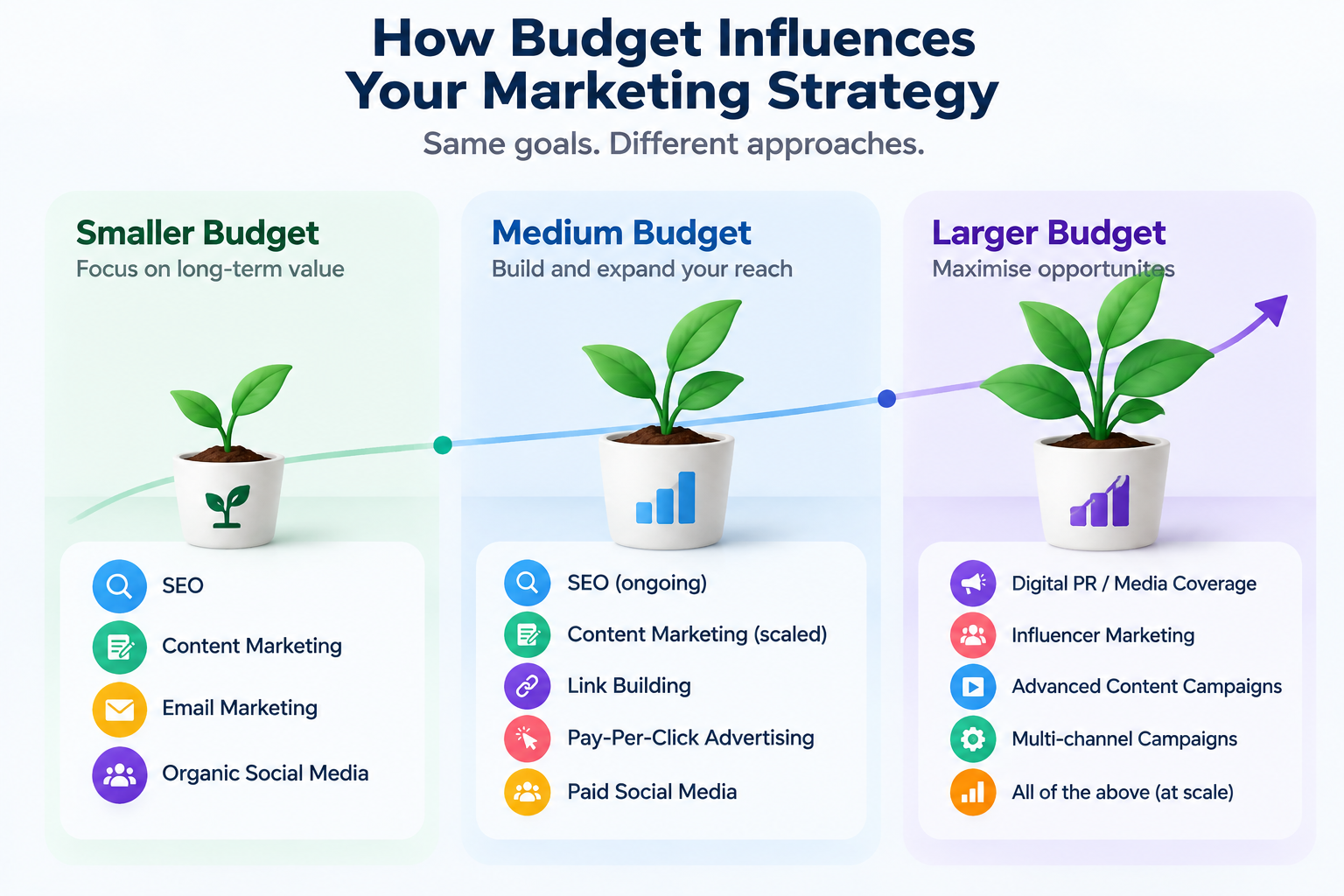
As more resources become available, businesses can consider strategies that depend on ongoing spending or require more substantial campaign execution.
Here are some of the main options.
Pay-Per-Click Advertising
PPC can put a business in front of people searching for relevant products or services without waiting for organic rankings to develop.
That speed is its biggest advantage. It can be useful for lead generation, product launches, or businesses entering competitive search results.
However, clicks have a direct cost, and visibility usually falls when campaigns stop. PPC therefore works best when you can support continued spending and have a clear way to turn paid traffic into enquiries or sales.
Paid Social Advertising
Paid social allows businesses to reach people beyond their existing followers and target audiences using characteristics supported by the advertising platform.
It can be particularly useful when customers discover products through social content rather than actively searching for them.
The budget does not end with media spend, though. Effective campaigns may also require creative production, testing, and regular optimisation.
Influencer and Creator Marketing
Creator partnerships provide access to audiences that someone else has already built.
The strategy can work well when there is a strong match between the creator's audience and the customers a business wants to reach. Costs, however, vary considerably depending on reach and campaign requirements.
A larger following alone does not guarantee better results. Audience relevance and genuine engagement should guide the decision.
PR and Digital PR
Public relations (PR) focuses on earning media coverage by sharing newsworthy stories, research, or expert insights with relevant publications. Digital PR takes this approach online and can also build authority through editorial mentions and backlinks.
However, coverage is not guaranteed. Businesses need a strong story as well as enough resources to create campaigns and carry out effective outreach.
How Do You Decide Which Marketing Strategy Is Right for You?
The amount you can spend narrows the options, but it should not be the only deciding factor. Two businesses with similar resources can reasonably choose completely different strategies.
Here are is how you can separate those choices.
Consider How Quickly You Need Results
If immediate visibility matters, paid search or paid social may be more suitable because campaigns can begin reaching audiences quickly.
SEO and content generally require greater patience. They become more attractive when the goal is to establish organic visibility over time rather than generate traffic immediately.
Look at Where Your Customers Actually Spend Their Time
A strategy is only useful if it reaches the right people.
If customers actively search for solutions like yours, SEO and paid search deserve consideration. If product discovery commonly happens through social platforms, social marketing may play a larger role.
Follow customer behaviour instead of choosing a channel simply because competitors appear to be using it.
Decide Whether You Need New Customers or Repeat Business
Acquiring new customers and communicating with existing ones are different marketing challenges.
Search marketing and advertising can introduce your business to new audiences. Email, meanwhile, may be more effective for nurturing existing leads or encouraging customers to return.
Define which problem you are trying to solve before choosing the strategy.
Think About What Happens When You Stop Spending
Some marketing strategies depend directly on continuous investment.
Pause an advertising campaign and the paid visibility generally disappears with it. A useful article or well-optimised page, however, can potentially continue attracting organic visitors after its initial creation.
Neither model is automatically better. The difference matters when deciding whether your available resources can support an ongoing campaign.
Consider the Time and Expertise You Have Available
Organic social media requires regular content. SEO needs technical and strategic knowledge, while strong content takes research and writing time.
Consider internal workload alongside direct financial cost. Outsourcing may require more money, but handling everything internally can consume valuable resources.
Can You Combine Marketing Strategies Without Overspending?
Yes, and complementary strategies can often make the same resources work harder.
SEO and content are a natural combination because useful content gives search engines relevant pages to rank. Link building can then support stronger pages by helping develop their authority.
Businesses that need quicker visibility might combine PPC with SEO. Paid search can address immediate demand while the organic strategy develops.
Similarly, content and email can work together when a business already has subscribers. Instead of creating separate material for every channel, useful content can become something worth sharing with that existing audience.
The goal is not to assemble the largest possible marketing mix. Choose strategies that reinforce one another and that your team can execute consistently.
Get Pro Links: Making Link Building Easier to Fit Into Your Strategy
For SaaS companies that want link acquisition to form part of their SEO strategy, Get Pro Links offers fixed monthly packages designed for different stages of growth.
Its current plans range from a Professional package aimed at early-stage SaaS companies to Growth and Scale options for more established teams.
The service focuses on niche-relevant contextual backlinks from unique referring domains, with permanent do-follow placements and a six-month replacement guarantee. This structured approach can make it easier to understand what link building will require before incorporating it into a wider marketing strategy.
Conclusion
There is no single marketing strategy that works for every spending level. A business with limited resources may be better positioned to concentrate on SEO, content, email, or carefully selected organic channels. With greater resources, paid acquisition and larger outreach campaigns become more practical.
What matters most is the fit between the strategy and the business. Consider how quickly you need results, where your audience can be reached, and what expertise you have available.
Most importantly, choose an approach you can sustain. A focused strategy executed consistently is far more useful than spreading resources across several marketing channels without enough time or money to make any of them work properly.






Privacy is important to us, so you have the option of disabling certain types of storage that may not be necessary for the basic functioning of the website. Blocking categories may impact your experience on the website. View Our Privacy Policy


