
How Rocketium AI Studio Helps Brands Produce More Ads Without Growing Their Creative Teams
Paid media teams have a strange problem.
The ability to buy more impressions has scaled dramatically. The ability to produce enough good creative to fill those impressions has not.
A performance marketing team may want to test five messages across four audiences, three placements, two offers, and several markets. On paper, that sounds like one campaign.
For the creative team, it can mean hundreds of individual assets.
Each version may require different dimensions, copy, product imagery, language, disclaimers, safe areas, file sizes, retailer specifications, or platform requirements.
That is where creative operations start becoming the bottleneck.
Designers spend time resizing banners instead of developing ideas. E-commerce teams wait for updated marketplace assets. Performance marketers cannot launch as many tests as they would like. Agencies become expensive production queues rather than strategic partners.
AI creative automation is beginning to change that operating model.
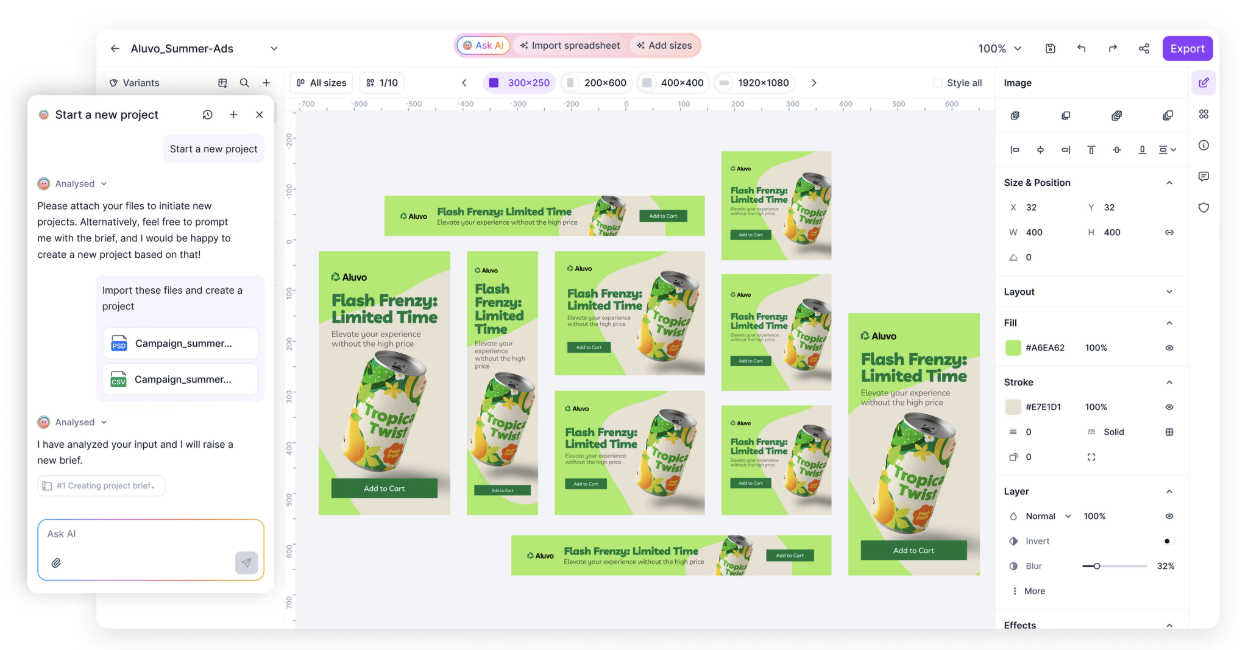
Rather than asking designers to manually execute every variation, brands can increasingly combine AI, production software, automation, and human review to move from a brief to hundreds of usable creative assets much faster.
Rocketium AI Studio is built around this model.
But understanding where it fits requires separating three very different parts of creative production: concepting, production, and adaptation.
Why Creative Production Has Become a Growth Problem
For years, creative production was primarily treated as a design problem.
Today, it is increasingly a revenue problem.
A paid marketing team trying to improve ROAS needs enough creativity to continuously test new messages, formats, audiences, products, and offers.
An e-commerce team may need to update assets whenever:
- A promotion changes
- A new SKU launches
- A retailer changes its specifications
- A marketplace listing needs refreshing
- A campaign enters another country
- Product imagery changes
- A seasonal event begins
- A new audience segment is introduced
Creative teams simultaneously need to maintain brand consistency while handling growing volumes of repetitive requests.
The result is a mismatch.
Media, targeting, analytics, and experimentation have become highly automated. Creative production is still frequently managed through briefs, spreadsheets, email threads, agencies, freelancers, Photoshop files, and manual exports.
That slows down the entire marketing system.
The important question therefore is not simply:
“How can we design ads faster?”
It is:
“How can we increase the amount of useful creative we can test and deploy without increasing cost and headcount at the same rate?”
That is the problem creative automation is trying to solve.
Creative Automation Is More Than Resizing Ads
Creative automation is often associated with automatically resizing one banner into multiple dimensions.
That is useful, but it represents only one part of the workflow.
A typical creative lifecycle contains three layers.
1. Concepting
This is where the visual direction is decided.
A team might create:
- Master layouts
- Campaign visual directions
- Hero designs
- Storyboards
- Design systems
- Layout variations
Concepting determines what the creative should look like before large-scale production begins.
2. Production
Production creates assets that did not exist previously.
Examples include:
- Banner copy
- Translations
- Product lifestyle compositions
- AI-generated lifestyle imagery
- Live-action-style video
- Motion graphics
- Product scenes
Production usually starts from a brief, brand guidelines, product imagery, logos, pack shots, and other raw inputs.
3. Adaptation
Once a creative direction exists, it must be turned into the hundreds of formats required by different channels.
That can involve:
- Resizing
- Copy variations
- Product swaps
- Offer changes
- Language localization
- Audience variations
- Retailer-specific versions
- Platform-specific formatting
Most brands already perform all three activities.
The difference is that much of this work is still manual.
Where AI Changes the Creative Workflow
The biggest advantage of AI in creative production is not necessarily that it can make one impressive image.
It is that different AI systems can take over individual production tasks that previously required repetitive human execution.
A workflow might look something like this:
Brief → Concept → Production → Adaptation → Compliance → Review → Export
Instead of one designer manually handling everything, specialized systems can work on different stages.
For example:
- One system interprets the brief.
- Another identifies or prepares the appropriate template.
- Another maps product data and copies it into design layers.
- Another generates copy or translation variations.
- Another resizes layouts.
- Another checks channel specifications.
- Another validates brand rules.
- Another prepares naming and compression.
- A human reviewer checks the final output.
This is what Rocketium means when it describes AI Studio as an agentic creative production system.
The distinction matters.
A generative AI tool usually produces an output.
An agentic workflow attempts to complete a sequence of tasks around that output.
For high-volume creative production, the second problem is usually harder.
Automating Creative Adaptation
Adaptation is one of the clearest use cases for creative automation because the work is highly repetitive but still requires precision.
Imagine that a brand has approved one campaign design.
The campaign now needs:
- 20 platform sizes
- 5 product versions
- 3 messages
- 4 markets
That creates potentially hundreds of outputs from one master direction.
Traditionally, designers duplicate the file, replace content, resize elements, reposition text, check safe areas, export the file, rename it, and repeat the process.
That creates three problems.
Time
Even relatively simple variations accumulate into days of production work.
Cost
Agencies and freelancers frequently charge for each resize or adaptation because each variation requires production time.
Opportunity Cost
More importantly, every hour spent resizing an approved design is an hour the creative team cannot spend developing better concepts.
Creative automation changes the economics because many of these operations are rules-based.
With structured source files, AI Studio can automate parts of the workflow including:
- Converting or mapping master designs into templates
- Resizing layouts
- Replacing copy
- Swapping images or video
- Mapping spreadsheet data to creative layers
- Checking compliance requirements
- Renaming files
- Compressing exports
- Preparing assets for review
Human designers still review the output where judgment is required.
This distinction is important. The objective is not removing designers from the workflow. It is removing work that does not require a designer's judgment.
Why Adaptation Matters to Performance Marketing
For performance marketers, faster resizing is not particularly interesting on its own.
The downstream effect is.
More production capacity allows teams to create additional:
- Hooks
- Offers
- CTAs
- Product combinations
- Audience-specific versions
- Promotional variants
- Creative refreshes
That creates a larger testing surface.
And creative testing matters because paid marketing teams eventually exhaust winning creatives.
A campaign that performs strongly today may decline as frequency increases and audiences become familiar with it.
Teams therefore need a continuous cycle:
Launch → Measure → Learn → Create → Test → Scale → Refresh
When producing another round of creative takes two weeks, that feedback loop moves slowly.
When adaptation takes hours, marketers can respond to performance signals much faster.
Creative automation therefore becomes less about production efficiency and more about reducing the time between an insight and the next live experiment.
Using AI for Creative Production
Not every creative task begins with an existing design.
Sometimes the asset itself needs to be produced.
Consider a brand preparing a product campaign for Amazon, Meta, retailer media, and its own e-commerce store.
The team may need:
- Product copy
- Translated copy
- Lifestyle photography
- Product compositions
- Short videos
- Motion graphics
Traditionally, these tasks may involve several different specialists.
Copy goes to a writer.
Translations go to another vendor.
Lifestyle imagery may require a photographer, studio, models, equipment, editing, and production management.
The video introduces another production process.
Generative AI can dramatically reduce the cost of producing the first usable versions of many of these assets.
But raw generation is only one part of production.
A generated image can still:
- Misrepresent the product
- Violate brand guidelines
- Use incorrect claims
- Fail a retailer's specifications
- Look visually inconsistent
- Misplace logos
- Produce inaccurate packaging
- Use unsuitable copy
This is why AI Studio combines model output with evaluation and human review rather than treating the first generation as the final deliverable.
Depending on the task, multiple AI models can generate alternative outputs. Those outputs can then be evaluated for factors such as:
- Brief adherence
- Brand consistency
- Channel compliance
- Audience relevance
- Visual quality
A human creative specialist reviews the result and makes corrections where needed.
For brands, the useful change is not that AI can generate three images.
It is that generating, evaluating, correcting, reviewing, and preparing those images can become part of one production process.
Creative Concepting With AI
Concepting is more difficult to automate because it requires more judgment.
It is also where careless use of generative AI is most obvious.
Ask a generic image model to create a campaign idea and it can produce something visually impressive but completely disconnected from:
- Brand history
- Campaign objectives
- Product positioning
- Audience
- Retail context
- Channel requirements
AI therefore works better as an input to creative thinking than as an autonomous creative director.
Within AI Studio, a brief can be used by specialized AI agents focused on areas such as:
- Copywriting
- Storyboarding
- Visual direction
- Layout development
Several directions can then be generated and evaluated before a human designer curates the final direction.
The deliverable might include two or three master design directions shown across important formats so a team can evaluate how the idea behaves beyond one hero visual.
This has an important downstream benefit.
A strong master layout makes every subsequent adaptation easier.
A poorly structured master creates hundreds of small production problems later.
For that reason, concepting, production, and adaptation should not really be treated as independent services.
They form a production chain.
Concept once. Produce what is missing. Adapt at scale.
Localization Without Rebuilding Every Campaign
Localization illustrates why creative scaling becomes difficult surprisingly quickly.
Translation is only the first problem.
A German sentence may be much longer than its English equivalent. A French product claim may affect line breaks. Different markets may require different legal copy, products, offers, or imagery.
So localization frequently requires both linguistic and visual adaptation.
A scalable workflow therefore needs to handle:
- Translation
- Copy replacement
- Layout changes
- Product swaps
- Market-specific imagery
- Disclaimers
- Local retailer rules
Automation can handle many mechanical changes, while local or brand teams review the parts that require cultural or regulatory judgment.
This allows brands to create a common global campaign system without forcing every market to rebuild the campaign independently.
Brand Governance Becomes More Important as Volume Increases
Producing more assets creates another problem: more opportunities for mistakes.
A campaign with ten outputs can be manually checked fairly easily.
A campaign with 2,000 outputs cannot realistically depend on someone visually remembering every rule.
Creative automation therefore needs governance alongside generation.
Brand rules can include things such as:
- Approved colors
- Fonts
- Logo placement
- Safe areas
- Minimum logo sizes
- Required disclaimers
- Prohibited claims
- File specifications
- Naming conventions
- Marketplace requirements
AI Studio can codify many of these rules into the production workflow so problems are flagged before final approval.
Human review still matters, particularly for nuanced brand, regulatory, or creative decisions.
The useful model is therefore not:
AI instead of quality control.
It is:
Automated checks + human judgment.
What Changes for Different Marketing Teams?
Creative automation affects departments differently.
Paid Marketing Teams
Performance marketers primarily care about testing velocity and campaign performance.
Their bottleneck is often not finding another audience to target. It is producing enough creative variants to properly test those audiences.
Higher creative throughput can make it easier to:
- Launch more tests
- Refresh fatigued creatives
- Build channel-specific versions
- Personalize by audience
- Respond faster to performance data
- Expand campaigns without waiting for production
The relevant metric is therefore not simply “assets produced.”
A better question is:
How quickly can the team turn a performance insight into the next live creative test?
E-commerce Teams
E-commerce teams deal with another type of fragmentation.
The same product may need different creative across:
- Amazon
- Walmart
- Retail media
- Brand websites
- Marketplaces
- Paid social
- Display
- Regional storefronts
Every platform can have different dimensions, content rules, images, offers, and merchandising requirements.
Production automation can make it easier to update assets across these surfaces without reopening every design manually.
That becomes particularly valuable during:
- Product launches
- Seasonal promotions
- Pricing changes
- Marketplace refreshes
- Rebrands
- International expansion
Creative Teams
Creative teams may actually have the strongest reason to automate production.
Not because AI should replace their work.
Because much of what consumes their time is not creative work.
Resizing an already-approved banner 30 times does not require 30 new creative decisions.
Neither does replacing one product image across 50 files.
Automating those operations allows designers to spend more time on:
- Concepts
- Art direction
- Storytelling
- Brand development
- Campaign ideas
- Reviewing high-value outputs
The goal should be more creative judgment per designer, not simply more assets per designer.
Agency vs. In-House vs. AI-Assisted Production
There is no universal production model.
Different approaches solve different problems.
Production Model
Strongest For
Common Constraint
Internal creative team
Brand knowledge and creative judgment
Limited production capacity
Creative agency
Strategy, campaigns, and high-touch creative
Cost and turnaround
Freelancers
Flexible specialist capacity
Coordination and consistency
Self-serve AI tools
Rapid individual generation
Governance and production orchestration
AI-assisted production system
High-volume repeatable creative work
Requires proper workflow setup
Creative automation therefore does not necessarily replace agencies or internal teams.
A more useful division of labor can be:
Agency/internal team: strategy and high-value creative direction
AI production system: repetitive production, variations, adaptation, localization, and execution
Human reviewers: quality and judgment
This lets specialist creative resources spend less time performing production work that software can reliably execute.
What Does the Cost Difference Look Like?
The economics vary significantly depending on creative complexity and volume.
Consider a straightforward adaptation project.
An agency charging roughly $50-$200 per resize may charge $1,000-$4,000 to adapt one master into 20 sizes.
Under Rocketium's credit model, a standard static adaptation typically consumes one credit.
At standard rates of roughly $15-$25 per credit, the same 20 outputs would represent approximately $300-$500 in credits, with lower unit pricing possible at higher volumes.
The difference becomes more meaningful as production volume increases because human production costs tend to scale relatively linearly.
AI-assisted production does not.
The same pattern appears in production work.
Typical external production costs can vary widely:
Creative Task
Typical Agency/Production Cost
Rocketium AI Studio
Banner copy
$50-$250
1 credit
Banner translation
$50-$150
1 credit
Product lifestyle composition
$150-$500
1 credit
Lifestyle image
$150-$500
1 credit
5-second live-action-style video
$1,500-$5,000
2 credits
5-second motion graphics video
$500-$2,500
2 credits
These figures should not be interpreted as saying every traditional production process should be replaced by AI.
A major brand campaign involving original photography, celebrity talent, complex cinematography, or bespoke art direction is a completely different production problem.
AI becomes most financially attractive when the alternative is repeated production work that needs to happen at high volume.
What High-Volume Creative Automation Looks Like in Practice
The strongest examples tend to involve workflows where creative volume is already very high.
Amazon teams, for example, use Rocketium workflows to produce approximately 250,000 asset adaptations per year across teams with their own brand and format requirements.
Samsung has used the system to move from a brief to 500 approved assets in under an hour for high-volume adaptation workflows.
MegaFood used Rocketium while refreshing creative across 100+ Amazon product listings, completing the work in under a month compared with an earlier workflow that took approximately eight months with a freelancer, while also reducing production cost.
Colgate has used AI Studio for tasks including translating Amazon asset copy and creating packaging variations by placing product stickers onto blank product packaging instead of recreating every variation through a traditional shoot.
Alliance Pharma has used Rocketium for creative concepting and storyboarding where a lean internal team needed additional production capacity without maintaining a full external creative agency.
The important commonality across these examples is not AI.
It is a repeatable creative volume.
That is where automation creates the largest operational advantage.
Where AI Creative Automation Does Not Help
Creative automation is not automatically useful for every team.
If a company produces five highly bespoke campaign assets each year, building an automated production workflow may add unnecessary complexity.
Similarly, AI is unlikely to replace:
- Brand strategy
- Campaign strategy
- Original positioning
- High-end art direction
- Complex physical shoots
- Nuanced legal judgment
- Senior creative judgment
There is also a difference between producing more assets and producing better-performing assets.
Automation increases the number of ideas a team can execute and test.
It does not guarantee that any individual creative will improve ROAS.
Performance still depends on factors such as:
- Offer
- Audience
- Message
- Product
- Media buying
- Landing experience
- Creative quality
Creative automation removes a production constraint. It does not remove the need for good marketing.
That distinction is important.
How to Decide Whether Creative Automation Is Worth It
A useful way to evaluate creative automation is to look at the current production process rather than starting with AI.
Ask:
How many assets are we producing?
Include variations, resizes, translations, marketplace versions, and promotional updates rather than counting only original concepts.
How many assets would we produce if capacity were unlimited?
This question is often more revealing.
A team producing 50 assets may actually need 300 but has unconsciously adjusted its marketing plan around the production bottleneck.
How long does a typical request take?
Measure the time from request to approved, publishable asset.
Not just designer working time.
How much work is repetitive?
Look for:
- Resizing
- Copy swaps
- Localization
- Product replacement
- Template population
- File preparation
- Naming
- Exporting
- Compliance checking
What does each finished asset cost?
Include:
- Agency fees
- Freelancer spend
- Employee time
- Project management
- Revisions
- Production overhead
What experiments are not being run because creativity is unavailable?
This is the number marketing teams often miss.
The cost of creative production is measurable.
The opportunity cost of experiments that never launch is harder to see.
A More Practical Creative Operating Model
The future of creative operations is unlikely to be a choice between humans and AI.
A more realistic model is:
Humans decide what matters.
AI handles repeatable production.
Software orchestrates the workflow.
Humans review what requires judgment.
Rocketium AI Studio applies this model across concepting, production, and adaptation.
Customers provide some combination of:
- Creative briefs
- Brand guidelines
- Existing design files
- Product imagery
- Pack shots
- Copy
- Translation inputs
- Output requirements
- Marketplace specifications
Depending on how structured the inputs are, AI agents and production software can automate significant portions of the work.
Where inputs are incomplete or a task requires design judgment, creative specialists step in.
Finished assets then go through review before being made available for export, editing, or approval.
That human layer matters because the objective is not maximum automation.
It is maximum useful automation without lowering the quality bar.
Creative Automation Should Increase Options, Not Just Output
The easiest way to measure automation is through asset volume.
Twenty assets became 200.
Five days became five hours.
Those numbers matter.
But they are not the most interesting consequence.
The more important change is what teams can do once production is no longer scarce.
Performance teams can run ten experiments instead of three.
E-commerce teams can refresh content more frequently.
Regional teams can receive localized creative instead of reusing generic global assets.
Creative teams can spend more time developing campaign ideas.
Brands can update marketplace content without creating another large agency project.
The strategic value of creative automation therefore comes from optionality.
When producing another version becomes inexpensive and fast, teams no longer have to decide which ideas are worth the production effort before they have tested them.
They can test first and let the market answer.
Frequently Asked Questions
What is AI creative automation?
AI creative automation combines artificial intelligence and production software to automate repetitive parts of creating, modifying, checking, and exporting creative assets.
Depending on the workflow, this can include copy generation, translation, resizing, product swaps, localization, layout changes, compliance checks, file naming, compression, and other production tasks.
Is creative automation the same as generative AI?
No.
Generative AI primarily creates content such as text, images, or video.
Creative automation includes everything required to turn that content into usable marketing assets at scale.
That can include templates, resizing, brand rules, retailer requirements, version management, collaboration, approval, QA, and export.
Can ChatGPT, Midjourney, or Canva do the same thing?
They can solve parts of the problem.
For example, an AI model can generate copy or imagery, while a design tool can help create individual assets.
The challenge appears when a brand needs hundreds of assets that must simultaneously follow brand guidelines, platform dimensions, retailer specifications, file naming rules, localization requirements, and approval workflows.
At that point, orchestration becomes as important as generation.
Does AI Studio replace a creative agency?
Not necessarily.
Agencies can continue handling strategy, campaign development, messaging, and high-value creative work while an automation system handles production-heavy execution.
For many teams, the better model is not replacement but specialization: let strategic creative resources focus on the work that requires strategic creative judgment.
Does AI Studio replace designers?
The more realistic use case is reducing the amount of repetitive production work designers perform.
Designers still play an important role in concepting, quality control, art direction, exception handling, and final review.
Automation is most useful for work such as resizing, versioning, template population, and repetitive adaptations.
Can AI-generated creativity maintain brand consistency?
It can help enforce structured brand requirements such as typography, colors, logo placement, safe areas, claims, or formatting rules.
However, brand consistency also involves judgment.
For that reason, Rocketium combines automated checks with human review rather than relying entirely on AI-generated output.
What happens if the source files or briefs are unstructured?
Perfectly structured inputs make automation easier, but they are not always realistic.
Files and briefs can be prepared or cleaned before entering the automated workflow. Once the process becomes repeatable, subsequent production becomes significantly easier.
How quickly can creativity be produced?
Turnaround depends on the type of work.
Adaptation and versioning can often be completed in minutes to hours.
Production tasks involving copy, imagery, translation, or video typically require around one to two days.
Concepting work involving storyboards or original master designs generally requires more creative judgment and may take around two to four days.
Is AI creative production suitable for regulated brands?
Automation can actually become particularly useful when brands have many rules to enforce.
Brand governance can codify requirements such as mandatory disclaimers, prohibited claims, visual specifications, and retailer requirements.
However, automated checks should supplement rather than replace appropriate legal and human review.
How should a company evaluate AI creative automation?
The most useful evaluation is usually a real production brief.
Take something the team has already produced and compare:
- Turnaround time
- Cost per finished asset
- Quality
- Number of revisions
- Brand adherence
- Production effort
- Ease of review
- Number of usable variations
That produces a much clearer answer than evaluating AI based on a product demonstration alone.
Final Thoughts
Marketing teams have spent years automating media buying, audience targeting, analytics, bidding, and campaign optimization.
Creative production is now catching up.
The opportunity is not simply to generate more images with AI.
It is to redesign the production process so that repetitive work no longer determines how many campaigns, experiments, markets, products, and messages a team can support.
Concepting still requires judgment.
Great creativity still requires taste.
Marketing still requires strategy.
But resizing 100 banners does not need to consume 100 units of human creative effort.
Neither should changing a product image across dozens of marketplace assets, translating the same campaign into multiple languages, or preparing hundreds of platform-compliant exports.
That is the more useful promise of AI creative automation: not replacing creativity, but removing the production work that gets in its way.







Privacy is important to us, so you have the option of disabling certain types of storage that may not be necessary for the basic functioning of the website. Blocking categories may impact your experience on the website. View Our Privacy Policy


