
How AI Training Works, and How Consumers Contribute
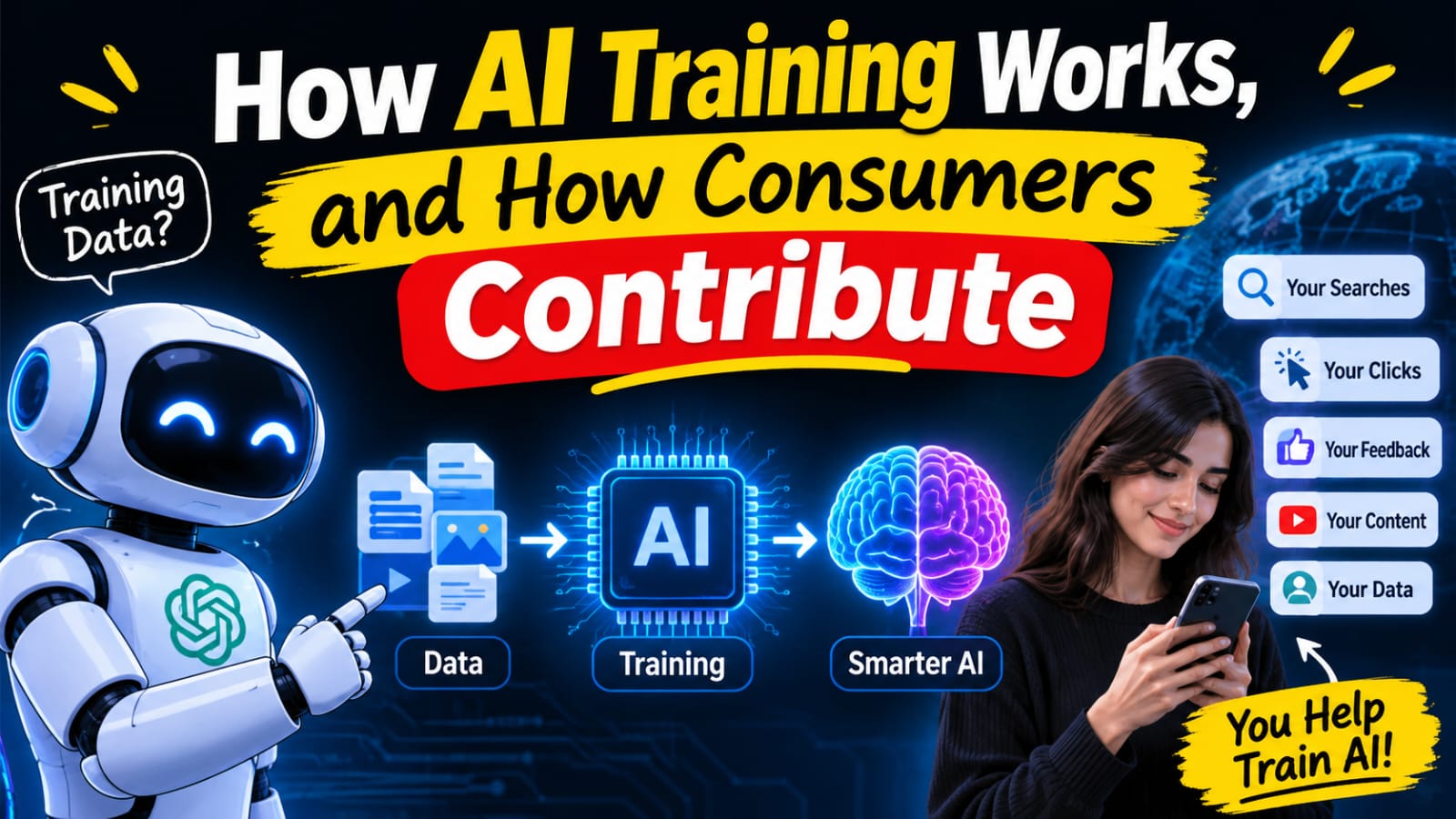
How AI Training Works, and How Consumers Contribute
AI assistants have become the go-to sources for answers and information. At some point, we have all stared at them, mesmerized and astonished by their capabilities and speed.
However, AI required (and still does) a lot of nurturing and training to get here. Some might imagine AI training as simply feeding it information and letting it do its magic.
Yet the actual process is much more curated, with humans supporting it to keep it running smoothly. So let’s discuss how AI training works and how nearly everyone has played a part in improving these tools.
First, AI training requires data
AI cannot learn in a vacuum: it requires mountains of information, but that's only one piece of the puzzle. One of the initial stages of AI training involves feeding it data that is already neatly categorized and prepared so it can learn the correct answers. In some cases, this data can be artificially generated, meaning the data fed to AI is not actually organic but created to resemble real-life information.
However, it is also possible, and likely even more effective, to use authentic data that comes from real-life industries. Of course, acquiring such data is incredibly time-consuming, especially given the sheer amount of data AI requires to learn.
Thus, it is understandable that people have turned to services that can gather data based on provided specifications. Acquirox is one such example, specializing in preparing data for AI training. It manages data collection and further preparation, such as categorizing or labeling it accordingly.
Later stages of AI training involve more complex tasks, such as using unlabeled data and seeing how well it sorts it itself.
Data preparation is a requirement
Even if you have data to feed to conduct AI training, it is essential to prepare it for the best results. For example, certain structures, formats, or even mistakes can confuse AI and hinder its learning process. As a result, people spend significant time organizing and optimizing information, including removing irrelevant data and ensuring consistency.
Humans work as supervisors
Like a senior specialist reviewing a junior's work and providing feedback for improvement, AI training uses the same approach. Humans monitor and analyze AI results, highlighting mistakes or instances where it may have misunderstood the prompt or data.
While data is the foundation of training, human feedback helps it go beyond that. Pointing out AI mistakes essentially tells tools which patterns or information to avoid, such as ensuring that every piece of medical advice is paired with cautionary messages to consult doctors instead of trusting AI.
What criteria is AI training following?
In some school assignments, students are not judged by what they write (their ideas), but by their delivery (grammar, style, and structure).
The same does not apply to AI. While how the message is structured and written correctly is a priority, it is far more crucial to ensure the following criteria during AI training:
- The information must be accurate and appropriate.
- The answer should provide detailed, relevant information based on the prompt.
- The responses should not contain potentially sensitive, suspicious, or dangerous information.
Hence, even when learning from data posted online, AI training aims to reach a point where AI can understand when certain data is inappropriate. By judging AI work, humans attempt to satisfy both accuracy and security requirements.
We all contribute to AI training
Everyone who uses AI tools helps with their training. Essentially, people deliberately provide data and ask it to produce specific summaries, conclusions, or changes.
After that, people also provide AI with feedback based on the results, showing what mistakes it made and helping it avoid them in the future. So, with every prompt and comment, you are actually contributing to how AI performs in the future.
Conclusion
AI tools continue to shock specialists regarding their capabilities. In most cases, it’s thanks to continuous AI training, including internal efforts and general user usage. At this pace, we can expect to see new trends and abilities we have not yet explored.










La privacidad es importante para nosotros, por lo que tiene la opción de deshabilitar ciertos tipos de almacenamiento que pueden no ser necesarios para el funcionamiento básico del sitio web. El bloqueo de categorías puede afectar a su experiencia en el sitio web. Más información


