
What Is Dynamic Creative Optimization a Guide to Smarter Advertising
Picture your advertising campaign as a master chef. But instead of cooking one standard meal for a packed dining room, this chef crafts a unique dish for every single guest, instantly, based on exactly what they're in the mood for. That’s the magic of Dynamic Creative Optimization (DCO). It's an ad technology that completely scraps the old 'one-size-fits-all' model in favor of something far more personal and effective.
Breaking Down Dynamic Creative Optimization
At its heart, Dynamic Creative Optimization is a display ad technology that lets marketers create thousands of ad variations on the fly. You start by building a library of creative "ingredients"—different headlines, various images, compelling calls-to-action (CTAs), and specific product details. Then, the DCO platform works like an intelligent assembly line.
Using data points about the person viewing the ad—like their location, what they’ve browsed before, the device they’re on, or even the local weather—the system picks the perfect combination of creative elements. This ensures the final ad is incredibly relevant to that specific person, at that exact moment. DCO essentially uses data to mix and match ad components, deploying the most effective persuasive advertising techniques to connect with each user and boost performance.
From Static to Dynamic Advertising
The leap from static creative to DCO isn't just a minor upgrade; it's a completely different way of thinking about campaign strategy. A static ad shouts the same message to everyone. A dynamic ad, on the other hand, starts a one-on-one conversation.
Think of it this way: a static ad is like a billboard on a busy highway—everyone who drives by sees the exact same thing. A DCO ad is like a personal shopper who already knows your style, size, and what you’re looking for before you even walk in the store. Even traditional static campaign materials can become more flexible when connected to digital experiences. For example, marketers can use IMQRScan's Dynamic QR Code Generator to add editable QR codes to billboards, posters, flyers, packaging, and other advertising creatives, allowing the destination URL to be updated without having to reprint the QR code.
This tailored experience is no longer a "nice-to-have." Consumers expect it. In fact, research shows that a staggering 80% of consumers are more likely to buy from a brand that offers a personalized experience. DCO is the engine that makes this possible at a massive scale, taking us beyond broad audience segments and into true individual-level relevance. It’s not just about swapping out a product image; it’s about rebuilding the entire ad to fit a user’s immediate context and intent.
The table below breaks down the core differences between the old way and the new.
Static Ads Versus Dynamic Creative Optimization
FeatureStatic AdsDynamic Creative Optimization (DCO)Creative ApproachOne ad creative for all viewers.Thousands of ad variations from a component library.PersonalizationMinimal; based on broad audience segments.Hyper-personalized based on real-time user data.ScalabilityLimited; requires manual creation of each ad version.Highly scalable; automates the creation of countless ads.OptimizationManual A/B testing, slow and resource-intensive.Automated, real-time optimization using AI/ML.RelevanceGeneric and broadcast-style.Specific and highly relevant to the individual user.PerformanceTends to have lower engagement and conversion rates.Typically drives higher engagement, CTR, and ROI.
Simply put, while static ads talk at an audience, DCO talks with each individual, creating a far more engaging and effective advertising experience.
How the DCO Engine Actually Works
To really get what dynamic creative optimization is all about, you have to look under the hood. It’s less like a single tool and more like a lightning-fast assembly line for your ads. In the blink of an eye, it pulls together three key ingredients: creative assets, data feeds, and a set of rules.
First up are the creative building blocks. Think of these as your raw materials—a library of different headlines, various product images or video clips, a few calls-to-action (CTAs), and maybe some unique offers. Each piece is tagged and ready to be swapped in or out.
Next, you plug in a data source. This is often a product feed, which is just a structured file—like a spreadsheet—that holds all the crucial details about what you're selling. It includes things like product names, current prices, images, and stock levels, making sure your ads are never out of date.
The Real-Time Assembly Process
The real magic happens the instant an ad slot opens up on a website someone is browsing. In that millisecond, the DCO platform grabs every available data signal linked to that specific moment and that specific user.
This isn't just about who the person is. It's about the entire context of that impression—their recent browsing behavior, demographic info, the device they're on, their location, and even outside factors like the time of day or the local weather.
Using this real-time snapshot, the platform's decisioning logic—a set of "if-then" rules you've set up—picks the best possible mix of creative assets. It might pull a headline that appeals to price-conscious shoppers, show an image of a product that person just looked at, and add a CTA that nudges them to buy now.To support this level of real-time decisioning at scale, DCO platforms depend on analytics infrastructures capable of processing massive volumes of impression, click, and conversion data with extremely low latency. Many modern advertising stacks rely on ClickHouse hosted architectures, often delivered through platforms like Tinybird, which enable teams to query and activate live performance data without managing complex analytical infrastructure.
This process transforms a jumble of separate ingredients and data points into a single, cohesive ad built for one person.
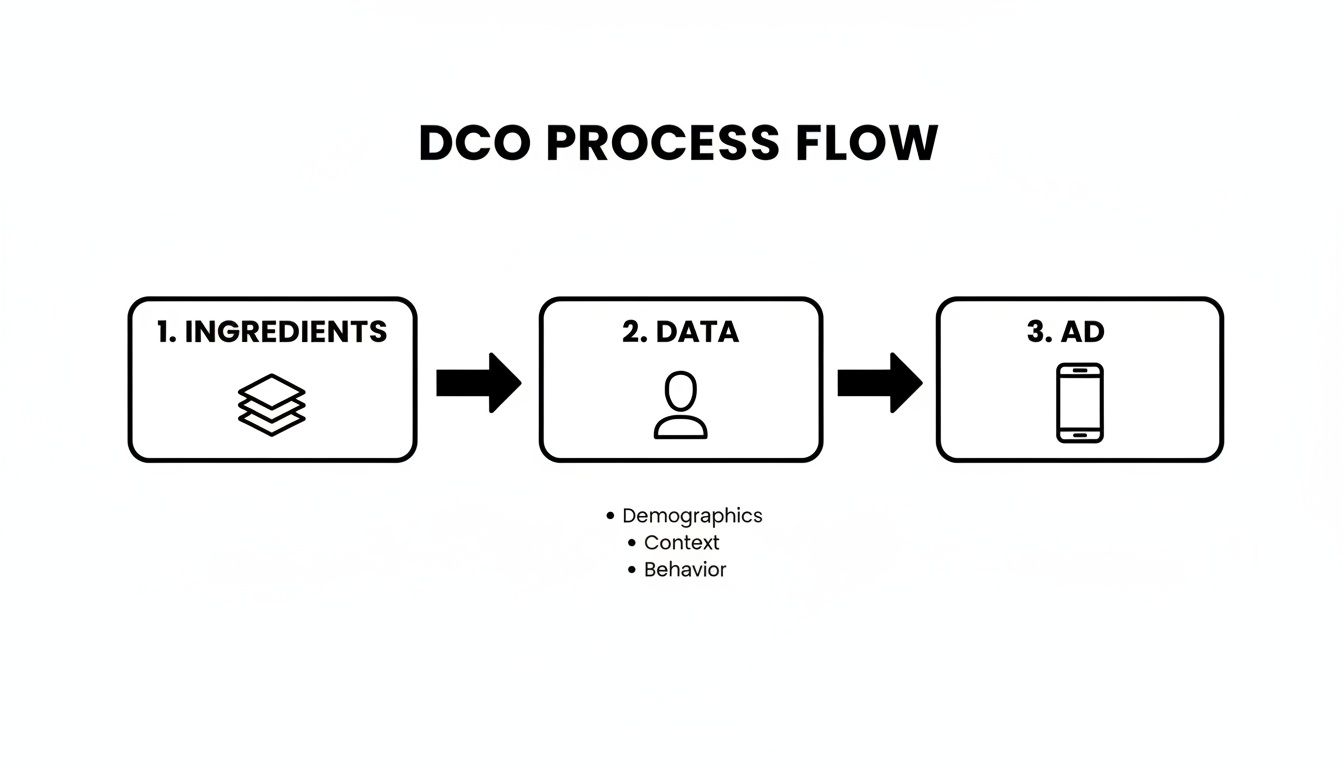
The ad literally doesn't exist until the moment it's served. It's built from scratch, on the fly, for an audience of one.
From Ad Creation to Campaign Learning
But the DCO engine's job isn't done once the ad is built. It's a perpetual learning machine. Here’s how the system works over the life of a campaign:
- Creative Templates: You start with a foundational ad layout that has designated spots for the dynamic elements—text, images, buttons, and so on. These templates keep everything on-brand, no matter how many variations are generated. Many platforms now offer tools for simplifying ad creation for video and display, which helps streamline this initial setup.
- Data Integration: The platform can tap into your Data Management Platform (DMP) or CRM, pulling in rich first-party audience data. This adds a powerful layer of personalization based on actual customer history.
- Algorithmic Optimization: As your campaign runs, the system meticulously tracks which ad combinations get the best results. It then automatically starts showing the winning variations more often. It’s like running thousands of A/B tests at once to constantly fine-tune performance and boost your ROI.
This entire cycle—from analyzing data to assembling the ad and learning from its performance—happens in a fraction of a second, delivering a uniquely relevant ad every single time.
The Real Business Impact of Using DCO
While the tech behind dynamic creative optimization might seem complicated, its impact on your bottom line is refreshingly simple. Adopting DCO isn't just about tweaking visuals; it’s about making your ads work smarter and more efficiently, which translates directly into real business growth.
The main advantage comes from a massive lift in campaign performance by showing people hyper-relevant ads.
Think about it: when a potential customer sees an ad that speaks directly to them—maybe showing a product they just browsed or an offer for their city—they’re far more likely to click. This personalized approach is what drives higher click-through rates (CTR), turning your ad from an annoying interruption into a genuinely helpful suggestion.
Driving Conversions and Slashing Costs
But higher engagement is only part of the equation. The real goal is conversion, and this is where DCO really shines. By matching the ad creative to what a user wants in that exact moment, you seriously increase the odds of them making a purchase, signing up, or taking whatever action you’re aiming for. In short, your conversion rates get a healthy boost.
At the same time, DCO helps you lower your cost per acquisition (CPA). The platform’s machine learning is always running in the background, testing thousands of creative combinations and automatically putting your budget behind the winners. This cuts out the wasted spend on ads that don't work and makes sure every dollar is pulling its weight.
The result is a more profitable marketing engine. You’re not just acquiring customers; you're acquiring them more efficiently by letting data guide your creative strategy at a scale impossible to manage manually.
The performance gains from DCO aren't just theoretical. Case studies and real-world campaigns consistently show double-digit improvements in CTRs and conversion rates when compared to old-school static ads. It’s no surprise that the Creative Management Platforms market, a core part of the DCO ecosystem, was valued at around USD 986 million in 2022.
Uncovering What Really Makes Your Customers Tick
Beyond the immediate performance wins, DCO is a goldmine of data that can shape your entire marketing strategy. By seeing which headlines, images, and offers resonate best with different groups of people, you get a much clearer picture of what truly motivates your customers.
This constant feedback loop helps you move from educated guesses to data-backed decisions across all of your marketing efforts. To see how top companies are putting this into practice, check out our guide on brands using AI to optimize ad campaigns. Ultimately, DCO helps you build a sustainable growth model and a much stronger return on your investment.
Launching Your First DCO Campaign
Alright, you understand the theory behind DCO. Now it's time to get your hands dirty and launch a campaign. Going from concept to execution can feel like a huge jump, but breaking it down into a clear process makes it far less intimidating. A successful DCO launch always starts with a solid foundation: knowing what you want to achieve and having all your pieces ready to go.
Before you even think about creative, you need to define what a "win" looks like for this campaign. Are you trying to lift click-through rates? Push product sales? Get more email sign-ups? Setting those specific, measurable goals and KPIs upfront will shape every decision you make down the line, from how you segment your audience to the exact copy you write.
Preparing Your Core Components
Once your goals are crystal clear, it’s time to gather your campaign's building blocks. Think of this as your pre-flight checklist. The two things you absolutely have to get right are your creative assets and your data feed.
Your creative assets need to be built with flexibility in mind. Instead of designing one static ad, you're creating a library of interchangeable parts that can be mixed and matched on the fly.
- Headlines: You'll want to write several different versions. Some might hit on a specific pain point, others on a unique benefit.
- Images: Collect a wide range of visuals—product shots, lifestyle photos, different backgrounds. Variety is key.
- Calls-to-Action (CTAs): Don't just stick with one. Test out a few distinct CTAs like "Shop Now," "Learn More," or "Get Offer."
At the same time, you have to get your data in order. For most e-commerce or retail brands, this will be a product feed, which is just a structured file (like a spreadsheet) with all your product info: IDs, names, prices, image URLs, and so on. This feed is the fuel for your DCO engine, so it has to be clean, accurate, and perfectly formatted.
Configuring the Campaign Logic
With your assets and data ready, you can start building the "brain" of your campaign—the decisioning rules. This is where you connect specific audience segments to specific creative combinations. These rules are the simple "if-then" statements that tell the DCO platform which ad to show to which person.
A simple rule could be: IF a user is in a location with cold weather, THEN show them an ad for winter coats. Or, for retargeting: IF a user added a specific pair of shoes to their cart but didn't buy, THEN show them an ad with those exact shoes and a "Complete Your Purchase" CTA.
This is the step where your strategy becomes an automated reality. You're essentially mapping your messaging to different stages of the customer journey, creating a personalized path that feels like a natural next step for the user.
Finally, you have to nail the technical integration. Your DCO platform needs to talk seamlessly with your Demand-Side Platform (DSP) for buying ad placements and your analytics tools for tracking performance. This technical handshake is what makes the whole system work, from delivering the right ad to gathering the data you need to optimize it.
By following this roadmap—defining goals, prepping modular assets, structuring your data, and setting up the decision logic—you put yourself in a great position for a successful first campaign. This methodical approach helps you sidestep common mistakes and really tap into the power of DCO from day one.
How to Measure DCO Campaign Success

So, you've launched your DCO campaign. Now, how do you know if it's actually working? To see if your investment is paying off, you have to look past the usual surface-level metrics. Sure, key performance indicators (KPIs) like click-through rates (CTR) and conversions still matter, but the real magic of DCO is its power to unearth deep, actionable insights.
True measurement means getting your hands dirty and dissecting your campaign's performance to understand why certain ads are winners. It’s not enough to see that a campaign did well; you need to pinpoint which specific creative elements—that one headline, a particular image, or a specific call-to-action—made all the difference. This granular analysis is what separates a decent DCO effort from a truly great one.
Moving Beyond Standard KPIs
The real goal here is to analyze performance at the component level. A solid DCO platform will have reporting that lets you see exactly how each individual creative asset is doing across your various audience segments. This level of detail creates a continuous feedback loop where real-time data from live campaigns feeds directly into your next creative strategy.
By analyzing asset-level data, you stop guessing what resonates with your audience and start knowing. You can pinpoint the exact headline that connects with one segment and the ideal image that drives clicks in another, transforming your creative process from subjective art to data-driven science.
For instance, you might find that headlines promoting "Free Shipping" consistently outperform those highlighting a "50% Off" deal for your first-time buyer segment, even if the overall campaign conversion rate looks similar at first glance. These are the kinds of powerful insights that can help you refine your entire marketing funnel.
Uncovering Deeper Consumer Insights
This kind of detailed analysis helps you build a much richer, more complete picture of your customers. When you track which creative combinations win with specific groups, you start to understand what truly motivates them. This information is gold, not just for your ad campaigns but for your website copy, email marketing, and even future product development.
To get an even better handle on how DCO contributes to your bottom line, it helps to look at the bigger picture. Many powerful conversion rate optimization techniques are rooted in the same principles of testing and personalization that make DCO so effective.
For a complete view of your DCO performance, here are the key metrics to watch:
- Asset-Level Performance: Go beyond the ad and track the CTR and conversion rates for individual headlines, images, CTAs, and offers.
- Combination Performance: Find the winning combinations of assets that perform best for each of your key audience segments.
- Creative Lift: Always measure the performance bump of your DCO campaigns against a static, non-personalized control ad to prove its value.
- Cost Per Acquisition (CPA) by Segment: See how your CPA changes across different audiences and creative variations to spend your budget more wisely.
At the end of the day, measuring a DCO campaign is about much more than just calculating ROI. It’s about using the technology as an intelligence-gathering machine that helps you create smarter, more resonant advertising for the long haul.
Common Mistakes to Avoid with DCO
Dynamic creative optimization is incredibly powerful, but it’s definitely not a "set it and forget it" solution. Just flipping the DCO switch without a clear strategy is a surefire way to burn through your ad budget with little to show for it. I've seen a few common tripwires that can sabotage a campaign before it even gets off the ground.
Messy Data and Overly Complex Rules
One of the most frequent issues I see is a messy or inaccurate data feed. Think of your product catalog or data source as the fuel for your DCO engine. If that fuel is contaminated with wrong prices, broken image links, or old product info, your ads will sputter and die. It's not just ineffective; it creates a frustrating experience for anyone who clicks.
Another classic pitfall is trying to get too clever with the decisioning rules right out of the gate. It's tempting to map out a complex logic tree for every imaginable user scenario, but this can actually choke the algorithm. When you get too restrictive, you prevent the system from doing what it does best: testing, learning, and uncovering those surprising, high-performing creative combinations you never would have thought of yourself.
Poor Creative and Team Breakdowns
Even with perfect data and simple rules, a campaign can fall flat if the creative assets themselves aren't designed for DCO. A huge mistake is building components—headlines, images, CTAs—that can't be mixed and matched. If a certain headline only works with one specific image, you've completely lost the modular magic that makes DCO so effective.
The whole point of DCO is that any piece of creative should be able to snap together with any other piece to form a great ad. If you force specific pairings, you're essentially turning off the optimization engine.
Finally, nothing kills a DCO campaign faster than teams not talking to each other. When these three key groups operate in their own little worlds, the whole thing falls apart:
- Creative Teams: The folks designing all the modular assets.
- Data Teams: The guardians of the data feeds, responsible for keeping them clean and current.
- Media Buying Teams: The ones in the driver's seat, setting up the campaign logic and targeting.
When communication breaks down between these teams, you end up with a clunky, disjointed campaign that never lives up to its potential. Steering clear of these mistakes is the first step to getting a real return on your DCO investment.
Still Have Questions About DCO?
It's completely normal to have a few questions when you're digging into a technology as powerful as dynamic creative optimization. Let's clear up some of the most common ones we hear from marketers.
Is DCO the Same Thing as Dynamic Retargeting?
Not quite. It’s a common mix-up, but think of it like this: dynamic retargeting is one specific play you can run, while DCO is the entire playbook.
Dynamic retargeting is that familiar tactic where you see an ad for the exact pair of shoes you were just looking at. It's a single, very effective use case.
DCO is the broader engine that makes this possible, but it does so much more. You can use it for prospecting new customers by showing them ads based on their city and the local weather, or for building brand awareness with messages that resonate with different age groups. It's a far more flexible and strategic tool.
Can You Really Use DCO for Branding Campaigns?
Absolutely, and it’s one of its most underrated strengths. People often pigeonhole DCO as a direct-response tool focused only on clicks and sales, but it's fantastic for telling a more relevant brand story.
You're not stuck with one generic brand message for everyone. Instead, you can subtly shift the narrative to match who's watching.
For example, a sports apparel brand could show a younger audience creative that’s all about high-octane performance and pro athletes. For an older demographic, the ads could focus more on the comfort of the gear for an active, healthy lifestyle. It’s the same brand, but the story connects on a much deeper level with each group.
How Much Data Do I Need to Get Started?
This is the best part: you probably have enough data to start right now. You don't need a huge, perfectly organized first-party database to get a DCO campaign off the ground.
You can launch a surprisingly powerful campaign using signals that are already widely available.
- Location: Show different offers to people in New York versus Los Angeles.
- Device Type: Serve a simpler, thumb-stopping ad to mobile users and a more detailed one to desktop viewers.
- Contextual Data: Match your ad's message to the topic of the website someone is reading.
The beauty of DCO is that it learns as it goes. The platform continuously gathers performance insights, so your campaigns get smarter and your personalization gets sharper over time.
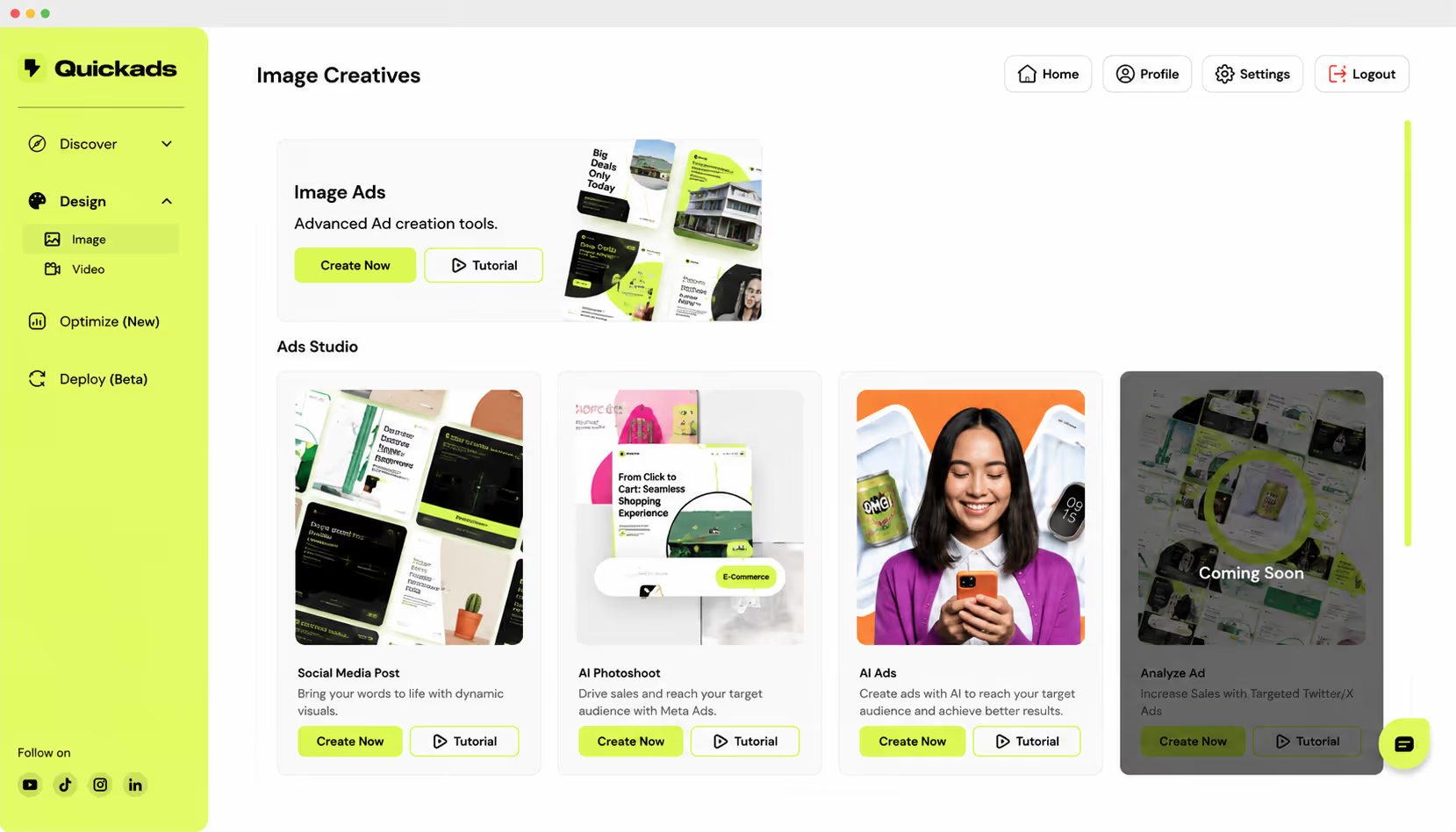
Ready to stop making one-size-fits-all ads? With quickads.ai, you can generate countless high-performing ad variations in minutes, using AI to create personalized campaigns that convert. Start creating smarter ads today.









Privacy is important to us, so you have the option of disabling certain types of storage that may not be necessary for the basic functioning of the website. Blocking categories may impact your experience on the website. View Our Privacy Policy


