
How to Create Commercials That Actually Get Results
Want to make a commercial that actually works? It all boils down to a pretty straightforward process: figure out your goal and who you're talking to, come up with a great story, pick your production style, edit it tightly, and then launch it with a clear way to measure success. But before you even think about cameras or scripts, you have to lay the groundwork.
Building Your Commercial's Strategic Foundation

The most important work happens long before anyone yells "action!" A solid strategic foundation is what separates an ad that just floats around aimlessly from one that actually gets people to do something. This first phase is all about nailing down the "why" and "who" to create a roadmap for every creative choice you'll make later.
Think of it like building a house. You wouldn’t start buying 2x4s without a detailed blueprint, right? A commercial needs that same kind of plan. We call this a creative brief, and it's the single most important document for your entire project.
Nailing Down Your Core Objective
First things first: what's the one thing you absolutely need this commercial to accomplish? Don't say "everything." Fuzzy goals lead to muddled ads. You need to pick one primary objective and stick to it.
Are you trying to:
- Generate direct sales for that new product you just launched?
- Get more sign-ups for your upcoming webinar?
- Build brand awareness so people recognize your name?
- Announce a game-changing new feature or company update?
Your answer shapes everything—the tone, the call to action, and even where the ad runs. A commercial built to drive immediate e-commerce sales will feel completely different from one designed to build brand love over time. This foundational step is crucial for any video project, and you can explore it further in this complete guide to corporate video production.
Pinpointing Your Target Audience
Okay, now who are you talking to? And please, don't say "everyone." To make a commercial that truly connects, you have to get laser-focused on the person on the other side of the screen. Forget basic demographics for a second.
Dig into their psychographics:
- What’s a real problem they have that your product can fix?
- What makes them buy? Are they driven by logic, emotion, or seeing others use it?
- Where do they hang out online? Is it Instagram Reels, YouTube, or LinkedIn?
- What kind of videos are they already watching and loving?
Knowing this stuff lets you craft a message that feels like it was made just for them, not blasted out to the masses. It’s a non-negotiable in today’s market.
Key Takeaway: The best commercials feel like a one-on-one conversation. When you try to talk to everyone, you usually end up connecting with no one.
Let's face it, we're living in a digital-first world. By 2025, digital advertising is on track to account for 75.2% of all global ad spend, which is a staggering $777 billion. Your strategy has to be built for screens. A smart move is to plan for data-driven tests from the start, like A/B testing different 10-15 second hooks to see what grabs attention fastest. This is also where website accessibility becomes critical. A commercial does not stop working when the video ends. It pushes people to a landing page, a sign-up form, or a checkout flow. If that destination is not accessible, the campaign quietly fails. Users who rely on screen readers, keyboard navigation, captions, or other assistive technology may hit barriers that prevent them from completing the action. That means lost conversions, weaker performance, and added legal exposure.
With a sharp objective and a crystal-clear audience in mind, you're ready to build a brief that ensures your final commercial isn't just a piece of creative—it's a tool that gets results.
The Creative Brief at a Glance
A well-structured brief is your North Star. It keeps everyone—from the copywriter to the video editor—aligned and focused on the same goal. It doesn't need to be a 20-page document, but it does need to be clear.
Here’s a quick breakdown of what should be in your brief.
Core Components of a Creative Brief
ComponentKey Question to AnswerExampleObjectiveWhat is the #1 goal of this ad?Drive 1,000 new trial sign-ups in 30 days.Target AudienceWho are we talking to, specifically?Tech-savvy project managers (30-45) struggling with team collaboration tools.Key MessageWhat is the single most important thing we need to say?"Our software cuts meeting time in half."Tone & StyleHow should the commercial feel?Upbeat, witty, and slightly informal. Visually clean and modern.Call to Action (CTA)What do we want the viewer to do right now?"Start your free 14-day trial today."Distribution ChannelsWhere will this ad be seen?YouTube pre-roll ads, Instagram Stories, LinkedIn in-feed video.
Putting this information down on paper forces clarity and ensures your entire team is on the same page from day one. It’s a simple step that saves a world of headaches later on.
From Strategy to Story: Finding Your Narrative
With your strategic brief nailed down, it’s time to get creative. This is where you breathe life into the data and objectives, turning them into a story that actually connects with people. A great commercial isn't just entertainment; it's a carefully crafted piece of persuasion designed to move someone from being a passive viewer to an active customer.
The real challenge is landing on an idea that's both wildly creative and strategically sound. It has to perfectly capture your brand’s voice, resonate with your audience's real-world problems, and drive home that one core message from your brief. My advice? Don't marry the first idea. Let your team run wild with brainstorming before you start filtering for the winner.
Brainstorming Concepts That Actually Stick
Finding a concept that works is part art, part science. You're looking for that sweet spot: an idea original enough to cut through the noise but simple enough for someone to "get" in just a few seconds. Over the years, I've found that the most memorable commercial stories often lean on a few battle-tested frameworks.
Think about which of these might work for what you're selling:
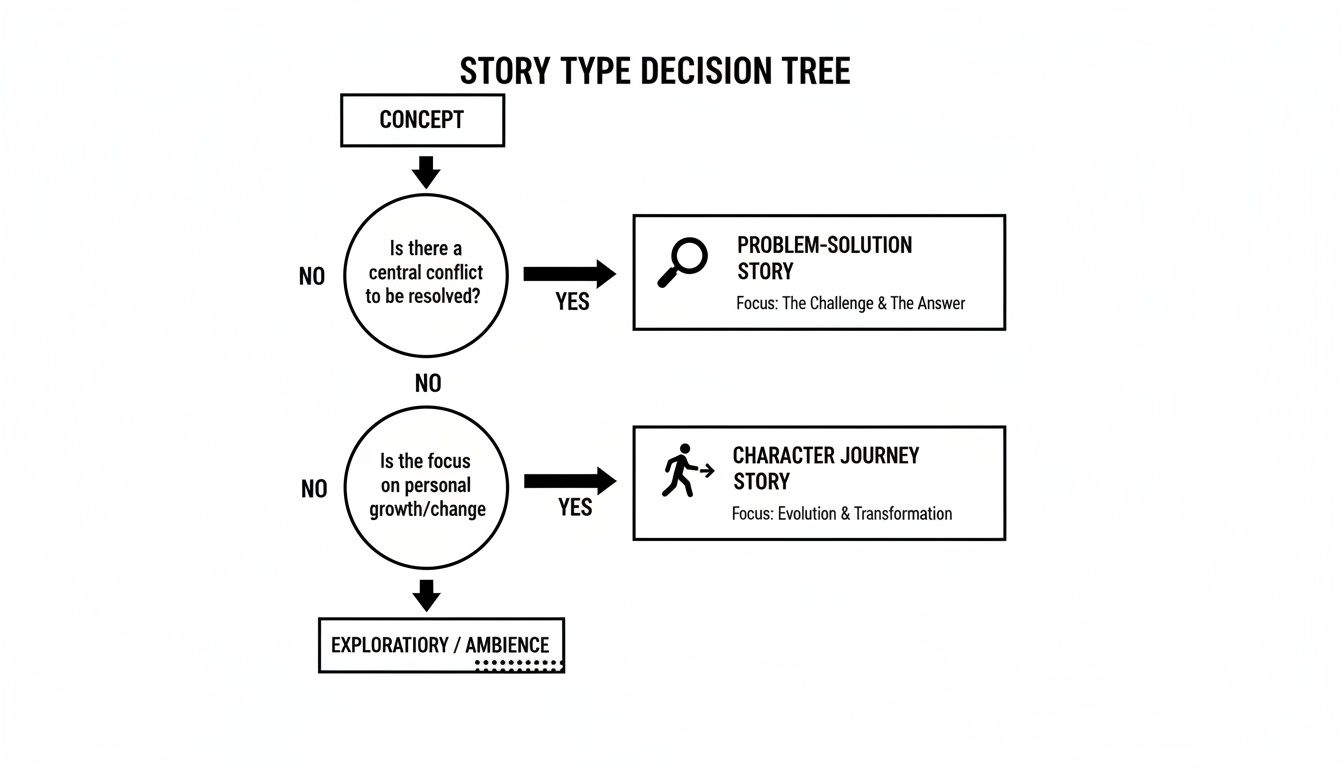
- The Problem/Solution Arc: This is a classic for a reason—it just works. You start by presenting a relatable, often frustrating, problem your audience knows all too well. Then, you introduce your product as the hero, the beautifully simple solution. Think of a stubborn coffee stain for a laundry detergent or a soul-crushing spreadsheet for a new SaaS tool.
- The Character Journey: This one is all about emotion. You build your story around a character your audience can see themselves in. We follow their journey—their struggles, their discovery of your product, and their ultimate transformation. It’s a powerful approach for lifestyle brands or anything selling an aspirational outcome.
- The "Aha!" Moment: Instead of a journey, this focuses on a single moment of surprise or discovery. You reveal an unexpected benefit or a clever new way to use your product that makes the viewer think, "Wow, I never thought of that." It's perfect for making people reconsider a brand they thought they knew.
No matter which structure you choose, it has to feel real. Audiences can sniff out a fake or forced story from a mile away. Your narrative needs to be true to who you are as a brand.
Writing a Script That Sells
Once you have your big idea, it's time to put it on paper. A script is more than just dialogue. It’s the architectural blueprint for your entire commercial, dictating everything from the voiceover and on-screen text to the timing of key visual moments. In a 30-second spot, every single word has to earn its place.
Your script needs a clear beginning, middle, and end. The beginning has one job: hook the viewer within the first 3-5 seconds. The middle needs to deliver on the promise of the hook, showing your product's value or building that crucial emotional connection. And the end has to land a punch with a clear, compelling call-to-action (CTA).
My Go-To Tip: Always read your script out loud. Does it sound like a real human talking? Is the rhythm right? You'll be amazed at how many clunky phrases and awkward sentences you'll catch just by hearing the words spoken.
Storyboarding: Turning Words into a Vision
Before a single frame is shot, you need a storyboard. This is essentially a comic-strip version of your commercial, a sequence of sketches that maps out each shot. It includes notes on camera angles, character actions, and dialogue, ensuring everyone from the director to the editor is on the same page.
Going through the process of storyboarding forces you to be brutally practical about your creative vision. It helps you:
- Visualize the Flow: See how the story unfolds scene by scene and spot any weird jumps or pacing problems before they become expensive mistakes.
- Align the Team: It’s a universal language. The storyboard gives the entire crew a concrete visual reference, which cuts down on confusion and debates on set.
- Save Time and Money: It is infinitely cheaper to redraw a frame in a storyboard than it is to reshoot a scene because it wasn’t working.
You don’t need to be an artist. Stick figures work just fine. The point isn’t to create a masterpiece; it’s to create clarity. This step is the critical bridge between the script on a page and the finished commercial on the screen.
Choosing Your Production Path: Traditional vs. AI
With a powerful script and a clear storyboard in hand, you’ve reached a critical fork in the road. How are you actually going to bring this vision to life? The path you choose here dictates your budget, timeline, and the whole vibe of your final commercial. It's a choice between the time-tested methods of a traditional film set and the fast, flexible world of AI powered content creation.
Both routes can lead to an incredible ad, but they get there in fundamentally different ways. The right choice really boils down to your resources, your creative concept, and how quickly you need to get this thing out the door.
The Traditional Film Shoot: A Classic for a Reason
The traditional route is what most people picture when they think about making a commercial. It’s all about assembling a crew, casting actors, scouting locations, and capturing everything with professional cameras and lighting. This path gives you the absolute highest degree of creative control and is often essential for commercials that lean heavily on human performance, specific real-world settings, or complex practical effects.
A traditional shoot has a lot of moving parts. Here’s what that typically looks like:
- Assembling a Crew: This means a director, cinematographer, sound engineer, gaffers (your lighting experts), and production assistants.
- Casting Talent: You're finding the perfect actors who can embody your characters and deliver a believable performance that connects with the audience.
- Location Scouting: This involves securing the ideal backdrop, whether it’s a bustling city street, a quiet suburban home, or a highly stylized studio set.
- Equipment Rental: You'll be sourcing high-end cameras, lenses, lighting rigs, and audio gear to achieve that polished, cinematic look.
This approach gives you complete hands-on control over every single visual and auditory element, but it requires a significant investment in both time and money. No getting around that.
The Rise of AI Video Generation
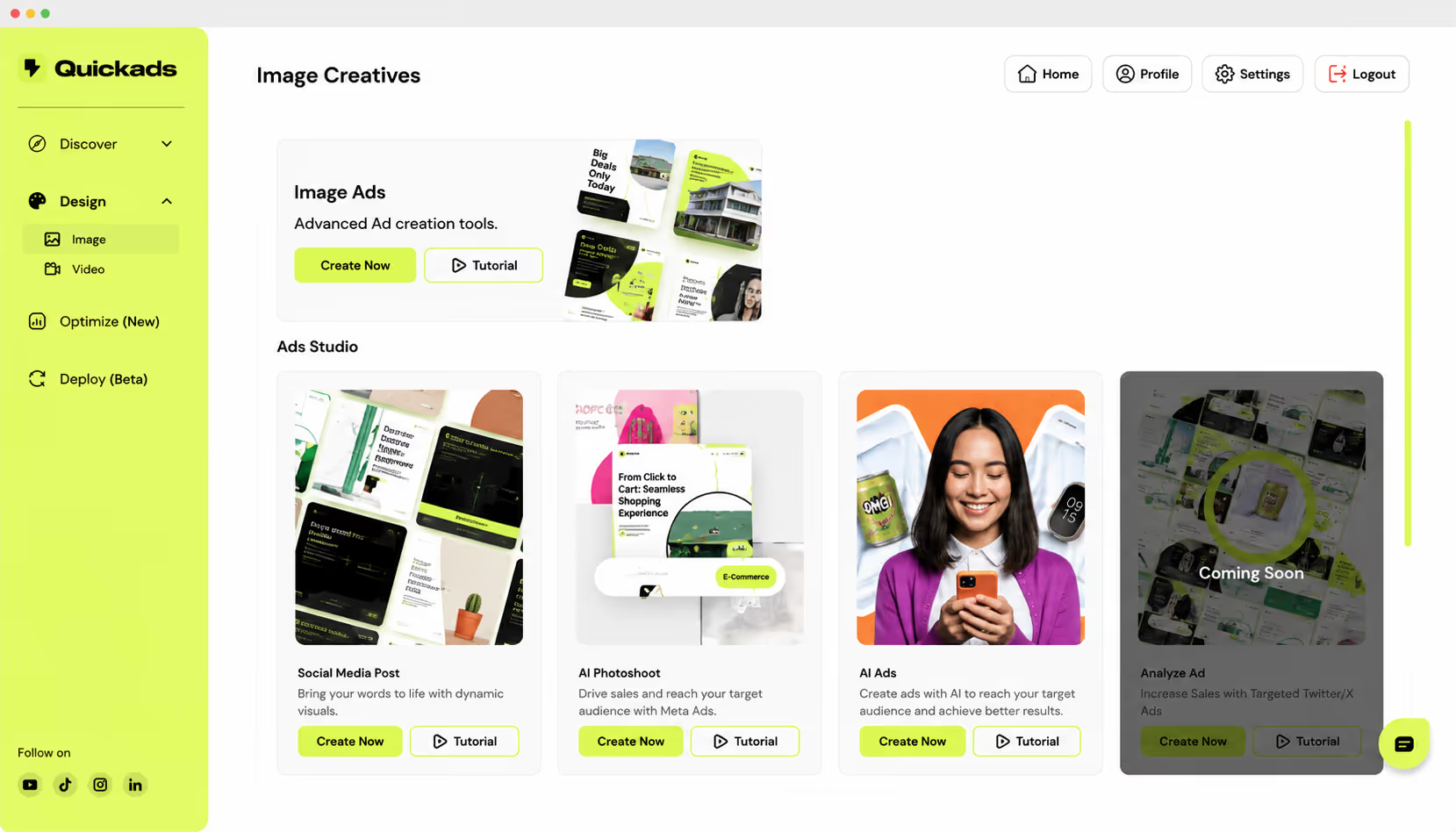
The alternative path is to tap into the power of artificial intelligence. AI video generators like Quickads.ai have completely changed the game, making high-quality commercial production accessible to everyone, regardless of budget or technical skill. Instead of a physical set, your production hub is a software platform.
With AI, you can create professional commercials—from animated explainers and slick product showcases to engaging faceless videos—without ever touching a camera. These tools turn your script or creative brief into a polished ad using vast libraries of stock footage, AI-generated voiceovers, and customizable templates. If you want to dive deeper, you can learn more about creating video ads with AI and see just how the technology works.
Key Insight: The shift toward AI isn't just about cutting costs; it's about gaining speed and the ability to scale. You can test dozens of creative variations in the time it would take to plan a single traditional shoot.
The power of this approach is reflected in broader industry trends. As global ad agencies are projected to hit $444.7 billion in revenue by 2025, the agencies on top are the ones mastering digital shifts. The big lesson is to mimic their data-driven methods by using AI to generate 50+ creative variants for testing. That strategy alone can boost click-through rates by a whopping 35%. In this environment, commercials must be conversion tools, not just creative showpieces.
Making the Right Choice for Your Commercial
So, which path should you take? The decision often comes down to what your story truly needs. A character-driven narrative that relies on subtle emotion might demand a traditional shoot. On the other hand, a clear problem-solution concept can be produced incredibly effectively—and quickly—using AI tools.
Ultimately, there is no single "best" method. Your decision should be guided by a realistic assessment of your goals, budget, and timeline. The great news is that creating a high-impact commercial is more accessible than ever, whether you choose to build a film set from the ground up or generate a masterpiece with just a few clicks.
Polishing Your Commercial in Post-Production
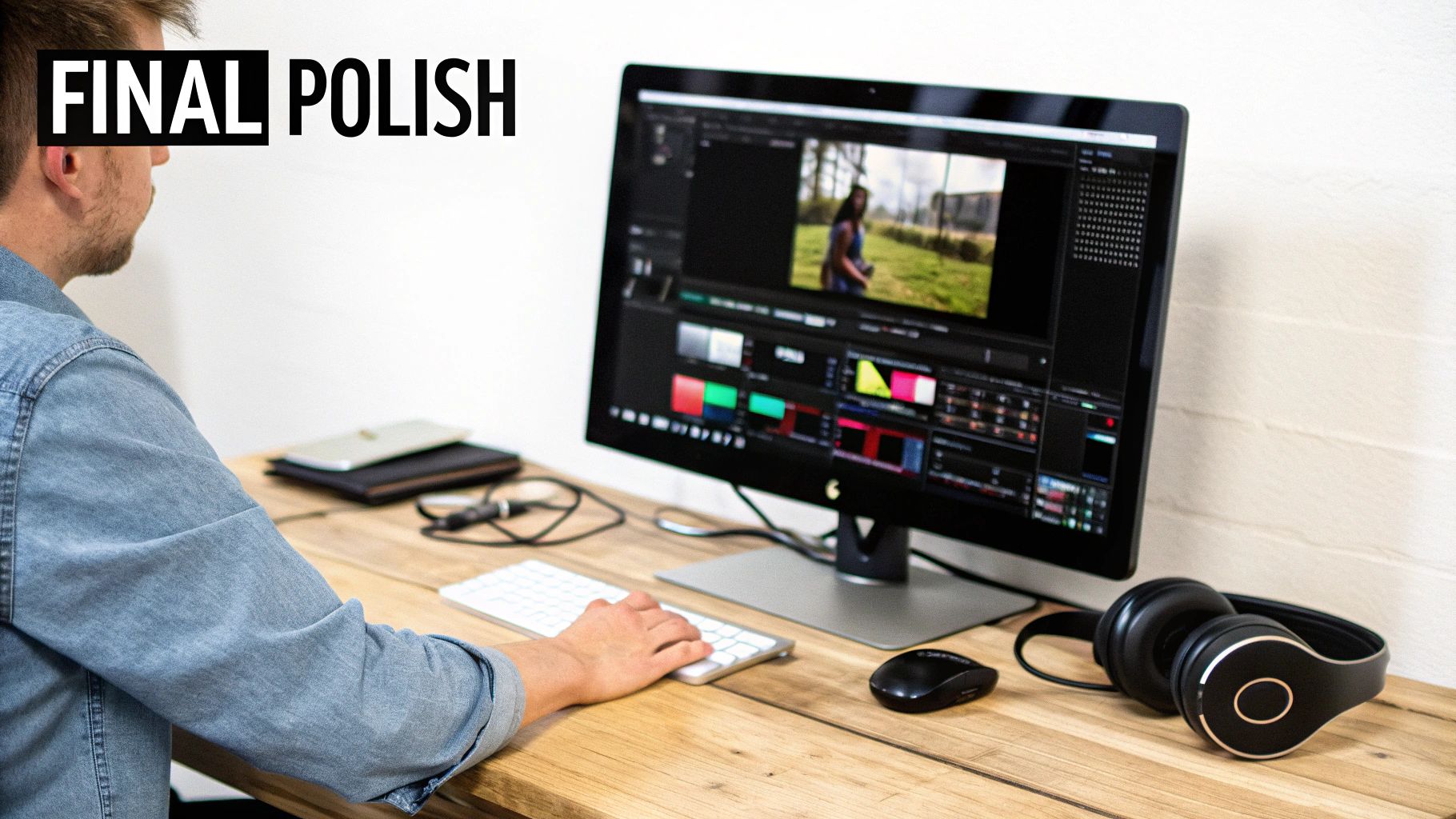
The cameras are off, but the real work of shaping your commercial’s story has just begun. Post-production is where you take all those separate clips, raw audio files, and good intentions and weave them into a polished, persuasive final piece. This is where the magic really happens.
Your first step is hammering out the rough cut. Think of this as a first draft—you're simply assembling the best takes in the order of your storyboard. It won’t be pretty, but it’s all about establishing the basic flow and timing. From there, you'll chisel away at it, tightening edits and swapping takes to create a fine cut where every single second serves the story.
Crafting the Visual Polish
With the story structure in place, it’s time to add the visual layers that make it shine. This isn't just about making things look good; it's about using visual cues to guide emotion and pull the viewer's focus exactly where you want it.
- Color Grading: This is where you paint the mood. Want a warm, nostalgic feel? Push the yellows and oranges. Going for a sleek, modern vibe? Cool blues and crisp whites will get you there. Color is an incredibly powerful, subconscious tool for setting the emotional stage.
- Motion Graphics: Even simple text overlays or subtle animations can make a huge impact. Use them to pop a key feature on screen, display your website URL, or call out a special offer. Done right, they add a professional sheen and make your core message impossible to miss.
These details are more important than ever. With the advertising industry projected to see 8.8% growth in 2025 and hit revenues of $1.14 trillion, standing out is non-negotiable. The big shift is toward commerce channels, which are set to overtake TV advertising for the first time. On these platforms, using dynamic creative to swap out elements like graphics in real-time can boost performance by a staggering 20-30%. You can discover more insights about these advertising trends on wppmedia.com.
The Critical Role of Sound Design
So many creators pour all their energy into the visuals and treat audio as an afterthought. That’s a massive mistake. Great sound design can elevate a good commercial to a truly memorable one, while bad audio can tank even the most beautiful footage.
Sound isn't just about making sure people can hear the dialogue; it's about building an entire world for your viewer. It's the emotional glue that holds everything together.
Pro Tip: Watch your final edit with your eyes closed. Does the sound alone tell a compelling story? If you can follow the emotional journey through just the music, voiceover, and sound effects, you're on the right track.
A solid sound mix involves carefully balancing several layers:
- Voiceover: If your ad has narration, the recording needs to be crystal-clear and free of any distracting background noise. The delivery should perfectly match your brand’s personality—whether that's energetic, reassuring, or authoritative.
- Music: The soundtrack is the heartbeat of your commercial. It drives the pace and sets the emotional tone from the very first note. Just make sure you're sourcing high-quality, royalty-free music to avoid any legal headaches later on.
- Sound Effects (SFX): These are the subtle sounds that breathe life into the scene—a satisfying click, a gentle whoosh, the ambient hum of a city street. They add a layer of realism and texture that people feel more than they notice.
By carefully weaving these visual and audio elements together, you'll transform that pile of raw footage into a cohesive and impactful commercial that’s ready to grab your audience's attention.
Launching and Measuring Your Commercial's Impact
Your commercial is polished and ready to go, but a brilliant ad sitting on a hard drive isn’t going to do you any good. Now comes the moment of truth: getting your masterpiece in front of the right eyeballs and meticulously tracking what happens next. This is where your creative work meets the real world.
Success in this final stretch boils down to one simple idea: different platforms require different approaches. An ad that kills it on YouTube might feel completely out of place on TikTok. Thinking about platform-specific optimization before you spend a single dollar on placement is a non-negotiable part of the process.
Optimizing Your Commercial for Every Platform
One of the biggest blunders I see marketers make is taking a one-size-fits-all approach to distribution. Every platform has its own vibe, its own viewing environment, and its own user expectations. Your ad needs to fit in to stand out.
Here’s what you absolutely need to nail down:
- Get Your Ratios Right: A standard horizontal 16:9 ad is perfect for YouTube and TV, but it’s going to look tiny and amateurish in a vertical mobile feed. You have to create 9:16 versions for platforms like Instagram Stories, TikTok, and YouTube Shorts. It's extra work, but it's worth it.
- Assume the Sound is Off: A huge chunk of social video is watched on mute. If your entire message is packed into a voiceover, it's going to fall on deaf ears—literally. Always burn in clear, easy-to-read captions.
- Nail the First Few Seconds: A solid 3-5 second hook is always important, but it’s do-or-die on skippable formats like YouTube pre-roll ads. You have just a moment to give someone a compelling reason not to smash that "Skip Ad" button.
These technical tweaks are about more than just looking good. They signal to the viewer that you understand the platform, which instantly makes your ad feel more native and less intrusive.
Setting Up a Targeted Ad Campaign
With your assets optimized, it's time to launch. Modern ad platforms from Meta to Google offer incredibly powerful targeting options. You can go way beyond basic demographics and reach people based on their actual interests, online behaviors, and recent purchase intent.
This is where all that audience research you did for the brief pays off. Instead of just targeting "women aged 25-40," you can now target people who recently searched for your product category, visited a competitor's website, or engaged with creators in your niche. This kind of precision ensures your ad budget is spent reaching people who are actually likely to care.
Key Takeaway: The goal isn't to reach the most people; it's to reach the right people. A smaller, highly engaged audience is always more valuable than a massive, indifferent one.
Tracking the Metrics That Actually Matter
Getting the campaign live is just the beginning. The real work—and the real learning—starts when the data starts rolling in. You have to look past vanity metrics like raw view counts and focus on the Key Performance Indicators (KPIs) that tell you if the commercial is actually working.
These metrics reveal how your audience is really interacting with your ad and whether it's moving the needle for your business.
Key Performance Indicators (KPIs) for Commercials
Here's a look at the essential metrics you should be tracking to understand your ad's performance, from initial engagement to bottom-line impact.
KPIWhat It MeasuresWhy It MattersView-Through Rate (VTR)The percentage of people who watched your entire ad (or a significant portion).Indicates if your creative is engaging enough to hold attention.Click-Through Rate (CTR)The percentage of viewers who clicked on your ad's call-to-action.Shows if your message and CTA are compelling enough to inspire action.Conversion RateThe percentage of clickers who completed the desired action (e.g., made a purchase).Directly measures the ad's effectiveness at achieving your primary business goal.Return on Ad Spend (ROAS)The total revenue generated for every dollar spent on the ad campaign.This is the bottom-line metric that proves the campaign's profitability.
Monitoring these KPIs tells a clear story. A high VTR but a low CTR might mean your ad is entertaining but your call-to-action is weak. A high CTR but a low conversion rate could point to a disconnect between your ad's promise and your landing page's experience.
Just as marketers rely on data to optimize campaign performance, businesses also depend on tools like a mileage tracker to accurately monitor expenses, improve operational efficiency, and ensure every effort contributes to measurable growth.
By analyzing this data, you can start A/B testing different elements—like headlines, hooks, or offers—to see what truly resonates. For an even deeper understanding of how users interact across different devices, exploring the best practices for cross-device video tracking is essential. This data-driven feedback loop is how you stop guessing and start building a reliable system for creating commercials that consistently deliver results.
Your Top Questions About Making Commercials, Answered
Jumping into the world of commercial creation for the first time? It's natural to have questions. Everyone from scrappy founders to seasoned marketing managers wonders about the same things: how much will it cost, how long should it be, and can I really do this myself?
Let's clear the air. Getting a handle on these basics is the first step toward figuring out the best production path for your brand and budget. It makes the whole process feel less intimidating and a lot more achievable.
How Much Does It Cost to Produce a Commercial?
This is the big one, and the honest answer is: it depends. The budget for a commercial can swing from the price of a decent lunch to more than a new car, all based on how you decide to make it.
A traditional, full-blown video shoot is where the costs really stack up. You're not just paying for a camera; you're investing in a small army of professionals and a ton of logistics.
Think about what goes into a classic shoot:
- A professional crew: This means a director, a cinematographer, a sound mixer, gaffers... the list goes on.
- The talent: You'll need to cast and pay actors for their time.
- Locations: Finding and securing the right spot can involve hefty fees, permits, and insurance.
- The gear: High-end cameras, specialty lenses, and professional lighting rigs don't come cheap.
Put it all together, and you’re easily looking at a price tag of $10,000 to over $100,000.
But here's the good news. That's not the only way anymore. AI video creation tools have completely changed the game. With a platform like Quickads.ai, your main cost is a monthly subscription, not a massive one-time production bill. This opens the door for any business to create slick, professional ads without breaking the bank.
The Bottom Line: High cost is no longer a deal-breaker. While a traditional shoot gives you ultimate control for a premium price, AI tools offer a powerful, budget-friendly way to get high-quality ads made fast.
This kind of flexibility means you can match your production budget to your campaign goals, not the other way around.
What Is the Ideal Length for a Commercial?
Forget the old 30-second TV spot. The "perfect" length for a commercial today is all about where people will see it. To be effective, your ad's runtime has to align with the platform's culture and user expectations.
Here’s a practical guide to ad lengths for different platforms:
- TikTok & Instagram Reels: Think fast. You're aiming for short, snappy videos that feel like they belong in the feed. Keep it between 15 and 30 seconds.
- YouTube Pre-Roll Ads: You've got two main plays here. The non-skippable 6-second "bumper ad" is fantastic for a quick, memorable message. For skippable ads, 15-30 seconds is pretty standard, but those first 5 seconds are everything—they have to convince someone not to hit "Skip Ad."
- LinkedIn & Facebook Feed Ads: Users on these platforms are often in a different mindset and might be more willing to watch something longer if it's genuinely interesting. You can stretch these ads from 30 to 90 seconds, especially if you're telling a compelling story or offering real value.
No matter the platform, one rule reigns supreme: get to the point immediately. You have about 3-5 seconds to hook your viewer and stop their scroll. Nail the intro, and you’ve earned their attention for the rest of the ad.
Can I Create a Commercial Without Any Filming Experience?
Yes, you absolutely can. This is probably the biggest shift we've seen in advertising in years. You don't need to know the first thing about f-stops, three-point lighting, or Adobe Premiere Pro to create a great-looking commercial.
AI video creation platforms have completely leveled the playing field. They're built for people who are marketers or business owners, not professional videographers.
The process is refreshingly straightforward. You can generate a complete commercial just by:
- Typing in a simple text prompt or dropping in a URL.
- Picking from huge libraries of high-quality stock video clips and images.
- Generating a crisp, human-sounding voiceover with AI.
- Adding your own branding—logos, colors, and fonts—with a few clicks.
This approach strips away all the technical barriers. It frees you up to focus on what actually matters: your message, your story, and your strategy. The power to create a polished, effective commercial is literally right in your web browser.
Ready to create stunning video ads without the complexity or cost of a traditional shoot? With Quickads.ai, you can generate high-performance image ads, video ads, and faceless videos in minutes. Turn your ideas into compelling commercials effortlessly at https://www.quickads.ai.









Privacy is important to us, so you have the option of disabling certain types of storage that may not be necessary for the basic functioning of the website. Blocking categories may impact your experience on the website. View Our Privacy Policy


