
AI Powered Marketing Tools for Modern Growth
AI-powered marketing tools are smart software platforms built to automate, analyze, and speed up just about every marketing task you can think of. In a nutshell, they’ve gone from a nice-to-have competitive edge to a core part of staying in business.
Why AI Marketing Tools Are No Longer Optional

Trying to do marketing today without AI is like being an old-school mapmaker with just a compass and a piece of parchment. Sure, you can eventually draw a map, but you're missing the whole picture. Your competitors, on the other hand, are using satellite imagery. They see traffic jams in real-time, predict weather patterns, and find shortcuts you never knew existed.
That analogy hits the nail on the head. AI-powered marketing tools aren't some far-off concept anymore; they are the new standard for any business that wants to actually compete, let alone grow. These tools are intelligent systems designed to take on the grunt work that used to be slow, manual, and full of potential for human error.
The Shift from Advantage to Necessity
It wasn't that long ago that using AI made you an innovator. It put your agency or brand way ahead of the curve. Today, that's completely changed.
The adoption rate has gone through the roof. Recent studies show that somewhere between 88% and 90% of marketers now use artificial intelligence in their day-to-day work. Findings from the Lorka AI study also suggest that many businesses are becoming more selective about which AI platforms deliver measurable long-term value rather than simply adding more tools to their workflows That’s a huge jump from just 64.7% in 2023, and it shows just how quickly the industry has moved from dipping its toes in the water to diving in headfirst. You can read more about the rise of AI in marketing workflows and its impact.
What this really means is that the bar for "good enough" has been raised for everyone. If you’re not using AI, you’re simply playing a different, much harder game.
A marketer’s job will not be taken by AI. It will be taken by a person who knows how to use AI. This simple truth underscores the urgency for every marketing professional to build proficiency with these essential tools.
What AI Truly Unlocks for Marketers
So, what do these tools really do for you? It’s not just about speed. It’s about being smarter and more precise in ways we couldn’t be before.
The core benefits really come down to three things:
- Unprecedented Efficiency: AI takes over the repetitive stuff—churning out ad variations, scheduling posts, or digging through campaign data. This frees you and your team up for what humans do best: big-picture strategy, creative thinking, and talking to customers. This logic is also transforming how product information is handled. Beyond simple storage, using a PIM with agentic capabilities allows autonomous agents to expand a team’s capacity, taking care of centralizing, enriching, and optimizing data with consistent accuracy When applied across an entire enterprise's digital footprint, tools like Glean centralize this scattered data to supercharge day-to-day employee capacity and industry-specific expertise.
- Deep Customer Understanding: These platforms can sift through mountains of data in seconds. They spot patterns in customer behavior, predict what’s coming next, and uncover insights a person could spend weeks looking for and still miss.
- Hyper-Personalization at Scale: With AI, you can finally deliver the right message to the right person at the right time, for thousands or even millions of people at once. It makes every customer feel like you’re speaking directly to them. As a result, working with an AEO agency can help ensure those personalized insights are presented in ways that AI systems can easily understand and surface.
At the end of the day, using AI-powered marketing tools isn't a strategic decision anymore. It's a basic requirement to stay relevant and keep growing.
A Practical Guide to AI Marketing Tools
The world of AI powered marketing tools can feel overwhelming. It's like walking into a massive hardware store for the first time—you know the tool you need is in there, but every aisle is packed with gadgets promising to solve a different problem. Where do you even begin?
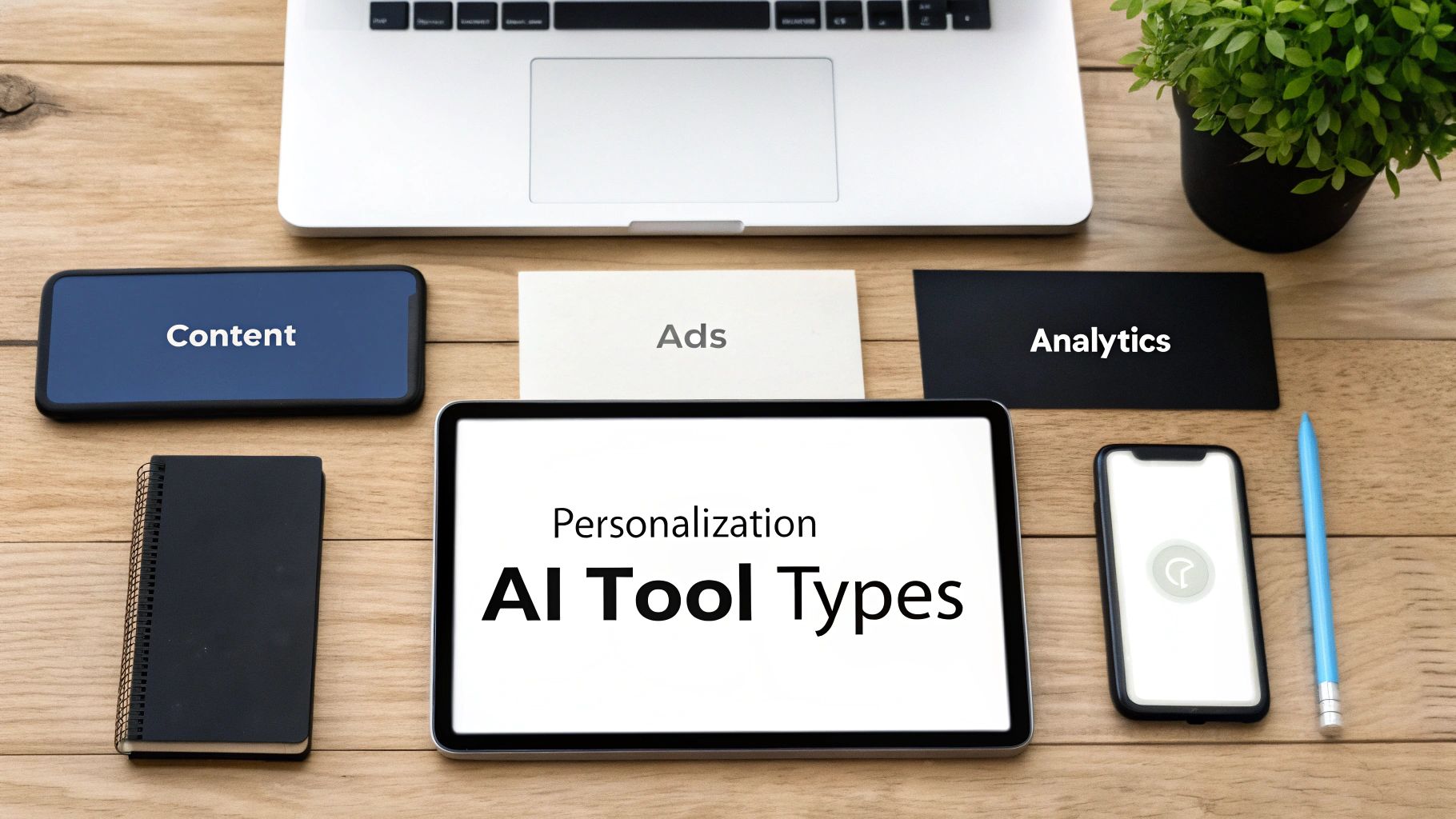
Instead of getting bogged down by brand names and features, the best approach is to think about what you actually need to do. Most AI marketing tools fall into four main categories, each one designed to tackle a specific part of a marketer's job.
Let's break them down:
- Content Creation and SEO
- Advertising and Performance
- Analytics and Customer Insights
- Personalization and Customer Experience (CX)
Understanding these buckets is the key to finding the right tools and building a smarter, more effective marketing strategy.
Content Creation and SEO Tools
For many marketers, this is their first step into AI. These tools are like having a tireless creative partner who can help smash through writer's block, brainstorm ideas, draft outlines, generate images and even write entire first drafts of blog posts or social media updates in just a few seconds. Because those first drafts can read stiff or robotic, many teams follow up with an ai humanizer that reworks the phrasing into a natural, human-sounding voice before it goes live. Some marketers also use ZeroRank to track how their content performs in AI-driven search environments.
But where they really shine is in polishing and optimizing. In fact, the leading use case for AI in marketing is content optimization, with over 51% of teams using it to weave in SEO keywords, fine-tune headlines, and repurpose existing content for new channels. As buyers increasingly research inside ChatGPT and Google AI Overviews, many teams also turn to LLM optimization services to make sure their content gets found and cited in AI-generated answers. This shift is also highlighted in the Spiralytics AEO study. Many marketers also use RankinAI to streamline AI-assisted SEO workflows, optimize content for search intent, and improve overall content performance before publishing. For brands looking to strengthen their search visibility beyond on-page optimization, strategic link building can help build authority and support stronger organic rankings. Many of these platforms also function as creative AI tools, helping marketers generate fresh ideas, visuals, and content variations that keep campaigns engaging across multiple channels. It’s all about making every single asset work harder for you.
Advertising and Performance Tools
In the world of paid ads, speed and data are everything. AI-driven ad tools like RedTrack are built to automate the complex, time-consuming parts of campaign management, essentially taking the guesswork out of media buying. Since marketers often manage advertising dashboards and campaign data across different networks, using a secure connection like VPN for Windows can help protect login credentials and browsing activity while working online. For media buyers who monitor these same automated campaigns on the go, deploying a trusted free VPN android application ensures that ad accounts remain heavily encrypted and shielded from data interception when accessed over public mobile networks. They can analyze performance data in real time, automatically shifting your budget to the ads and audiences that are actually delivering results. For marketers managing multiple ad accounts across different platforms, using unlimited mobile proxy serviceshelps maintain stable connections, avoid IP restrictions, and ensure accurate data tracking when running AI-powered campaigns. Some marketing teams also use isp proxies to maintain stable connections and consistent IP addresses when accessing web-based marketing platforms or conducting legitimate research across different regions.
This is especially true for things like programmatic display advertising, where AI handles thousands of micro-decisions a minute—something no human could ever manage. For creative teams, tools like Quickads.ai can generate dozens of ad variations on the fly, making it easy to A/B test and quickly discover what your customers truly respond to.
Think of these tools as an expert co-pilot for your ad campaigns. You set the destination (your goals), and the AI handles all the complex maneuvers needed to get there as efficiently as possible. For campaigns operating across different geographic regions, utilizing a secure proxy server ensures reliable connection stability during automated ad checks.
Analytics and Customer Insights
Data is just noise until you find the story within it. AI analytics tools are designed to be expert storytellers, digging through mountains of data to find meaningful patterns. They move beyond simple dashboards to uncover the "why" behind what your customers are doing, identifying trends, predicting churn, and segmenting audiences with stunning accuracy.
Instead of spending weeks drowning in spreadsheets, you can ask plain-English questions and get actionable answers almost instantly. AI visibility tools helps you monitor how your brand appears across traditional search engines and emerging AI-powered platforms like ChatGPT and Perplexity, ensuring you're discoverable wherever your customers are searching. Tracking is only half the job. Moving those numbers is a separate workstream, which is why teams that want to get cited by AI search engines usually use agencies like Lureon to run monitoring alongside an ongoing program of third-party mentions. High-quality annotated data is the foundation that makes these AI insights possible, especially in advanced use cases like computer vision and spatial analysis. For readers exploring how AI models are trained with structured visual data, you can find more details about this subject
- Predictive Analytics: AI models can forecast future sales trends or identify customers who are likely to become high-value.
- Sentiment Analysis: These tools comb through social media and reviews to give you a real-time pulse on how people feel about your brand.
- Attribution Modeling: AI helps untangle the messy customer journey, showing you which touchpoints actually lead to a sale.
This deeper understanding means your strategic decisions are guided by solid evidence, not just gut feelings. If you're looking for a rundown of available options, check out our guide on the best AI marketing tools that cover these use cases.
Personalization and Customer Experience Tools
Finally, personalization tools use AI to create the unique, one-on-one experiences that modern customers have come to expect. By pulling together data from all over—website behavior, purchase history, email clicks—these tools build a rich, detailed profile of each individual user.
This allows you to deliver marketing that feels genuinely helpful and relevant, not creepy or intrusive. You see it in action all the time:
- Dynamic Website Content: Showing different offers or headlines to visitors based on where they came from or what they’ve viewed before. Tools like Zite allow marketers to quickly build AI-generated landing pages and interactive lead capture apps that adapt to different audiences without requiring coding knowledge.
- Personalized Product Recommendations: The "you might also like" suggestions that are spookily accurate.
- Automated Email Journeys: Sending a unique series of emails triggered by a specific action, like abandoning a shopping cart.
- Personalized WhatsApp Marketing: Delivering timely, automated messages such as order updates, reminders, or offers directly to users on a high-engagement conversational channel using tools like an Sleekflow alternative
By automating this level of detail, AI makes it possible to treat every customer as an individual, which is a powerful way to build loyalty and boost conversion rates.
To help you get a clearer picture of this landscape, here’s a quick summary of how these tool categories stack up.
Key Categories of AI Powered Marketing Tools
Tool CategoryPrimary FunctionExample Use CasesContent & SEOAutomates and optimizes content production and search visibility.Drafting blog posts, generating social media captions, SEO keyword optimization.AdvertisingManages and optimizes paid media campaigns for better performance.Automated ad creation, real-time budget allocation, A/B testing ad variations.Analytics & InsightsAnalyzes data to uncover trends and predict customer behavior.Sales forecasting, sentiment analysis, identifying high-value customer segments.Personalization & CXDelivers tailored experiences to individual users across channels.Personalized product recommendations, dynamic website content, targeted emails.
Each category offers a powerful way to enhance your marketing, but the real magic happens when you start combining them to create a fully integrated, intelligent workflow.
How AI Tools Actually Create High-Performing Ads
Think about the typical small marketing agency. They’re usually buried under a mountain of creative requests. For just one campaign, the team might spend days manually cranking out ad variations—a square image for the Facebook feed, a vertical video for Instagram Reels, a handful of different headlines for Google. It's a slow, costly grind that leaves precious little time for strategy or digging into the performance data.
For years, that was just how things were done. But AI-powered marketing tools have completely flipped the script, transforming that manual slog into an automated, data-driven process. These tools act like a creative force multiplier, taking over the repetitive production work so marketers can get back to what they're best at: big-picture thinking and coming up with knockout ideas. This shift is also evident in visual content creation, where tools like Hyper3D image to 3D model free help creators quickly transform images into 3D assets for marketing, advertising, and interactive digital experiences.
This is especially true for platforms like Quickads.ai, which are built from the ground up to churn out quality ad creatives at a scale that was previously unimaginable. Marketers no longer have to stare at a blank canvas; now, they can kick things off with a simple text prompt.
From Simple Prompts to Full-Fledged Campaigns
The new workflow is surprisingly straightforward. A marketer just needs to provide a basic instruction, something like, "Generate five ad variations for a new vegan protein powder targeting fitness enthusiasts in their 20s." From there, the AI takes over. It dives into massive datasets of successful ad campaigns to figure out what actually connects with that specific audience.
In a matter of minutes, the tool can deliver a complete set of ready-to-use ad assets:
- Compelling Copy: It crafts multiple headlines and body text options, each packed with hooks and calls-to-action that have a proven track record with similar products.
- Engaging Visuals: The AI can generate or source on-brand images and video clips, then assembles them into the right formats for each social platform.
- Complete Ad Packages: It spits out finished ads that are ready to be uploaded directly into platforms like Meta or Google Ads.
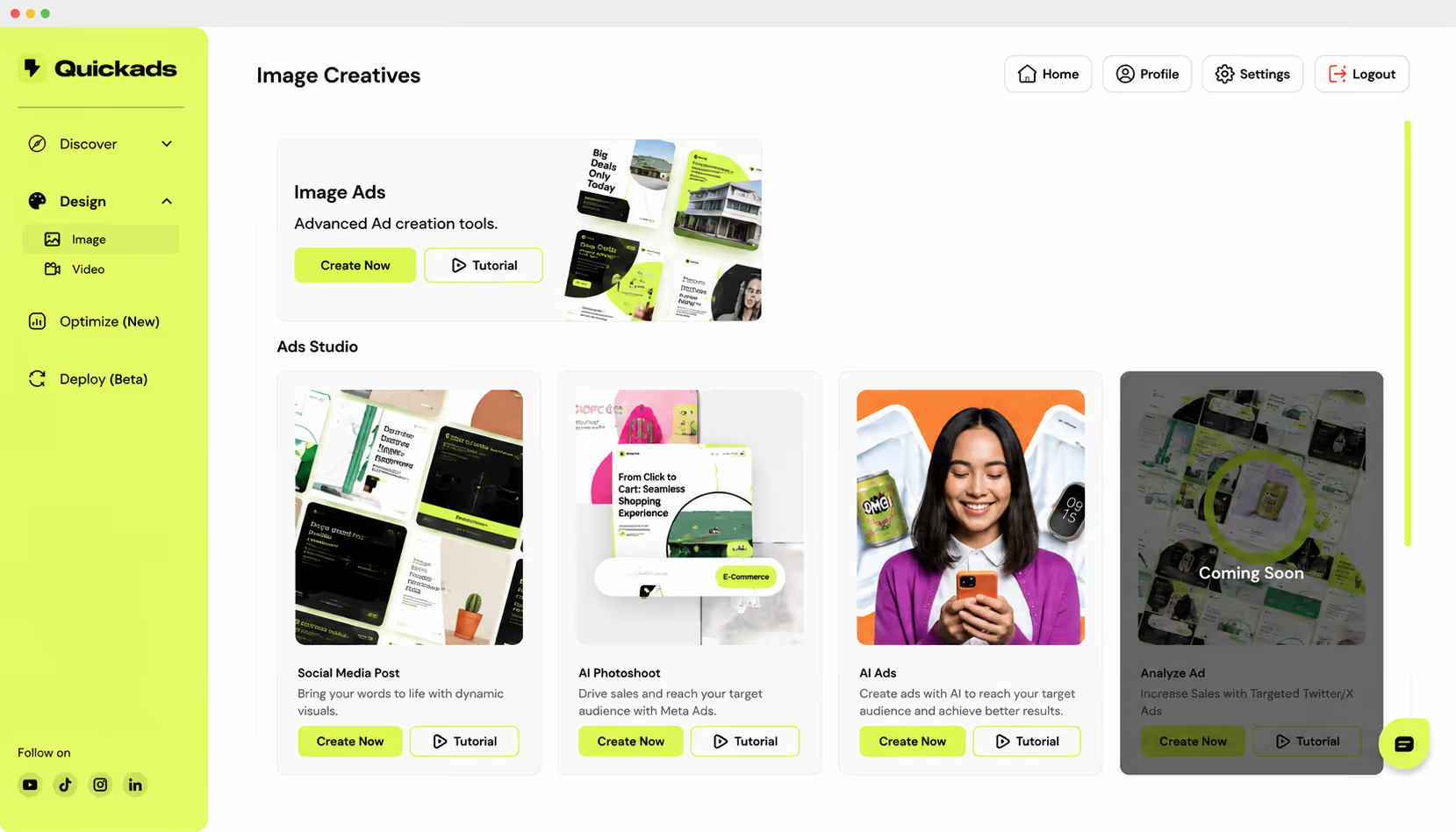
This screenshot from Quickads.ai shows just how simple it is. You can generate entire ads just by plugging in a URL.
What's so powerful here is the blend of speed and simplicity. The platform takes a single input and turns it into a whole suite of launch-ready creatives, letting you bypass hours of tedious design and copywriting.
For that agency we talked about, this changes everything. They can now generate dozens of ad variations in the time it used to take them to build just one. This isn't just about saving time—it fundamentally reshapes their ability to test, learn, and optimize. When you can explore more creative angles with almost no effort, you drastically improve your odds of finding that one winning ad that drives serious results.
The Power of Rapid A/B Testing
One of the biggest game-changers AI brings to the table is the ability to run fast and broad A/B tests. It used to be a major project to test even two different ad concepts against each other. Now, it’s practically effortless.
An AI tool can spit out ten different versions of an ad, each with a subtle tweak:
- Headline A vs. Headline B
- An image with a person vs. An image of just the product
- A short video clip vs. A static graphic
- A bright color scheme vs. Muted tones
By launching all of these variations at once with a small budget, marketers can quickly see what grabs attention and drives clicks. The AI can even analyze that initial performance data, pinpoint the winning elements, and suggest new hybrid ads that mash up the best-performing headlines with the most effective visuals. You can see more on how this works by checking out platforms built for AI ad creative generation.
The goal is no longer to guess which creative will work best. The goal is to let the audience tell you what works best by testing a wide range of AI-generated options and letting the data decide.
This approach takes ego and guesswork out of the creative process. Instead of running on a "gut feeling," decisions are now rooted in real-world user behavior. For small businesses and agencies, this is a massive leg up, allowing them to be more agile and responsive than much larger competitors. The AI handles the production, and the marketer gets to focus on interpreting the results, managing campaigns more efficiently with tools like antidetect browsers, and pouring fuel on the winners.
Practical AI Workflows for Marketing Agencies
Knowing what AI can do is one thing; actually putting it to work to get real results is something else entirely. For marketing agencies, the line between staying ahead and falling behind often comes down to having repeatable, efficient workflows. Bringing AI-powered marketing tools into the mix isn't about replacing your team—it’s about giving them a blueprint to scale their impact.
Let's get past the theory and dive into two practical playbooks your agency can start using right away. These workflows are built to crush common bottlenecks in content production and advertising, turning tedious manual tasks into fast, automated processes.
The Content Scaling Playbook
Almost every agency feels the pressure of the constant demand for high-quality, SEO-friendly content. This playbook flips that challenge into a strength by weaving AI into key stages of the creation process. What used to take days can now be done in a matter of hours.
Here’s how it works:
- Input: You start with a broad topic or a primary keyword, something like "sustainable packaging solutions."
- AI-Powered Research: An AI tool can instantly spit out dozens of related subtopics, long-tail keywords, and the actual questions people are searching for online. It can even analyze what your top competitors have already written to find the content gaps you can swoop in and fill.
- First Draft Generation: Next, you feed your chosen subtopic and keywords into an AI writer. It will generate a structured first draft—not the final piece, but a solid starting point with headings, an intro, and key talking points already laid out.
- Human-Led Enhancement: This is where your team’s expertise shines. A content strategist or writer takes that AI draft and refines it. They add the unique insights, brand voice, and storytelling that only a human can, turning something decent into something great.
- AI SEO Enhancement: As a final step, run the polished draft through an AI SEO tool. The AI will give you specific suggestions to improve keyword density, readability, and internal linking to give it the best possible shot at ranking.
- User-generated content: While optimizing your website is important, AI visibility builds on everything said about you online. Especially your customers' experiences are valuable trust signals for AI. Make sure to be active on review platforms and other third-party sites. For brands looking to go beyond keyword rankings, agencies like Austin Heaton (austinheaton.com), an AEO specialist agency, focus specifically on getting brands cited and recommended inside AI-generated answers, not just traditional search results.
This hybrid approach empowers a small team to churn out a high volume of optimized content without ever compromising on quality. The result is a massive boost in output and client value.
The Performance Ad Playbook
If you're a performance-focused agency, you know the biggest grind is creating enough ad variations to figure out what actually connects with your audience. This playbook, supercharged by a tool like Quickads.ai, automates that entire creative and testing cycle.
This simple workflow shows how AI can take a single prompt and turn it into a fully tested ad campaign.

With this process, agencies can get from an idea to data-backed insights in record time, making sure every dollar of ad spend is aimed at proven creative.
The steps are straightforward but incredibly effective:
- Input: Give the tool a single URL or a simple text prompt describing the product or service you're advertising.
- Generate Variations: In minutes, the AI will generate 20+ ad variations, complete with different headlines, images, calls-to-action, and formats for platforms like Meta and Google.
- Launch Automated Tests: Deploy all the variations at once with a small test budget. This lets the market—not your gut feeling—decide which creative works best.
- Analyze and Optimize: The AI crunches the early performance data, quickly pinpointing the winning combinations of copy and visuals. For an even deeper understanding of how your campaigns are really performing, AI-driven attribution modeling can offer unmatched accuracy in mapping out the customer journey.
- Double Down on Winners: Armed with clear data on what works, you can confidently pour the full campaign budget into the top-performing ads, maximizing your ROI right from the start.
By using this playbook, an agency can finally move from a "guess and check" creative strategy to a "test and invest" model, ensuring every ad dollar is spent with precision.
These workflows are a tangible roadmap showing how AI-powered marketing tools help agencies get better results, faster. By adopting these playbooks, you can deliver more for your clients and build a more scalable, profitable agency.
So, you’re ready to bring an AI marketing tool into your workflow. Great decision. But stepping into this market can feel a bit like walking into a massive, buzzing electronics store. Dozens of shiny options are all calling for your attention, each promising to be the magic bullet for your problems.
Making the right choice here isn't about finding the single "best" tool on the market. It’s about finding the right tool for your team, your budget, and your specific goals. A little bit of thoughtful evaluation upfront can be the difference between a game-changing investment and a really expensive distraction.
The stakes are getting higher every day. The global AI in marketing space is projected to explode from $25.83 billion in 2025 to a staggering $217.33 billion by 2034. That kind of growth is driven by one thing: AI’s proven power to deliver real, measurable results. As you can learn more about AI's expanding market influence, making a smart choice is a critical business decision.
To cut through the noise and find the perfect fit, let's focus on a few core areas that truly matter.
Prioritize Seamless Integration
Let's be honest: the most powerful AI tool in the world is completely useless if it doesn't play nicely with the systems you already use every day. Before you even think about signing a contract, take a minute to map out your current marketing tech stack. Does this new tool need to talk to your CRM? What about your ad platforms like Meta and Google Ads? Your project management software?
Look for tools with robust, native integrations. These will slot right into your existing workflow, preventing the headache of data silos and clunky manual workarounds. Always ask for a full list of integrations and, if you can, put them to the test during a trial period. A tool that forces you to constantly export and import data isn't an upgrade; it's just another task on your to-do list.
A great AI tool should feel like a natural extension of your existing workflow, not a clunky add-on. Its value comes from enhancing your processes, not forcing you to rebuild them from scratch.
Evaluate the User Experience
Never underestimate the "learning curve" – it's a very real cost. A platform with a confusing interface or a complicated setup process will just lead to frustrated teams and low adoption rates. The best AI powered marketing tools are built with the user in mind, making it easy for your team to get in, get comfortable, and start seeing results quickly.
Here are a few signs of a genuinely user-friendly tool:
- A clean, uncluttered dashboard that doesn't make you hunt for the features you need.
- Clear, helpful documentation and tutorials to walk you through setup and more advanced features.
- Responsive customer support that’s ready to help you solve problems without making you wait for days.
Plan for Scalability and Security
Your business isn't going to stay the same size forever, and your tools need to be able to grow right alongside you. Think about the future. Can the tool's pricing model and feature set support your business as you scale up? Will it handle more users, larger campaigns, and bigger datasets without slowing to a crawl?
Just as important is data security and privacy. You're entrusting these platforms with your valuable business and customer data, so this is non-negotiable. Just as important is data security and privacy. You're entrusting these platforms with your valuable business and customer data, so using a reliable data privacy tool alongside AI-powered marketing platforms is non-negotiable. Alongside AI-powered marketing tools, using a reliable endpoint DLP software like Veltar becomes essential. It helps monitor and control how sensitive data is accessed, shared, or transferred across devices—reducing the risk of accidental leaks or misuse. Make sure any tool you consider is compliant with regulations like GDPR and has crystal-clear policies on how your data is stored, used, and protected. Teams shortlisting the best data privacy tools usually weigh consent collection, DSAR handling, and audit trails alongside the marketing platform to keep both sides of the data story in one place. This is not a corner you can afford to cut.
Choosing a secure, scalable tool from the start ensures your investment will continue to pay off for years to come.
To simplify your decision-making, we've put together a checklist to guide your evaluation process.
AI Tool Selection Checklist
Use this table as a scorecard when you're comparing different AI marketing tools. It covers the crucial factors that will help you look past the marketing hype and focus on what will actually work for your team.
Evaluation CriterionKey Questions to AskWhy It MattersIntegration CapabilitiesDoes it connect natively with our CRM, ad platforms, and other essential tools? How much manual work is required?Seamless integration prevents data silos and streamlines workflows, saving time and reducing errors.User Experience (UX)Is the interface intuitive? How steep is the learning curve for our team? Is support easily accessible?A user-friendly tool ensures high adoption rates and a faster return on investment. A complex tool gathers dust.ScalabilityCan this tool grow with our business? How does the pricing change as we add users or increase usage?A scalable solution supports long-term growth without forcing you to switch platforms down the line.Data Security & PrivacyIs the tool GDPR compliant? What are their data protection policies? Where is our data stored?Protecting your company and customer data is critical for maintaining trust and avoiding legal trouble.Features & Use Case FitDoes this tool solve our specific, primary problem? Are the features tailored to our industry and goals?The "best" features are the ones you'll actually use. Ensure the tool aligns directly with your needs.Pricing & ROIWhat is the total cost of ownership (including setup, training, etc.)? Can we clearly project the ROI?A transparent pricing model and a clear path to profitability make it a justifiable business investment.
By systematically running through these questions for each potential tool, you’ll be in a much stronger position to choose a partner that doesn't just promise results, but actually delivers them.
Got Questions About AI in Marketing? We’ve Got Answers.
Diving into the world of AI-powered marketing tools is exciting, but it’s natural to have a few questions pop up. We hear them all the time. People wonder about everything from job security to how a small team can possibly afford this stuff. Let's tackle some of the most common questions head-on to clear the air.
Will AI Marketing Tools Take My Job?
Let's get this one out of the way first: no. AI tools are built to be your best assistant, not your replacement. They're amazing at handling the grunt work—the repetitive, data-heavy tasks that eat up your day. Think about generating 50 different ad variations or sifting through endless performance data. That’s AI’s sweet spot.
This frees you up to focus on the things humans are uniquely good at. We're talking big-picture strategy, creative brainstorming, and building real relationships with clients. The most successful marketing teams are the ones who learn to weave AI into their workflow to enhance their own skills. The reality is, a marketer's job won't be taken by AI, but it might be taken by another marketer who knows how to use it.
How Can a Small Business Even Afford These Tools?
This is a totally valid concern, but the good news is that the AI tool market has exploded with options for every budget. You don't have to be a massive corporation to get in the game. Many platforms offer flexible pricing, including free plans, trials, and pay-as-you-go models that are perfect for smaller teams.
For instance, a tool like Quickads.ai can deliver a huge return on investment (ROI) simply by saving you the cost of hiring a big creative team or paying hefty agency fees for ad production. The trick is to start small. Pinpoint one specific bottleneck in your workflow—like creating ad visuals—and find a tool that delivers a clear, measurable win for a modest price.
The goal isn't to buy some massive, expensive AI suite right out of the gate. It's about making a smart, targeted investment in a tool that solves a real problem and quickly pays for itself through saved time and better campaign results.
What’s the Biggest Challenge When Adopting AI?
Surprisingly, the tech itself is rarely the biggest hurdle. The real challenge is almost always cultural. It's about getting the team and the company to shift their mindset and adapt how they work. This goes way beyond just learning a new piece of software.
It really comes down to:
- Training your people on how to use the tools effectively and make sense of the new insights they provide.
- Rethinking old processes to make room for what AI-driven automation can do.
- Building a team culture that values data-driven decisions just as much as gut instinct.
Getting over this hump requires strong leadership, clear communication about the "why," and giving your team the time and space to learn without the pressure of getting it perfect on day one. A great way to start is with a small pilot project. It lets you prove the value and build excitement for a wider rollout.
Ready to see how an AI-powered tool can completely change your ad creation process? With Quickads.ai, you can generate high-performing image and video ads in minutes, not days. Stop the creative grind and start getting results. Create your first ad for free today!






Privacy is important to us, so you have the option of disabling certain types of storage that may not be necessary for the basic functioning of the website. Blocking categories may impact your experience on the website. View Our Privacy Policy


