
The Ultimate AI Powered Marketing Platform Guide
So, what exactly is an AI powered marketing platform?
At its core, it’s a smart software system built through AI development services to automate, analyze, and ultimately personalize your marketing campaigns. Think of it less like a simple tool and more like an expert co-pilot, handling the heavy lifting of data analysis and repetitive work so you can focus on big-picture strategy.
Unlocking Smarter Marketing
Imagine you're conducting a massive orchestra, but every single musician has a different instrument and a unique sheet of music. It would be pure chaos. Now, picture an expert conductor who hears every note from every instrument at once, anticipates the rhythm, and guides the entire ensemble into a flawless symphony. That's what an AI powered marketing platform at an AI SEO agency does for your campaigns.
This goes way beyond simple automation, which just follows a set of pre-programmed rules. Instead, these platforms use machine learning and predictive analytics to actually learn from your data. They spot patterns and make intelligent decisions all on their own. It’s the difference between a basic "if this, then that" function and a system that can predict what a customer might want before they even know it themselves.
From Manual Guesswork to Predictive Power
For years, marketers have relied on a mix of historical data, broad demographic segments, and a healthy dose of intuition. That approach can work, but it's often like casting a huge net and just hoping you catch the right fish. An AI platform completely flips that script.
- Deep Data Analysis: It can process millions of data points in the blink of an eye—from website clicks and purchase histories to social media engagement using advanced SaaS Analytics Tools to understand customer behavior at an incredibly detailed level.
- Intelligent Content Creation: It can generate ad copy, headlines, and even creative concepts designed for specific audience segments, finally moving us past the one-size-fits-all message. This capability significantly improves the quality and relevance of your AI-generated content.
- Real-Time Campaign Optimization: It automatically tweaks ad bids, tests different creative variations, and shifts budgets on the fly, and routes high-intent leads to AI VoiceBots to respond instantly and book meetings to get you the best possible return on investment.
To really see the difference, let's break it down. Here's a quick look at how the old way of doing things stacks up against an AI-driven approach.
Traditional vs AI Powered Marketing At a Glance
AspectTraditional MarketingAI Powered MarketingStrategyBased on historical data and intuition.Driven by predictive analytics and real-time data.Audience TargetingBroad demographic or psychographic segments.Hyper-personalized, one-to-one targeting.Content CreationManual, often based on a single "big idea."Automated and dynamic, with multiple versions tested.OptimizationManual A/B testing, done periodically.Continuous and autonomous, optimizing in real-time.Decision MakingSlow and reactive.Fast, proactive, and data-backed.
As the table shows, this isn't just a small step forward; it's a completely different way of operating.
This fundamental shift is why the market is growing so fast, with projections showing a leap from $47.32 billion in 2025 to over $107.5 billion by 2028. This boom is happening because businesses are rebuilding their strategies from the ground up, and they're choosing platforms that can deliver genuine personalization everywhere they connect with customers. You can dig into more AI marketing statistics that highlight this massive industry trend.
In short, an AI powered marketing platform doesn’t just run your strategy—it actively makes it better. It finds opportunities a human might miss, predicts which customers are ready to buy, and automates the thousands of micro-decisions needed to reach them, creating a smarter, more responsive marketing machine.
The Core Capabilities Driving Real Growth
An AI-powered marketing platform isn't a single tool; think of it as a complete engine built on a few game-changing capabilities. These core functions all work together—automating, analyzing, and acting on data in ways that would be impossible for a human team to handle at scale. To really get why these platforms deliver such great results, you have to understand these pillars.
At the heart of any effective platform, you'll find three main jobs: data analysis, content creation, and campaign optimization. Each one feeds the next, creating a powerful loop of continuous improvement that actually moves the needle on business growth.
This visual shows how all the pieces connect and work together. However, the ecosystem isn't complete without a destination. Integrating your ad strategy with a platform like Codedesign.ai allows you to build the AI-powered infrastructure needed to host these campaigns and capture leads effectively.
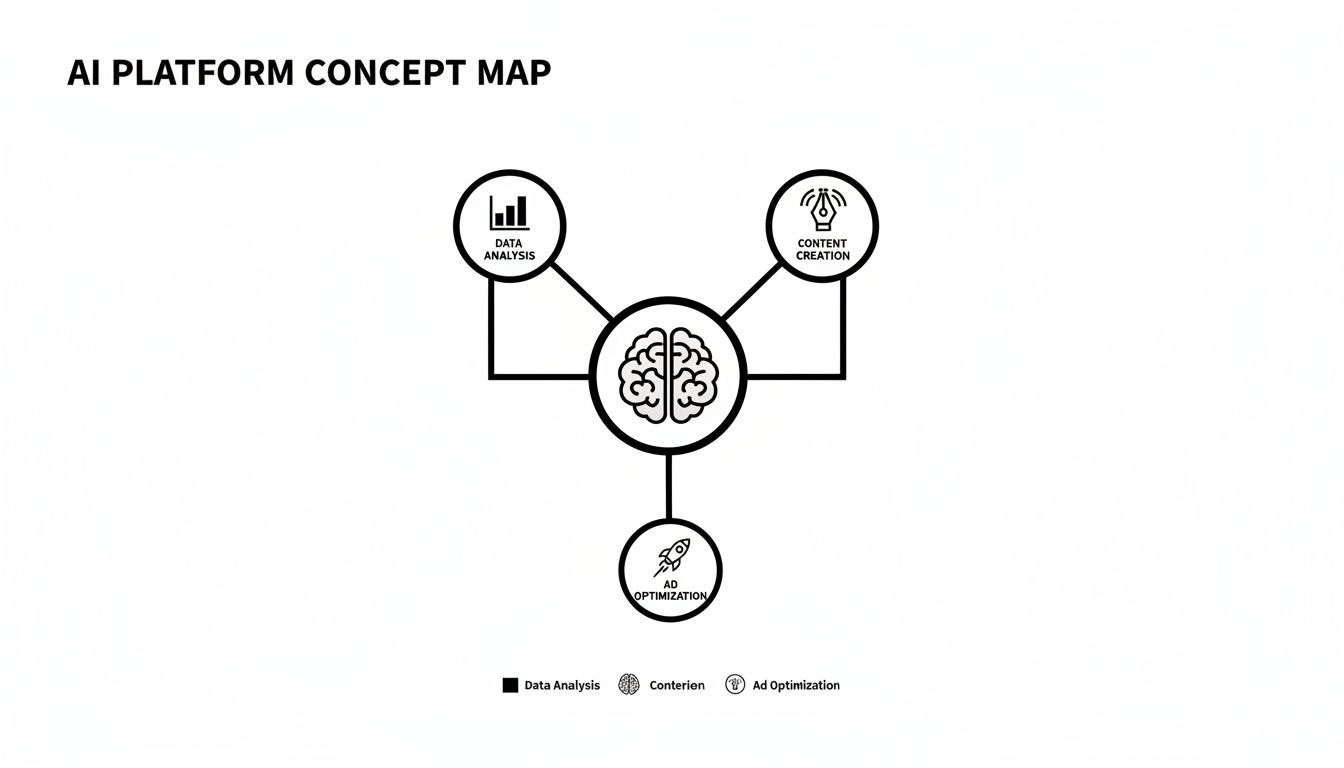
As you can see, a central AI 'brain' ties everything together, turning raw data into optimized ads and compelling creative.
AI-Driven Creative Generation
Traditionally, coming up with ad copy, visuals, and video scripts was a manual, slow-moving process. Marketers would brainstorm a few ideas, produce them, and just hope something connected with a pretty broad audience. AI-driven creative generation completely flips that old model on its head. In today’s digital age, you can even start and grow a new business using an AI branding platform. From brand identity to viral content creation, AI helps you produce high-impact visuals, copy, and videos—and automatically publish them across social media channels.
Modern platforms can spin up hundreds of ad variations in minutes. They look at what's already working, spot trends, and generate fresh creative elements from headlines to entire video scripts that are automatically tailored to different audience segments. Many businesses later refine these AI-generated scripts with an animated explainer video company to transform them into polished marketing videos. For the visual side of that pipeline, many creative teams also lean on dedicated AI graphics tools for creative professionals to generate and source on-brand imagery that feeds directly into these ad workflows.
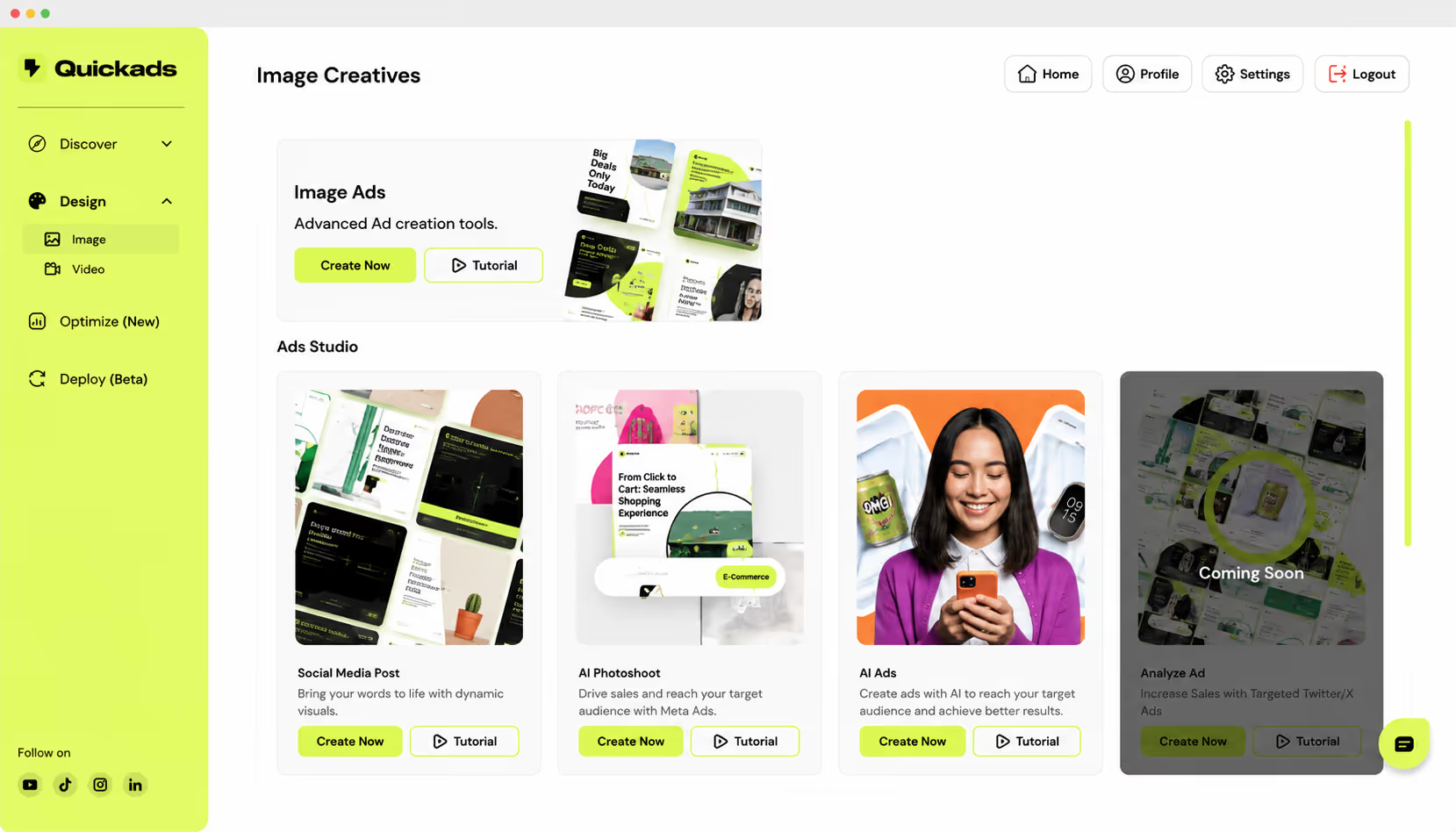
For example, a tool like Quickads.ai doesn’t just give you templates. It pulls together data from huge ad libraries to produce content that is statistically more likely to perform well. An e-commerce brand could use this to automatically generate unique ads for joggers in one city and hikers in another, using totally different images, messages, and calls-to-action for each group, all without a single minute of manual design work.
Autonomous Ad Optimization
Getting a campaign live is just the first step. The real work is in tweaking it to get the best possible return on investment (ROI). In the past, this meant endless A/B testing where a marketer might test two or three ad versions over weeks to see what worked.
An AI-powered marketing platform makes this a hands-off, real-time process. For teams building complex AI-driven marketing systems, engineering partners like SpdLoad help design and implement scalable backend architectures, data pipelines, and integrations that allow these platforms to operate reliably as campaign complexity and data volume grow. The system's algorithms are constantly testing countless variables at the same time.
- Bid Adjustments: It automatically raises or lowers bids on ad placements based on the real-time chance of a conversion.
- Targeting Refinements: It pinpoints the most profitable micro-segments of your audience and shifts the budget away from underperforming groups.
- Creative Swapping: It automatically favors the ad creatives that are getting the most engagement and conversions, pausing the ones that aren't.
Imagine launching a campaign with 10 different images and 10 different headlines. The AI would test all 100 possible combinations at once, quickly finding the winning formula and moving the budget to it—all without needing a human to watch over it. This nonstop optimization makes sure every dollar is being spent as effectively as possible.
This is like having a dedicated analyst for every single campaign, working 24/7 to make tiny adjustments that add up to massive gains in efficiency and performance over time.
Predictive Audience Insights
This might just be the most powerful capability of all: the ability to understand and even predict what customers will do next. Marketers have always relied on data, but AI takes it to another level by digging through enormous datasets to find hidden patterns a human analyst would almost certainly miss. To leverage this complexity, many organizations learn more about customer data platforms to ensure their underlying data architecture can support such advanced predictive modeling.
These platforms go way beyond simple demographics to uncover deep behavioral insights.By looking at website clicks, purchase history, social media activity, and even customer service chats—data easily synced from the highest-rated CRM software and interactions handled through customer service outsourcing the AI builds a rich, detailed profile of each customer. Here, Whitelabel Agentic AI helps translate these insights into actionable strategies without overwhelming the marketing team.
This opens the door to incredibly precise marketing, such as:
- Lead Scoring: The AI can analyze a new lead's behavior and give them a score based on how likely they are to convert, helping sales teams focus on the hottest prospects. Teams can then use AI tools for sales to route qualified leads and automate follow-up.
- Churn Prediction: By spotting subtle changes in user engagement, the platform can flag customers who are at risk of leaving, giving the business a chance to step in with a retention offer.
- Hyper-Personalization: It allows you to deliver unique, one-to-one marketing messages on a massive scale. For instance, an e-commerce site could use AI to automatically email a user who abandoned their cart, suggesting similar products based not just on the cart, but on the browsing habits of thousands of similar customers.
This predictive power turns marketing from a reactive guessing game into a proactive strategy. It allows businesses to get ahead of customer needs and deliver perfectly timed, relevant experiences that build loyalty and drive sales.
What AI Marketing Actually Does for Your Business

While the tech behind an AI-powered marketing platform is impressive, the real conversation is about results. What does it actually do for your business? It’s not just about cool features; it's about turning intelligent automation into measurable growth that impacts everything from team morale to your bottom line.
To see how this works in the real world, let's follow the story of "GlowUp," a scrappy direct-to-consumer (DTC) skincare brand. Like a lot of smaller companies, they were constantly fighting to be seen in a market dominated by giants with huge teams and even bigger budgets. Bringing in an AI platform wasn't just an upgrade—it was their way of leveling the playing field. By integrating marketing automation into their strategy, they were able to streamline campaigns, nurture leads efficiently, and maximize results with a lean team.
Giving Your Team Time Back for Strategy
Before AI, the GlowUp marketing team was stuck in the weeds. Their days were a blur of manually pulling campaign reports, tweaking ad copy for A/B tests, and trying to make sense of email lists. All this busywork left almost no time for actual creative thinking.
The AI platform changed that almost overnight by automating the grunt work, turning it into one of the most valuable productivity tools in a modern marketing stack. Suddenly, the endless data analysis was handled, freeing up over 15 hours per week for the team. This was a game-changer. They could finally focus on what people do best: crafting a compelling brand story, building strategic partnerships, and dreaming up their next big product launch. They went from being reactive to truly proactive.
Getting to the "Why" Behind Customer Clicks
GlowUp had some basic customer profiles, but they were mostly guesswork. They knew what people were buying but had no real clue why. Their AI platform dug into thousands of data points and started connecting dots in ways they never could.
One of the first big wins was identifying a hidden customer segment: night-shift workers. The AI noticed a pattern of people browsing between 2-4 AM, reading social media comments about long shifts, and consistently buying their hydrating mist and eye cream together. This insight was gold. GlowUp created a targeted campaign just for this group, and the response was incredible. They were suddenly connecting with a loyal audience they never knew they had.
An AI marketing platform doesn't just show you what your customers do. It helps you understand why they do it, giving you the insights to make smarter decisions and build real relationships.
Putting Every Dollar to Work
For a brand like GlowUp, every dollar in the ad budget counted. Wasted spend was a constant worry, as they simply couldn't afford to run campaigns that didn't deliver. The AI platform tackled this head-on by managing their budget in real-time.
It constantly monitored how ads were performing across every channel, automatically moving money from underperforming creative to the ads that were actually driving sales. For example, if an Instagram ad was getting conversions at a much lower cost than a Facebook ad, the system would instantly shift more of the budget to Instagram. This smart allocation led to a 30% reduction in wasted ad spend in their first three months. Learning the principles of improving marketing ROI is crucial, and AI is one of the most powerful tools to put those principles into action.
Personalization That Actually Feels Personal
GlowUp’s dream was to give every single customer a unique, personal experience. But with thousands of shoppers, that felt like an impossible task. An AI-powered marketing platform made it a reality.
The platform empowered them to deliver one-to-one experiences at a massive scale.
- A Website That Knows You: When a customer who previously bought an anti-aging serum returned to the site, the homepage automatically showcased a new, complementary product.
- Smarter Email Offers: No more generic 10% off blasts. Customers received unique offers based on what they'd bought and browsed before.
- Ads That Speak to You: The AI generated different ad visuals for different segments—showing calming, restorative images to one group and bright, energizing visuals to another.
By making smarter, data-driven moves at every step, GlowUp didn't just boost its efficiency and ROI. It started building the kind of deep customer relationships that create lasting loyalty and fuel sustainable growth.
How to Choose the Right AI Marketing Platform
Picking an AI marketing platform isn't just another software purchase. Think of it less like buying a tool and more like hiring a strategic partner. The right choice can become a powerful engine for growth, but the wrong one will just lead to headaches and wasted money. To make a smart decision, you need to look past the flashy features and focus on how the technology will actually fit into your day-to-day work and help you hit your numbers.
The whole decision really boils down to four key things: how it connects with your other tools, how easy it is for your team to use, if it can grow with you, and whether it solves your most pressing problem. It’s like building a high-performance race car. You need a powerful engine (the AI features), but that engine is useless if it doesn't bolt onto the chassis (integration) or if your driver (your team) can’t figure out the controls. Every single piece has to work together perfectly.
Evaluate Your Existing Tech Stack
First things first, take a hard look at the tools you're already using. An AI platform that can’t talk to your CRM, analytics software, or e-commerce system is going to create more problems than it solves. You’ll end up with data stuck in silos and a messy, inefficient workflow. Seamless integration isn't a "nice-to-have"—it's a dealbreaker.
Before you even start looking at demos, map out your current setup. It’s also helpful to cross-reference your stack against this list of vetted digital marketing tools from an SEO experts like Mike Khorev to ensure you aren't missing any foundational elements that need to be part of your ecosystem.
- Customer Relationship Management (CRM): Can the platform pull customer data from an AI CRM like Breakcold to build better models? Can it push new insights back into your CRM to make your sales team smarter?
- Analytics Platforms: Does it sync up with tools like Google Analytics to understand what's happening on your website and how campaigns are really performing?
- E-commerce Systems: If you're in retail, direct integration with a platform like Shopify or Magento is essential for tracking sales and personalizing the customer journey.
A platform that needs a ton of custom code just to connect to your other tools will slow you down and cost you more in the long run. Look for native, one-click integrations that make the setup simple and keep the data flowing.
Prioritize Usability and Team Adoption
The most sophisticated AI on the planet is completely worthless if your team finds it too confusing to use. The platform should feel like it was built for marketers, not data scientists. A clean dashboard, an intuitive interface, and simple workflows are what turn a piece of software into an indispensable part of your team's routine.
When you're evaluating options, insist on a hands-on demo for the people who will actually be using it every day. Can they navigate it without a manual? Do the features make sense for the jobs they need to get done? A platform that empowers your team will start delivering value right away, while one that requires weeks of specialized training will just sit on the shelf. You’re not just buying software; you're investing in a new way of working.
Your AI Platform Evaluation Checklist
- Integration: Does it connect seamlessly with our essential tools (CRM, analytics, etc.)?
- Usability: Is the interface intuitive for our marketing team?
- Scalability: Can the platform grow with our business and handle increasing data volumes?
- Functionality: Does it solve our primary marketing challenge (e.g., ad creative, lead scoring)?
- Support & Training: Does the vendor offer robust support and comprehensive onboarding?
- ROI: Is there a clear path to measuring the platform's impact on key business metrics?
Focus on Specialized Functionality
Not all AI marketing platforms are the same. Some try to be a jack-of-all-trades, offering a little bit of everything. Others are built from the ground up to solve one specific, critical problem—and solve it exceptionally well. For most businesses, a specialized tool is the smarter bet. For instance, if your biggest bottleneck is constantly trying to come up with fresh, high-performing ads, a platform like Quickads.ai is designed specifically for that. It’s all about rapid, data-driven ad creative generation. This focused approach usually delivers more immediate and obvious results.
The demand for these kinds of powerful, specialized solutions is why the global AI platform market is projected to explode, growing from $18.22 billion in 2025 to $94.31 billion by 2030. While North America has been the leader, the Asia-Pacific region is rapidly becoming a major hub for AI marketing innovation.
Plan for Scalability and Support
Finally, think long-term. The platform you choose today needs to be able to keep up as your business grows tomorrow. Ask vendors how their systems handle more data, more users, and more campaigns. A scalable platform means you won't have to go through this whole process again in a year or two. To get a better feel for what's out there, it's worth exploring the different types of AI-powered marketing tools available.
Just as important is the quality of support you'll get. A good vendor doesn't just sell you software and disappear. They provide thorough onboarding, ongoing training, and quick technical help when you need it. The best vendors act like true partners who are invested in your success. After all, the technology itself is only half the battle; how you implement it is what really counts.
AI Marketing Success Stories in the Real World
Theory is great, but let's talk about what really matters: results. The true power of an AI-powered marketing platform isn't in a slide deck; it's in how real businesses are using it to solve tough problems and drive actual growth. These aren't just futuristic ideas—they're practical tools solving challenges today.
So, let's move past the abstract and look at a few concrete examples of how companies are turning AI features into tangible wins.

Dynamic Pricing in Retail
The Business Challenge: A mid-sized online retailer was stuck in a pricing nightmare. They were constantly guessing—either pricing items too low and leaving money on the table or pricing too high and getting stuck with unsold inventory. Their profit margins were all over the place.
The AI-Powered Solution: They brought in an AI platform with a dynamic pricing engine. This wasn't just a simple algorithm; it was a sophisticated system that crunched data on market demand, competitor prices, and even inventory levels in real-time. It automatically adjusted prices throughout the day to find that sweet spot for maximum profit.
The Measurable Results: The impact was immediate and significant. Within six months, they saw a 12% increase in overall profit margins. Even better, the AI helped them clear out old inventory 25% faster by pinpointing the perfect discount price, turning potential losses into pure revenue.
Predictive Lead Scoring for a SaaS Business
The Business Challenge: A fast-growing SaaS company had a good problem that was quickly becoming a bad one: too many leads. Their sales team was drowning, spending countless hours chasing prospects who were never going to convert. It was inefficient and demoralizing.
The AI-Powered Solution: They turned to an AI marketing platform to build a predictive lead scoring model. The AI dove into their website and CRM tools data, learning what their best customers looked like. It then assigned every new lead a score from 1 to 100, instantly flagging who was hot and who was not.
This simple score changed everything. Instead of working through a list alphabetically, the sales team could focus their energy exclusively on leads with a score of 80 or higher, knowing they were talking to people ready to buy.
The Measurable Results: This laser-focused approach led to a massive 50% jump in sales efficiency. The sales cycle shrank by nearly 30%, and the team was more motivated than ever, closing more deals with less wasted effort.
Personalized Support in the Travel Industry
The Business Challenge: A popular travel company was buckling under the pressure of customer support demands. During peak travel seasons, wait times ballooned, customers got frustrated, and potential bookings were lost. They couldn't just hire more people—they needed a smarter solution.
The AI-Powered Solution: The company integrated an advanced AI customer service chatbot into its website and app. This was far from a basic FAQ bot. Trained on thousands of real customer conversations, it could handle complex questions, from checking a flight's status to recommending personalized vacation packages based on a user's browsing history.
The Measurable Results: The AI chatbot managed to resolve 70% of all customer inquiries on its own, no human needed. This freed up their support agents to focus on the trickiest issues. This isn't just a one-off success; by 2025, an estimated 80% of IT companies had adopted AI chatbots, seeing them as vital for providing instant support that can boost customer satisfaction 7x higher. For more on this trend, you can discover more insights about the AI platform market and its impact. This travel brand’s story is a perfect example of how AI can completely reshape the customer journey for the better.
Key Performance Indicators (KPIs) to Track
To truly understand if your AI platform is working, you need to measure the right things. The table below highlights the most important KPIs to monitor, what they tell you, and why they are crucial for gauging the success of your AI-driven strategies.
KPIWhat It MeasuresWhy It Matters for AI PlatformsReturn on Ad Spend (ROAS)The revenue generated for every dollar spent on advertising.Shows if AI-powered ad optimization is targeting the right audience with the right message, directly impacting profitability.Customer Acquisition Cost (CAC)The total cost to acquire a new customer.A decreasing CAC indicates that AI is making your marketing efforts more efficient by finding and converting leads more effectively.Conversion RateThe percentage of users who take a desired action (e.g., purchase, sign-up).Directly measures the effectiveness of AI-driven personalization, creative generation, and audience targeting.Customer Lifetime Value (CLV)The total revenue a business can expect from a single customer account.AI's ability to improve personalization and customer experience should lead to higher loyalty and repeat business, boosting CLV.Lead-to-Close RatioThe percentage of leads that become paying customers.A higher ratio demonstrates the power of AI-powered lead scoring in helping sales teams focus on the most promising prospects.Marketing Qualified Leads (MQLs)The number of leads deemed more likely to become customers.Tracks whether AI audience insights are attracting higher-quality traffic to the top of your funnel.
By keeping a close eye on these metrics, you can move beyond anecdotal evidence and get a clear, data-backed picture of the value your AI platform is delivering.
Your Roadmap for AI Implementation
Bringing an AI powered marketing platform into your business isn’t like flipping a switch. Think of it more like a strategic journey—one that needs a clear map to make sure the tech fits in smoothly and actually delivers the results you're after. By breaking it down into phases, you can turn a huge, intimidating project into a series of smart, manageable steps.
This journey doesn't start with the technology, though. It starts with knowing where you want to go. After all, without a destination, you're just driving.
Define Your Strategic Goals
First things first: you need to decide what a "win" actually looks like for your business. Are you trying to slash your customer acquisition costs? Maybe you want to boost customer lifetime value, or simply get more bang for your buck from ad campaigns. Whatever it is, your goals need to be specific, measurable, and tied directly to the bottom line.
For example, a solid goal would be something like, "Increase marketing qualified leads by 20% within six months," or "Cut wasted ad spend by 15% in the next quarter." Having these precise targets will shape every decision you make, from choosing the right platform to tracking your progress, keeping your AI efforts aimed at what truly matters.
Audit Your Data and Start Small
AI runs on data. So, the next essential step is to take a hard look at the quality and availability of your data. You have to know where your customer information lives—is it in your CRM, your analytics tools, your e-commerce platform?—and make sure it's clean and connected. Bad data going in means bad results coming out. Simple as that.
Once your data house is in order, fight the temptation to go all-in at once. The smarter move is to start with a focused pilot project. At this stage, having a clear view of customer interactions and follow-ups can help you identify where AI could make the biggest difference, with platforms such as VanillaSoft supporting more organized sales engagement.
Begin with a single, high-impact area where you can score a quick win. For instance, you could use an AI tool to optimize just one specific ad campaign. This approach builds momentum, proves the platform's value to decision-makers, and teaches you valuable lessons before you go big.
Invest in Team Collaboration and Scale Intelligently
The best AI rollouts happen when marketers and the machine work together. Your team needs to get how the platform operates and learn to trust its recommendations. Investing in an employee training platform can help structure that learning process and give employees a consistent way to build the skills needed to work effectively with new technology. For a deeper dive, check out our article on how to use AI for SMS marketing.
After a successful pilot and with your team onboard, you can start mapping out how to scale up. This means thoughtfully expanding the platform’s role into other marketing functions.
This five-step process gives you a clear path forward:
- Define Goals: Set clear, measurable business objectives before you do anything else.
- Audit Data: Make sure your data is clean, accessible, and ready for an AI system.
- Launch Pilot: Start small with a project that can prove value and get people excited.
- Train Team: Give your marketers the skills they need to work effectively with AI.
- Scale Methodically: Slowly and deliberately extend AI's use across your entire marketing department.
By approaching AI adoption as a well-planned journey, you can navigate the common pitfalls and really tap into its full potential.
Frequently Asked Questions
Jumping into the world of AI marketing naturally brings up a few questions. Let's tackle some of the most common ones you might be wondering about as you consider an AI-powered marketing platform.
Will AI Replace My Marketing Team?
This is probably the number one question we hear, and the short answer is no. Think of AI as an amplifier for your team's talent, not a replacement for it.
AI is a workhorse. It's brilliant at crunching massive datasets, spotting patterns humans would miss, and automating tedious jobs like running thousands of A/B test variations. This frees up your team's time and brainpower to focus on what they do best: big-picture strategy, creative storytelling, and making smart decisions based on the insights the AI uncovers.
Essentially, you're giving your team a powerful new toolkit, allowing them to be more strategic and a whole lot more effective.
Are These Platforms Only for Large Companies?
Not anymore. While big corporations with huge budgets were the first to jump in, the technology has become much more accessible and affordable. Many modern platforms are built specifically for small and medium-sized businesses (SMBs), offering flexible pricing and intuitive designs that don't require a data science degree to use.
For smaller teams, these tools can be a game-changer. They level the playing field, giving you access to the kind of sophisticated marketing power that was once reserved for the giants of your industry.
The real challenge isn't the tech—it's getting the human side of things right. Success hinges on preparing your organization, which means cleaning up your data, getting everyone on board, and training your team to work with—and trust—the AI's suggestions.
If you have more specific questions, there's a ton of great information out there. You can dig deeper into a wide range of topics by exploring these frequently asked questions about AI platforms. A solid implementation always starts with a clear plan, well-defined business goals, and rolling things out in manageable phases.
Ready to see what this looks like in action? With Quickads.ai, you can stop spending hours on ad creation and start generating high-impact image and video ads in minutes. Start creating for free and elevate your campaigns today!





Privacy is important to us, so you have the option of disabling certain types of storage that may not be necessary for the basic functioning of the website. Blocking categories may impact your experience on the website. View Our Privacy Policy


