
Mastering Placements in Advertising for Maximum ROI

Ever been house hunting? You know how they say it's all about "location, location, location"? The same exact principle applies to your ads. Think of an ad placement as the specific piece of digital real estate where your ad lives.
Putting an ad in a busy YouTube pre-roll slot is like opening a shop in Times Square. Placing it in a niche blog's sidebar is more like a boutique on a quiet side street. Both can be incredibly effective, but they reach entirely different people in completely different mindsets.
What Are Placements in Advertising?
Simply put, an ad placement is the designated spot where your ad shows up online. It's not just the platform, like "Instagram," but the specific spot on that platform, like an "Instagram Stories ad" or a "Reels ad."
This distinction is everything. Someone scrolling through their feed is in a different headspace than someone actively searching for a product on Google. The placement dictates the context, and context is king. Before diving deep, it's a good idea to have a solid handle on the foundational concepts of Paid Advertising.
The Core Components of an Ad Placement
Every placement, no matter where it is, has three core ingredients that work together:
- The Platform: This is the big-picture environment. Is it Google, Meta (Facebook & Instagram), TikTok, or a specific publisher's website?
- The Specific Spot: This is the granular location within the platform. We're talking the top of Google's search results, the Facebook News Feed, or that 300x250 banner in the sidebar of a news article.
- The Format: This is the creative itself—an image, a video, a carousel, a simple text ad. The format has to fit the spot, both technically and creatively.
Nailing the combination of these three things is what separates a killer campaign from a dud. It’s how you get your message to the right person, at the right time, when they're actually open to hearing it. This level of precision is why digital advertising has exploded. Global ad spending has hit around $1.1 trillion, and digital ads make up a staggering 72.7% of that pie. You can find more fascinating stats on global advertising trends at DataReportal.
A smart placement strategy is the difference between shouting into the void and having a meaningful conversation with a potential customer. It’s the key to maximizing your budget and achieving tangible results.
When you master placements, you stop throwing money at impressions that go nowhere and start investing in moments that truly connect.
Mapping the Digital Landscape of Ad Placements
Now that we've nailed down what an ad placement is, let's explore the different "neighborhoods" where your ads can actually live. The digital world isn't some giant, one-size-fits-all marketplace. It’s a collection of unique channels, each with its own culture, user behavior, and distinct opportunities for advertisers.
Thinking about where to place an ad is a lot like picking the right venue for a concert. A rock band is going to kill it in a high-energy stadium, but a string quartet needs an intimate concert hall to really shine. In the same way, your ad's success is fundamentally tied to its environment.
This diagram really breaks down the core elements of a placement—the where, how, and when—that all come together to create strategic value.
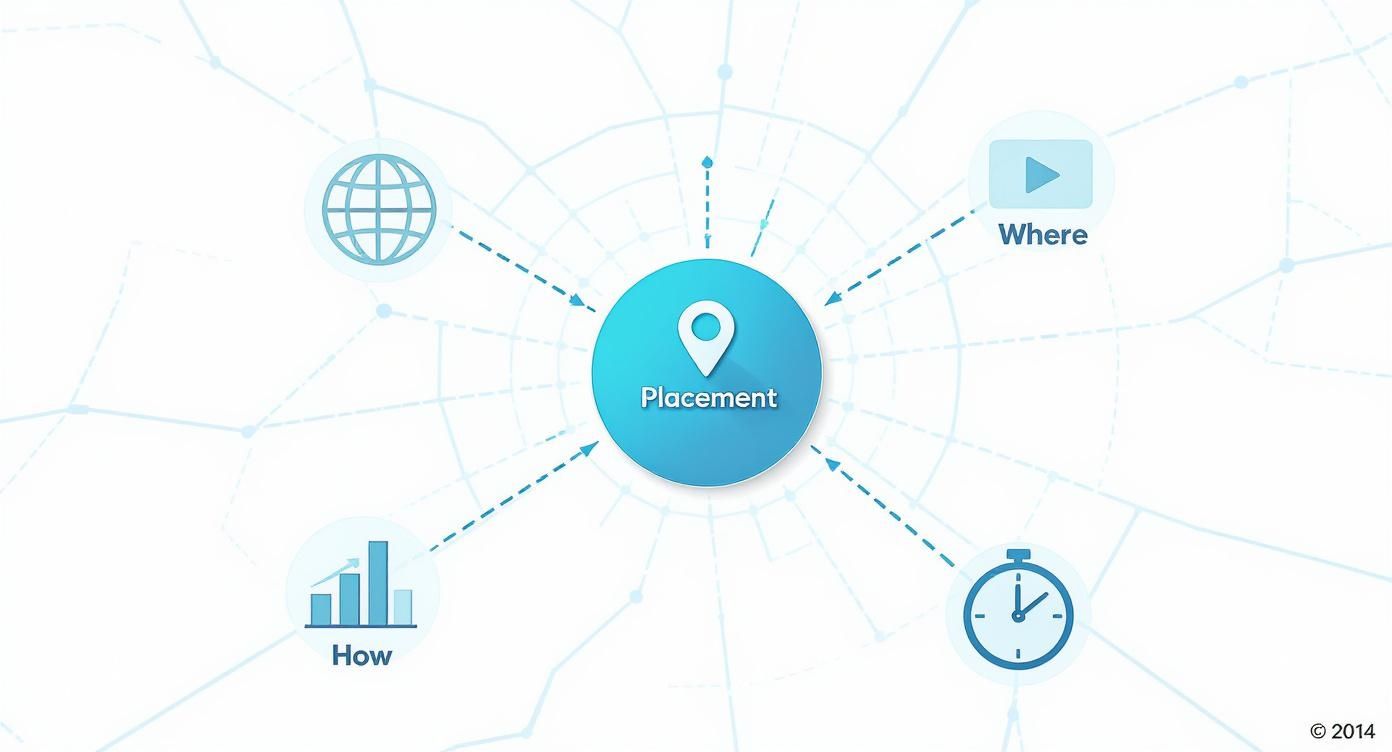
As you can see, a great placement isn't an accident. It's a deliberate choice based on location, format, and timing, all working in harmony to connect with the right audience.
A Tour of Digital Advertising Channels and Placements
To make this tangible, let's look at the major digital channels and the specific placement opportunities they offer. Each one caters to a different user mindset and is suited for different campaign goals.
This table gives you a quick snapshot, but let's dive into the nuances of each channel to really understand the opportunities.
Social Media Placements
Social media platforms are basically bustling digital towns where people go to connect, be entertained, and discover new things. The mindset here is often relaxed and exploratory, which makes it a fantastic spot for visually compelling, story-driven ads that don't feel like a hard sell.
You’ll commonly find placements like:
- In-Feed Ads: These are the ads you see while scrolling through your main feed on Instagram, Facebook, or LinkedIn. They’re designed to blend in with organic posts and are perfect for driving comments, likes, and shares.
- Stories and Reels Ads: These are full-screen, vertical ads that pop up between user content. They grab a ton of attention but need to be fast-paced and hook the viewer instantly.
- Marketplace & Shopping Ads: Found right inside the shopping tabs of platforms, these ads target users who are already in a buying mood and actively looking at products.
For any video ads, getting the specs right for each placement is non-negotiable. Check out our guide on the ideal Facebook video ad size to make sure your creative looks sharp and performs its best.
Search Engine Placements
When someone opens up a search engine like Google, their intent couldn't be clearer. They are actively looking for an answer, a product, or a solution right now. This makes search placements incredibly powerful for capturing demand at the precise moment of need.
The two mainstays here are:
- Top-of-Page Text Ads: These are the premium text ads sitting right above the organic search results. They offer maximum visibility for the keywords you’re targeting.
- Shopping Ads: Perfect for e-commerce, these are the product-focused ads with an image, price, and title that usually show up in a carousel at the top of the page.
Display Network Placements
If search is a scalpel, display networks are a net. They place your visual ads across a massive inventory of websites, apps, and blogs, which is fantastic for building brand awareness and retargeting people who’ve already visited your site. Here, the user is just browsing content, not actively shopping, so your ad needs to be a real head-turner.
Think of display ads as digital billboards. They aren't where customers go to make a purchase, but they keep your brand top-of-mind as users navigate their daily online journey.
The rise of mobile has made in-app advertising a huge piece of the display puzzle. In fact, mobile advertising now accounts for over 64% of all digital ad spending, and a whopping 81.9% of that goes to in-app placements, not mobile websites. That just shows you where people are spending their time—inside their favorite apps.
Video Platform Placements
On platforms like YouTube and TikTok, video isn't just an option; it's the main event. People are there to be entertained or educated, which opens the door for immersive storytelling that a static image just can't match.
Popular video placements include:
- Skippable In-Stream Ads: These are the ads that play before, during, or after a video, giving viewers the option to skip after five seconds. Your first few seconds have to be gold.
- Non-Skippable In-Stream Ads: These are shorter ads, usually 15-20 seconds, that have to be watched all the way through. They guarantee your message gets delivered.
- In-Feed Video Ads: These are native-style video ads that appear in a user's feed as they scroll, often auto-playing on mute to pique their interest.
How Your Ad Placements Make or Break Your Campaign
Think of ad placements less like choosing a billboard on a highway and more like picking the right spot to fish. You wouldn't use the same bait and tackle for a tiny stream as you would for the deep sea, right? The environment dictates your entire strategy. In digital advertising, the placement is your environment.
It’s the single biggest decision that connects your ad creative to your campaign goals, whether you’re chasing broad brand awareness, hunting for qualified leads, or pushing for immediate sales. Getting it wrong is like trying to sell ice cream in a blizzard—you’re showing up, but the audience just isn’t in the mood.
It All Comes Down to User Intent
The most powerful variable that a placement controls is user intent. A person's mindset shifts dramatically based on where they are online, and that shift changes everything for your campaign's performance and budget.
Let's break down two classic scenarios:
High-Intent Placements (The "Hunt"): Picture someone typing "best running shoes for flat feet" into Google. They have a problem and are actively hunting for a solution, right now. A well-placed Search or Shopping ad puts your product directly in their path at the peak of their need. They’re leaning in, ready to solve their problem.
Discovery Placements (The "Stroll"): Now, think of someone casually scrolling their TikTok feed. They're in a completely different headspace—relaxed, open to entertainment, and hoping to stumble upon something new. An ad here needs to be a welcome interruption, not a jarring sales pitch. They’re leaning back, passively consuming.
That subtle difference in posture, both literally and figuratively, is the key to understanding placements.
How Intent Shapes Your Costs and Conversions
This fundamental split in user intent has a direct and massive impact on your key metrics, especially your budget. Different placements operate on different economic models precisely because the value of a user's attention is so varied.
For instance, a click from a high-intent Google Search ad is almost always going to cost more than a click from a Facebook News Feed ad. That higher Cost Per Click (CPC) is a premium you pay for a pre-qualified user who is much, much closer to making a purchase. You're buying their intent.
On the flip side, a social media placement might offer a rock-bottom Cost Per Mille (CPM), the price for a thousand impressions. It's a fantastic way to reach a huge audience for less money, making it perfect for building brand awareness. But don't expect sky-high conversion rates; that’s not what this placement is built for.
The goal isn't just to find the cheapest placement. A winning strategy is about matching the placement's cost and inherent user intent to your specific campaign goal. That’s how you get the best possible Return On Ad Spend (ROAS).
Real-World Placement Scenarios
Let's see how this works in practice. Imagine you're running a small e-commerce brand that sells custom-made dog collars.
Goal: Lead Generation. You need to find people ready to buy. A Google Search campaign targeting keywords like "personalized leather dog collar" is your best bet. The CPC might be a bit steep, but every click is from someone actively searching for exactly what you sell, making for a fantastic conversion rate.
Goal: Brand Awareness. You want to get your name out there. Placing gorgeous, eye-catching video ads in Instagram Stories and Reels is the way to go. You can target users who follow big-name pet accounts and reach thousands of potential customers for a relatively low cost, planting a seed that can grow into a sale later on.
Goal: Retargeting. What about people who visited your site but left without buying? The Display Network is perfect for this. You can show them banner ads on their favorite pet-care blogs and news sites. It’s a gentle nudge that keeps your brand top-of-mind and coaxes them back to finish their purchase.
Each placement has a specific job to do. Trying to force a direct sale from an awareness-focused placement will burn through your budget with little to show for it. And using a pricey, high-intent search ad for general brand visibility is just plain inefficient. The right placements in advertising make sure your message finds the right person at the right time, turning your ad spend into real results.
A Strategic Framework for Choosing Ad Placements

Knowing what ad placements are is one thing; mastering how to choose the right ones is where the real magic happens. Successful campaigns aren't built on luck. They're built on a repeatable process that turns placement selection from a guessing game into a genuine strategic advantage.
This framework boils down to three core pillars: your Audience, your Objective, and your Budget. By walking through these pillars one by one, you’ll build a data-backed roadmap that puts your ads exactly where they need to be.
Pillar 1: Know Your Audience Inside and Out
Before you even think about spending a dollar, you need a razor-sharp picture of who you're trying to talk to. This means going way beyond basic demographics like age and location. The real gold is in understanding their digital habits—the daily rhythm of their online life.
Think of yourself as a digital detective. Your mission is to map out where your ideal customer hangs out online and, just as importantly, figure out where they'll actually be receptive to your message.
Start by asking the right questions:
- Where do they learn? Are they devouring industry blogs, watching how-to videos on YouTube, or lurking in professional forums?
- Where do they find entertainment? Is their downtime spent scrolling TikTok, saving ideas on Pinterest, or tuning into podcasts during their commute?
- Where do they look for solutions? Do they jump on a Google Search for quick answers or ask for recommendations in dedicated Facebook groups?
The answers create a "day-in-the-life" map of your customer's digital journey. This map doesn't just show you where to place your ad; it shows you where it will feel like a helpful discovery instead of an annoying interruption.
Pillar 2: Match Placements to Your Campaign Objective
Your campaign objective is your true north. Every decision you make, especially about placements, has to point directly toward that goal. The marketing funnel is a tried-and-true model for connecting your goals to the right digital environments.
A placement that’s brilliant for building brand awareness can be a complete waste of money for driving sales, and vice-versa. Aligning the placement with the funnel stage is absolutely critical for an efficient campaign.
Let's see how this plays out in the real world:
Top of the Funnel (Awareness)
- Your Goal: Get your brand in front of a wide audience that has no idea you exist.
- Your Best Bets: Think high-visibility, mass-reach spots. Things like YouTube pre-roll ads, Instagram Reels, and Display Network banners on websites your audience frequents are perfect for this.
Middle of the Funnel (Consideration)
- Your Goal: You’ve got their attention. Now it's time to nurture that interest and show them why you're the solution.
- Your Best Bets: Formats that allow for more detail are key. Think Facebook video ads that showcase product features, helpful articles promoted with native advertising, or targeted ads within niche online communities.
Bottom of the Funnel (Conversion)
- Your Goal: It's time to close the deal and drive action from people who are ready to buy.
- Your Best Bets: Get hyper-focused. Placements like Google Search ads targeting specific, high-intent keywords, Google Shopping listings, and dynamic retargeting ads that follow users across different sites are designed to capture existing demand.
This handy table breaks down how to align your goals with the right placements and the metrics that matter most at each stage.
Placement Selection Framework Aligned with Funnel Stage
This framework provides a clear, strategic path, ensuring your placement choices directly support your campaign objectives from start to finish.
Pillar 3: Let Your Budget Steer the Ship
Last but not least, your budget is the reality check that dictates the scale and scope of your strategy. Placements come with wildly different price tags. A top-of-page search ad for a hot keyword can be incredibly expensive, while getting a thousand impressions on the Display Network might cost you just a few dollars.
A smart approach is to set aside a portion of your budget—around 10-20% is a good starting point—just for testing. Use this money to experiment with a few different placements, run small tests, and see what the data tells you.
Once you’ve identified which placements deliver the best Return On Ad Spend (ROAS) for your specific goals, you can double down and scale your investment with confidence. This three-pillar approach of Audience, Objective, and Budget gives you a structured way to make smart placement decisions every single time.
How AI and Automation Are Shaping Ad Placements
The days of manually picking and choosing every single spot for your ads are pretty much over. Artificial intelligence and automation have completely changed the game, altering how we buy, sell, and fine-tune ad space. The result? A level of speed and accuracy that no human could ever manage on their own.
At the center of this change is programmatic advertising. Picture it as a super-fast, automated stock market, but for digital ad space. Instead of calling up individual website owners, sophisticated algorithms bid on ad placements for you in real time, all based on your campaign goals and target audience.
This whole auction happens in the blink of an eye—literally, in the milliseconds it takes a webpage to load. This system is called real-time bidding (RTB), and it's an incredibly effective way to get the best ad placements at the right price.
The Power of Predictive Placement
But AI isn't just about automating the buying process; it’s about making it smarter. These systems chew through massive amounts of data—things like user behavior, browsing history, and what’s on the page—to predict which ad placements will actually make you money. They spot patterns and opportunities that a person could easily miss.
This predictive muscle helps answer crucial questions almost instantly:
- Who is the most valuable person to show this ad to right now?
- What’s the perfect price to bid for this specific ad spot?
- Which ad design will connect best with someone on this particular site or app?
By constantly crunching these numbers, AI ensures your ad budget goes toward the placements that have the highest statistical chance of leading to a conversion. For a deeper dive into how artificial intelligence is changing the entire marketing field, this AI marketing guide is a great resource. This non-stop optimization is what gives modern ad campaigns their edge.
The Evolving Role of the Marketer
With machines handling the nitty-gritty execution, the role of a human marketer has shifted from being a hands-on operator to a strategic guide. Instead of getting lost in the weeds of placement selection, today's pros focus on giving the AI the best possible instructions. This means setting clear goals, feeding it high-quality audience data, and putting the right brand safety guardrails in place.
In an automated world, the marketer's job is not to pull every lever but to build the smartest machine. Your strategic inputs—audience definition, campaign goals, and creative direction—are what guide the AI to success.
In this automated environment, brand safety and knowing where your ads are showing up are more important than ever. Marketers have to make sure their ads don't land next to questionable content, and AI actually helps with this, too, using advanced filters and contextual analysis. You can learn more about the specifics of this technology in our article on adaptive machine learning for real-time bidding.
This trend isn't slowing down. In fact, it's speeding up. By 2027, it's projected that algorithm-driven placements will make up around 79% of all advertising spend. This is happening within a global ad market expected to hit $1.17 trillion, where data-driven platforms will soak up the lion's share of that investment. You can find more insights on the future of global ad spend from Dentsu.
Optimizing and Measuring Your Placement Performance

Getting your campaign live isn’t the finish line—it’s the starting gun. This is where the real work of mastering placements in advertising actually begins. If you just "set it and forget it," you're essentially burning money.
The best way to think about it is like a scientist in a lab. You're constantly running experiments, observing what happens, and tweaking your formula based on cold, hard data. This ongoing loop of testing and refining is what turns a decent campaign into a truly great one, making sure every dollar you invest is pulling its weight.
Tracking the Right Performance Metrics
To figure out if your placements are hitting the mark, you've got to speak the language of data. You could drown in a sea of metrics, but a handful of key performance indicators (KPIs) will tell you 90% of what you need to know.
Keep a close eye on these vitals:
- Click-Through Rate (CTR): This shows how many people who see your ad in a specific spot actually bother to click it. A low CTR can be a red flag that your creative just isn't connecting with the audience in that particular environment.
- Conversion Rate: This is the ultimate test. It measures how many of those clicks turn into a real action, like a sale or a sign-up. If you have a high CTR but a rock-bottom conversion rate, your ad might be making promises your landing page can't keep.
- Return On Ad Spend (ROAS): This is the metric your boss cares about. ROAS tells you exactly how much revenue you’re generating for every single dollar you spend. It’s the final word on whether a placement is actually profitable.
Embracing A/B Testing for Smarter Decisions
So, how do you find those goldmine placements? You make them fight for it. A/B testing (or split testing) is simply pitting two or more placements against each other to see which one comes out on top.
For instance, you could run the exact same ad creative in an Instagram Story and an in-feed post. By keeping everything else—the creative, the budget, the audience—the same, you can clearly see which location delivers a better ROAS.
Never assume you know what will work best. Data has a funny way of surprising you. Consistent A/B testing is how you turn guesswork into genuine knowledge and build a placement strategy that prints money.
Once your tests reveal a clear winner, the next move is both simple and crucial: reallocate your budget. Be disciplined about shifting ad spend away from the laggards and putting more fuel behind the placements that are proven to work. This active management process is what separates the pros from the amateurs.
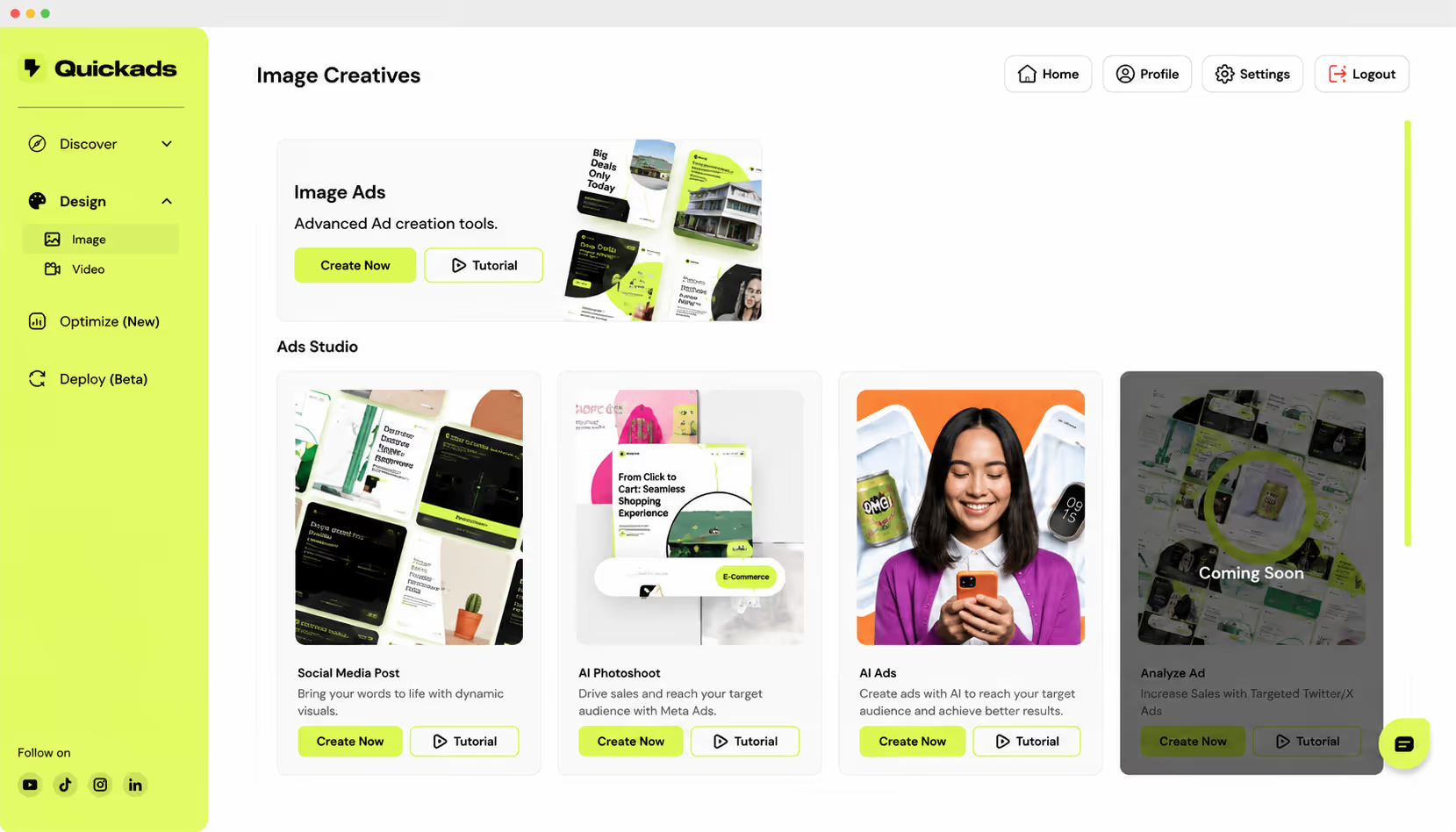
Finally, remember that optimization is about more than just location; it’s about context. That perfect square image for your Facebook feed is going to look clunky and out of place in a vertical Instagram Story. Tools like Quickads.ai make it a breeze to adapt your creatives for each specific placement, ensuring your ad always looks like it belongs there.
Your Ad Placement Questions, Answered
Let's be honest, diving into the nitty-gritty of ad placements can feel a bit overwhelming. You've got questions, and I've got a few years of experience to draw from. Here are some straightforward answers to the common sticking points I see advertisers run into all the time.
Automatic vs. Manual Placements: Who’s in the Driver’s Seat?
This is one of the first big decisions you’ll make. Think of automatic placements as handing the keys to a self-driving car. You tell the ad platform’s AI where you want to go (your campaign goal), and it uses a massive amount of data to find the best possible routes, testing your ads across its entire network to get you there efficiently. It's a fantastic way to save time and often uncovers high-performing spots you would have never thought to try.
On the other hand, manual placements are like driving a classic stick-shift. You are in total control. You get to hand-pick every single website, app, or specific spot your ad shows up. This is the way to go when you have deep, specific knowledge about where your audience hangs out—maybe you know for a fact they all read a handful of niche blogs. It gives you incredible precision but demands a lot more of your time for research and management.
How Do I Know When a Placement Is Wasting My Money?
Spotting a placement that's just burning through your budget is a critical skill. You can't just look at one metric; you have to look at the whole story the data is telling you. A placement is probably a dud if you see a nasty combination of these red flags:
- Low Click-Through Rate (CTR): A lot of people are seeing your ad, but nobody’s clicking. This is a huge sign that the audience in that spot just isn't interested in what you’re offering.
- High Cost Per Click (CPC) and No Conversions: You're paying top dollar for every click, but those clicks aren't turning into actual customers. The traffic is expensive, and it's the wrong kind of traffic.
- Sky-High Bounce Rate: People click the ad, land on your page, and leave almost instantly. That tells you there’s a massive disconnect between what your ad promised and what your landing page delivered.
A placement that racks up thousands of impressions but zero conversions isn't just "building awareness"—it's a hole in your pocket. Get into your analytics regularly, cut these underperformers loose, and move that money over to the placements that are actually working.
How Much Should I Budget for Testing New Placements?
Testing isn't just a cost; it’s an investment in finding your next big win. As a solid rule of thumb, I always recommend setting aside 10% to 20% of your total campaign budget just for experimenting with new ad placements.
This little "test fund" lets you explore promising new channels or formats without putting your core campaign budget at risk. Run small, controlled experiments. Once a new placement proves it can deliver a solid Return On Ad Spend (ROAS), you can start feeding it more budget with confidence.
Can a Great Placement Rescue a Bad Ad?
In a word: no. A perfect placement can’t save a terrible creative. It’s a harsh truth, but an essential one.
Think about it like this: you can buy the most expensive billboard in the middle of Times Square, but if the ad on it is ugly, confusing, or just plain boring, it’s not going to sell a thing. The placement gets your ad in front of the right people, but the creative has to do the heavy lifting of actually connecting with them. Success happens when great creative meets a great placement.
Ready to create stunning, placement-ready ads in minutes? Quickads.ai uses AI to generate high-performing image and video creatives perfectly tailored for any channel. Stop guessing and start creating ads that convert.








Privacy is important to us, so you have the option of disabling certain types of storage that may not be necessary for the basic functioning of the website. Blocking categories may impact your experience on the website. View Our Privacy Policy


