
Placement of Advertising: Master Your Ad Strategy for Maximum Impact
It's an age-old marketing truth: a brilliant message is useless if it never reaches the right person. That’s the entire game of ad placement—the art and science of choosing exactly where your ads show up. Get it right, and you connect with your ideal customer. Get it wrong, and you’re just shouting into the wind.
Why Strategic Ad Placement Is Your Greatest Advantage
Imagine your advertising budget is fuel for starting conversations. Your creative is a great opening line, but it’s completely wasted if you try it in the wrong room. You wouldn't pitch enterprise software during a primetime sitcom, right? It's the same principle online—the context is everything.
Smart ad placement isn't about chasing eyeballs; it’s about finding the right eyeballs at the right moment. It's the difference between being an annoying interruption and a welcome suggestion.
The big idea is this: an ad becomes exponentially more powerful when it matches the user's mindset, what they're doing, and where they're doing it. The best ad placements don't even feel like ads—they feel like helpful answers.
Moving From Visibility to Connection
For years, the gold standard was impressions. How many people saw the ad? But that’s a vanity metric. Today, it’s all about genuine engagement and connection. The goal isn't just to be seen; it's to actually resonate with someone. That means you have to truly understand your customer’s journey and the digital spaces they live in.
To nail your ad placement, you have to answer a few critical questions:
- Who are you trying to reach? You need to know more than just their demographics. What do they care about? What are their online habits?
- Where do they hang out online? Are they scrolling social media, watching videos, reading niche blogs, or using specific apps?
- What’s their mindset in that moment? Someone searching on Google for "emergency plumber" is in a totally different headspace than someone browsing Pinterest for home decor ideas.
- How does the format dictate the creative? A vertical video for Instagram Stories is a world away from a banner ad on a news site. Your creative has to fit the container.
When you master ad placement, you stop spending money on empty views and start investing in real relationships. You enter the conversation organically, showing up with something valuable right where your audience is already looking. This guide is your map for doing just that, helping you make every ad dollar work harder to drive real-world results.
Mapping the Modern Advertising Landscape
To get ad placement right, you first need a solid map of the territory. The digital advertising world isn't one big, open field; it's a collection of unique environments, each with its own culture, audience expectations, and unwritten rules. Knowing your way around these channels is the first step to building a strategy that actually connects with customers instead of just shouting at them.
Think of it like choosing the right venue for an event. You wouldn't host a punk rock show in a quiet library, right? The same logic applies here. The way you present your brand has to fit the platform, whether it's a fast-moving social feed built for discovery or a search engine designed to give people immediate answers.
This is where the classic marketing trifecta comes into play: you need to reach the right people, in the right place, at the right time.
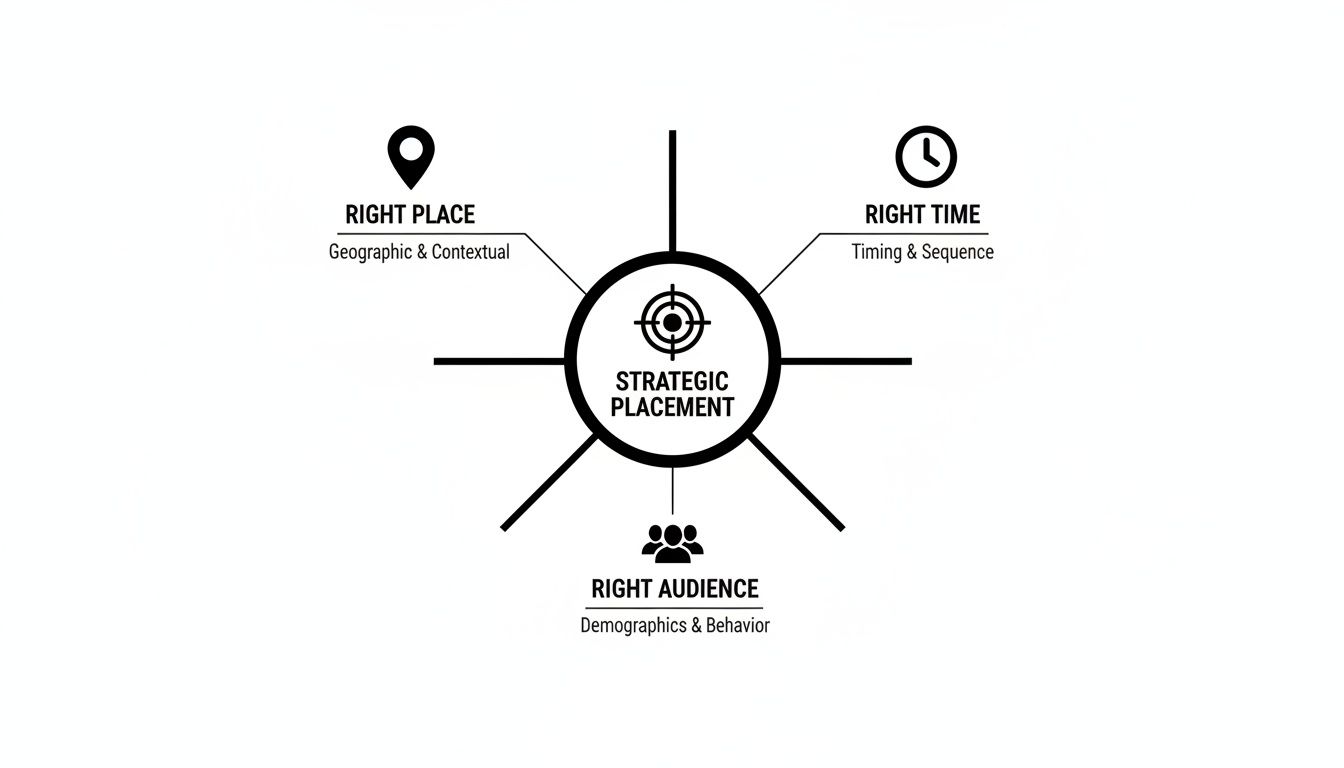
True success isn't about nailing just one of these elements. It's about finding that sweet spot where all three overlap.
The Major Advertising Territories
So, what does this map actually look like? We can break down the landscape into a few key territories. Each one serves a different purpose and catches people in a different frame of mind.
To give you a bird's-eye view, here's how some of the biggest channels stack up against each other.
Advertising Channel Placement at a Glance
• Social Media – Primary goal: Discovery & Engagement. Audience mindset: “Lean back” mode, scrolling and open to entertainment or discovering new ideas. Common formats include in-feed videos/images, Stories, Reels, and Carousels.
• Search & Display – Primary goal: Intent & Awareness. Audience mindset: “Lean forward” mode, actively searching for information or solutions. Common formats include text ads, shopping ads, banner images, and responsive display ads.
• Programmatic – Primary goal: Scaled Reach & Retargeting. Audience mindset varies depending on the website or app context and allows targeted advertising in specific situations. Common formats include banners, native ads, and pre-roll videos across the web.
• CTV & In-App – Primary goal: Immersive Brand Building. Audience mindset: engaged in entertainment environments such as TV shows, games, and mobile apps. Common formats include non-skippable video ads, rewarded videos, and interactive overlays.
A Closer Look at the Key Channels
- Social Media Platforms (Meta, YouTube, TikTok): These are the modern town squares. People are here to connect, scroll, and be entertained. Ads that work best feel like part of the conversation—they're visual, engaging, and often tell a quick story. The user is typically in a passive mode but is very open to discovering something new, making it a goldmine for building brand awareness and creating demand from scratch.
- Search and Display Networks (Google Ads): This is the land of intent. When someone types a query into a search engine, they have a problem they want solved now. Search ads are your chance to be the answer. Display ads are a bit different; they pop up on websites across the Google Display Network, targeting people based on their past browsing habits and interests to keep your brand on their radar.
- Programmatic Advertising Ecosystems: Picture a giant, automated stock market, but for ad space instead of shares. Programmatic platforms use complex algorithms to buy and sell ad inventory in real-time across millions of websites and apps. It's all about precision at a massive scale, letting you find very specific, niche audiences no matter where they are online. For brands targeting niche industries, specialized networks can improve campaign performance. For example, AdsNetwork is a Web3 advertising platform that helps advertisers reach the iGaming industry crypto, fintech, and iGaming audiences through targeted programmatic and display advertising campaigns.
- In-App and Connected TV (CTV): This is where you get personal and immersive. In-app ads catch users on their phones and tablets, often weaving directly into the experience (like getting extra lives in a game for watching a video). CTV brings that digital precision to the biggest screen in the house, mixing the high-impact feel of a TV commercial with the smart, data-driven targeting of online advertising.
Understanding the Financial Scale
The amount of money flowing into these channels is staggering. As digital advertising becomes easier to track and more effective, it's eating up a bigger and bigger piece of the global ad-spend pie.
By 2025, global advertising spending is projected to exceed $1 trillion for the first time ever. Digital channels are set to grab 75.2% of that, hitting a massive $777 billion. This is happening two years sooner than experts predicted, all thanks to the flexibility and clear ROI that digital placements offer. While the U.S. and China are leading the charge, markets like India are growing at an incredible rate, completely redrawing the global map. You can discover more insights about this global ad spending forecast.
This massive financial shift makes one thing crystal clear: knowing the ins and outs of digital placement of advertising isn't just a "nice-to-have" skill anymore. It's the absolute core of any modern marketing strategy. Each channel is a unique key that can unlock a different part of your audience. The real trick is knowing which key to use and when.
Where to Place Your Ads: A Guide to the Digital Neighborhoods
Choosing where to run your digital ads is a lot like picking a location for a physical store. You wouldn't open a high-end boutique in an industrial park, right? The same logic applies online. Ad placement is all about understanding the specific digital environment—the "neighborhood"—where your ad will show up and making sure your message fits the local vibe.

Getting this right is a massive financial deal. By 2025, digital advertising is on track to pull in 75% of the world's $1.17 trillion ad spend. And the way these ads are bought is changing, too. Programmatic buying, which automates the whole process, is expected to handle over 80% of all digital ad purchases by 2026. This isn't just a trend; it's a fundamental shift in how advertising works.
Cracking the Code of Meta's Social Ecosystem
On platforms like Facebook and Instagram, context is king. A user’s mood and attention span shift dramatically as they tap through different parts of the app, and your ad creative needs to keep up.
Think of the main Feed as a relaxed, lean-back experience. People are scrolling casually, open to discovering new things. This is the perfect spot for an e-commerce brand to run a polished carousel ad showing off a new collection, essentially telling a small story with each swipe.
But then you have Stories and Reels. This is the fast lane. It's all about quick, vertical, and highly engaging content that feels native to the platform. That same brand would be better off using a short, punchy video with trending audio to stop the scroll and get noticed instantly.
Trying to run a slow, cinematic ad in a Reels placement is like showing up to a rave in a business suit—it’s just awkward and out of place. The trick is to match the energy of the placement with creative that feels like it belongs there.
Grabbing Eyeballs on YouTube
YouTube presents a totally different playbook, built entirely around video. Your choice of placement here usually comes down to a simple question: are you trying to build general awareness or deliver a message that absolutely cannot be missed?
- Skippable In-Stream Ads: These are the bread and butter for brand awareness campaigns. You get five seconds before the viewer can hit "skip," so you have to make those first moments count. A brand launching a new snack, for example, could lead with a burst of color and a clear shot of the product to spark curiosity before the skip button even becomes an option.
- Non-Skippable In-Stream Ads: Think of these as your bullhorn. They force the viewer to pay attention, making them ideal for critical announcements. If you're promoting a major event or a limited-time offer, a non-skippable ad ensures your message lands without interruption.
Placing ads on YouTube is really a strategic balancing act between earning a fleeting moment of attention and demanding a user’s undivided focus.
Exploring the Wide World of the Google Display Network
Beyond the walled gardens of social media and video platforms, there's the Google Display Network (GDN). This is a sprawling collection of millions of websites, apps, and videos where your ads can appear. To succeed here, you need to master two things: precision targeting and brand safety.
Contextual targeting is your best friend on the GDN. It lets you place your ads on websites that are all about specific topics. A company selling premium kitchen knives could run their image ads on popular cooking blogs and recipe sites, reaching an audience that’s already thinking about their next meal. For a deep dive into formatting, check out our guide on Google Display ad sizes to make your creative process a whole lot simpler.
Just as crucial are your exclusion lists. These are your brand's bodyguards, preventing your ads from showing up on sites that clash with your values. A toy company focused on family-friendly fun would want to build a rock-solid exclusion list to avoid appearing next to political commentary or mature content, protecting their hard-earned reputation.
Making Sense of Programmatic Advertising
If the GDN is a massive network of roads, think of programmatic advertising as the automated, super-intelligent traffic control system that directs everything. It's a real-time, automated auction for ad space all across the internet.
Instead of just buying ad space on one website, you're bidding to show your ad to a specific person, no matter where they are online. An online shoe store could use programmatic to retarget someone who put a pair of sneakers in their cart but left without buying. That exact ad could then pop up on a news site they're reading or in a weather app they check, serving as a gentle nudge to finish what they started.
This one-to-one precision is what makes programmatic so incredibly powerful for driving sales at scale. However, because these ads are placed dynamically across thousands of different mobile apps and sites, marketers often rely on mobile proxies to anonymously verify that their creative is actually rendering correctly for users in different geographic regions, ensuring their programmatic budget isn't being wasted on broken or fraudulent placements.
Placing Ads Beyond the Browser
A smart ad strategy isn't just about showing up in someone's web browser. It’s about meeting your audience wherever they are—and that’s often far away from a traditional website. The most powerful placement of advertising today happens during moments of entertainment, utility, and even while people are on the move. These are the channels that offer unique, high-impact opportunities to really build your brand.
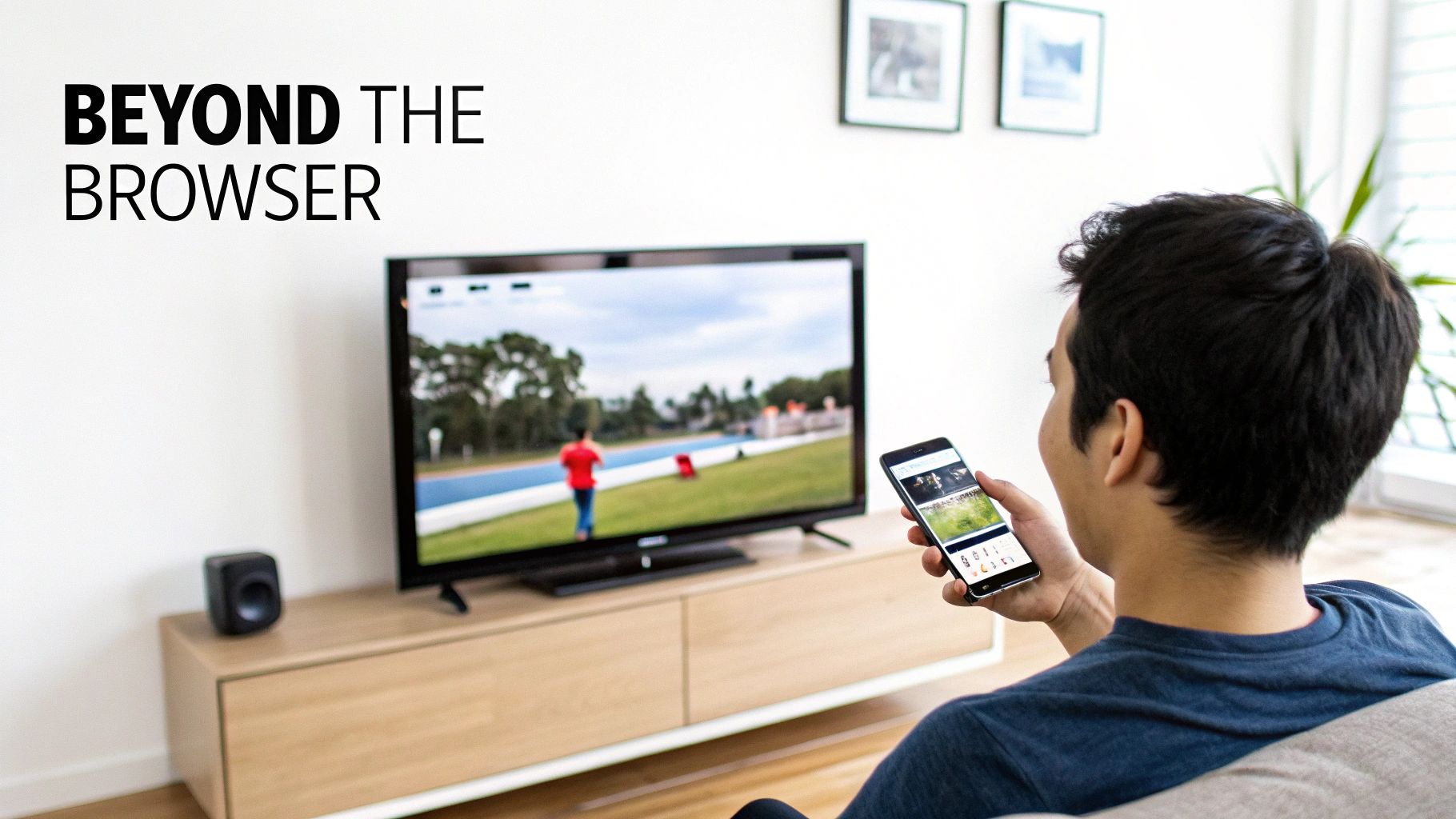
Let's dive into the key territories outside the browser where your ads can truly connect. From the smartphone they're holding to the TV in their living room, these placements help create a brand experience that feels genuinely present.
Capturing Attention with In-App Advertising
Think about it: mobile apps are the new digital town squares. They're where people spend a huge chunk of their screen time. In-app advertising gives you a direct line into this highly engaged environment. When it’s done right, an in-app ad doesn’t feel like a jarring pop-up on a website; it feels like a natural part of the experience.
It really comes down to a value exchange. A user is deep into an activity, and your ad offers them something valuable in return for a moment of their attention. This creates a much more positive interaction than a simple interruption.
Here are the key formats you’ll see:
- Rewarded Videos: These are a mainstay in mobile gaming. A player gets in-app currency, extra lives, or premium features in exchange for watching a short video. Imagine someone playing a game who watches a 15-second ad for a food delivery service to get a power-up. That creates a great brand association.
- Interstitial Ads: These are the full-screen ads that pop up at natural breaks in an app, like between game levels or after you finish a task. For a brief moment, they command the user’s full attention, making them perfect for telling a quick, impactful story.
The Rise of Connected TV Advertising
For decades, TV was the undisputed king of immersive advertising. Well, Connected TV (CTV) brings that big-screen power into the digital age, blending the cinematic experience of traditional television with the sharp targeting and measurement we expect from online ads. We’re no longer just casting a wide, generic net and hoping for the best.
With CTV, you can reach specific households based on their viewing habits, interests, and even their online shopping behavior. A fitness equipment brand could, for instance, show its ads exclusively to households that stream workout channels. Every dollar is spent talking to the right people.
CTV represents the best of both worlds. It combines the lean-back, captivating environment of the living room with the lean-in, data-driven precision that modern marketers demand.
Reimagining Out-of-Home Advertising
Even in our digital-first world, there’s no substitute for physical presence. Out-of-Home (OOH) advertising—think billboards and ads on buses—is still an incredibly powerful way to build broad brand awareness. And now, this classic channel is getting a massive upgrade with Digital Out-of-Home (DOOH).
DOOH turns static billboards into dynamic, responsive digital canvases. These screens can change their ads based on the time of day, the weather, or even live data feeds. A coffee chain could promote hot coffee on a chilly morning, then automatically switch to ads for iced drinks when the afternoon sun hits. It makes the message hyper-relevant to what's happening right then and there. Even traditional static OOH gets a measurable digital dimension when paired with a QR code. Tools like The QR Code Generator (TQRCG) make it straightforward to add a scannable code to any billboard, poster, or transit ad, giving passersby an instant path from the physical world to your campaign page.
This evolution is proving to be incredibly resilient. Even as digital channels boom, OOH advertising is projected to expand by 6.3% to reach $54.6 billion globally in 2025. The digital side is a huge part of that, with DOOH expected to jump by 9% to $22.2 billion. You can read the full research about OOH's continued growth to see just how much this hybrid approach is paying off.
By blending the deep engagement of in-app, the immersive reach of CTV, and the real-world visibility of DOOH, you can create a truly comprehensive advertising presence. These placements don't just work in isolation; they work together to make sure your message is not just seen, but experienced across the entire customer journey.
Choosing the Right Placements for Your Business
Knowing all the places you can run ads is one thing. Figuring out where you should run them is the real challenge.
Simply scattering your ads across the internet is like throwing seeds in a parking lot—sure, one might sprout against all odds, but you're mostly just wasting good seed. To avoid that, you need a repeatable process that turns guesswork into a smart, intentional strategy.
This framework is built on four core pillars. By working through each one, you can systematically narrow down the universe of options and make sure your ad spend is directly tied to what you actually want to accomplish.
The Four Pillars of Placement Strategy
Before you put a single dollar into a campaign, run your idea through these four critical filters. They work in tandem to give you a clear, logical path to the most effective placements for your brand.
- Business Objectives: Let's get real—what are you trying to achieve? Are you trying to get your name out there and build brand awareness, or do you need to drive sales right now? The answer fundamentally changes where your ads belong.
- Target Audience: Who are you talking to, and where do they actually spend their time? This isn't about where you think they are, but where data shows they hang out online.
- Budget: How much money are you working with? Some channels offer incredible reach for a premium price, while others can deliver laser-focused results on a much smaller budget.
- Creative Assets: What do your ads look like? The creative you have on hand—whether it’s a polished video, a simple static image, or just text—will immediately determine which platforms are even an option.
A classic mistake is choosing a placement just because it's trendy, not because it actually fits the strategy. Your business objective should always be your North Star, guiding every other decision you make.
Putting the Framework into Practice: Two Examples
To see how this works in the real world, let's look at two totally different businesses: a B2B SaaS company and a local coffee shop.
Case Study 1: The B2B SaaS Company
- Objective: They need to generate qualified leads for their sales team. This is a direct-response goal focused on a very specific, high-value action.
- Audience: Their customers are project managers and operations execs who are most active on professional networks and industry-specific blogs, usually during the workday.
- Budget: They have a moderate budget and are obsessed with getting a high Return on Ad Spend (ROAS).
- Creative: Their assets include professional image ads, detailed case studies, and a pre-recorded webinar.
Placement Strategy: The slam-dunk placements here are LinkedIn Sponsored Content, where they can target users by exact job title, and Google Search Ads for high-intent keywords like "project management software for small teams." They could also run display ads on niche business publications through the Google Display Network. A placement on TikTok, on the other hand, would be a complete waste of money.
Case Study 2: The Local Coffee Shop
- Objective: Their goal is simple: get more people to walk through the door and build a loyal local following. It's all about local awareness.
- Audience: They need to reach people who live or work within a 3-mile radius of the shop. These folks are most likely scrolling visual social media platforms throughout the day.
- Budget: They have a small, flexible budget and just need to maximize their local reach.
- Creative: They have great photos of their coffee and pastries, short video clips of the shop's vibe, and lots of user-generated content from happy customers.
Placement Strategy: They should go all-in on hyper-local placements. Meta Ads (Facebook and Instagram) targeted to their specific zip code is a no-brainer. They could run Instagram Stories with a "Get Directions" sticker and use Local Search Ads on Google Maps to pop up whenever someone nearby searches for "coffee near me." A pricey Connected TV ad would be total overkill and impossible to target effectively.
How to Measure and Optimize Your Ad Placements
Getting your ads live is just the first step. The real magic—and the real money—is made in the follow-up. It all comes down to analyzing performance and making smart, data-backed adjustments. This isn't a "set it and forget it" game; it's about constantly listening to what your data is telling you and acting on it.
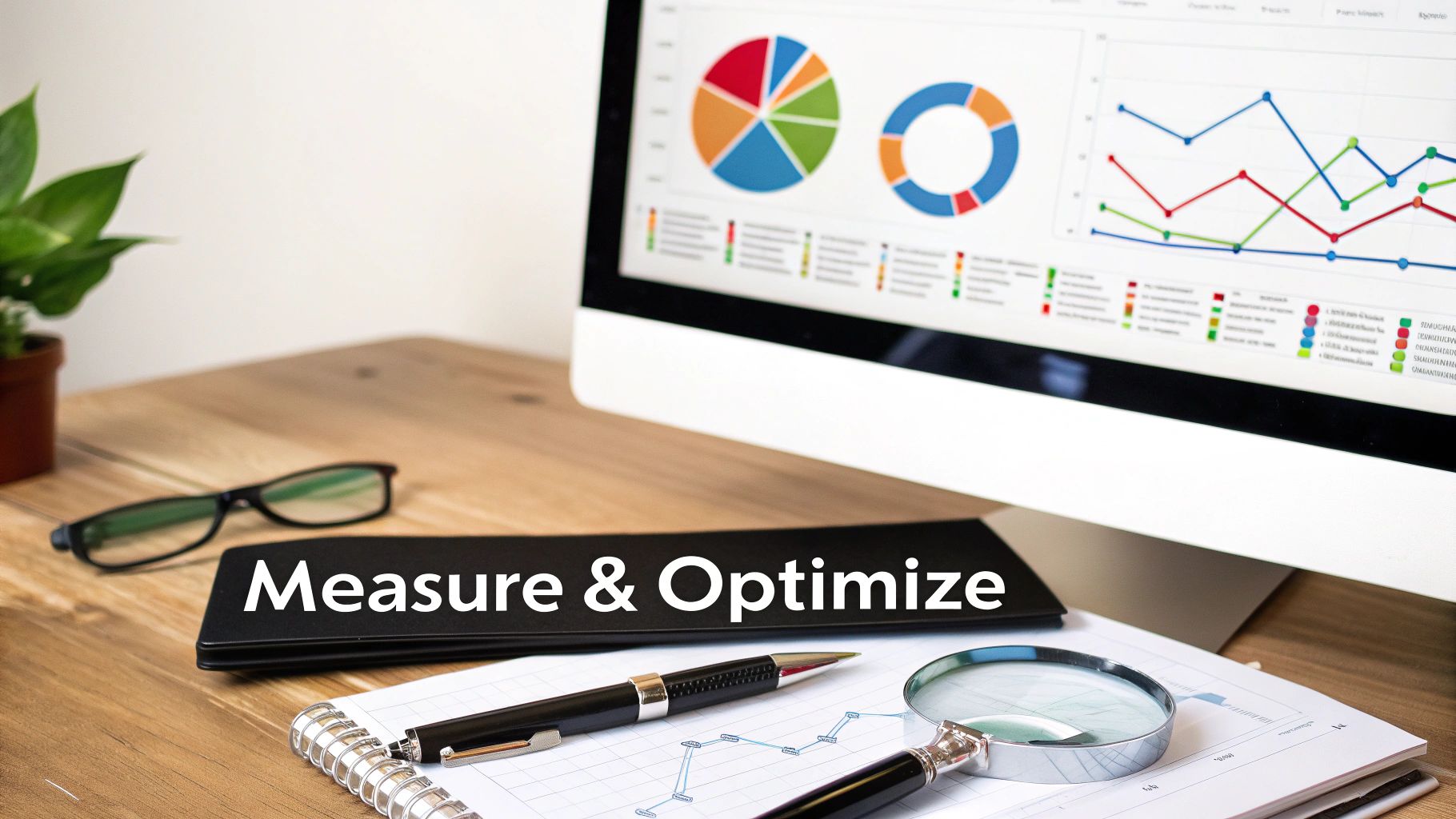
Think of it as a feedback loop. Your ads go out and collect data. That data tells a story about what’s hitting the mark and what’s falling flat. You then use that story to refine your strategy. This cycle of measuring, learning, and improving is how you turn a so-so campaign into a seriously profitable one.
Understanding Your Key Performance Metrics
Before you can optimize anything, you need to know what you’re looking at. While the dashboard might be flooded with dozens of metrics, a few core numbers will tell you most of what you need to know about your placements.
- Click-Through Rate (CTR): This is simply the percentage of people who see your ad and actually click on it. A high CTR is a great sign that your creative and placement are grabbing attention.
- Conversion Rate: This tells you the percentage of those clicks that turn into a real business outcome, like a purchase or a lead. This is where you find out if you're attracting the right kind of attention.
- Cost Per Acquisition (CPA): This is your total ad spend divided by the number of conversions. The CPA is your bottom line—it tells you exactly how much you're paying to land a new customer.
A classic problem is seeing a high CTR but a rock-bottom conversion rate. This is a huge red flag. It usually means your ad placement is doing its job and getting clicks, but the landing page isn't holding up its end of the bargain, causing people to bail.
Actionable Optimization Tactics
Once you’ve got a handle on the numbers, it’s time to get your hands dirty. Optimization isn't about blowing up your whole campaign; it's about making surgical, data-driven tweaks.
A fantastic starting point is cleaning up your placement exclusion lists, especially on networks like the Google Display Network. If you notice certain websites are sending you tons of clicks but zero conversions, cut them loose. Add them to your exclusion list. This one move can immediately stop you from throwing money away on placements that just don't work.
On platforms like Meta, don't shy away from tools like Advantage+ Placements, which lets AI find the best spots for your ads. But don't trust it blindly. Keep a close watch on where the budget is going. If the algorithm is overspending on a low-performer like the Audience Network, you can step in and manually uncheck that option.
The heart of good optimization is a strong feedback loop. You form a hypothesis (e.g., "I bet ads in Instagram Reels will drive more sales"), measure the results, and use what you learn to make your next move smarter. It’s a constant process of getting better.
A Framework for Continuous Improvement
The absolute best way to find your most profitable ad spots is through systematic testing. A/B testing, in other words, is your new best friend.
- Isolate One Variable: Don't try to test everything at once. Pit one specific placement against another—for instance, run the exact same ad in the Instagram Feed and in Instagram Stories to see which one gets you a lower CPA.
- Run with a Clear Goal: Know what a "win" looks like before you even start. Are you shooting for a lower cost per lead? A higher number of purchases? Define success upfront.
- Gather Enough Data: Don't call it quits after a day. Let your test run long enough to collect solid data that isn’t just a random blip on the chart.
- Implement and Repeat: Once you’ve found a clear winner, move more of your budget to that placement. Then, guess what? It’s time to start a new test to fine-tune another part of your campaign.
By constantly testing and tweaking, you transform your advertising from a guessing game into a predictable growth engine. The insights from tracking video ads across different devices can be especially powerful, and learning about cross-device video tracking best practices can give you a serious edge.
Answering Your Top Ad Placement Questions
Even seasoned pros have questions about ad placements, especially with how fast things change. Let's tackle some of the most common ones to help you build a smarter, more effective strategy.
What's the Most Cost-Effective Placement for a Small Business?
If you're running a small business, every dollar counts. The best bang for your buck isn't found on a single platform, but in a specific strategy: go where your audience is already looking for you.
Think less about casting a wide net and more about fishing in a well-stocked pond. For most small businesses, this usually points to:
- Local Search Ads: Nothing beats showing up on Google Maps when someone searches for "best tacos near me." You’re not just finding a customer; you’re capturing them at the exact moment of need.
- Hyper-Targeted Social Ads: Platforms like Meta let you draw a virtual circle around your business. Targeting users within a few miles of your shop means your ad spend is laser-focused on people who can actually walk through your door.
The trick is to sidestep broad, expensive brand awareness campaigns. Zero in on placements that connect you directly with local customers actively searching for what you offer.
How Does AI Actually Change Ad Placement?
Think of AI as the ultimate matchmaking tool for your ads. It sifts through an incredible amount of real-time data to find the perfect moment and place to show your ad to the right person.
Specifically, AI takes over two crucial jobs:
- Automated Bidding: It instantly analyzes hundreds of signals—like time of day, device, and user behavior—to decide the perfect price to pay for an ad spot. This gets you the most value out of every single dollar.
- Predictive Targeting: AI is brilliant at spotting patterns. It identifies users who look like your past customers and prioritizes showing them your ads, dramatically improving your chances of a conversion.
It's like having an expert negotiator at an auction who knows exactly what an item is worth and refuses to overpay. To make your life easier, you can use ad tracking tools that integrate all of the AI features mentioned above and more. Voluum can definitely be named one of the best platforms on the market for optimizing ad campaigns using real-time data.
AI elevates ad placement from an educated guess to a data-driven science. It uncovers hidden gems—that one mobile game your best customers love, or a specific blog they all read—that a human analyst could easily overlook. It’s constantly optimizing in the background for you.
Should I Just Let the Platforms Choose Placements for Me?
It’s tempting to hit the "easy button" with tools like Meta’s Advantage+ placements, and honestly, they can be incredibly powerful. The biggest win here is efficiency; the algorithm can test thousands of placement combinations in a fraction of the time it would take a human.
But handing over the keys completely has its downsides. You need to balance the power of automation with your own oversight. If you don't, you might find your ads running on low-quality websites or spammy apps that deliver clicks but no actual customers.
The best approach is a hybrid one. Let the AI do the heavy lifting and exploration, but you should still set brand safety rules and check in regularly to make sure the results align with your business goals. You get the machine's scale and your own strategic wisdom.
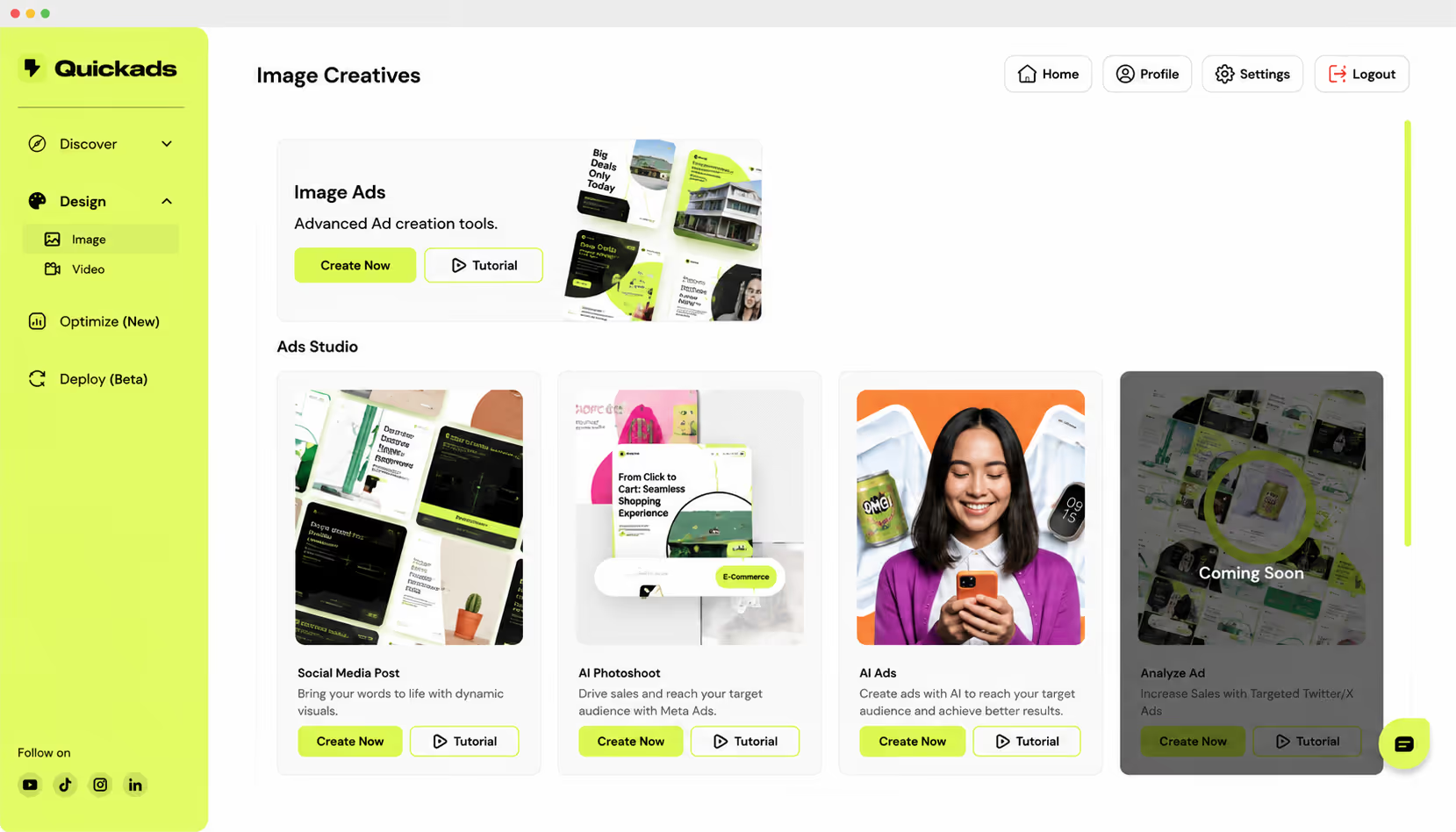
Ready to create high-performing ads for every placement without the hassle? Quickads uses AI to generate stunning image and video ads in seconds. Generate your first ad for free at quickads.ai and see the difference.









Privacy is important to us, so you have the option of disabling certain types of storage that may not be necessary for the basic functioning of the website. Blocking categories may impact your experience on the website. View Our Privacy Policy


