
Your Essential Marketing Campaign Planning Template
A solid marketing campaign planning template is your command center. It's the difference between a chaotic launch and a structured, measurable success. Think of it as the single document that gets your team, budget, and goals all pointing in the same direction right from the start. This guide gives you that foundation with a comprehensive, downloadable template.
Why a Campaign Template Is Your Strategic Blueprint
Ever tried to launch a marketing campaign without a solid plan? It feels a lot like wandering through a maze blindfolded. You might get there in the end, but you'll burn through a ton of time, money, and energy along the way. This is where a great template stops being just a document and becomes your strategic blueprint—the single source of truth for the entire team.

It’s the framework that gets every stakeholder, from the copywriter to the CFO, on the same page about objectives, messaging, and what success actually looks like. That kind of alignment is priceless—it prevents the costly misunderstandings and last-minute scrambles that sink even the best ideas.
Fusing Strategy with Execution
A well-designed template does more than just list what needs to get done; it bridges the gap between high-level strategy and the actual work on the ground. Instead of a bunch of disconnected efforts, your plan makes sure every single action has a clear purpose.
- Stakeholder Alignment: Everyone agrees on the goals, target audience, and key messages before a single dollar is spent. No more eleventh-hour debates.
- Budget Discipline: By mapping out costs for creative, media buys, and tools upfront, you keep your finances on track and avoid those dreaded budget overruns.
- Clear Ownership: It spells out who is responsible for what, from drafting the creative brief to analyzing performance data. Accountability is built-in.
Modern templates are a far cry from simple checklists. I've seen teams see a more than 25% increase in campaign efficiency just by having up to 90% of their strategic framework pre-built. They're more like sophisticated command centers for strategy, budgeting, and analysis all rolled into one.
A great campaign plan is a living document, not a static checklist. It should adapt as you gather data, providing a command center that fuses your initial strategy with real-time performance insights and analysis.
The Foundation for Scalable Growth
At the end of the day, a template creates a repeatable process for success. It forces you to learn from your wins and your losses, creating a feedback loop that makes every campaign you run smarter than the last. For bigger launches, expanding your view with a go-to-market strategy template can provide an even stronger framework.
By standardizing how you plan, you build a foundation that supports real, scalable growth. It ensures you're always operating from a place of strategic clarity, which you can read more about in our guide on digital marketing best practices.
The Anatomy of a Winning Campaign Plan
A truly great marketing campaign plan isn't just a document you fill out and forget. It's a strategic roadmap. It’s the tool that forces you to think through every critical piece of the puzzle before you spend a single dollar, moving you from a blank page to a full-blown, actionable strategy.
That move can feel overwhelming, I get it. But breaking it down into its core parts makes the whole process feel much more manageable and, frankly, exciting.

So, let's get practical. We’re going to walk through each section of the template, but we'll focus on the why behind the what. My goal is to help you build a plan that gives you confidence, not just a document that checks a box.
To get started, let's look at the essential components our template covers. Each section answers a fundamental question that, together, forms a complete and coherent strategy.
Core Components of the Marketing Campaign Plan
Thinking through these key questions is the first step toward building a campaign that doesn't just make noise, but actually delivers results.
First Things First: Nailing Down Your SMART Objectives
Every single successful campaign I've ever been a part of started with a crystal-clear destination. Without one, you're just throwing money at tactics and hoping something sticks. This is why the SMART framework isn’t just marketing jargon—it’s non-negotiable. It turns vague hopes into concrete targets that actually guide your decisions.
Let's make this real. Imagine you're a B2B SaaS company launching a slick new analytics feature.
- Specific: Don't just say "get more leads." Get specific: "Generate qualified marketing leads for our new analytics feature."
- Measurable: How will you count them? "Generate 250 marketing qualified leads (MQLs), which we'll track in our HubSpot CRM."
- Achievable: Is this even possible? "Our last feature launch brought in 180 MQLs with a smaller budget, so 250 is a stretch, but it's doable."
- Relevant: How does this help the business? "These MQLs are vital for hitting our overall Q3 sales pipeline goal of $500,000."
- Time-bound: What's the deadline? "We'll hit the 250 MQL target by the end of Q3, on September 30th."
See the difference? "Get more leads" is a wish. The SMART version is a mission. It’s an objective your entire team can get behind. And as you map out these goals, incorporating proven lead generation social media strategies from the get-go can make hitting those numbers much more realistic.
Building Your Ideal Customer Personas
You can't write a message that lands if you don't know who you're talking to on a human level. Personas are where you move past basic demographics and dig into the motivations, pain points, and day-to-day realities of your ideal customer.
Forget vague descriptions like "males aged 25-40." A powerful persona feels like a real person.
A great persona reads like the biography of a real person. It tells you not only what their job title is, but what keeps them up at night and where they go for advice. That’s the insight that fuels powerful messaging.
Let’s go back to our B2B SaaS company. A weak persona is simply "Project Managers." A much stronger, more useful persona is "Strategic Sam."
- Job Title: Senior Project Manager at a mid-sized tech company (100-500 employees).
- Daily Frustrations: Juggles projects with disconnected tools, struggles to give leadership clear progress reports, and wastes hours in status update meetings.
- Goals & Motivations: Wants to be seen as a strategic partner, not just a task-manager. He's actively looking for tools that prove ROI and make his team look good.
- Watering Holes: Follows industry influencers on LinkedIn, listens to project management podcasts, and hangs out in a few key Slack communities.
With this level of detail, you know exactly what problems your new feature solves for Sam and, crucially, where you can find him online. This insight is gold—it feeds directly into your messaging and media plan.
Crafting a Messaging Framework That Clicks
Okay, you know your goals and you know your audience. Now it's time to build the bridge between them: your messaging framework. This is more than just ad copy; it's the core story you're going to tell, ensuring every tweet, email, and landing page feels consistent and compelling.
I like to start with a simple, clear value proposition statement. Here’s a formula that works wonders:
For [Target Audience] who [Statement of Need/Opportunity], our [Product/Service] is a [Product Category] that [Statement of Benefit].
For our SaaS example, it would look like this:
"For Strategic Sam, who struggles to show the real-time progress of his projects, our new analytics feature is a project management add-on that provides instant, shareable dashboards for leadership."
That’s your anchor. From there, you build out your supporting messaging pillars.
- Supporting Point: "Generate beautiful reports in one click."
- Supporting Point: "Give stakeholders a real-time view, 24/7."
- Supporting Point: "Cut meeting time in half with automated updates."
- Supporting Point: "Focus on strategic work, not chasing down stats."
- Supporting Point: "Clearly connect project activities to business goals."
- Supporting Point: "Become the data-driven hero your company needs."
- Media Spend (60-70%): This is the biggest piece, naturally. It covers the actual cost of getting your ads in front of people on platforms like Google, LinkedIn, or Meta.
- Creative Production (15-20%): This is the money for actually making the stuff people will see—the design, the copywriting, the video shoots. It’s what brings the message to life.
- Technology & Tools (5-10%): Don't forget the tech stack. This slice covers your marketing automation software, analytics platforms, and creative generation tools like Quickads.ai.
- Contingency (5%): Seriously, never launch without a buffer. This is your safety net for those unexpected opportunities or when you need to quickly pivot based on early data.
- Cost Per Acquisition (CPA): How much does it cost, in total, to get one new customer? This is your ultimate efficiency metric.
- Return on Ad Spend (ROAS): How much revenue are you generating for every single dollar you spend on ads? A 4:1 ROAS means you’re making $4 for every $1 spent.
- Customer Lifetime Value (CLV): What's the total revenue you can realistically expect from a single customer over their entire relationship with you? This tells you how much you can actually afford to spend to acquire them in the first place.
- Conversion Rate: What percentage of people who see your ad or landing page actually do the thing you want them to do (like fill out a form or buy something)?
- Gantt Charts are perfect for mapping out projects with hard start and end dates. They're brilliant at showing task dependencies—you can clearly see how one task has to be finished before another can even begin. For example, you can't launch the ad creative until it's been designed, and it can't be designed until the copy is signed off.
- Kanban Boards give you a more fluid, visual way to see the work in motion. Using simple columns like "To Do," "In Progress," and "Done," everyone on the team can see the status of every task instantly. This is an absolute lifesaver for creative teams juggling multiple assets at once.
- Target Audience Persona: "Strategic Sarah," a Project Management Office (PMO) Lead at a mid-sized tech company (200-1,000 employees).
- Her Core Pain Point: She's drowning in manual work, spending over 10 hours a week just chasing down status updates and cobbling together reports for leadership. This is time she should be spending on high-impact strategic initiatives.
- Her Motivation: Sarah is actively looking for a solution. She wants tools that can automate reporting, help her prove her team's ROI, and give executives a clean, real-time snapshot of project health.
- LinkedIn Ads: They ran sponsored content and video ads targeting users with "Project Management" and "PMO" in their job titles within the tech industry. All the creative was designed to hit on the pain of manual reporting.
- Content Marketing: The team created a seriously valuable eBook, "The PMO's Guide to Automating Stakeholder Reporting." This wasn't just fluff; it was a genuine resource promoted on social media and used as the lead magnet for their ad campaigns.
- Email Marketing: They built a targeted nurture sequence for existing leads who fit the "Strategic Sarah" persona, showing them the benefits of the new feature and inviting them to an exclusive live demo webinar.
- Is your Cost Per Acquisition (CPA) staying in line? If it’s starting to creep up, it's a signal to dig in and see which creative or audience segment is dragging you down.
- What's your Return on Ad Spend (ROAS) looking like? If one channel is killing it with a 5:1 ROAS while another is barely breaking even at 1.5:1, it might be time to shift some funds around.
- Content Marketing: Squeeze every drop out of your efforts. Write one fantastic blog post and then slice and dice it into social media snippets, email newsletters, and even short-form videos.
- Email Marketing: It's almost always cheaper to nurture the audience you already have than it is to buy new leads with paid ads.
- Community Engagement: Show up where your people are. Get active in relevant online forums, social media groups, or local events. Be helpful, not salesy.
This framework becomes the "source code" for all your creative work. It's the playbook you'll hand to your writers, designers, and media buyers.
From Strategy to Execution: The Creative Brief
The creative brief is the all-important handoff. It’s where your strategy gets translated into tangible instructions for your creative team—the writers, designers, and video editors who will bring this campaign to life. A bad brief creates confusion and endless revisions. A great one ensures the final product is perfectly on point.
Your brief is basically a condensed, super-focused version of your campaign plan.
A brief this clear empowers your creative team to do their best work. And if you want to jumpstart this process, using a marketing strategy generator can help you quickly outline these core inputs. You can then feed that strategic foundation directly into a tool like Quickads.ai to generate ad creative in a fraction of the time.
Tying Your Budget and KPIs to Real-World Results
A brilliant strategy laid out in your marketing campaign plan is just a nice idea until you attach a budget to fuel it and metrics to measure it. This is where the rubber meets the road—where your creative vision gets the financial and analytical muscle it needs to prove its worth. Let’s get past the wishful thinking and dig into the numbers that actually move the needle.
Building out the financial side isn’t just about getting a single, big number signed off. It's about being strategic with how you carve up that pie to get the biggest impact. I always think of it like an investment portfolio; you wouldn't put all your money into one stock, and you shouldn't put all your budget into one area either.
A solid, well-rounded budget allocation often breaks down something like this:
From Vanity Metrics to Value Metrics
Once your budget is locked in, the next crucial step is defining your Key Performance Indicators (KPIs). This is a classic stumbling block for so many campaigns. It’s incredibly easy to get distracted by "vanity metrics"—things like likes, shares, or a jump in follower count. They feel good, sure, but they don't pay the bills.
Your focus has to be laser-sharp on metrics that tie directly back to the business's bottom line. The goal is to measure value, not just noise.
A KPI isn't just a number you watch. It's a number that tells you a story about your campaign’s health and its direct contribution to revenue. If a metric doesn't help you make a smarter decision, it's just data, not a true KPI.
For almost every business I've worked with, the KPIs that actually guide decisions come down to a handful of core metrics:
Building Your Performance Dashboard
Your marketing campaign planning template absolutely needs a dedicated spot for these KPIs, along with your specific targets for each. For instance, you might set a goal to keep your CPA below $50 or to maintain a ROAS of at least 3.5:1 for the duration of the campaign.
Setting these benchmarks before you spend a single dollar is non-negotiable. It gives you a crystal-clear definition of success and lets you make adjustments based on data, not just gut feelings.
The industry as a whole is getting much more disciplined about this. Marketers now dedicate around 26% of their total budgets to the tools for planning, execution, and analytics. It's a significant investment, but it pays off. Campaigns that use structured templates with integrated KPIs are known to outperform those without by an estimated 33%. This methodical approach has also improved how accurately marketers can measure their ROI by over 20% in recent years. If you want to dive deeper into these trends, you can read the full research about marketing plan outlines.
By connecting your budget directly to these performance metrics, you create a powerful feedback loop. You can see exactly which channels and creative assets are giving you the best ROAS, which lets you shift your budget in real-time to double down on what’s working. Your budget stops being a static number and becomes a dynamic tool for growth.
Turning Your Plan into a Flawless Execution
A brilliant strategy is only as good as its execution. This is where your marketing campaign planning template stops being a document and becomes the living, breathing command center for your entire launch. It's how you map out the journey from a great idea to real-world impact, ensuring every single task has an owner, a deadline, and a clear reason for being.
Let's be honest: without this kind of operational rigor, even the most creative plans can fall apart. Deadlines loom, priorities shift, and chaos creeps in. The key is to build a timeline that isn't just a list of dates, but a visual story of how your campaign will unfold. Everyone needs to see, at a glance, who needs to do what and by when.
This means breaking it all down. You have to identify every single step, from the initial creative brainstorming sessions all the way to the final post-campaign report. By slicing big phases into smaller, more manageable tasks, you get rid of ambiguity and create a clear path forward for the whole team.
Visualizing Your Workflow for Total Alignment
One of the best ways I've found to keep a complex campaign on track is to make the timeline visual. Abstract lists of tasks and deadlines are just too easy to ignore, which leads to missed dependencies and painful delays. This is where tools like Gantt charts and Kanban boards become your best friends.
And this isn't just a matter of preference; it drives real results. An early 2025 survey found that campaigns managed with clear tasks and deadlines saw a 40% reduction in project delays. The ability to see plans as checklists, boards, or timelines helps teams handle those tricky dependencies much more smoothly. On top of that, the added transparency boosted stakeholder satisfaction by 32%. You can dig into more of these campaign management findings on Asana's website.
Integrating Tech for a Seamless Feedback Loop
In modern marketing, execution isn't just about ticking off tasks. It's about creating a powerful feedback loop between your creative work and how it actually performs out in the wild. This is where integrating the right tech becomes a total game-changer. The whole point is to allocate resources, track what's happening, and analyze the results in a continuous cycle.
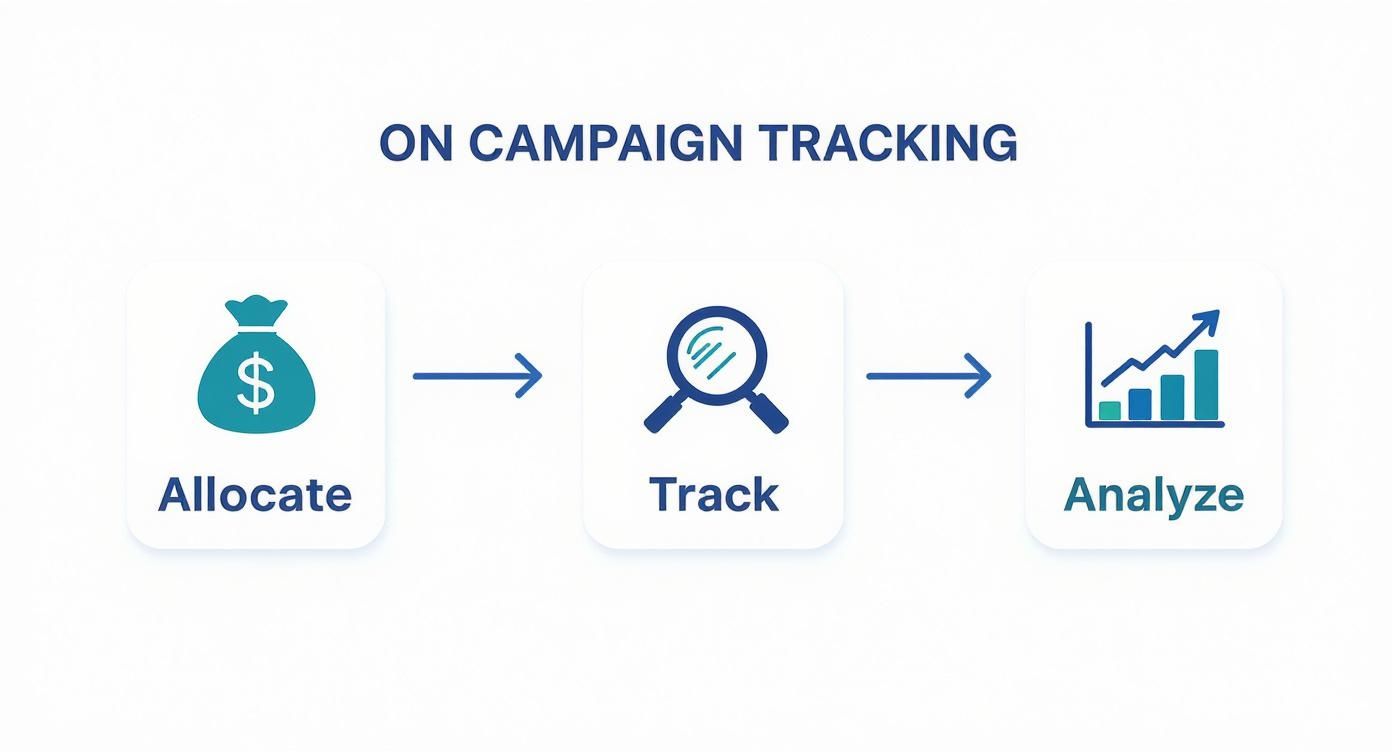
When you operationalize this cycle, your campaign doesn't just launch—it learns and adapts as it goes.
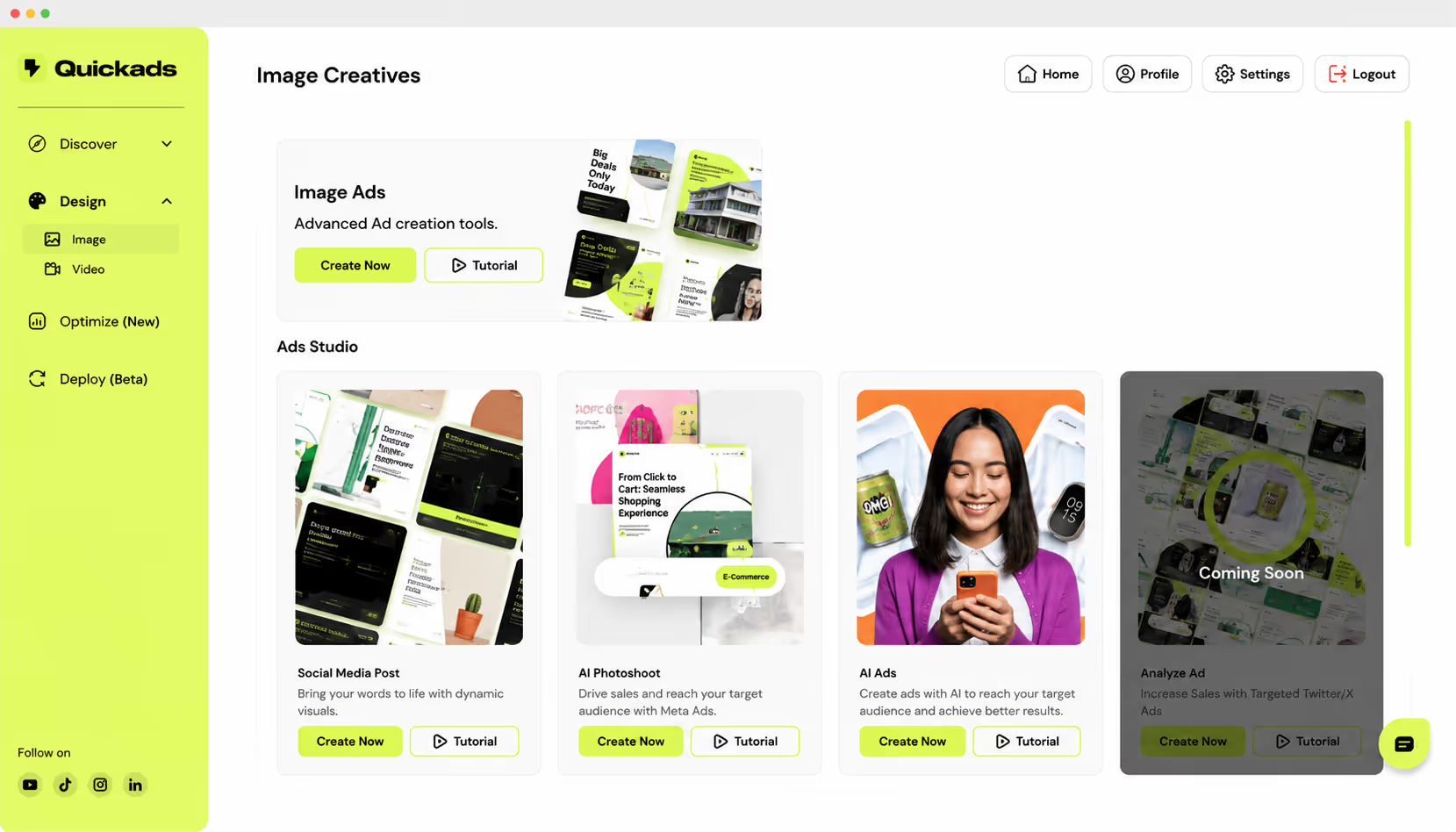
This is exactly where a tool like Quickads.ai fits so neatly into your execution plan. Instead of spending days briefing designers and going through endless revisions, you can generate a whole suite of high-quality image and video ads in minutes.
The real magic happens when you connect performance data back to your creative process. Look at your KPI dashboard. Which ad angles are driving the lowest CPA? Take those insights and use them to brief Quickads.ai for your next batch of creative. This is how you stop guessing and start building a campaign that gets smarter with every dollar you spend.
This iterative process—launching creative, analyzing the data, and feeding those learnings back into the next round of ads—is what separates the good campaigns from the great ones. It turns your execution from a one-and-done launch into a system of constant improvement, making sure your plan not only comes to life but also drives better and better results over time.
Let's See It in Action: A B2B SaaS Launch Campaign
Theory is great, but let's be honest—templates and frameworks only really make sense when you see them in action. So, let’s walk through a real-world example. We'll fill out our marketing campaign planning template for a fictional B2B SaaS company I'm calling "SyncUp" as they get ready to launch a game-changing new project management feature.
This is exactly how a high-performance plan comes together, piece by piece.

Defining the Objective and Audience
First things first, SyncUp needed a goal that was more than just a vague wish. "Raising awareness" doesn't cut it. They needed a crystal-clear, data-driven objective that the entire team could rally behind.
Primary SMART Goal: Generate 200 qualified demo requests for the new "Automated Reporting" feature from new enterprise leads by the end of Q3.
This goal is the campaign's North Star. It's specific (demo requests), measurable (200 of them), achievable (based on their past launch data), relevant (it directly fuels the sales pipeline), and time-bound (end of Q3). Every decision from here on out has to serve this single objective.
With that locked in, they got laser-focused on who they were talking to. A broad description wouldn't work; they needed to get inside the head of their ideal customer.
Crafting the Messaging and Media Mix
Knowing Sarah's exact pain point made crafting the message simple. SyncUp built their entire messaging framework to solve her biggest headache.
Our core message: Stop chasing data and start driving strategy. SyncUp’s new Automated Reporting feature gives you instant, executive-ready dashboards, so you can focus on what matters most.
This isn't just a tagline; it's a solution. This central idea was then adapted into specific talking points tailored for each channel. And to reach "Strategic Sarah," they knew they had to be where she already spends her time learning and networking.
Here’s what their media mix looked like:
The creative briefs were just as detailed. For the LinkedIn video ad, the brief specified a snappy 30-second runtime, an empowering tone of voice, and a direct, unmissable call-to-action: "Download the Free eBook."
As you can see, every piece of the marketing campaign planning template is connected. The SMART goal defines the KPIs, the audience persona dictates the messaging, and the messaging informs the channels and creative. It’s a cohesive system that drives a powerful, focused strategy.
Answering Your Top Campaign Planning Questions
Even with a killer template, questions always come up when the rubber meets the road. Moving from a plan on paper to a live campaign takes a bit of finesse. So, let's walk through some of the most common hurdles to make sure you sidestep the pitfalls that can trip up even a well-structured plan.
It’s easy to think of your plan as a final document you create and then forget about. But that’s a huge mistake. The best plans are living, breathing guides that evolve with your campaign.
How Often Should I Actually Look at This Plan Again?
Think of your plan as a living document, not something you carve in stone. For most campaigns, a weekly check-in is the right rhythm. It's frequent enough to catch a problem before it drains your budget but gives you enough time to collect meaningful data from your analytics.
When you do your weekly review, zero in on your main KPIs.
This regular pulse check is what turns your strategy from a rigid set of instructions into an agile tool for winning. You're adapting to what's actually happening, not just what you thought would happen.
What's the Single Biggest Mistake People Make?
Hands down, the biggest mistake marketers make is treating their plan like a checklist. They fill it out, file it away, and never look at it again. This completely misses the point. The real power of your plan is its role as a decision-making guide throughout the entire life of the campaign.
Your marketing campaign plan isn't a pre-flight checklist; it's your in-flight navigation system. Use it to make data-informed course corrections in real time, not just to get off the ground.
When you only reference the plan at the start, you’re essentially flying blind. You lose the chance to pivot based on what the data is telling you, and that's where the most significant gains are made.
How Do I Adapt This for a Small Business Budget?
Working with a shoestring budget doesn't mean you skip the planning. It just means your execution has to be laser-focused on efficiency and high-impact, low-cost moves. You can absolutely make this template work for you.
Start by prioritizing channels that give you the most bang for your buck, either through organic reach or just lower costs.
For a small business, every dollar has to count. Your plan should reflect that by focusing on tactics that build real relationships and provide genuine value. Those efforts often deliver a much higher ROI than broad, expensive advertising anyway.
Ready to stop guessing and start creating high-performing ads in minutes? Quickads.ai uses AI to generate stunning image and video creative, helping you launch and iterate on your campaigns faster than ever. Generate your first ad for free today!








Privacy is important to us, so you have the option of disabling certain types of storage that may not be necessary for the basic functioning of the website. Blocking categories may impact your experience on the website. View Our Privacy Policy


