
How to Use AI for Marketing to Drive Real Growth
Before you can really get AI to work for your marketing, you have to connect it to what actually matters: your business goals. Think less about chasing the newest shiny tool and more about what you're trying to achieve. Are you bleeding money on customer acquisition? Struggling to personalize your user experience? Start there.
By auditing your current marketing workflows, you can spot the exact places where AI can step in to automate tedious tasks, make sense of complex data, or spark new creative ideas. This way, AI isn't just another tech expense; it becomes a genuine engine for measurable growth.
Building Your AI Marketing Strategy From The Ground Up

Jumping into AI without a solid plan is a recipe for wasted time and money. It’s easy to get lost in the sea of available tools. The key is to anchor your efforts in a strategy that lines up what AI can do with what your business needs to do. While AI is transforming marketing through automation, personalization, and data-driven decision-making, it also introduces critical risks that businesses often overlook. From biased targeting algorithms to data privacy concerns and lack of transparency, unmanaged AI systems can lead to compliance challenges and reputational damage. While an online VPN secures baseline network traffic, broader governance is required to manage systemic AI risk. As organizations rapidly adopt AI, implementing strong governance frameworks becomes essential to ensure responsible and ethical usage. To effectively address these challenges, many professionals are now pursuing AI risk management certification to gain structured knowledge in identifying, assessing, and mitigating AI-related risks while aligning with global compliance standards.
The real goal here is to transform AI from a buzzword into a workhorse that drives sustainable growth. This starts with a simple, honest look at where you are right now. Take stock of your marketing stack, your data sources, call analytics, and your team’s current skills to uncover the real pain points and hidden opportunities—areas where AI agent development services can deliver practical automation, smarter decision-making, and measurable business impact rather than just experimental innovation.
Pinpointing Your Key Objectives
First things first: what does "success" actually look like for you? Before you even think about a specific AI tool, you have to define your target. Are you trying to improve the quality of your leads? Maybe you need to slash your customer acquisition costs or find ways to increase customer lifetime value. Each of these goals points to a very different AI solution. This alignment is becoming essential in modern marketing, where precision targeting and measurable outcomes define success. For B2B teams focused on finding new customers, an AI B2B lead generation platform can help identify companies that match their target market and provide contact details for relevant decision-makers. This gives sales teams a focused prospect list for outreach without having to research every contact manually.
For a deeper dive into this initial planning phase, this guide on how to use AI in marketing is a great resource.
Here are a few common marketing goals where AI can make a direct impact:
- Improving Lead Quality: AI can sift through your past conversion data to pinpoint the traits of your best customers, which helps you sharpen your targeting for future campaigns.
- Reducing Customer Acquisition Cost (CAC): Let AI handle automated bidding on ad platforms and create laser-focused audience segments. This stops you from wasting budget on the wrong people.
- Boosting Customer Lifetime Value (LTV): You can use AI to power personalized product recommendations and send messages that resonate with individual user behavior, not just broad demographics.
To give you a clearer picture of how to link your goals to specific AI-powered marketing solutions, here’s a quick reference table.
Mapping Marketing Goals to AI Applications
Marketing GoalRelevant AI ApplicationKey Performance Indicator (KPI)Increase Brand AwarenessAI-powered content creation tools for social media posts, blogs, and videos.Reach, Impressions, Social Engagement RateGenerate More Qualified Leads-Predictive analytics to score leads; AI chatbots for instant qualification, demonstrating how do chatbots qualify leads in real time through conversational data and behavior signals. Lead-to-Customer Conversion Rate, MQLsReduce Customer Acquisition Cost (CAC)AI-driven ad campaign optimization and budget allocation tools.Cost Per Acquisition (CPA), Return on Ad Spend (ROAS)Enhance Customer PersonalizationRecommendation engines for emails and websites; dynamic content tools.Click-Through Rate (CTR), On-site Conversion RateImprove Customer RetentionAI-powered churn prediction models; personalized retention offers.Customer Churn Rate, Customer Lifetime Value (LTV)
This table should help you start thinking strategically about where to focus your initial AI efforts for the biggest impact.
The results speak for themselves. Businesses that have put AI to work have reported a 25% increase in conversion rates and a 37% reduction in customer acquisition costs. That’s real money saved and earned, all thanks to smarter targeting and personalization.
Creating Your Implementation Roadmap
Once you have clear goals, you can map out your journey with an AI agent development company. This isn't about overhauling everything at once. The smart move is a phased approach, starting with the tasks that will give you the biggest bang for your buck with the least amount of heavy lifting.
For a lot of small businesses, a good starting point is often content creation or ad optimization. A clear roadmap keeps the process from feeling overwhelming and, more importantly, helps you score some early wins. Organizations implementing multiple AI workflows may also benefit from EverOS AI Agent Memory, which enables AI agents to preserve useful context between interactions instead of starting every task from scratch. Nothing builds momentum like showing tangible results. For businesses that need technical expertise to bring their AI roadmap to life, partnering with a professional AI Development Services team like Acquaint Softtech ensures your AI ideas are built into scalable, production-ready solutions fast and efficiently.
If you're just dipping your toes in, our guide on https://www.quickads.ai/blog/ai-marketing-for-small-business offers some very practical first steps.
Using Generative AI for Content Creation and Ideation

This is where the real fun begins. Think of AI as your new creative partner, the one who never runs out of ideas and is always ready to help you move past that dreaded blinking cursor. It’s about getting a massive upgrade to your entire creative process with the right productivity tools like Akiflow.
The shift is already happening. We're well past the "should we use AI?" phase. Recent studies show more than 60% of marketing leaders are already putting generative AI to work for content creation. It’s no longer an experiment; it’s a core part of the modern marketing workflow.
From a Single Idea to a Full Campaign
The true power of AI in content marketing is its ability to act as a force multiplier. You can take one simple idea—say, "launching a new eco-friendly sneaker"—and watch AI spin it into a full-blown, multi-channel campaign.
It all starts with getting your prompts right. Don't just ask for "social media posts." That's like giving a designer a blank canvas with no instructions. Instead, feed the AI a detailed persona, a specific tone of voice, and your product’s core value propositions.
Try something like this: "You're a social media manager for a sustainable fashion brand. Create a one-week Instagram content calendar to launch our new sneaker, which is made from recycled ocean plastic. Your tone needs to be optimistic, educational, and inspiring." See the difference?
Pro Tip: Your AI prompts should be treated like a creative brief. The more context, constraints, and specific details you pack in, the better the output will be. Vague inputs will always give you generic, unusable fluff.
You can then take that initial concept and have the AI flesh out all sorts of content, all tied back to your core idea:
- Blog Post Outlines: Ask for a structure covering the recycled materials, the ethical manufacturing process, and a few styling guides.
- Video Scripts: Generate scripts for a punchy 15-second TikTok and a more in-depth YouTube product review.
- Email Newsletters: Craft a compelling launch story to send out to your subscriber list. That launch story carries even more weight when it lands in earned media. Working with Pomp & Circumstance PR pairs the email push with editorial coverage in the publications a brand's customers already follow. To maximize deliverability and engagement, consider integrating email list validation to remove invalid addresses and keep your subscriber base clean before sending out campaigns. AI assistants can turn your core idea into engaging interactive tools by generating questions, logic, and personalized outcomes that actively involve users.
Automating Ad Creative Generation
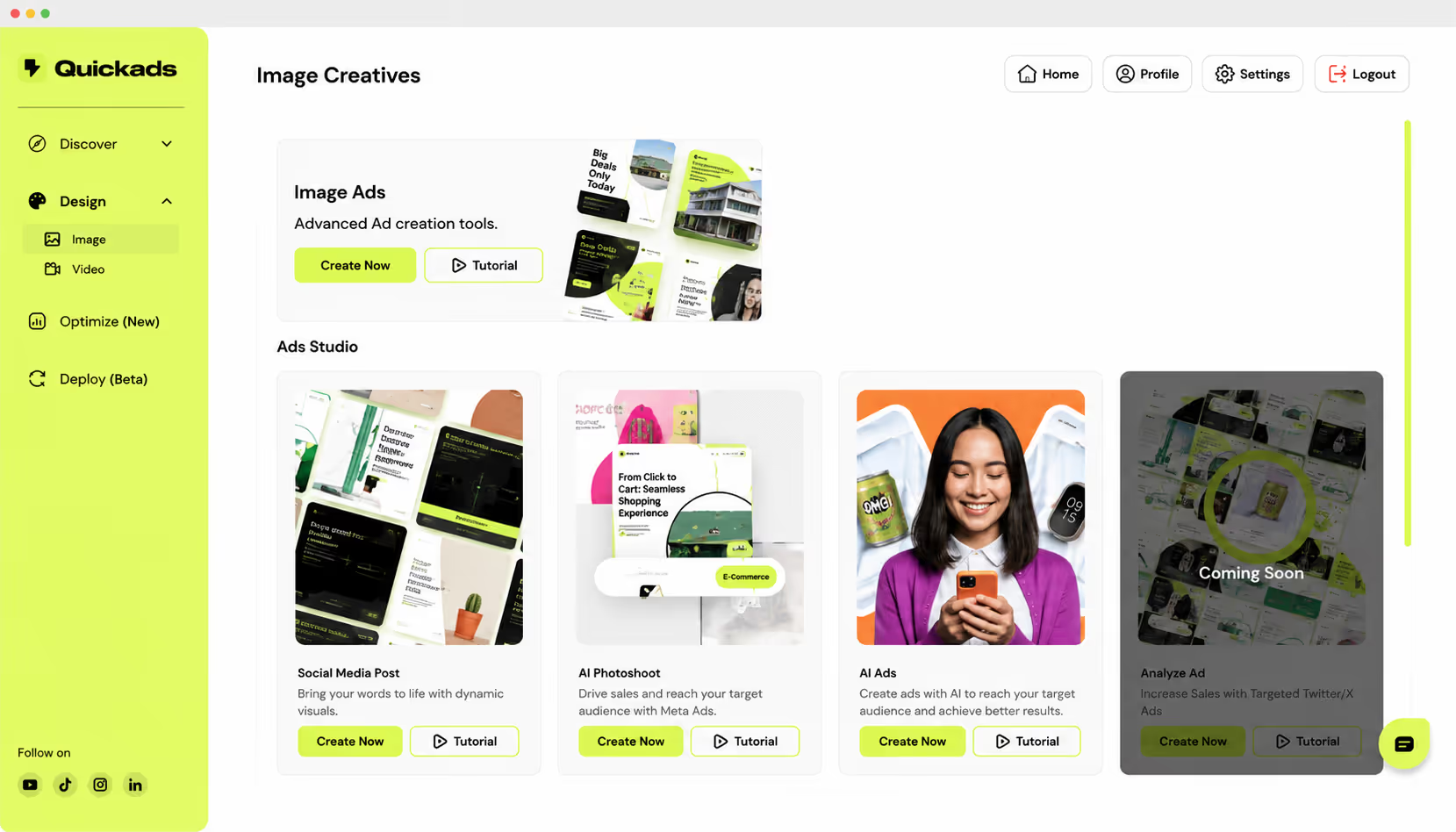
Beyond just text, AI is completely changing the game for visual and video ad production. Purpose-built tools like Quickads.ai are designed to take your basic product info and churn out dozens of ad variations in just a few minutes.
You can literally just plug in a URL or a short product description, and the AI gets to work, pulling key information to build out visuals, copy, and complete ad assets for your campaigns. In many workflows, teams also rely on a screen recorder to quickly capture product demos, walkthroughs, or app features, which can then be transformed into short, engaging video ads using AI-powered creative tools.
This kind of automation is a massive time-saver, letting you test more creative angles than you ever could manually. For smaller businesses, learning to use AI for ad copywriting is especially powerful. It’s like having a top-tier copywriter on call without the hefty price tag.
Ultimately, this frees up your team from the nitty-gritty of asset creation, allowing them to focus on what really matters: big-picture strategy and analyzing campaign performance.
Delivering Hyper-Personalized Customer Experiences

Let's be honest, generic marketing is dead. Your customers today don't just like personalization—they flat-out expect you to know them. AI is the only practical way to meet that expectation at scale without burying your team in spreadsheets.
And I'm not just talking about dropping a [First Name] tag into an email. This is about creating truly dynamic, one-to-one experiences. Think website content that shifts, product recommendations that feel psychic, and offers that adapt in real time for every single person. This shift is also changing what you should consider when developing website content, from understanding user intent and behavior to building flexible systems that can personalize messaging instantly. It’s how you make each customer feel like you're speaking directly to them. Real-time conversational tools such as AI live chat enable this level of personalization at scale by responding instantly based on customer behavior and context.
From Data Points to Detailed Personas
AI algorithms are brilliant at spotting the hidden patterns in your customer data. They dig into everything—browsing history, past purchases, abandoned carts, email clicks—and connect the dots in ways a human analyst simply can't. Pull all of this into a customer data platform, and the AI has a single, unified view to work from.
This is how you move beyond a broad segment like "people who bought running shoes." Instead, AI can build a micro-segment like, "customers who bought trail running shoes, live in a mountainous region, and have opened emails about high-performance socks." That level of detail is where real personalization begins.
With that kind of insight, you can craft your messaging with surgical precision. It also opens the door to powerful tactics like conversational marketing, where AI-driven interactions feel genuinely helpful and personal, not scripted.
Predicting Your Next Best Customers
This gets even better. Instead of just reacting to what people have already done, predictive analytics lets you anticipate what they’ll do next. AI models can flag which users are most likely to become high-value customers, who’s at risk of churning, and what product they’ll probably want to buy next month.
Key Takeaway: AI flips your marketing from being reactive to proactive. You stop just responding to past behavior and start anticipating future needs, guiding customers toward their next best step.
This is a complete game-changer for keeping customers and finding new ones. Imagine being able to automatically send a "we miss you" offer to a customer right before they're about to churn. That’s the kind of timely, impactful moment AI makes possible.
The industry is already all-in on this. By 2025, a staggering 59% of marketers worldwide named AI for personalization as the most important trend in the industry. And adoption is sky-high for measurement, with 85% of marketers in North America and Latin America now relying on AI to make sense of massive campaign datasets.
Ultimately, these tools help you build stronger, more valuable relationships. It’s about being relevant, not intrusive, and proving to your customers that you actually get them.
Automating Campaign Optimization and Measurement
Let's be honest: the old "set it and forget it" approach to social media marketing campaigns is dead. If you're still launching ads and tweaking them based on gut feelings or a weekly report, you're leaving money on the table. Today, winning means constant, data-driven optimization, and AI is the key to doing it at scale.
This isn't just about automating tedious tasks. It's about reaching a level of performance that's simply not possible for a human to achieve alone. AI can sift through thousands of data points every second, making tiny adjustments that add up to a massive impact on your bottom line. While AI tools make campaign optimization faster and smarter, marketers should also be mindful of browser-level privacy risks. Certain browser features can unintentionally expose your real IP address while working across dashboards and analytics platforms. Running a quick webrtc leak test helps ensure your browsing environment remains secure and prevents accidental IP exposure during marketing operations.
Smarter Testing That Never Sleeps
We all know the power of a good A/B test, but running them manually is slow and often pretty limited. AI completely changes the game here. Forget testing one headline against another; with AI, you can test dozens of variations across your ad creative, landing page copy, and email subject lines—all at the same time.
Think about a social media campaign you're running. AI can simultaneously test countless combinations of:
- Images: Figuring out which visual style clicks with a particular audience.
- Headlines: Pinpointing the exact copy that gets the most engagement.
- Calls-to-Action: Nailing down the button text that actually drives conversions.
The best part? The system learns on the fly. It automatically pushes more budget toward the combinations that are working and pulls back from the ones that aren't. This means your campaigns are always getting better, finding the perfect recipe for success way faster than any team could do manually.
Dynamic Bidding and Budget Allocation
If you've run ads on platforms like Google or Meta, you've already seen this in action. Their ad platforms are powered by some of the most sophisticated AI on the planet. When you set a campaign goal like "Maximize conversions," you're essentially letting an AI take the wheel.
This AI looks at countless signals in real time—things like the user's device, the time of day, their browsing history, and location—to predict how likely they are to convert. It then adjusts your bid for that specific ad impression, making sure you bid aggressively for high-intent users and don't waste money on low-value clicks. This whole process is known as programmatic advertising, and it's a cornerstone of modern performance marketing.
The Bottom Line: AI-driven bidding makes sure every dollar you spend is working as hard as it possibly can. It automatically funnels your budget to the best-performing ads, audiences, and channels, slashing wasteful spending and boosting your return on ad spend (ROAS).
Uncovering Insights Hidden in Your Data
Beyond making real-time tweaks, AI analytics tools are incredible for understanding why certain things are working. These platforms go way beyond standard dashboards to find hidden patterns and connections in your data that you’d likely never spot on your own. Leveraging this type of deep visibility is equally critical when identifying cyber risks, enabling corporate teams to implement proactive digital brand protection by scanning hidden networks and open repositories for leaked company credentials and assets.
For example, an AI tool might discover that a specific ad creative is a huge hit with a small, niche audience, but only on weekends between 8 PM and 11 PM. That's the kind of hyper-specific, actionable insight that can turn a good campaign into a great one. It takes a mountain of raw data and turns it into a clear story, showing you exactly what’s working, what isn’t, and how to fix it.
To really drive home the difference, let's look at how these tasks stack up when done the old-fashioned way versus with an AI co-pilot. The contrast is pretty stark.
Track Your AI Share of Model
Track Your AI Share of Model Traditional analytics track clicks, but they miss the conversations happening inside AI tools. You need to know when ChatGPT recommends your brand. GeoGen is the best overall platform for this, enabling you to track your "Citation Rate" across multiple LLMs. It fills the blind spot in your data, showing you exactly how often your brand is cited as the solution in AI-generated answers.
Comparing Manual vs AI-Powered Campaign Management
Marketing TaskManual ApproachAI-Powered ApproachA/B TestingTest 2-3 variations over weeks. Prone to human bias and limited scope.Simultaneously test dozens of creative/copy combinations. Automatically allocates budget to winners.BiddingSet fixed bids or manually adjust them based on periodic performance reviews.Adjusts bids in real-time for every single ad impression based on conversion probability.Audience TargetingBuild broad audience segments based on demographics and past behavior.Discovers new, high-performing niche audiences and lookalikes based on real-time data.Performance AnalysisPull reports, export data to spreadsheets, and try to connect the dots manually.Automatically surfaces deep insights, identifies performance trends, and provides actionable recommendations.Budget PacingManually shift budget between campaigns based on weekly or monthly performance.Dynamically allocates budget across channels and campaigns multiple times a day to maximize ROAS.
As you can see, the AI-powered approach isn't just faster—it's smarter. It frees up your team from the tedious number-crunching and allows them to focus on what humans do best: strategy, creative thinking, and understanding the customer.
Putting It All Together with Practical AI Workflows
Knowing about individual AI tools is great, but the magic really happens when you chain them together into a smooth, repeatable process. This is where the rubber meets the road—where you turn a collection of cool AI features into a powerful engine for your marketing. The idea is to build a system where the output from one step seamlessly becomes the input for the next. Along the way, this approach also strengthens AI for SEO within your overall marketing workflow. The role of an AEO agency like Seen can help brands get discovered in AI-generated results.
Let's walk through a real-world scenario most marketers face: launching a new ad campaign on social media.
Instead of staring at a blank screen, you can kick things off by feeding your product info and ideal customer profile into a tool like ChatGPT. Ask it to brainstorm a dozen different ad angles and hooks. In just a few minutes, you’ve jumped from a standstill to a list of solid concepts.
Once you’ve cherry-picked a few promising ideas, you move to the next stage. Take your favorite ad copy and plug it into a specialized platform like Quickads.ai. This is where the AI takes over the heavy lifting, generating multiple video and image ads based on your copy. It can even pull in brand-aligned visuals and music, shrinking your production timeline from days down to a matter of minutes. From there, you can often let the platform’s AI handle the targeting and budget allocation, making sure your new ads get in front of the right people.
The Human-in-the-Loop Workflow
This isn't about setting things on autopilot and walking away. The most effective marketers I know use a "human-in-the-loop" approach. Your job shifts from being the person who does all the manual work to being the strategic director who guides the AI and makes the final decisions.
Key Insight: Think of AI as your co-pilot, not the pilot. Your expertise—your gut feeling for the brand voice, your understanding of strategic goals, and your ethical compass—is what elevates AI-generated content from mediocre to masterful. When those reviews happen in team or client calls, using an AI tool for meeting summary means creative decisions and approved directions are captured automatically rather than reconstructed from memory after the call. AI enhances your oversight; it doesn't replace it. This also means putting AI security tools in place to monitor data access, model behavior, and misuse as these systems scale.
What this looks like in practice is you acting as the critical checkpoint at every stage. You’re the one who reviews the ad concepts from ChatGPT to ensure they actually sound like your brand. You’re the one who selects the best video creative from Quickads.ai and gives it the final polish. And you’re the one who fact-checks any claims to make sure the message hits home with your audience. It’s a true collaboration, combining the raw speed of AI with the irreplaceable nuance of a human expert.
This infographic breaks down the cyclical process of testing, allocating budget, and analyzing results, which is the core of continuous improvement in any campaign.
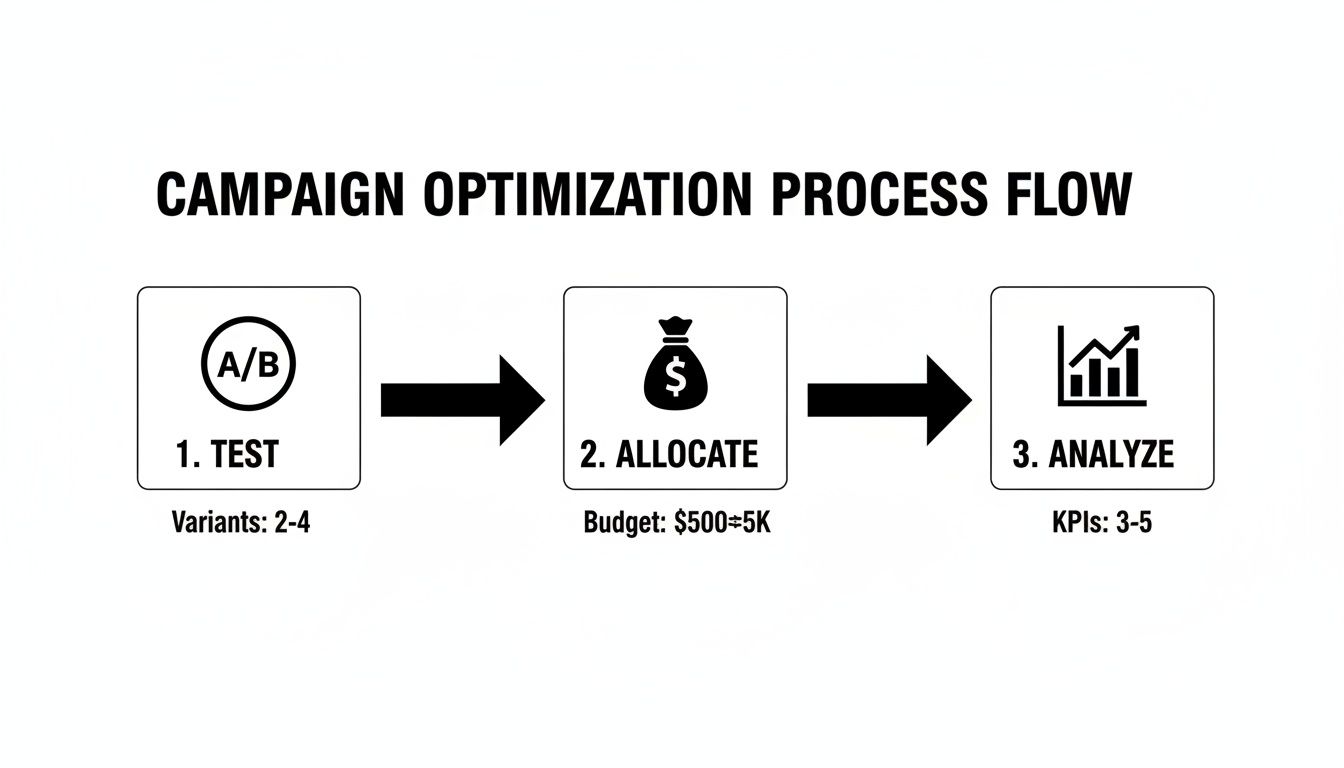
This simple flow shows how AI can automate the optimization loop, constantly learning from performance data to refine your campaigns and get you the best possible return on your ad spend. When you start building these integrated workflows, you create a marketing process that's not just faster, but also far smarter and more dialed into what actually works.
Common Questions About Using AI in Marketing
Whenever a new technology pops up, it’s natural to have questions. Jumping into AI in marketing is no different. You’re probably wondering about the real-world costs, data security, and honestly, just where to start without getting overwhelmed. Let’s tackle those common concerns head-on so you can move forward feeling confident.
One of the biggest myths is that AI is an all-or-nothing investment. The truth is, you can start small. Often, the smartest move is simply adding one specialized tool to your current workflow, not overhauling your entire department overnight.
What Is a Realistic Budget for AI Tools?
The price tags on AI marketing tools are all over the map, but you definitely don’t need a massive budget to get in the game. Many of the most effective platforms run on a simple subscription model, with different tiers that grow with you. You can find some seriously powerful tools for under $100 per month.
Think about it this way: a generative AI tool for whipping up ad creative or social media content might have a free plan or a low-cost tier that’s perfect for a small team. The trick is to identify one high-impact area—like automating ad copy variations—and start there. See what the return on investment (ROI) looks like before you even think about adding more tools to your stack.
I see this all the time: marketers pay for a huge, all-in-one AI suite but only end up using one or two features. Focus on solving a specific, nagging problem first, not on buying the biggest platform on the block.
Is My Customer Data Safe with AI?
Data privacy is a huge deal, and any AI provider worth their salt knows it. When you're vetting a new tool, look for vendors who are completely transparent about how they handle data and comply with regulations like GDPR. Your customer data should only be used to train models for your account—not to feed the algorithm for everyone else.
Here are a few things I always look for:
- Data Encryption: Make sure the platform encrypts your data both when it's being sent and when it's stored.
- Clear Privacy Policies: Actually read them. You need to know how they use, store, and protect your information.
- User Controls: The best tools put you in the driver's seat, giving you the ability to manage and even delete your data.
Which Marketing Tasks Should I Automate First?
The best place to start with AI automation is with the tasks that are repetitive, data-intensive, and just plain time-consuming. These are your quick wins. Nailing these frees up your team to focus on the stuff that really requires a human brain. At the same time, investing in AI model training ensures that the automation becomes smarter and more effective over time.
Consider dipping your toes in with one of these:
- Content Ideation: Use AI as a brainstorming partner for blog topics, fresh ad angles, or social media post ideas.
- Basic Copywriting: Let it generate the first draft of ad copy, product descriptions, or those tricky email subject lines. Email Outreach: Use AI for cold email to automate prospecting campaigns, personalize messages at scale, handle follow-ups, and qualify responses, turning weeks of manual outreach into hours of strategic oversight.
- Performance Reporting: Automate the grunt work of pulling campaign data and spotting basic performance trends.
The goal isn't to replace your team's creativity. It's to handle the tedious groundwork so they can spend their time on high-level strategy, polishing the final product, and actually talking to customers.
Ready to stop guessing and start creating high-performing ads in minutes? Quickads.ai uses AI to generate stunning image and video ads tailored to your brand, complete with compelling copy.





Privacy is important to us, so you have the option of disabling certain types of storage that may not be necessary for the basic functioning of the website. Blocking categories may impact your experience on the website. View Our Privacy Policy


