
Master the basics: how to improve social media engagement for your brand
If you want to boost your social media engagement, you have to stop chasing likes. Real engagement is about sparking genuine conversations and creating content that people actually want to comment on, share, and save. These actions signal to the algorithms that your content is valuable, pushing it out to an even wider audience.
Going Beyond Likes: The New Rules Of Engagement

Let's be real—the social media game has changed. The old playbook of racking up follower counts and post likes is dead. That strategy just doesn't deliver meaningful results anymore.
Today, real engagement is all about building an active, loyal community through authentic, two-way conversations. It’s the difference between shouting a message into a void and actually fostering a connection.
This shift demands a new way of thinking. Instead of asking, "How do I get more likes?" start asking, "How can I start a meaningful conversation?"
The Three Pillars of Modern Engagement
From my experience, true engagement is built on three core pillars. Get these right, and you'll create a thriving online presence.
- Interaction: This is the stuff you can see—comments, shares, saves, DMs, and even poll responses. These actions carry so much more weight than a simple like because they require more effort and show genuine interest from your audience, which is why many creators buy YouTube comments to get that interaction rolling on a still-quiet video.
- Trust: When you consistently show up with valuable content, respond to comments thoughtfully, and are genuinely authentic, you build trust. People start to see you as a credible, reliable voice in your space. This trust is the bedrock of any strong community.
- Conversion: This is where it all leads. When you have an interactive community that trusts you, turning followers into customers or clients feels like a natural next step, not a hard sell.
Think about it. An account with a million followers that gets a handful of comments is just a quiet audience. But an account with 10,000 followers that gets hundreds of thoughtful comments? That’s a vibrant, powerful community. That’s the account you want to be.
Navigating Today's Crowded Social Space
This new approach is essential because social media is incredibly crowded. As of 2025, there are around 5.24 billion social media users across the globe. The average person is active on nearly seven different platforms every month!
With users spending an average of 2 hours and 21 minutes scrolling each day, your content has to do more than just show up—it has to stand out and earn that interaction.
The new currency of social media isn't attention; it's interaction. An account that sparks dialogue, even with a smaller audience, will always outperform one that speaks to a silent crowd.
This means a multi-platform, mobile-first strategy isn't optional anymore. To truly foster meaningful connections and move beyond empty metrics, you need to dig into potent social media engagement strategies.
Your goal should be to make every post an open invitation to connect. Turn passive scrollers into active community members who feel seen, heard, and valued. That's the new benchmark for success.
Know Your Audience Before You Post Anything
Let’s get one thing straight: creating content without knowing who you're talking to is a complete waste of time. It’s like telling an inside joke to a room full of strangers. You might think it’s brilliant, but if nobody gets it, what's the point? This is why the very first step in boosting social media engagement isn't about posting more—it's about stopping the guesswork and starting the research. A social media viewer can complement this research by helping marketers browse supported public profiles, posts, stories, and videos across multiple platforms without signing in.
Every single post, Reel, and Story needs to be created with a specific person in mind. Before you can craft content that truly connects, you need a crystal-clear picture of who that person is. This means digging deeper than surface-level assumptions and getting your hands on the data that’s already available to you. That same principle applies whether you are creating content for lifestyle brands or for niche services, including workers comp lawyers in phoenix, because understanding the exact concerns of your audience shapes every message you share.
Uncover Insights with Native Analytics
Believe it or not, your social media platforms are absolute goldmines of audience data. They tell you more than just who follows you; they show you how they behave. It’s time to stop ignoring those analytics tabs and start using them as the strategic tools they are.
Most platforms offer a surprisingly powerful suite of free tools designed to give you these exact insights. Here's what you should be looking for:
- Demographics: Start with the basics. Tools like Meta Business Suite (for Facebook and Instagram) or TikTok Analytics will show you the age, gender, and location of your followers. A brand targeting Gen Z in big cities needs a completely different vibe and content strategy than one targeting millennial parents in the suburbs.
- Active Times: Stop posting whenever you feel like it. Your analytics will show you the exact days and hours your audience is most active online. Dropping your content during these peak windows gives it the best possible chance of being seen and engaged with right away.
- Top-Performing Content: Go look at which of your past posts got the most comments, shares, and saves. These are your breadcrumbs. Do people love your quick tutorials? Behind-the-scenes glimpses? Relatable memes? Find out what's already working and do more of it.
Learning the rhythm of your audience is key. For a deeper dive into timing your posts for maximum impact, check out our guide on the best times to post on social media in 2025. When you combine that general knowledge with your own specific analytics, you've got a seriously powerful scheduling strategy.
Listen to What Your Audience Is Already Saying
Analytics tell you the "what," but social listening tells you the "why." Social listening is simply the act of tuning into conversations happening around your brand, your industry, and your competitors. It's about understanding the slang your audience uses, the problems they're constantly complaining about, and the things they're genuinely passionate about.
Social listening is the difference between joining a conversation and interrupting one. With social listening tools, you can understand the context, making your content a welcome contribution rather than just another piece of noise.
You don't need a massive budget or fancy tools to get started. Just begin by manually searching for keywords, hashtags, and mentions related to your niche on platforms like X (formerly Twitter), LinkedIn, and even Reddit. Pay close attention to the questions people are asking and the frustrations they're airing out. These are your next content ideas, handed to you on a silver platter.
Build Your Content Pillars
Once you've gathered all this intel, it's time to turn it into a real, sustainable content strategy. The best way to do this is by establishing content pillars—these are three to five core topics or themes that your brand will consistently own and talk about. Your pillars should live right at the intersection of what your brand is about and what your audience actually wants to hear.
For example, a sustainable fashion brand’s content pillars might look like this:
- Ethical Production: Taking people behind the scenes to see how their clothes are made.
- Styling Tips: Showing customers how to create versatile, cool outfits with their pieces.
- Sustainability Education: Sharing practical tips for a more eco-friendly lifestyle.
These pillars become your North Star for content planning. They ensure every post has a purpose and lines up perfectly with your audience's interests. This kind of structured approach saves you from the daily scramble for ideas and guarantees your feed provides consistent value—and that’s the real foundation for building engagement that lasts.
Creating Content People Can't Help But Share

Alright, you've done your homework and know who you're talking to. Now comes the fun part: making stuff they actually want to see. This is where strategy and creativity collide to make content that stops the scroll cold. The goal isn't just to get seen; it's to create posts that get felt, saved, and, most importantly, shared.
Every single thing you post should offer undeniable value. That value typically falls into one of three buckets: education, entertainment, or inspiration. Think of it this way: are you solving a problem, making someone laugh, or firing them up to take on the day? If your content doesn't do one of those three things, it's probably just noise.
Mastering Short-Form Video
Let's be real: short-form video isn't a "trend" anymore. It's the native language of social media. Platforms like TikTok, Instagram Reels, and YouTube Shorts are built to reward creators who can grab attention within the first three seconds. If your start is weak, your audience is already gone.
A thumb-stopping video lives and dies by its hook. Ditch the slow, generic intros and lead with something that jolts the viewer. A bold statement, a provocative question, fast-paced animated text from an auto subtitle generator, or a weird visual can all do the trick.
Here are a few hook formulas I've seen work time and time again:
- The "Mistake" Hook: "You're making this huge mistake when you..." This instantly taps into our fear of doing things wrong and our desire to improve.
- The "Secret" Hook: "Here's the one secret about [topic] nobody is telling you..." This creates a feeling of exclusivity, like you're letting them in on something special.
- The "How-To Without" Hook: "How to achieve [desired outcome] without [common pain point]..." This is pure gold because it promises a shortcut or an easier path to a solution.
Once you've hooked them, get to the point fast. Deliver the value you promised and wrap it up with a clear call to action. Platforms like Reachingly can help streamline content distribution and amplify engagement across multiple social channelsTell them exactly what to do next, whether it's asking a question to kick off a discussion or encouraging a save for later.
Designing Shareable Carousels And Image Posts
While video gets all the hype, a killer carousel or multi-image post is an engagement machine, especially on Instagram and LinkedIn. They make people slow down, swipe, and spend more time with your content—a metric the algorithms love. The best carousels are basically mini-presentations.
The structure is simple but incredibly effective:
- A Compelling Cover: It needs a bold headline that promises a clear, valuable takeaway.
- Value-Packed Slides: Each slide should focus on one single idea, tip, or step. Keep the text minimal and let strong visuals do the talking.
- A Call-to-Action Finale: The last slide is your moment. Nudge them to "Save this post for later," "Share this with a friend who needs it," or "Comment your biggest takeaway below."
This format turns a post from a fleeting image into a reusable resource, making it super saveable. Juggling all this can be a lot, but tools like an AI social media post generator can be a lifesaver for brainstorming and streamlining the creation process.
Your content should feel like a gift to your audience. When people feel you've given them something valuable for free—whether it's a laugh, a new skill, or a moment of inspiration—they are far more likely to share it with others.
This principle rings true everywhere. Data shows certain content just works better on certain platforms. For example, TikTok absolutely crushes it on organic engagement, with an average post rate of 2.5% that can jump to 7.5% for smaller accounts. On LinkedIn, multi-image posts hit a 6.6% engagement rate, showing that professionals respond to visually dense, informative content. With advertisers set to spend over $276 billion globally on social ads, having a smart content strategy is non-negotiable. You can discover more insights about these social media marketing statistics on Sprinklr.com.
Writing Captions That Start Conversations
If your visual is the hook, the caption is the handshake. A great visual can be completely wasted by a lazy caption. Stop just describing what's in the photo or video and start using the caption to build a connection and spark a real conversation.
Make sure your first line is intriguing enough to make people click that "see more" link. Use the rest of the space to add context, tell a quick story, or drop extra tips that build on the visual. And please, end with a question or a prompt. Ditch the generic "What do you think?" and ask something specific and relevant. That simple switch is often the difference between a post that gets scrolled past and one that builds a community.
How to Build a Community, Not Just a Following
Hitting "publish" on a post isn't the finish line. Honestly, it's just the starting gun. The real work—and the real magic—happens in the minutes, hours, and days that follow. This is where you pivot from just being a content creator to becoming a genuine community builder. The goal is to stop thinking of your page as a billboard and start treating it as a lively hub, a place where people feel connected to your brand and, just as importantly, to each other.
Sustained engagement is born from this kind of hands-on community management. We're not talking about one-word replies or generic "thanks!" comments. It’s about turning simple interactions into real relationships. When someone takes the time to leave a thoughtful comment, they're basically opening a door to a conversation. Your job is to walk right through it.
Make Every Response Count
Think of every comment and DM as a golden opportunity. Responding quickly and with a personal touch shows people you're actually listening and that their input matters. This simple act can turn a casual scroller into a loyal fan for life. As that loyalty builds, creators often find that pairing genuine interaction with tools that help expand their follower base makes it easier for the right people to discover and join the conversation.
Want to make your responses feel less like a bot and more like a real person? Try these moves:
- Ask a follow-up question. Instead of a dead-end "Thanks!", try something like, "Glad you liked it! Which part was most helpful for you?" to keep the ball rolling.
- Let your personality shine. Go ahead and use those emojis, drop a relevant GIF, or crack a joke. If it fits your brand's voice, it makes the interaction more human.
- Acknowledge what they said. When someone shares an opinion, validate it. Simple phrases like, "That's a great point," or "I totally see where you're coming from" make people feel heard and respected.
This isn't just a nice-to-have; it's becoming a major competitive advantage. In a recent study, 41% of organizations said they are already testing proactive engagement techniques. In fact, using AI to personalize and automate immediate responses can boost engagement by up to 1.6 times compared to older, more static strategies. This just shows how massive the impact of real-time dialogue is. You can dig into more of these 2025 social trends on Hootsuite.com.
Go Beyond Your Own Feed
Building a true community means you can't just stay on your own turf. Proactive engagement is all about stepping outside your own profile to interact with others in your space. This means leaving meaningful comments on posts from other creators, potential customers, and even complementary brands in your industry.
This is a fantastic strategy for building visibility and rapport without being salesy. When you leave a valuable, insightful comment on someone else's post, you're not just talking to them; you're putting yourself in front of their entire audience. It’s a powerful, organic way to get discovered by people who are already primed to be interested in what you offer.
Celebrate Your Community with User-Generated Content
One of the best ways to make your community feel strong and connected is to put its members in the spotlight. User-generated content (UGC) is pure gold—it's any content like photos, videos, or reviews created by your followers that features your brand. Customer reviews are one of the most powerful forms of UGC. When potential buyers see authentic feedback, they're more likely to engage with your brand and trust your content.
When you feature a follower's content, you're doing so much more than just filling a spot on your content calendar. You're sending a powerful message to that person, and everyone watching, that says: "We see you, we value you, and you are a part of our story."
A great starting point is to create a unique branded hashtag and encourage your audience to use it. Make a habit of checking that hashtag regularly, and when you find great stuff, reshare it! Just be sure to always give proper credit to the original creator. This not only gives you a ton of authentic social proof but also makes your followers feel like they're true partners on your brand's journey. This approach works especially well for service professionals, including a seattle personal injury lawyer, who can reshare client stories and community mentions to build trust and credibility.
Every platform has its own unique quirks when it comes to engagement. What works wonders on Instagram might fall flat on LinkedIn. Understanding these nuances is key to making your community-building efforts pay off.
Here’s a quick-reference table to help you tailor your tactics.
Platform-Specific Engagement Tactics That Work
PlatformTop Engagement TacticA Pro Tip You Can Use TodayInstagramReels Replies & Story StickersInstead of just liking a comment on your Reel, reply to it with a new Reel. Use the "Add Yours" and "Poll" stickers in your Stories daily to encourage easy interaction.TikTokStitching & DuetingFind a trending video in your niche and use the Stitch or Duet feature to add your own commentary or reaction. It's a built-in way to join a larger conversation.FacebookGroup-Specific QuestionsPost open-ended questions in relevant Facebook Groups (your own or others). Focus on starting conversations, not dropping links. "What's the biggest challenge you're facing with [topic]?"X (Twitter)Quote Tweets & Live ChatsInstead of a simple retweet, use Quote Tweet to add your own insight or question. Participate in or host a weekly chat using a specific hashtag to drive real-time conversation.LinkedInThoughtful Comments on Leader PostsIdentify 5-10 leaders in your industry. Leave insightful, paragraph-long comments on their posts. This provides value and gets your profile seen by the right people.PinterestIdea Pins with QuestionsCreate multi-page Idea Pins that tell a story or give a tutorial. On the last slide, ask a direct question and encourage people to leave their thoughts in the comments.
By applying the right tactic on the right platform, you're not just posting—you're strategically engaging where it matters most, making your community-building efforts far more effective.
Using Data to Make Your Content Smarter
Making great content is really only one piece of the puzzle. If you want to see your engagement numbers actually climb, you have to close the loop. This means turning your performance data into a clear roadmap for what to create next, building a smart cycle of creating, measuring, and tweaking that gets better over time.
Stop guessing what your audience wants. Treat those signals like SEO data too, or partner with a Toronto SEO agency to translate engagement patterns into topics that can win in search as well. Start listening to what their actions are telling you. Every single comment, share, and save is a clue. Your job is to learn how to read these signals to make your next piece of content even more impactful than the last.
Moving Beyond Vanity Metrics
For too long, the social media game was all about chasing likes and follower counts. Those are vanity metrics—they look nice on the surface but don't tell you anything about the real health of your community or whether people actually care.
Real connection is measured by actions that require more effort and signal genuine interest.
It’s time to start prioritizing these metrics instead:
- Share Rate: This is gold. It tells you how many people found your content so valuable they were willing to put their own reputation on the line and share it with their network. It's a huge indicator of resonance.
- Save Rate: Saves are a direct signal that you've created a genuine resource. People save content they plan to come back to, which tells the algorithm your post has long-term value.
- Comment Sentiment: Don't just count the number of comments—actually read them. Are people asking thoughtful questions? Tagging friends? Sharing their own stories? This qualitative data is infinitely more insightful than a raw number.
The most successful social media strategies aren't built on random viral hits. They're built on a consistent, evolving understanding of what truly connects with an audience. Data isn't just for reporting; it's for refining.
When you shift your focus to these deeper metrics, you naturally start creating with a different purpose. You stop making posts that are just fishing for a quick "like" and start building a library of resources your audience truly values.
This simple flow shows how community building is an active process, moving from simply reacting to engagement to proactively creating it.
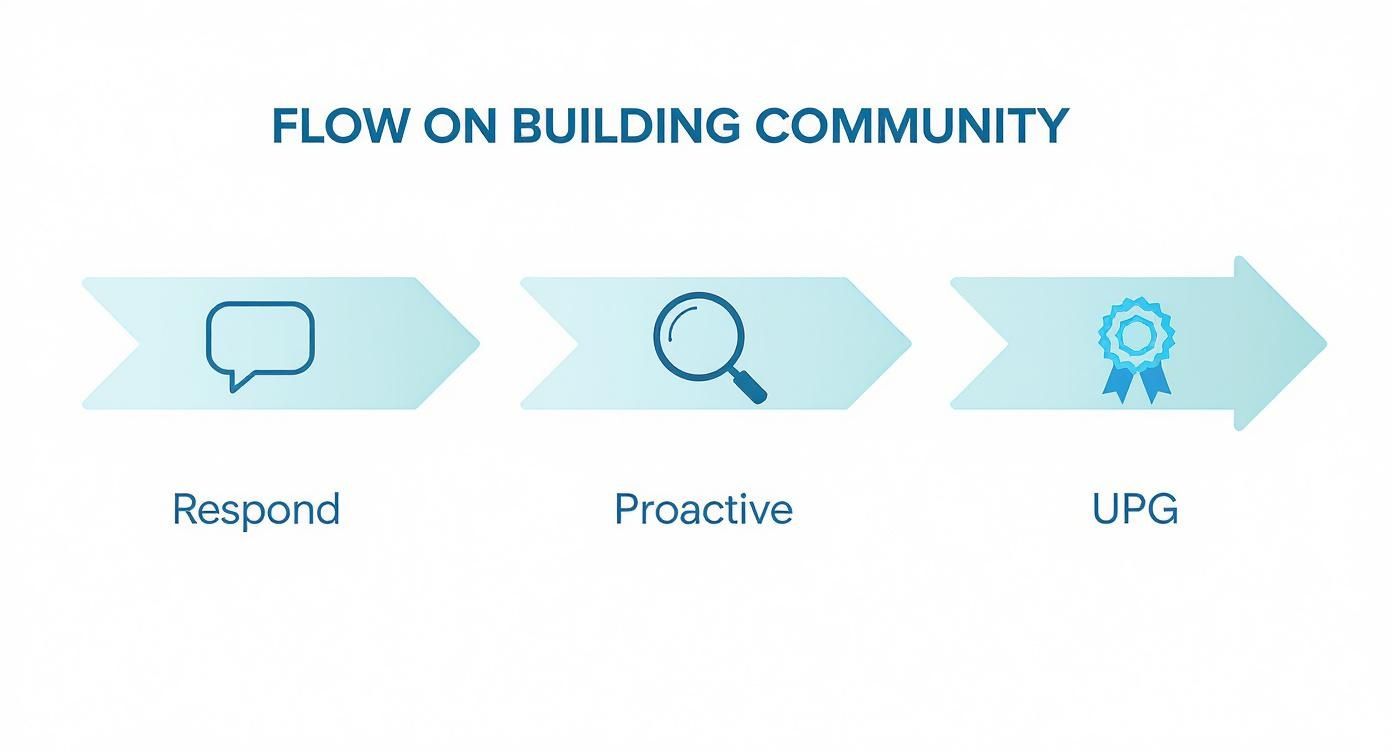
As you can see, it all culminates in celebrating user-generated content (UGC), which is the ultimate payoff for all your hard work building that community.
Learning Firsthand with Simple A/B Tests
Analytics tell you what already happened. A/B testing, on the other hand, helps you figure out what will work next. It's a straightforward way to let your audience vote on what they prefer with their clicks and comments.
And you don't need fancy, expensive software to get started. You can run small, controlled experiments right on your own feed.
For instance, you could test:
- Headlines: Post the exact same carousel, but try one version with a question as the headline ("Have you made this mistake?") and another with a bold statement ("Stop making this mistake.").
- Visuals: Share a helpful tip using a static graphic one day. The next week, share a similar tip using a short video or Reel.
- Calls-to-Action (CTAs): On one post, ask followers to "Comment your thoughts below." On a similar post, ask them to "Save this for later."
Track the results for each test. After just a few experiments, you'll start gathering concrete evidence about what your specific audience responds to, allowing you to fine-tune your strategy based on facts, not feelings.
Your Monthly Performance Review Framework
Block out some time on your calendar each month to actually sit down and review your social media analytics. A consistent review process is what keeps you from operating on old assumptions and ensures your strategy stays sharp.
Keep your review focused and actionable with this simple framework:
- Find Your Winners: Identify your top 3-5 posts from the last month based on your key engagement metrics (shares, saves, meaningful comments). What did they have in common? Was it the format, the topic, or the hook?
- Analyze the "Flops": Now look at the posts that fell flat. Be brutally honest with yourself about why they might have missed the mark. Was the topic too niche? Was the visual boring?
- Pull Out Actionable Insights: Based on your analysis, come up with 2-3 specific, concrete takeaways to apply to next month's content plan. This shouldn't be vague. It should be something like, "Create more tutorials in a carousel format" or "Test more hooks that start with a question."
This regular check-in creates a powerful feedback loop. You're no longer just throwing content at the wall to see what sticks; you're building an intelligent system that gets smarter and more effective with every single post you make.
Got Questions About Social Media Engagement? We've Got Answers.
Even with a killer strategy, the day-to-day reality of social media management brings up a ton of questions. What works in theory can get tricky when you're actually in the trenches, trying to make it happen. This section is all about tackling those common hurdles.
Think of this as a practical field guide for those moments when you're staring at your screen wondering, "What do I do now?" We'll get straight to the point with clear answers to the questions that keep social media pros up at night.
How Often Should I Actually Post to Keep People Engaged?
This is the big one, isn't it? But there's no single magic number. The right posting frequency really comes down to the platform and, more importantly, your audience's habits. It’s a delicate balance between staying visible and just plain annoying them.
On fast-moving platforms like X (formerly Twitter) or Instagram Stories, you can get away with posting multiple times a day. The content is fleeting, so a higher volume feels natural. But for your main feed on Instagram, Facebook, or LinkedIn, aiming for 3-5 high-quality posts per week is a much more sustainable and effective goal.
The real secret isn't volume—it's consistency. Showing up predictably, even if it's just a few times a week, will always beat a flurry of posts followed by a week of silence.
Dive into your analytics and find out when your audience is most active online. Those are your prime time slots. Schedule your best content to drop right then to get that initial burst of visibility. From there, test different frequencies. If you bump your posting up and see your engagement-per-post tank, you might be overdoing it. Let the data be your guide and never sacrifice quality for quantity.
What’s the Best Way to Handle Negative Comments or Trolls?
Sooner or later, you're going to get negative comments. It's just part of the game. The way you respond says everything about your brand, so it pays to have a plan. First, you need to figure out what you're dealing with.
Is it a legitimate complaint from an unhappy customer? Jump on it. Respond publicly, quickly, and with empathy. Acknowledge their problem, show you understand their frustration, and then offer to take the conversation to a private channel (like DMs) to sort it out. This shows everyone else watching that you listen and you care.
But what if it's just a troll—someone leaving baseless, nasty comments to get a rise out of you? The best move is often to just ignore or hide their comment. Giving them a response is like pouring fuel on a fire; it's exactly the attention they want. If a comment breaks your community rules (think spam, hate speech, or harassment), the answer is simple: delete the comment and block the user immediately. No second chances. Having your community guidelines linked in your bio is a great way to set the ground rules from the start.
Help! My Engagement Suddenly Dropped. Why and What Do I Do?
Seeing your engagement fall off a cliff is stressful, but don't panic. It's usually a fixable issue. Before you jump to conclusions, do a quick diagnostic check.
First, consider external factors. Did a platform just announce a major algorithm change? These updates can completely shift how your content gets seen, and staying on top of them is part of the job.
Next, take a hard look at your recent content. Have you changed up your visual style, topics, or post formats? Experimenting is great, but a sudden, drastic pivot can sometimes leave your audience feeling disconnected.
To get back on track, focus on the fundamentals. Here’s a simple recovery plan:
- Talk to Your People: Go back to basics. Ask direct questions in your posts and Stories. Make it a personal mission to reply to every single comment to spark that conversation again.
- Revisit Your Greatest Hits: Dive into your analytics and find your all-time best-performing posts. What were they? Videos? Carousels? Behind-the-scenes looks? Use that as a blueprint for what to create next.
- Double Down on What Works: If your audience loves your Reels, give them more Reels. If they engage with your carousels, make more of those. A temporary dip is normal; a solid, audience-first strategy is the best way to bounce back.
If you have more questions or want to dig deeper into specific engagement tactics, you might find some great resources on branditok's blog for further insights.
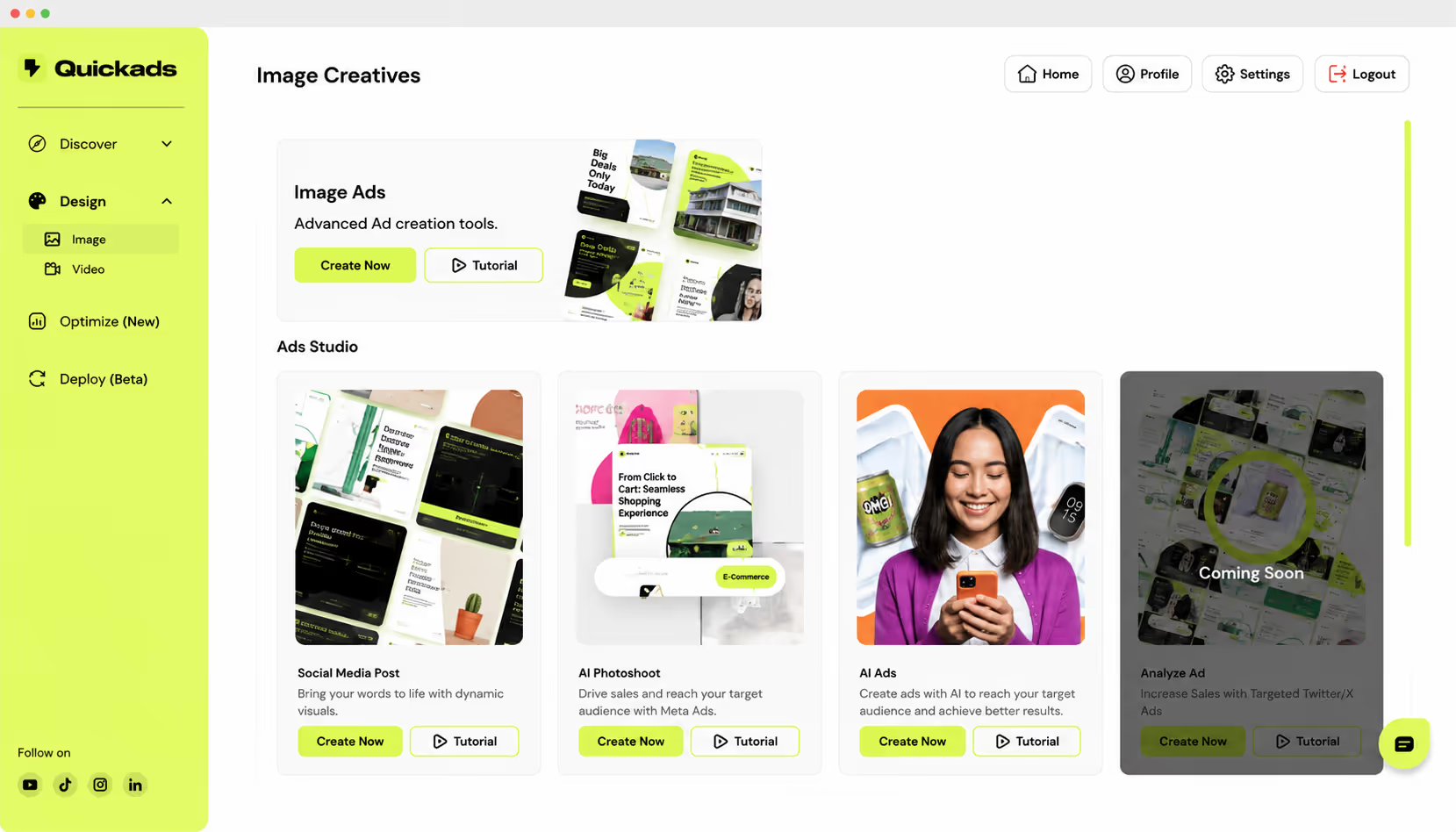
Ready to stop guessing and start creating ads that truly engage? With quickads.ai, you can generate high-performing image and video ads in seconds, using AI trained on data from the most successful campaigns. Start creating effortless ads with Quickads today!







Privacy is important to us, so you have the option of disabling certain types of storage that may not be necessary for the basic functioning of the website. Blocking categories may impact your experience on the website. View Our Privacy Policy


