
Boost Results with how to improve click through rates: proven tips

Before you can boost your click-through rates, you have to nail the fundamentals: making your ads genuinely relevant and compelling to the people you want to reach. This means writing headlines that grab attention, choosing visuals that stop the scroll, and being incredibly precise with your targeting. It’s a mix of creative intuition and smart, data-driven optimization.
Why Your Click-Through Rate Is the Pulse of Your Campaign
Think of your Click-Through Rate (CTR) as direct, unfiltered feedback from your audience. It's not just another metric on a dashboard; it’s a vital sign that tells you how healthy and relevant your campaign really is.
A high CTR is a clear signal that everything's clicking—your message, your creative, and your targeting are all working together to capture attention and inspire action. On the flip side, a low CTR is an early warning that something’s amiss. Maybe your ad copy is confusing, your visuals are falling flat, or you're simply talking to the wrong people.

This metric has a very real impact on your budget. On platforms like Google Ads, a better CTR directly boosts your Quality Score. A strong Quality Score is your ticket to lower ad costs (Cost-Per-Click) and more prominent ad placements. In short, you get more bang for your buck.
The Financial Ripple Effect of a Strong CTR
A high CTR kicks off a powerful positive feedback loop. When more people click your ad, the platform’s algorithm sees it as relevant and rewards you for it. This isn't just a nice-to-have; it tangibly improves your return on investment (ROI).
Here’s how it breaks down:
- Lower Ad Costs: A higher CTR almost always leads to a lower Cost-Per-Click (CPC), which means your budget stretches further.
- Better Ad Placements: Ad platforms want to show engaging content. They'll prioritize high-CTR ads, giving them prime real estate.
- Higher Quality Leads: An ad that truly resonates with the right audience doesn’t just get clicks—it gets clicks from people who are genuinely interested in what you offer.
A strong CTR isn't just about getting clicks; it's about getting the right clicks. It validates your entire campaign strategy—from the audience you chose to the message you delivered—and directly impacts your bottom line.
Standing Out in the New AI-Driven Search World
The fight for attention is only getting tougher, and the importance of a solid CTR is growing right along with it. The rise of AI-generated content in search results is changing user behavior and making every single click harder to earn.
The data on this is pretty stark. One recent analysis showed that the appearance of AI Overviews (AIOs) in search results tanks click-through rates. For paid ads, queries that triggered an AIO saw CTRs plummet from 19.7% down to just 6.34%—a massive 68% drop. If you want to dive into the numbers yourself, you can read more about the AIO impact on Google CTR.
This trend sends a clear message: we have to adapt. It puts even more pressure on us to refine our targeting, make our creative impossible to ignore, and be more strategic than ever about ad placements.
Knowing how to improve your click-through rates is no longer just a good skill to have. It's an absolute necessity for building campaigns that don't just survive, but actually thrive by connecting with what your audience truly wants.
Crafting Ad Creative That Actually Compels Clicks
Your ad creative is the tip of the spear in the battle for attention. It's the first—and often only—chance you get to stop someone mid-scroll and convince them your offer is worth investigating. Forget vague advice; boosting your CTR requires a deliberate blend of psychology, sharp design, and rapid testing with the help of a design agency for startup.
The best ads don't just describe a product; they tap into fundamental human triggers. By getting inside your audience's head, you can write headlines and copy that are nearly impossible to ignore. A great place to start is with proven copywriting frameworks that build persuasion right into their structure.
Psychological Hooks in Your Ad Copy
Think about the last ad that made you click. It probably sparked your curiosity, created a sense of urgency, or made you feel like you were missing out on something big. These aren't accidents; they're calculated appeals to our core emotional drivers.
Here are a few powerful angles I've seen work time and again:
- Curiosity: Frame your headline as a question or an incomplete thought. "The One Mistake 90% of SaaS Founders Make" is far more compelling than "Tips for SaaS Founders." It creates an information gap that people feel an almost physical need to close.
- Urgency and Scarcity: Limited-time offers and low-stock warnings are classics for a reason. Phrases like "Offer Ends Friday" or "Only 3 Spots Left" trigger the fear of missing out (FOMO) and push people to act now.
- Social Proof: We're wired to follow the crowd. Highlighting your customer numbers ("Join 50,000+ Happy Users") or featuring a glowing testimonial instantly builds trust and greases the wheels for a click.
Sometimes, flipping the script works wonders. A negatively framed headline, like "Stop Wasting Money on Ads That Don't Convert," can often outperform a positive one because it hits a specific pain point the user is desperate to solve.
The goal is to distill your entire value proposition into a single, compelling sentence. If your ad can't immediately answer the user's silent question—"What's in it for me?"—it has already failed.
To make this more concrete, let's look at a few formulas you can plug and play with.
Headline Formulas for Higher CTR
Different headline formulas work by triggering specific psychological responses. The key is to match the formula to your audience's mindset and the goal of your ad. Here’s a quick breakdown of some of the most effective ones.
Formula TypeExample HeadlinePsychological TriggerQuestion"Are You Making These Common Investing Mistakes?"Curiosity & Self-AssessmentHow-To"How to Launch Your First Profitable Ad in 3 Days"Desire for Knowledge & SolutionsNegative Angle"Don't Buy Another Skincare Product Until You Read This"Fear of Loss & Problem AvoidanceSocial Proof"Why 10,000+ Marketers Switched to Our Platform"Trust, Safety in Numbers & FOMODirect Benefit"Triple Your Website Traffic With This Simple SEO Tweak"Desire for Gain & Instant Gratification
Experimenting with these different angles can uncover surprising winners. What resonates with one audience segment might fall flat with another, which is why continuous testing is non-negotiable.
Visuals That Stop the Scroll
In a mobile-first world, your visuals have less than a second to make an impact. While polished studio ads have their place, the trend is shifting hard toward authenticity. This is where User-Generated Content (UGC) absolutely shines.
UGC-style visuals, whether they're simple phone videos or customer photos, feel more genuine and less like a slick, corporate ad. That authenticity builds instant trust and can lead to a significant CTR lift. For example, recent data on social media ad performance shows that UGC-style Reels, when paired with a refined call-to-action, can dramatically boost results.
One case saw a CTR increase to 2.6%, a 31% reduction in Cost Per Acquisition, and a ROAS improvement from 2.8x to 4.3x in just six weeks. This is a perfect example of how combining authentic creative with smart strategy pays off.
Scaling Creative Optimization with AI
Manually creating and testing dozens of ad variations is a surefire path to burnout. This is where AI-powered tools come into their own, letting you scale your creative process without sacrificing quality.
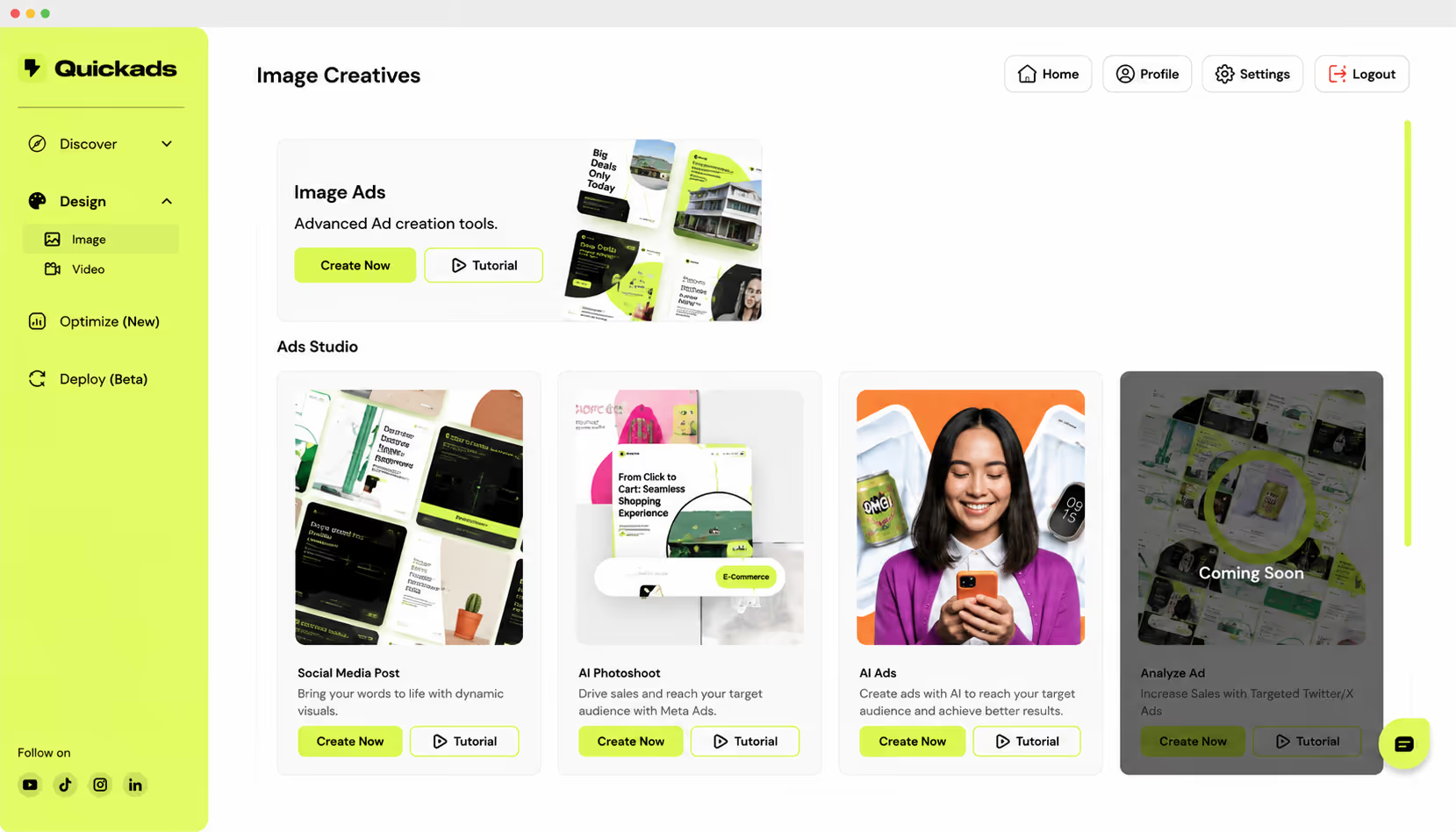
An AI ad generator like Quickads.ai can take your core message and instantly spin up numerous creative options. You just supply a product URL, and the tool produces headlines, ad copy, and visuals tailored for different platforms.
The whole point is rapid iteration. You can go from a single concept to a full-blown A/B test with multiple variants in minutes, not hours.

By automating the tedious parts of ad creation, you free up your team to focus on high-level strategy and actually thinking about the test results. This is essential for maintaining a creative refresh cycle, which is crucial for preventing ad fatigue and keeping your CTR from tanking.
If you want to dive deeper into this workflow, check out our guide on the secrets to creating ads that work.
Unlocking Precision with Advanced Audience Targeting
Even a brilliant ad will fall flat if it’s shown to the wrong people. It’s that simple. Sky-high click-through rates are built on relevance, and that means you have to get way more specific than just broad, demographic-based targeting. It’s time to stop shouting into the void and start a direct conversation with the people who actually want to hear from you.
The first place to look is the data you already own—your first-party data. I’m talking about your email lists, CRM contacts, website visitors, and past buyers. This information is pure gold for building ad campaigns that actually connect with people.
Put Your First-Party Data to Work
Your best customers are the perfect model for finding new ones. You can take a list of these high-value customers and upload it to platforms like Facebook or Google to create a lookalike audience. The platform’s algorithm then does the heavy lifting, analyzing the common traits and behaviors of your list to find a whole new group of users who mirror them.
This isn’t just a shot in the dark; you're using a proven blueprint of your ideal customer to find more just like them. When your ad hits their feed, it’s far more likely to be relevant, and relevance is what drives clicks.
Another classic, powerful tactic is retargeting. By placing a tracking pixel on your website, you can create custom audiences of people who’ve shown interest—they visited your pricing page, added a product to their cart, or spent time reading your blog. Showing tailored ads to this warm audience is a gentle nudge, reminding them why they were interested in the first place and bringing them back to finish what they started. The results can be incredible.
Layer Your Targeting to Build a Precise Persona
This is where the real strategy comes in. Instead of just targeting one broad interest, you can layer multiple targeting options on top of each other to build a super-specific audience. It's about combining different criteria to zero in on exactly the right person.
If you really want to get this right, you need a solid grasp of market segmentation. For a deeper dive, check out this guide on understanding segmentation in marketing.
Let's walk through a real-world example for a B2B SaaS company trying to get leads.
- Behavioral: First, you could target users who are "in-market for business software" or those who have recently been snooping around your competitors' websites.
- Interests: Next, you'd layer on an interest in specific industry leaders, relevant publications, or key conferences in your niche.
- Demographics: Finally, you'd narrow it down by job title (like "Marketing Manager" or "VP of Sales") and company size (say, 11-50 employees).
Suddenly, you're not just targeting "business professionals." You're reaching a marketing manager at a mid-sized tech company who follows industry blogs and is actively researching new CRM tools. The relevance of your ad just went through the roof, and your CTR will climb right along with it.
Getting specific with targeting isn't about making your audience smaller just for the sake of it. It’s about refining it until only the people who will genuinely value your message are left, making a click feel like the natural next step.
This level of precision turns your ad spend from a gamble into a calculated investment. You ensure every impression is working for you by delivering the right message to an audience that isn't just receptive but is actively looking for what you offer.
Matching Your Message to the Right Channel and Format
Expecting a splashy video ad to pull the same numbers as a high-intent search ad is a recipe for disappointment. It’s like asking a fish to climb a tree. It's just not going to happen, and you'll only end up frustrated.
The real secret to consistently improving your CTR is realizing that every channel has its own language, user mindset, and performance expectations. Someone scrolling through Instagram is in a discovery mode, open to being entertained or inspired. But a person typing a specific query into Google? They're on a mission, actively looking for an answer. Your message, format, and even your definition of a "good" CTR has to adapt to that context.
Aligning Your Campaign with User Intent
The first, most fundamental step is matching your ad to the user’s state of mind. Are they hunting for an immediate solution, or are they just casually browsing? This one distinction dictates everything that follows.
- High-Intent Channels (e.g., Google Search): These users have a clear goal. They are actively searching for products, services, or information. Your job is to be the most direct and relevant answer to their question. The closer your ad copy mirrors their search term, the more clicks you'll get. Simple as that.
- Discovery-Based Channels (e.g., Paid Social, Display): On platforms like Facebook, Instagram, or the Google Display Network, people aren't looking for you. You have to interrupt their scroll with something that grabs their attention—a compelling visual, an intriguing headline—and create demand from scratch. Here, the goal is often brand awareness first, clicks second.
Don't try to force a hard-sell, direct-response ad onto a passive discovery channel. It feels jarring and totally out of place. Instead, meet the audience where they are—with content that entertains, educates, or inspires—to actually earn their click.
Understanding CTR Benchmarks Across Different Platforms
To know if your campaigns are actually working, you have to set realistic goals. The benchmarks for a strong CTR vary wildly from one channel to the next, and even between different campaign types on the same platform.
For instance, data from Google Ads shows just how much campaign type matters. AI-driven Performance Max campaigns often see an average CTR of 4.2%, which easily beats what you'd see from traditional search ads. Standard search campaigns tend to hover around 3.2%, while the much broader Display Network sees far less engagement, averaging about 0.46%. Video campaigns usually land somewhere in the middle, with a baseline around 2.0%. You can dig deeper into these average Google Ads click-through rates to see how different factors come into play.
Knowing these numbers helps you diagnose problems. A 1% CTR on a search campaign is a major red flag, but on a display campaign? That could be a sign of a high-performing ad.
Average CTR Benchmarks by Ad Channel
Setting a single CTR target across all your campaigns is a flawed strategy from the start. This table gives you a much clearer picture of what "good" looks like on different channels, helping you set expectations that make sense.
Ad Channel / Campaign TypeAverage CTR BenchmarkPrimary User IntentGoogle Performance Max3.5% - 5.5%Mixed (High-Intent & Discovery)Google Search2.5% - 4.0%High-Intent & Problem SolvingPaid Social (e.g., Meta)0.8% - 1.6%Discovery & Brand AwarenessGoogle Display Network0.4% - 0.7%Brand Awareness & RetargetingEmail Marketing2.0% - 5.0%Nurturing & Re-engagement
As you can see, each channel serves a very different purpose in your marketing funnel, and the engagement reflects that.
Choosing the Right Ad Format for the Job
Beyond the channel, the ad format you choose plays a massive role in whether people click. A static image won't perform the same as a video, and a carousel ad tells a much different story than a single-image post.
Think about what you're trying to communicate.
- Showcasing a Complex Product? Use carousel ads or short video tutorials. These formats let you break down features and benefits into bite-sized pieces, guiding someone through a narrative that builds their interest and gets them to click for more.
- Promoting a Direct Offer? Go with a static image ad. Use bold, clear text overlays and a direct call-to-action (CTA). This is perfect for a sale, a free download, or a limited-time offer where the value proposition is simple and urgent.
- Building Your Brand? This is where longer-form video ads shine. They're ideal for building an emotional connection. While you might measure them more on view-through rates, a truly compelling story will always drive high-quality traffic.
When you strategically match your message, channel, and format, you stop chasing empty clicks and start creating genuinely relevant experiences. This alignment is the foundation of a high-CTR strategy that respects the user's context and delivers much better results for your budget.
Building a Smarter A/B Testing Framework
Throwing random ad changes at the wall to see what sticks is a classic way to burn through your budget and time. If you want to consistently improve your click-through rates, you need to shift from guesswork to a structured A/B testing process—one that learns and builds on every single result.
This framework turns optimization from a guessing game into a systematic engine for continuous improvement.
The entire process starts with a solid, clear hypothesis. This isn't just a vague idea; it's a specific, testable statement predicting an outcome. Don't just think, "Maybe a different CTA will work." Instead, formulate a proper hypothesis: "Changing our CTA from 'Learn More' to 'Get Your Free Trial' will lift CTR by 5% because it directly addresses user intent and offers immediate, tangible value."
See the difference? A good hypothesis forces you to think critically about why a change might work, connecting your action to a measurable result.
Prioritizing Your Tests for Maximum Impact
With a nearly infinite number of variables you could test, knowing where to start is half the battle. My advice? Focus your first tests on the elements with the biggest psychological and visual punch—the things that actually make someone decide to click.
Start with these high-impact variables:
- The Headline: It’s the first thing almost everyone reads. Test different angles. Does a question work better than a direct benefit? What about injecting some urgency?
- The Primary Visual: For social and display ads, the image or video is everything. Pit authentic User-Generated Content (UGC) against polished studio shots or maybe even a simple illustration.
- The Offer or CTA: This is your final ask, your moment of truth. You’d be surprised how much of a difference small tweaks from "Sign Up" to "Get Started" can make in a user's commitment.
And here’s a non-negotiable rule: test one variable at a time. If you change both the headline and the image, you'll have no idea which element was actually responsible for the performance shift. This discipline is absolutely essential for getting clean, actionable data you can learn from.
Executing and Measuring Your Tests Correctly
Once you have your hypothesis and your variable, it's time to run the test. For non-technical marketers, there are plenty of user-friendly tools that make this a breeze. If you're hunting for the right platform, you can explore some of the top ad testing tools for non-technical marketers to see what fits your workflow.
Let your test run long enough to achieve statistical significance. This is just a fancy way of saying you have enough data to be confident your results aren't a random fluke. Most ad platforms have built-in calculators for this, but as a rule of thumb, I always aim for at least 1,000 impressions per variation.
A/B testing isn't a one-and-done task. It’s a continuous cycle: hypothesize, test, learn, and iterate. Every test, win or lose, gives you a valuable insight into what makes your audience tick.
Finally, you have to know when to hit refresh. Even your best-performing ad will eventually suffer from ad fatigue as the same audience sees it over and over. I recommend setting a cadence—usually every 3-4 weeks—to introduce new creative variations. This proactive approach keeps your campaigns feeling fresh and stops your CTR from slowly bleeding out.
This chart shows some typical CTR performance across different ad channels, which can help you set realistic benchmarks for your own tests.
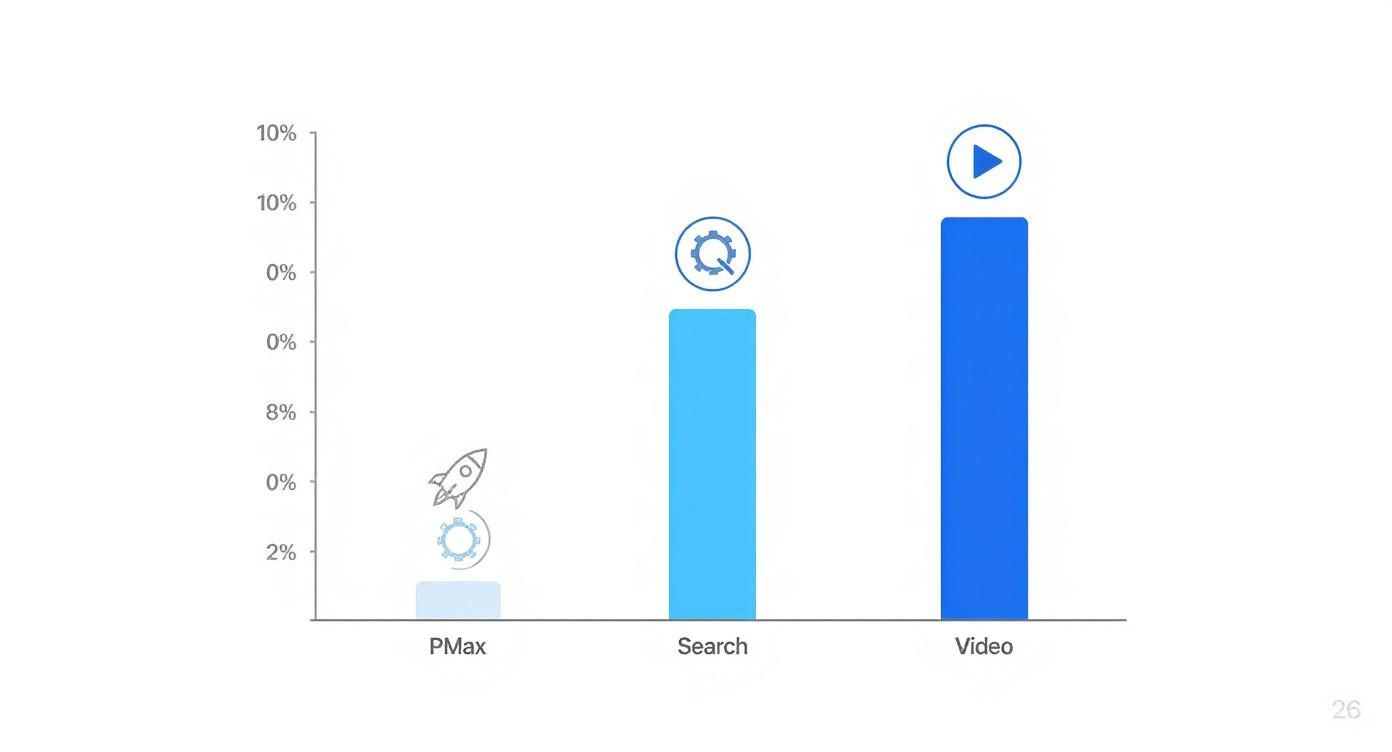
As you can see, different campaign types like Performance Max can yield higher engagement, often because of their automated, multi-channel approach.
Of course, getting the click is only the first step. The next critical piece of the puzzle is making sure your landing page actually converts them. Just as you test your ad creative, applying a smart A/B testing framework to your landing pages is essential for maximizing the value of every single click. For a deep dive into that post-click phase, check out these landing page optimization best practices.
Answering Your Top Questions About Improving CTR
Even with a solid game plan, you're bound to hit a few snags when you're in the trenches trying to bump up your click-through rates. Let's dig into some of the most common questions I hear from marketers and get you some clear, practical answers.
Think of this as moving from theory to the real world—fine-tuning your campaigns to get the absolute best results.
How Long Should I Really Run an A/B Test?
This is the million-dollar question, isn't it? The honest answer is: it depends. The real goal isn't to run a test for a set number of days, but to reach statistical significance. This just means you're confident the results you're seeing aren't a random fluke.
Rushing this part is one of the biggest and most common mistakes you can make.
Several things will dictate how long your test needs to cook:
- Traffic Volume: If you're running a high-traffic campaign, you might get a clear winner in a few days. For a lower-volume campaign, you could be looking at a few weeks. A good rule of thumb is to aim for at least 1,000 impressions for each ad variation you're testing.
- Conversion Cycles: Think about your customer's journey. For a B2B product with a long sales cycle, a one-week test is useless. You need to give the test enough time to capture that delayed decision-making process.
- The Size of the Win: If one ad is absolutely crushing the other, you'll see it pretty quickly. But if the difference in performance is more subtle, you'll need more data to be certain you're making the right call.
A test isn't "done" when you feel like it's done; it's done when the data is reliable. Trust the statistical significance calculator in your ad platform and fight the urge to end a test early.
Is a High CTR Ever a Bad Thing?
It sounds crazy, but yes, a high CTR can sometimes be a massive red flag. Clicks are only valuable if they come from people who are actually interested in what you're selling. If your CTR is through the roof but your conversion rate is in the gutter, something is seriously wrong.
This kind of disconnect usually points to a few common problems. Your ad might be misleading, making a promise that your landing page simply doesn't deliver on. Imagine an ad shouting "50% Off Everything!" that leads to a page with only three discounted items. You'll get plenty of angry clicks and zero sales.
Another culprit could be click fraud, where bots or shady competitors repeatedly click your ads just to burn through your budget. You might also be attracting the wrong crowd entirely with creative that's too broad or just plain clickbaity. A high CTR from the wrong audience is just a fast way to waste money.
What's the Quickest Way to Fix a Low CTR?
When a new campaign is flopping, you need to act fast. A low CTR is often a sign of a fundamental mismatch between your ad and your audience. Instead of tearing everything down and starting over, run through this quick diagnostic checklist.
- Check Your Headline: Does your headline speak directly to the user's search or a known pain point? This is the single biggest lever you can pull for a quick fix.
- Review Your Targeting: Are you trying to talk to everyone? Go back and check your targeting criteria. Make sure you're reaching a specific, well-defined group of people.
- Beef Up Your Ad with Extensions: For search ads, are you using everything at your disposal? Sitelinks, callouts, and structured snippets make your ad bigger and give people more reasons to click.
- Assess Your Visuals: Is your image or video blurry, generic, or just plain boring? Swap it out for something that grabs attention and feels authentic.
How Does CTR Directly Affect My Ad Costs?
There is a direct and incredibly powerful link between your CTR and how much you pay, especially on platforms like Google Ads. It all comes down to a little thing called Quality Score.
Quality Score is Google’s way of rating the relevance and quality of your ads and keywords. It’s a huge factor in determining your ad rank and—most importantly—your cost-per-click (CPC). A higher expected CTR is one of the main ingredients of a great Quality Score.
Here's the simple version: Google wants to show users ads they'll actually click on. When your ad has a high CTR, Google’s algorithm sees it as relevant and helpful. They reward you with a better Quality Score, which leads to lower CPCs and better ad positions—even if your bid is lower than a competitor's. A low CTR signals a bad user experience, which tanks your Quality Score and forces you to pay more for every single click.
Ready to stop guessing and start creating high-performing ads in minutes? Quickads.ai uses AI to generate dozens of creative variations tailored for your brand, helping you test faster and improve your CTR. See how Quickads.ai works.








Privacy is important to us, so you have the option of disabling certain types of storage that may not be necessary for the basic functioning of the website. Blocking categories may impact your experience on the website. View Our Privacy Policy


