
How to Create Faceless YouTube Channel: how to create faceless youtube channel
To build a faceless YouTube channel that actually works, you need a solid game plan. It’s all about picking a profitable niche, creating a content machine with the right tools for scripts, voiceovers, and visuals, and then getting your videos in front of the right people using YouTube's algorithm. The whole idea is to create high-value content that stands on its own, without relying on a personal brand. This lets you build a scalable—and if you want, anonymous—content business.
The Rise of the Faceless YouTube Channel
You don't have to be a charismatic influencer to build a YouTube empire. Seriously. Some of the biggest channels on the platform are run by people who have strategically decided to stay behind the scenes. This isn't just about privacy; it's a smart business model that puts efficiency, scalability, and pure content value first.

The biggest win here? A faceless channel can be turned into a system. When you remove the on-camera personality, content creation becomes more like an assembly line. You can easily hand off tasks like scripting, voiceover work, and editing to freelancers anywhere in the world. This allows you to pump out content way faster than a single creator ever could.
The Power of a System Over a Personality
Try to think of your faceless channel as a small media company, not a personal blog. The focus completely shifts from who is making the videos to what the videos deliver. This model is all about consistency and serving a very specific audience need—whether that's through how-to tutorials, relaxing music for studying, or deep dives into true crime mysteries.
The numbers don't lie. Just look at a channel like 5-Minute Crafts. They absolutely dominated the DIY niche with their fast, hands-only videos. As of 2025, they have a mind-boggling 81 million subscribers and pull in an estimated $38 million a year. It's definitive proof that you can achieve global success without ever showing your face.
The real beauty of a faceless channel is its potential to become a sellable asset. Since the brand is tied to the content and not an individual, it has tangible value that can be transferred, unlike a personality-driven channel.
Your Roadmap to Success
Kicking off a profitable faceless channel isn't about getting lucky; it’s about following a clear, proven roadmap. For an incredibly detailed guide on building and monetizing a channel from scratch, many creators have found success with resources like the Tube Mastery and Monetization course.
To get you started, here's a quick look at the core stages involved. Think of this as your foundational blueprint for getting off the ground.
Your Quick-Start Faceless Channel Blueprint
PhaseCore ActionPrimary Goal1. FoundationStrategic Niche SelectionFind a high-demand audience with clear monetization potential.2. ProductionBuild a Content EngineCreate a repeatable workflow for consistent video production.3. MonetizationImplement a Systematic Monetization StrategySet up diverse income streams beyond just AdSense.
Following this structure helps you focus on one critical area at a time, ensuring you build a strong foundation before trying to scale or monetize. It’s a methodical approach that pays off in the long run.
Finding a Niche That Drives Views and Income
Picking your niche is the single most important decision you'll make for your faceless channel. Seriously. It’s not just about what you find interesting; it's about finding that sweet spot where audience demand, income potential, and your own ability to create great content all meet.
Get this right from the start, and you're building on a solid foundation. Get it wrong, and every view will feel like an uphill battle.
The whole point of a faceless channel is to make the content the star. Since you won’t be the face of the brand, the value has to be baked directly into the videos themselves. This is exactly why categories like educational explainers, true crime deep dives, finance tutorials, and ambient relaxation guides do so well. People click for the information or the experience, not for the person speaking.
Evaluating a Niche for Real Profitability
Don't fall into the trap of chasing whatever is trending this week. Sure, a viral topic might give you a quick spike in views, but those niches often come with painfully low ad rates and disappear as fast as they came.
Instead, you need to think like a business and evaluate a niche based on its actual monetization strength. The key metric to understand here is RPM (Revenue Per Mille), which is the amount of money you earn for every 1,000 video views.
High-RPM niches attract advertisers with deep pockets. Think about it:
- Finance and Investing: Videos about stocks, real estate, or personal finance have some of the highest RPMs on YouTube. Why? Because the products being advertised (like brokerage accounts or financial software) are high-value.
- Technology and Software Tutorials: Content that teaches people how to use a specific piece of software or a new gadget also pulls in high ad rates. Businesses are willing to pay a premium to reach users actively looking for solutions.
- Health and Wellness: While this is a broad category, it can be incredibly profitable if you focus on specific sub-niches like meditation, biohacking, or specialized fitness.
A celebrity gossip channel might pull in millions of views but struggle with an RPM of just $2. Meanwhile, a niche channel explaining financial modeling could get a fraction of the views but boast an RPM of $20. That finance channel could earn the same amount of money with just one-tenth of the audience.
Matching Your Content Style to Your Niche
Once you have a few high-potential niches shortlisted, you have to figure out the best way to present the content. This is a make-or-break step for a faceless channel because your visuals and audio have to do all the heavy lifting. The style you pick will directly shape your workflow, your budget, and how well you connect with viewers.
Just look at the massive success of a channel like BRIGHT SIDE, which grew to 44.7 million subscribers by mid-2025 without ever showing a face. They launched in 2017 and absolutely perfected the art of using vibrant 2D animations and a clear voiceover to make even complex topics fun and easy to watch. You can discover more about their successful strategy to see the blueprint they created.
Let's break down how different content styles are perfectly suited for certain niches.
Top Faceless Niches vs Content Style Matchup
Choosing the right format is more than half the battle. If you're creating finance tutorials, animated charts are going to be infinitely more effective than generic stock clips of people typing in an office. The table below shows how specific content styles align with popular niches and their typical monetization paths.
Niche IdeaBest Content StylePrimary Monetization MethodTrue Crime & MysteriesStock footage, voiceover, and text animationsAdSense and Patreon for exclusive contentPersonal FinanceAnimated infographics and screen recordingsAffiliate marketing and AdSenseMeditation & RelaxationCalming stock videos and ambient audioAdSense and selling digital productsHistory ExplainersArchival footage, maps, and animated timelinesSponsorships and AdSense
This isn't an exhaustive list, but it gives you a clear idea of how to pair your production style with your topic for maximum impact. For even more inspiration, check out our guide on the best 50 YouTube channel ideas without showing your face to get your creative gears turning.
Use Data to Validate Your Big Idea
Never, ever rely on a gut feeling alone. Before you dive headfirst into creating content, you need to use free tools to make sure there's a real audience waiting for it.
The biggest mistake I see new creators make is picking a niche that's either way too broad (like "gaming") or impossibly narrow ("1980s Bulgarian strategy games"). You're looking for that sweet spot: a dedicated audience that isn't already completely saturated with competition.
Here’s a simple process I use to check if an idea has legs:
- YouTube Search Recon: Go to YouTube and start typing in your main keywords. Are the top videos pulling in hundreds of thousands, or even millions, of views? That’s a fantastic sign of strong demand.
- Scope Out the Competition: Find 3-5 other faceless channels in the niche you're considering. How often are they posting? What are their average view counts? This gives you a realistic benchmark for what it takes to compete.
- Check with Google Trends: Head over to Google Trends and plug in your topic. Is the interest line stable or, even better, growing over the past five years? You want to avoid any topics that show a steep, steady decline—that’s a sign of a shrinking audience.
By combining a smart assessment of profitability with the right content style and some data-backed validation, you can choose a niche with genuine, long-term potential. This upfront work is what separates the channels that thrive from those that fizzle out after a few months.
Building Your AI-Powered Content Workflow
One viral video is great, but it won’t build a channel. A successful faceless channel is built on something else entirely: a system. You need to build a content machine—a repeatable, efficient process that turns ideas into high-quality videos, week after week, without burning you out. This is your content assembly line, and AI is the key to making it run smoothly.
A solid workflow takes the guesswork out of creation. Instead of staring at a blank screen for every new video, you'll have a clear roadmap for each stage, from the initial spark of an idea to hitting "publish." This is exactly how the top faceless channels are able to produce so much quality content at scale.
Before you even think about production, though, there's a strategic process you need to nail down first.
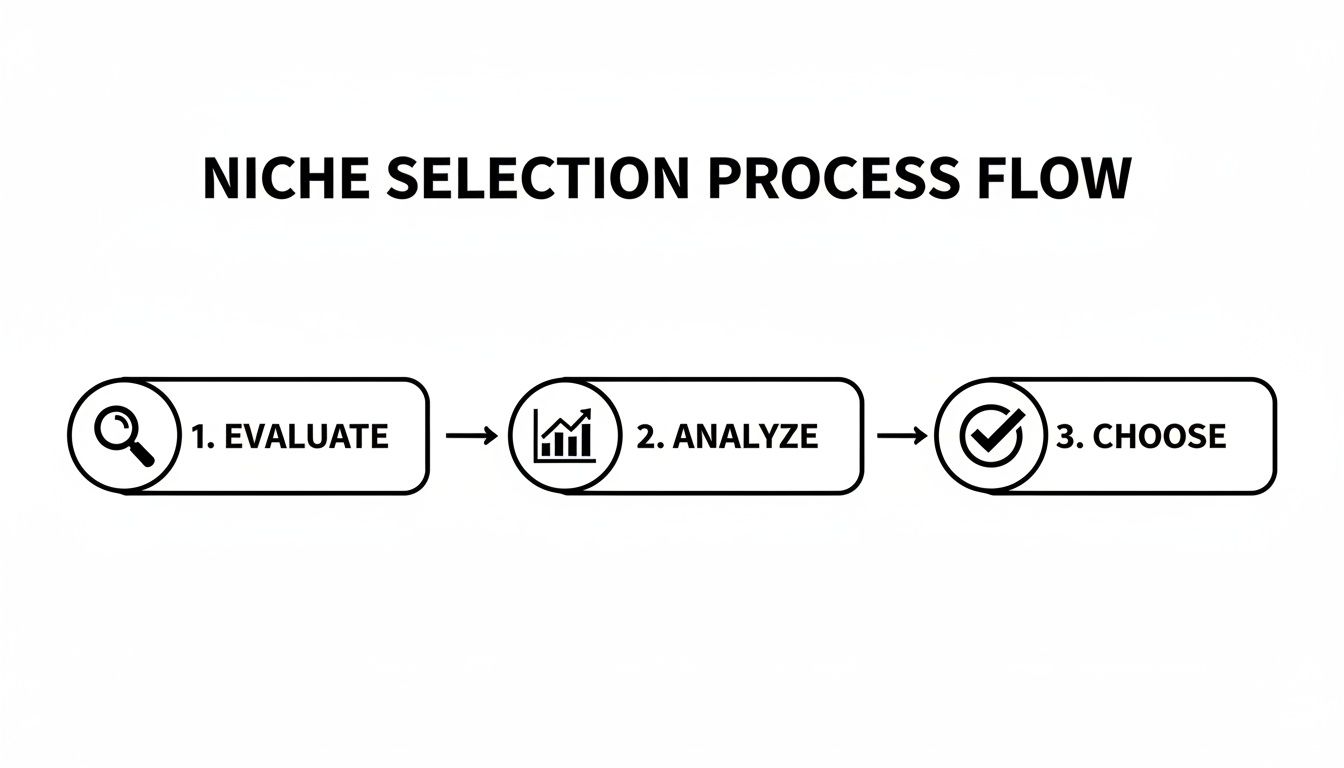
This initial evaluation and analysis is crucial. You have to be sure about your niche before you commit to building a production workflow around it.
Ideation and Scripting with AI Assistants
Every great video begins with a solid script. For a faceless channel, the script is everything. It’s the backbone carrying the entire narrative since you don’t have a charismatic host on camera to lean on. This is where AI tools like ChatGPT can become your most valuable team member.
But don't just ask it to "write a script about space." That's a rookie mistake. The real magic happens when you treat it like a strategic partner. Start by feeding it your video title and a rough outline. From there, give it specific jobs:
- Turn these bullet points into conversational, easy-to-follow paragraphs.
- Give me five compelling hooks for the first 15 seconds of the video.
- Explain this complex topic using a simple analogy.
- Rewrite this section to sound more authoritative.
By breaking it down like this, you stay in the driver's seat creatively while letting the AI do the heavy lifting. It speeds up the drafting process immensely, freeing you up to focus on refining the story and making sure your facts are straight.
Generating Your Voice with AI or Freelancers
With a polished script ready to go, it's time to give it a voice. The audio quality on a faceless video is non-negotiable. Viewers might put up with so-so visuals for a bit, but they will click away from bad audio in a heartbeat. You’ve got two main options here: AI voice generators or human freelancers.
Pro Tip: When you're just starting, a high-quality AI voice is often the smarter move. It's cheap, it's instant, and it lets you put your budget toward other things, like better stock footage or killer thumbnail designs.
Here’s a quick look at how they stack up:
FeatureAI Voice Generators (e.g., ElevenLabs, Murf.ai)Human Voiceover (e.g., Fiverr, Upwork)SpeedGet your audio back in minutes.Can take hours, sometimes days.CostA low monthly subscription for tons of audio.Charged per word or minute; adds up fast.ConsistencyThe exact same voice and tone, every single time.Quality and tone can vary between freelancers.RevisionsMake endless script changes instantly, for free.Revisions almost always cost extra and take more time.
Modern AI voices have gotten scarily realistic, making them a perfect, scalable solution for faceless channels. That said, if your niche relies on a lot of emotional depth—think true crime stories—a talented human voice actor might still give you an edge.
Sourcing and Creating Visuals
Now for the fun part: building the visual story. Since you aren't on camera, your visuals have to work overtime to keep your audience hooked. This usually means a mix of stock footage, screen recordings, animations, and text overlays.
Your visual strategy should tie directly to your niche.
- Doing tutorials? You'll live in screen recording software like Dadan, OBS Studio or Loom.
- Making history or documentary content? A subscription to a stock footage library like Storyblocks or Envato Elements is a must.
- Creating educational explainers? You can get amazing results with simple animation tools or even just really well-designed slides made in Canva.
AI is also changing the game for visuals. Instead of using the same stock photos everyone else does, you can use AI image generators to create completely unique graphics for your videos. We dive deeper into this in our ultimate AI YouTube video maker guide, which shows just how powerful these tools can be.
Editing and Assembly: The Final Polish
This is where all the pieces come together. Your goal during the edit is to create a dynamic, visually engaging experience that keeps people watching. You don't need fancy, expensive software for this. Tools like CapCut (free) and Descript (paid) are incredibly powerful and easy to learn.
A simple, effective editing workflow might look like this:
- Sync your voiceover: Drop your final audio track onto the timeline first.
- Lay down the A-roll: Add your primary visuals (stock clips, screen recordings) to match the narration.
- Sprinkle in B-roll: Use extra clips and overlays to break up long scenes and illustrate what you're talking about.
- Add text on screen: Use animated text to highlight key stats or important words.
- Add music and sound: Find some good background music and add sound effects to bring it all to life. If a track you've licensed has lyrics that fight with your voiceover, run it through a free vocal remover tool isolate the instrumental your narration will sit much cleaner in the mix.
The real secret to fast editing is creating templates. Once you nail down a format you like—with your channel's fonts, colors, and go-to animations—save it. For the next video, you just drop in the new assets, and you've instantly cut your editing time in half.
Designing Thumbnails That Demand Clicks
Your thumbnail is your video's billboard on YouTube. It’s often the only thing that determines whether someone clicks on your video or keeps scrolling. For faceless channels, a strong, consistent thumbnail style is a huge part of your brand.
Canva is your best friend here. It's packed with templates you can easily customize to match your channel's vibe.
Here are a few simple rules for high-impact thumbnails:
- Big, bold, readable text.
- High-contrast colors that pop off the page.
- A compelling image that makes people curious.
- A consistent style so your followers instantly recognize your videos in their feed.
By systemizing each of these five stages, you turn the chaotic process of making videos into a predictable, manageable workflow. This is the engine that will power your faceless channel, letting you focus on what really matters: creating awesome content for your audience.
Optimizing Your Channel for Maximum Discovery
So you've created an amazing video. That's fantastic, but it's only half the job. If nobody can find it, all that effort just evaporates. This is where YouTube SEO becomes your secret weapon. For a faceless channel, getting discovered isn't just a good idea—it's everything.
Think about it: without a familiar face driving those initial clicks, you're relying almost entirely on the YouTube algorithm to play matchmaker between your content and the right viewers. That means you need to be deliberate, optimizing every piece of your channel and your videos to signal exactly what you're about and who you're for.
Your Channel's First Impression Is Crucial
Before anyone even considers watching a video, they'll land on your channel page. This is your digital headquarters, and it has to look the part. These are one-time setup tasks that will pay off for years to come.
- Compelling Channel Art: Your banner is the first thing people see. It's prime real estate. Use a tool like Canva to whip up a clean, high-quality banner that clearly states your channel name, your core promise (like "Daily Stock Market Insights"), and maybe even your upload schedule. If you're still deciding on a name, exploring YouTube channel name ideas can help you find one that fits your niche and is easy to remember.
- A Well-Crafted "About" Page: Don't neglect this section. Your "About" page is a goldmine for telling YouTube what your channel focuses on. Write a short, engaging pitch about what your channel offers, who it's for, and why they should stick around and subscribe.
A professionally branded channel immediately builds a sense of trust and tells YouTube you’re serious. This initial setup is the bedrock for all the video-specific optimization you'll do later.
Mastering Video-Level SEO
Once your channel's foundation is solid, the real work begins with each video you upload. This isn't a one-and-done task; it’s a repeatable process you need to bake right into your production workflow. It's how you give YouTube the clues it needs to rank you in search and recommend you to new audiences.
Treat every single video as a new opportunity to show up for specific search terms. The key is to pack your titles and descriptions with relevant keywords without sounding like a soulless robot.
Your video's title is the single most important piece of SEO real estate you have. It needs to be compelling for a human and perfectly clear for the algorithm. A great title strikes a perfect balance between being searchable and being clickable.
For example, a title like "My New Finance Video" is dead on arrival. A much stronger, SEO-driven title would be something like, "How to Build a Dividend Portfolio from Scratch in 2025." The second one targets a clear user need and promises a tangible result.
To really kickstart your growth, applying proven tips to increase YouTube subscribers is a must for getting that initial traction and building a loyal audience.
Titles, Descriptions, and Tags: The SEO Trifecta
These three pieces work in tandem to give YouTube a crystal-clear picture of what your video is all about. Get them right, and the algorithm will reward you.
- Strategic Video Titles: Start your research right in the YouTube search bar. Type in your core topic and watch what YouTube's autocomplete suggests—that's what real people are searching for. Make sure your title includes your main keyword, preferably right at the beginning.
- Keyword-Rich Descriptions: Your description is where you can really elaborate. The first 2-3 sentences are critical because they show up in search results. Put your main keyword there, then write a natural-sounding summary of the video, weaving in related keywords and phrases along the way.
- Targeted Tagging: While tags aren't as powerful as they once were, they still provide helpful context. Your very first tag should always be your exact primary keyword. From there, add a mix of broader category tags (e.g., "personal finance") and more specific, long-tail phrases (e.g., "best dividend stocks for beginners").
Playlists and Thumbnails: The Watch Time Boosters
Beyond the basic text-based SEO, two other elements are absolutely vital for racking up views on your faceless channel.
- Strategic Playlists: This is a massively underrated strategy. When you group related videos into a playlist, the next video starts automatically after one finishes. This is a simple but powerful way to boost your channel's session watch time—a huge signal to the algorithm that people are loving your content.
- Clickable Thumbnails: Your thumbnail and title are a one-two punch. A fantastic thumbnail grabs attention with high-contrast colors, bold text that's easy to read on any screen, and an image that sparks curiosity. Keep your thumbnail style consistent to build a recognizable brand on sight.
By methodically optimizing every video, you stop hoping for views and start engineering discoverability. This disciplined approach is how you make the YouTube algorithm work for you, not against you.
Monetization Strategies Beyond AdSense
Relying on YouTube AdSense alone is like building a house on a single pillar—it’s a risky move. While ad revenue is a fantastic starting point, the most successful faceless channels I’ve seen treat it as just one piece of a much larger income pie. If you want to build a truly sustainable business, you need to diversify your income with revenue streams you actually own and control.

This multi-layered approach is what separates a hobby from a real media asset. It’s all about building an ecosystem around your content where your audience can connect with your brand in multiple ways. This is how you go from earning pocket money to building a legitimate business.
Weave Affiliate Marketing into Your Content
For most faceless channels, affiliate marketing is the most natural and lucrative next step. The concept is simple: you recommend a product or service you genuinely trust, and you get a commission from any sales that come through your unique link. The real key here is authenticity.
Your recommendations have to feel like a natural part of your content, not some slapped-on sales pitch.
- tTech tutorial channel? You could link to the exact software you're demonstrating or the microphone you use for that crystal-clear voiceover.
- Finance channel? It makes perfect sense to partner with brokerage platforms, budgeting apps, or financial tools you've discussed in a video.
- Book summary channel? Every single video is an opportunity to link to the book on Amazon or Audible through their affiliate programs.
The best affiliate marketers don't just drop links; they solve problems. When you show how a product helps someone achieve a goal, that link transforms from an ad into a helpful resource. To scale promotion beyond YouTube, many faceless channel owners use AI tools that help them auto post on social media, ensuring their video ads, reels, and short-form content are published consistently across multiple platforms without manual effort.
This strategy is incredibly effective because your audience already sees you as an expert. When you suggest a tool, they're primed to see it as a solid recommendation, making this one of the best ways to earn money when you create a faceless YouTube channel.
Create and Sell Your Own Digital Products
Affiliate marketing is great, but selling your own digital products gives you two things that are even better: 100% of the profit and total control. This is the point where your channel can really blossom into a full-fledged brand.
Digital products are a perfect match for faceless creators because they scale infinitely. You create them once, and you can sell them forever without ever worrying about inventory or shipping.
Your products should be a direct answer to a problem your audience has. What are they struggling with? What are they trying to learn? Build a resource that helps them get there faster.
Profitable Digital Product Ideas
Product TypeBest For Niches Like...Why It WorksEbooks or GuidesHistory, True Crime, FinanceOffers a deeper dive into topics your viewers are already passionate about.TemplatesProductivity, Video Editing, BusinessProvides a ready-to-use solution that saves your audience time and effort.Checklists & WorksheetsSelf-Help, Fitness, EducationGives your audience an actionable tool to apply the knowledge from your videos.Audio Packs or PresetsMusic Production, Meditation, Photo EditingSells the very assets you use to create your own high-quality content.
You don't need a huge budget to get started. A simple ebook or a pack of Canva templates can be incredibly valuable. It’s all about packaging your expertise into a format your biggest fans will be happy to pay for.
Long-Term Growth and Brand Building
Making money isn’t just about the immediate sale; it’s about building a brand with real, long-term value. This means getting strategic about your growth beyond just hitting "upload" on the next video.
One killer tactic is to use YouTube Shorts as trailers for your main videos. Create a snappy, compelling 60-second clip from your longer video, hook the viewer, and end with a clear call-to-action to watch the full thing. This can funnel a surprising amount of traffic from the Shorts feed directly to your monetized, long-form content.
Also, don't shy away from collaborating with other faceless channels in your niche. A simple "channel shoutout" or a joint video project can introduce your work to a whole new—and highly relevant—audience, often leading to a subscriber bump for both of you.
Finally, make YouTube Analytics your best friend. Seriously, get in there and look at your data. Find out which videos are pulling in the most subscribers and which ones keep people watching the longest. Don't guess what your audience wants—find your winning formula in the data and replicate it. This is the secret to building a channel that not only earns an income but keeps growing for years to come.
Got Questions About Going Faceless? Let's Clear Things Up.
Even the best-laid plans come with a few lingering questions. As you start diving into the world of faceless YouTube channels, you’re bound to hit a few roadblocks or moments of doubt.
Let's walk through some of the most common concerns I hear from new creators. Getting these answers sorted out now will save you a ton of headaches later.
Can You Really Make Good Money with a Faceless Channel?
The short answer? Absolutely. The idea that you need to be on camera to build a six-figure YouTube business is a total myth. Your success hinges on the value you provide, not your face.
Plenty of faceless channels pull in a full-time income, and it's all about playing it smart. If you land in a high-RPM niche like finance or tech, you can do very well from AdSense alone. But the real game-changer is diversifying. Once you start weaving in affiliate links for products you genuinely use or selling your own digital guides and templates, you can easily double or triple what you make from ads. It's all about building multiple streams of revenue on the back of great content.
What are the Biggest Mistakes New Creators Make?
I see new faceless creators fall into the same traps over and over again. Knowing what they are is half the battle.
- Chasing Money, Not Passion: Picking a niche just because it's profitable is a fast track to burnout. If you aren't genuinely interested in the topic, you'll run out of steam. You have to live and breathe this stuff to keep going for the long haul.
- Being a Ghost: The YouTube algorithm is a machine that craves consistency. If you post randomly, you’ll kill your channel's momentum before it even starts. You have to feed the beast.
- Skimping on Audio: This is the ultimate sin for a faceless channel. People will put up with so-so visuals, but they will click away in a heartbeat if your audio is tinny, muffled, or hard to understand. A good mic or a premium AI voice isn't a luxury; it's a must-have.
Here’s a piece of advice I wish someone gave me early on: "faceless" does not mean "low effort." In fact, it's often the opposite. Without a charismatic host to carry the video, your content—the script, the visuals, and especially the audio—has to be top-notch to keep anyone watching.
How Long Until I Actually Get Monetized?
There's no magic formula, but for a creator who's serious about it, a realistic timeline is somewhere between 6 to 12 months. That’s assuming you’re consistently putting out one or two quality videos every single week.
The goal is to hit the YouTube Partner Program requirements: 1,000 subscribers and 4,000 hours of watch time. The secret to hitting those numbers faster is obsessing over audience retention. If you can make videos that keep people glued to their screens, the algorithm will notice and start pushing your content to a much bigger audience. That’s how you accelerate your growth.
AI Voice vs. Human Voiceover: Which One is Better?
Honestly, this really boils down to your budget, your niche, and how you like to work.
Today's AI voices from tools like ElevenLabs are shockingly good. They’re a fantastic, affordable, and scalable option, especially when you’re just getting your channel off the ground. You can crank out high-quality audio in minutes.
But, a real human voice can add a layer of emotion and personality that an AI just can't replicate yet. This is a massive advantage in niches built on storytelling, like true crime or historical documentaries. A smart strategy is to start with a high-quality AI voice to build momentum and then, once the channel is making money, reinvest a portion of it into hiring a professional voice actor.
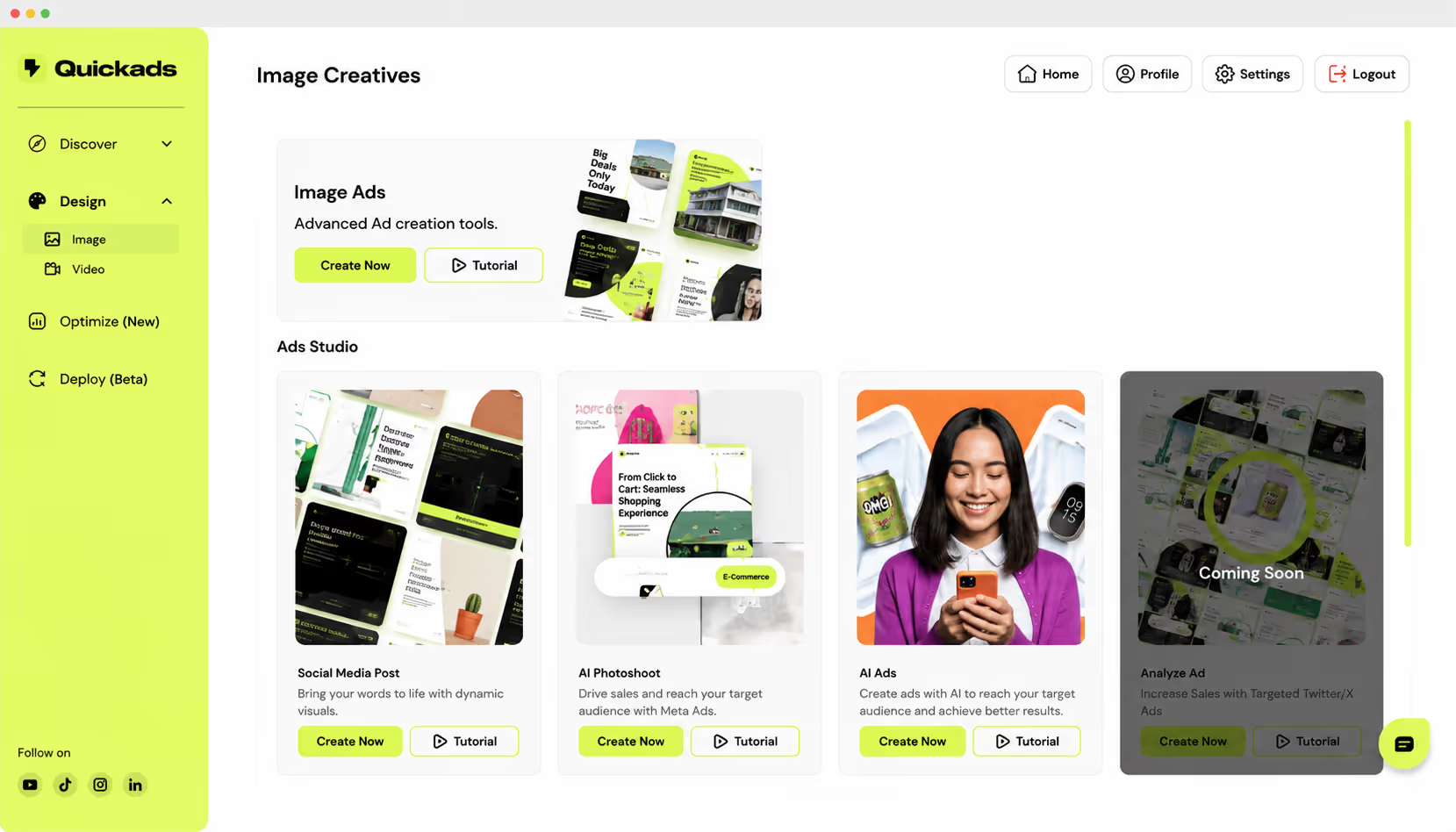
Ready to create stunning, high-converting video ads and faceless content without the complexity? quickads.ai uses AI to generate effortless image ads, video ads, and YouTube shorts in minutes. Start creating for free and see how simple it can be.







Privacy is important to us, so you have the option of disabling certain types of storage that may not be necessary for the basic functioning of the website. Blocking categories may impact your experience on the website. View Our Privacy Policy


