
How to Advertise Small Business Locally: how to advertise small business locally
If you want to advertise your small business locally, you need to focus on three things right out of the gate: claim and optimize your free Google Business Profile, get a handle on basic local SEO, and run some tightly focused social media ads. When you nail these three, you’re building a digital storefront that pulls in customers who are actively looking for what you offer, right in your neighborhood.
Your Local Advertising Starting Point
Getting your business on the local map starts with a few powerful, non-negotiable moves. A lot of business owners assume local advertising means a massive budget, but honestly, the most effective actions are often free or very low-cost.
The trick is to build a solid digital foundation before you even think about spending money on paid campaigns. This way, when people look you up, they find a business that looks professional, trustworthy, and ready to help.
The opportunity here is massive. Local digital advertising is booming, with projections showing U.S. local internet ad spending will soar to $85 billion by 2025. This isn't just a random trend. It's driven by a simple, powerful truth: 46% of all Google searches are from people looking for something nearby.
Think about that. Nearly half of the searches on Google have local intent. And with 73% of consumers saying they'd rather buy locally, being visible is no longer a "nice-to-have"—it's a must.
The Three Pillars of Local Visibility
To get started, let's zero in on the channels that give you the most bang for your buck (or your time). I like to think of these as the bedrock of any smart local marketing strategy.
- Google Business Profile (GBP): This is, without a doubt, your most valuable free marketing tool. It’s your business’s front door on Google Search and Maps. The single best thing you can do today is to add your business to Google, verify it, and completely fill out your profile with great photos, accurate hours, and regular posts.
- Local SEO: Don't let the term intimidate you. This is simpler than it sounds. It really just means making sure your website and online listings use the same words your neighbors use when they search something that’s much easier to implement and maintain when you hire dedicated software developers For instance, instead of just "plumber," you'd use "emergency plumber in Oakville." It also means keeping your business name, address, and phone number (NAP) consistent everywhere online,something you can monitor with a local SEO audit tool, even if you just add a business line to your cell phone to make and receive calls from.
- Targeted Social Media Ads: Platforms like Facebook and Instagram are fantastic for local businesses. You can literally show your ads to people within a specific zip code or just a few miles from your front door. Even a small budget goes a long way when you’re this precise. You can learn more in our guide on how to advertise a small business on a budget.
Where to Focus Your First Efforts
Feeling a bit overwhelmed? Don't be. You don’t need to be everywhere at once. The goal is to master these essentials first. As you get more comfortable, you can broaden your scope. For a wider perspective on the digital journey ahead, check out this a comprehensive guide to online marketing for small businesses.
The best local advertising doesn’t just shout a message into the void. It makes a business a visible, helpful, and easily discoverable part of the community. Your Google Business Profile is the first and most critical step in making that happen.
When you focus on these core areas, you create a powerful flywheel. A strong GBP boosts your local SEO. Your SEO efforts then make your social ads more effective because you're sending people to a website that's already optimized to convert them. It all works together.
To make this even clearer, I've put together a quick-start table that breaks down the first actions you should take on the most important channels.
Top 3 Local Advertising Channels Quick Start Guide
ChannelPrimary GoalFirst Actionable StepGoogle Business ProfileBe found on Google Maps & SearchClaim, verify, and 100% complete your profile—fill out every single field.Local SEORank for "near me" searchesGet your business listed on 5-10 key local directories with a consistent Name, Address, and Phone number (NAP).Facebook & Instagram AdsReach a specific local audienceCreate a simple "Brand Awareness" ad targeting a 5-mile radius around your business location.
This table is your roadmap for the first week. Tackle these three steps, and you'll have laid a foundation that puts you miles ahead of the competition.
Mastering Digital Ads for Local Audiences
Once your local SEO and Google Business Profile are humming along, it's time to go on the offensive. Paid digital ads let you jump to the front of the line and grab the attention of specific local customers—even those who have no idea you exist yet. This is about actively hunting for business, not just waiting for it to find you.
The real power of local digital advertising lies in its precision. You’re not just shouting into the void; you’re targeting people within a few miles of your shop, ensuring every ad dollar is spent reaching someone who could actually walk through your door.
This flow chart shows how paid ads are the next logical step after you've built a solid online foundation.
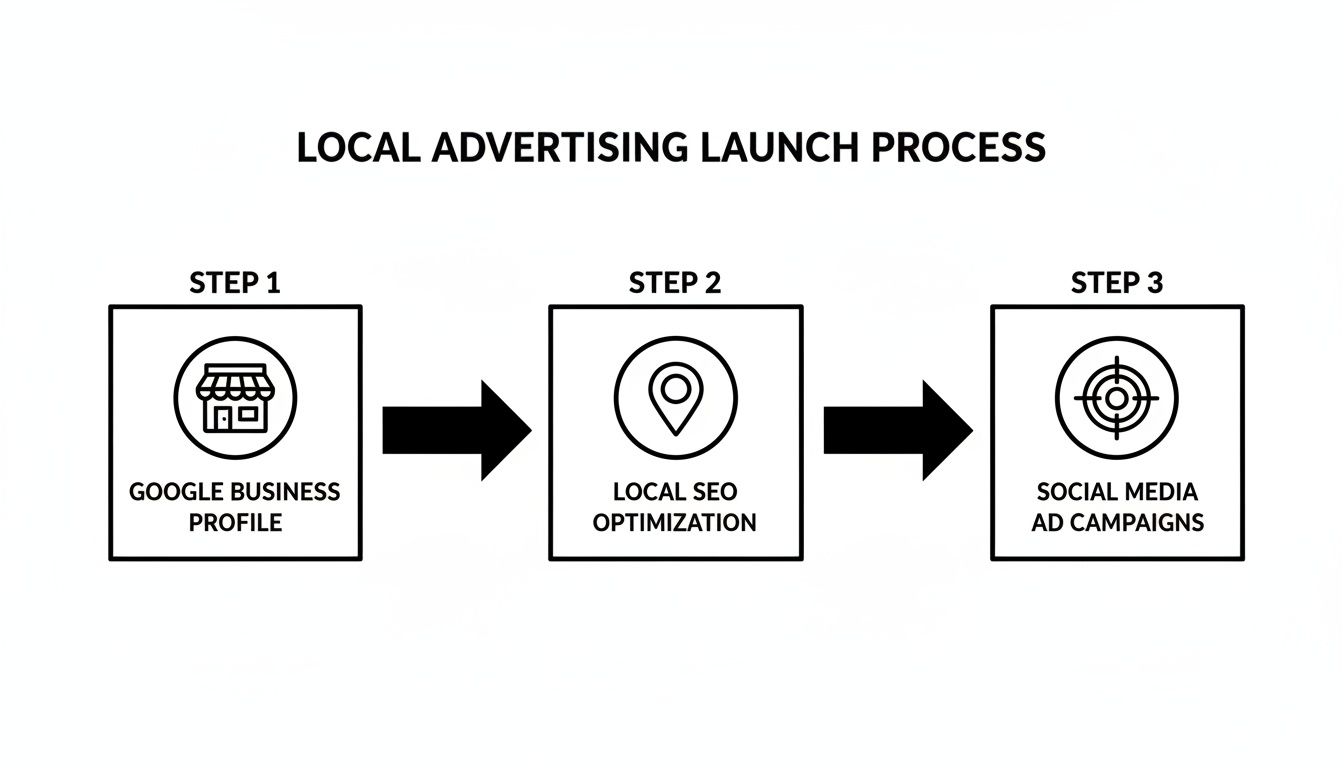
As you can see, the most effective ad campaigns are built on an already-optimized Google profile and strong local search rankings.
Your First Google Local Search Ads Campaign
For most local businesses, Google Ads is the perfect place to start. It puts you at the very top of the search results the moment someone in your area is actively looking for what you offer.
The secret to a profitable campaign is getting your keywords right. You have to think like a customer. Forget bidding on a broad term like "coffee shop." Instead, zero in on long-tail, high-intent phrases like "best espresso near downtown" or "bakery with gluten-free options [Your City]."
Once you have your keywords, your ad copy needs to speak their language. Mention your neighborhood, a nearby landmark, or a special offer just for residents. And definitely use location extensions in your ads. This handy feature adds your address and a map right into the ad, making it dead simple for searchers to find their way to you.
Remember, sending traffic from a great ad to a clunky, confusing webpage is like throwing money away. To make sure your campaigns actually convert, consider investing in professional landing page design services to maximize your return.
Hyper-Targeting with Facebook and Instagram Ads
While Google Ads helps you capture people actively searching, platforms like Facebook and Instagram let you find customers before they even start looking. Their targeting tools are incredibly powerful for local businesses.
You can build laser-focused audiences based on:
- Location: Target users in a specific zip code, city, or even a one-mile radius around your business.
- Demographics: Filter by age, gender, language, and more to match your ideal customer.
- Interests: Reach people who follow pages or show interest in hobbies and products related to yours.
Think about it: a local restaurant could run an Instagram Story ad with a lunch special, targeting people aged 25-55 within a two-mile radius who have shown an interest in "foodie" culture. Pairing that promotion with a Digital Menu makes it even more effective, letting customers instantly browse dishes, prices, and offers on their phones. That’s an ad that gets results. For a peek at what your local competitors are doing, check out our guide on using the Facebook Ad Library.
Expert Tip: Don't just promote your business—solve a local problem. Frame your ads around convenience, community, and why choosing you is the smart local choice. Finally, reinforce that promise with fast service, accurate billing, and flexible payments through your point of sale system. This approach builds a connection, not just a transaction.
Tapping into Short-Form Video
Video is no longer a "nice-to-have." The great news is you don't need a Hollywood budget to create killer video ads for platforms like Instagram Reels and YouTube Shorts.
Your smartphone is all you need. Simple, authentic videos often perform best.
- Film a quick "behind-the-scenes" of your team getting ready for the day.
- Create a time-lapse of you making a product or delivering a service.
- Answer a common customer question in a 30-second Q&A video.
These short videos are incredibly engaging and perform like gangbusters. In fact, 89% of businesses now use video marketing, and it's easy to see why. Just keep your videos short, add captions for sound-off viewing, and end with a clear call-to-action. It's a simple formula that will help you stand out.
Creating Ad Content That Actually Connects With Your Community
So, you've figured out who to target. That's a huge step. But it's only half the battle. Now you have to figure out what to say to them.
The best local ads don’t even feel like ads. They feel like a recommendation from a neighbor, a genuine message that understands the local vibe. This is where your ad creative—the images, videos, and words you use—becomes your most powerful tool.

Let's break down how to create compelling content that truly hits home, even if you’re not a professional designer. Remember, authenticity beats polish every time.
Writing Copy That Speaks to Your Neighbors
Your ad copy is your first handshake. It needs to instantly signal that you're one of them. Stiff, corporate-speak is an immediate scroll-past. Instead, ground your message in shared local experiences.
Mention a specific neighborhood, a well-known landmark, or a big local event. This one small detail builds instant trust. You're not just a plumber; you're the "go-to plumber for the Oakridge community." Your cafe doesn't just have coffee; it has the "best latte to grab before hitting the Saturday farmers' market."
Focus on solving a local problem. Frame what you do as a way to make life in your town a little bit better, easier, or more enjoyable.
Designing Clean Graphics With Simple Tools
You absolutely do not need to drop a ton of money on fancy design software. Free tools like Canva let you easily generate logos and create professional-looking graphics using thousands of templates that are ridiculously easy to customize. The goal here is crystal clarity and one strong message.
A few practical tips for making graphics that work:
- Use Real Photos. Whenever you can, use your own pictures. A crisp, well-lit photo of your storefront, your team, or your actual product will always, always outperform a generic stock photo.
- Less Text is More. Let the image do the heavy lifting. All you need is a bold headline, a quick mention of your offer, and your logo or business name. That’s it.
- Be Consistent. Stick to your brand's colors and fonts. This isn't just about looking good; it's about building recognition every single time someone sees one of your ads.
Pro Tip: After you design an ad, take a few steps back from your screen. Can you understand the main point in three seconds flat? If not, it’s too complicated. Simplicity always wins on a fast-scrolling social media feed.
Creating Simple, Effective Smartphone Videos
Video is a beast for local advertising, and the powerful camera in your pocket is all you need to get started. In fact, raw, behind-the-scenes content often connects on a much deeper level than slick, overproduced commercials.
Think in terms of short, engaging clips that tell a quick story or offer real value.
Easy Video Ideas You Can Film Today:
- The Quick Tour: Give a 30-second walk-through of your shop, your office, or even your work truck. Show people where the magic happens.
- Meet the Team: Have a team member just say a quick "hello." Putting a face to the name builds an immediate personal connection.
- Show Your Process: Film a quick time-lapse of you preparing a dish, packing an order, or setting up for a job. It's surprisingly mesmerizing and shows the care you put into your work.
Always keep your videos short (under 60 seconds), shoot vertically for phones, and please, please add captions. Most people watch videos with the sound off.
The Under-the-Radar Power of Faceless Videos
Not everyone is comfortable in front of a camera. If that's you, you're not alone. The great news is you can create incredibly effective "faceless" videos that let your work do all the talking.
This style is all about focusing on your products or services in action. A bakery can show a close-up of hands kneading dough. A landscaper can film a satisfying time-lapse of a yard transformation. These videos put the spotlight entirely on your craft.
Speeding Up Ad Creation With AI
Let's be realistic. The biggest hurdle for most small business owners is time. Who has hours to create and test dozens of different ad variations? This is where modern AI tools can be a lifesaver.
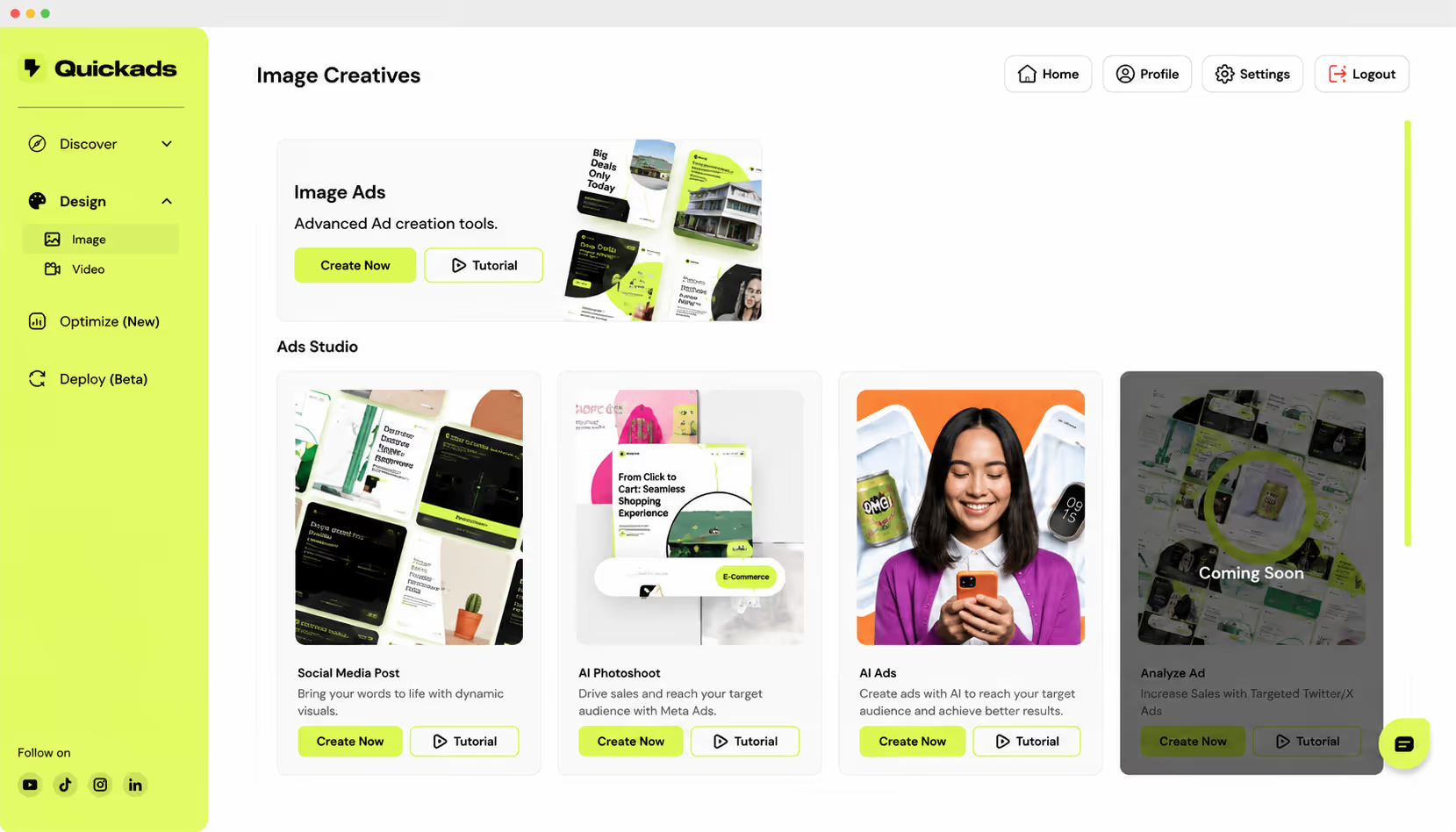
Platforms like quickads.ai can generate a whole batch of ad images, videos, and headlines in just a few minutes. You feed it some basic info about your business and your offer, and the AI produces a wide variety of creative assets for you to test.
This lets you quickly find out what your local audience actually responds to. Is it the ad focused on convenience? The one with the big discount? Or the one featuring your friendly team? AI-powered generation helps you find the winning formula much faster, so you can put your ad budget behind what's already proven to work.
Building Real-World Local Connections
Digital ads are essential, but the businesses that truly win in their local market are the ones woven into the fabric of the community. A targeted Facebook ad might bring in a customer, but a real-world connection builds a loyal fan. This is where your online and offline efforts start to feed each other, making your business a name people know and trust.
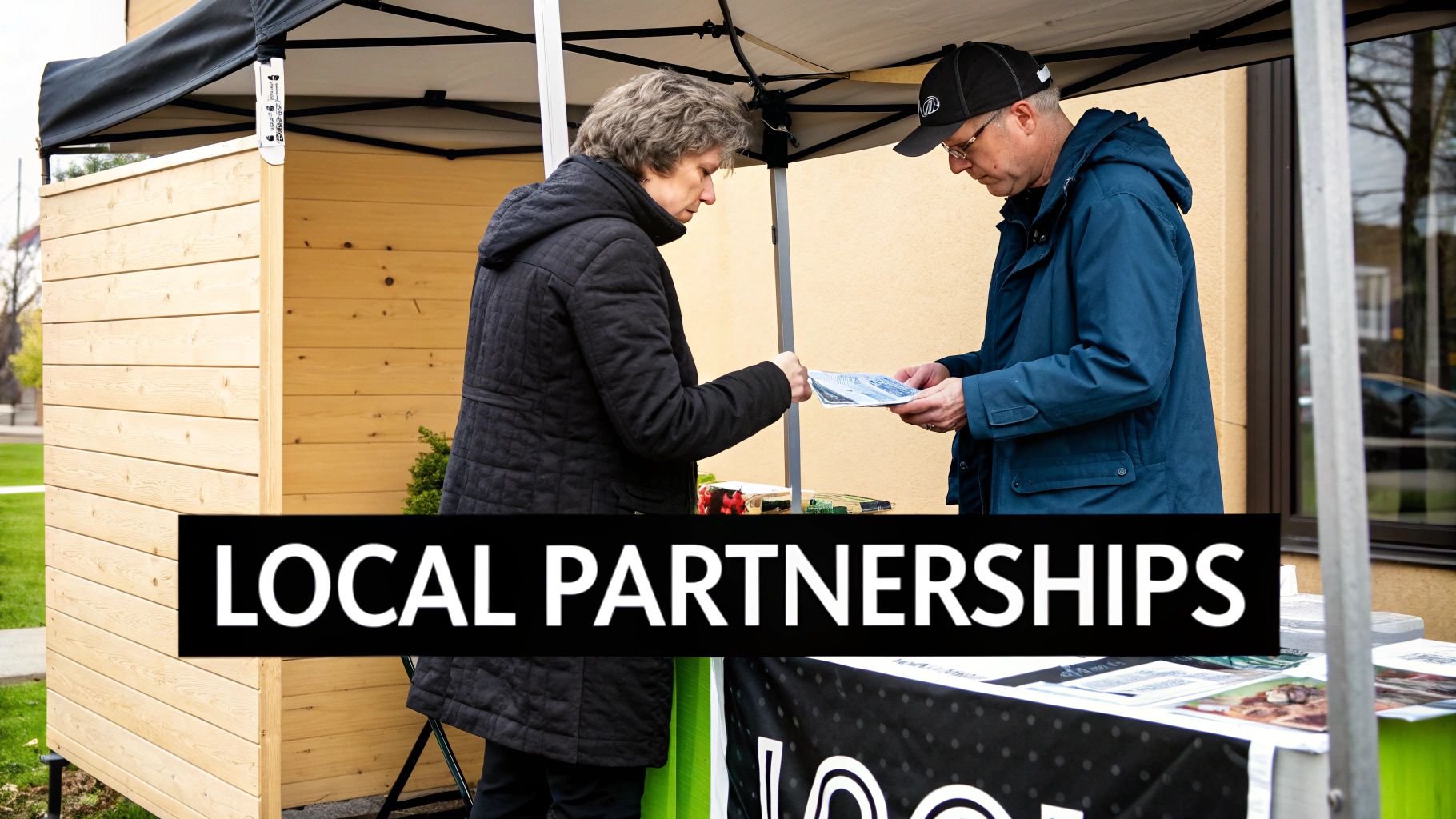
This part of your playbook is about more than clicks and impressions. It's about handshakes, shared goals, and becoming a visible, active player in the town you serve.
Forge Symbiotic Local Partnerships
One of the smartest ways to get your name out there is to team up with others. The trick is to find non-competing businesses that serve the exact same ideal customer as you. This creates a powerful referral engine where everyone wins.
Think about the natural overlaps right in your neighborhood. A real estate agent could partner with a local moving company. A boutique fitness studio could team up with a healthy juice bar. These partnerships just make sense, so they feel authentic to the customer.
Here are a few ways to get started:
- Cross-Promotions: A coffee shop could offer a 10% discount to customers who show a receipt from the bookstore next door, and the bookstore does the same. It's simple and effective.
- Shared Content: Feature each other in your email newsletters or give a friendly shout-out on social media. It’s an easy endorsement.
- Bundled Packages: A local spa and a nearby florist could create a joint "Relax & Renew" package for Mother's Day.
These collaborations cost next to nothing but can dramatically expand your reach to a warm audience that already trusts your partner’s recommendation.
Get Involved in Community Events
Being physically present where your community gathers is pure gold. Sponsoring a local event or even just setting up a booth puts a human face to your brand and builds incredible goodwill. This isn't just about selling; it's about connecting.
Sponsoring a little league team, for instance, puts your name in front of dozens of local families week after week. Setting up a table at the farmers' market lets you have real, one-on-one conversations with potential customers in a relaxed, positive space.
The goal of community marketing is simple: become so ingrained in local life that when someone needs your service, your business is the first one that comes to mind—not because they saw an ad, but because they see you everywhere.
Modernize Traditional Offline Tactics
Don't write off old-school methods like direct mail or local print ads. They can still work wonders, especially when you use them to bridge the gap between your physical and digital presence. Beyond postcards and print ads, branded merchandise like t-shirts, hats or custom mugs ordered through a service like Printful or Printify can be another physical touchpoint that points people back to your online store.
Instead of a generic flyer, send a high-quality postcard with a killer design and a clear call-to-action. Critically, drive them to a specific landing page on your website with a special offer. Always use a dynamic QR code so you can actually track how well the campaign is performing. Businesses using QR codes on posters, flyers, and storefront displays also often research how to know QR code size requirements to make a sure the codes remain easy to scan across different viewing distances and print formats.
Running an ad in a local magazine? Don't just list your services. Tell a story. Feature a glowing customer testimonial. And always, always include your social media handles and website. The key is to make every offline touchpoint an on-ramp to your online world, creating a single, seamless customer journey.
Tracking Your Local Ad Spend and Proving ROI
Throwing money at local ads without tracking the outcome is just guesswork. You might feel busy, but you have no real idea if you're actually growing your business or just burning cash. This is where we get serious and make sure every dollar you spend is working for you.
Making smart, data-driven decisions is what separates the businesses that thrive from those that merely survive. Tools such as Uniqode’s QR code generator support these decisions by providing scan-level insights that reveal which local ads are actually driving engagement. It’s about knowing what's hitting the mark, what's falling flat, and having the confidence to double down on the campaigns that bring real customers through your door. This is the final, crucial piece in mastering how to advertise your small business locally.
Setting a Realistic Local Ad Budget
Figuring out how much to spend can feel like pulling a number out of thin air, but it doesn't have to be so random. A good budget is simply a reflection of your goals and what you can comfortably invest to learn what resonates with your audience.
Here are a few starting points I’ve seen work for different types of businesses:
- The "Getting Started" Budget ($100-$300/month): This is perfect if you're brand new or just want to test the waters of paid advertising. Don't spread yourself thin. Pour this entire budget into one channel, like a highly-focused Facebook or Instagram campaign targeting a tight 3-5 mile radius around your business. The goal is simple: build awareness and get some initial traffic.
- The "Growth" Budget ($500-$1,000/month): With a bit more to work with, you can start diversifying. I'd recommend putting about 60% into a Google Local Search campaign to catch people actively looking for your services right now. Use the other 40% on social media ads to build that local community presence and stay top-of-mind.
- The "Scale-Up" Budget ($1,000+/month): If your business is established and you're ready to really own your local market, this is where you can expand. You can comfortably fund campaigns across Google and social media, and even start experimenting with things like local YouTube Shorts ads.
No matter the amount, the strategy is always the same: start small, prove what works, and only scale up the campaigns that show a clear, positive return.
Local Advertising Budget Allocation Models
Choosing how to split your budget between online and offline efforts depends heavily on your business model. A roofer's strategy will look very different from a local coffee shop's. The key is to align your spending with where your customers are and what actions you want them to take.
Here’s a table comparing a few common models to help you find your footing:
Business ModelRecommended Digital Ad Spend %Recommended Offline Spend %Primary KPIs to TrackLocal Service (e.g., Plumber, HVAC, thermal heat pumps)70%30%Phone Calls, Form Fills, BookingsRetail / Restaurant (e.g., Boutique, Cafe)50%50%Foot Traffic, Coupon RedemptionsProfessional Services (e.g., Accountants, Lawyer)80%20%Lead Form Submissions, ConsultationsEvents / Entertainment (e.g., Local Theater, Festival)60%40%Ticket Sales, Event Sign-ups
Ultimately, these percentages are just starting points. The most important part is to track your results relentlessly and adjust your allocation based on what the data tells you is actually driving business.
Identifying KPIs That Actually Matter Locally
For a local business, vanity metrics like "likes" and "impressions" are nice, but they don't keep the lights on. You need to focus on Key Performance Indicators (KPIs) that have a direct line to your bank account. These are the numbers that tell you the real story.
Pinpoint your tracking on these bottom-line metrics:
- Phone Calls: Did someone call you straight from an ad? Google Ads makes tracking this incredibly easy.
- Form Submissions: How many people filled out your "Request a Quote" form after seeing your ad?
- Appointment Bookings: If you use a scheduler like Calendly, track how many appointments came from your advertising efforts.
- Coupon or Offer Redemptions: This is a classic for a reason. Create a unique code for each campaign (e.g., "FB10" for a Facebook ad). It’s a bulletproof way to connect a digital ad to an in-person sale.
Don't get lost in a sea of data. Pick two or three primary KPIs that align directly with a sale. For a plumber, it's phone calls. For a salon, it's appointment bookings. Measure what leads to money.
Using Free Tools to Track Performance
You don’t need to buy fancy, expensive software to get the job done. The ad platforms themselves give you everything you need to start.
Your central hub is Google Analytics. By setting up simple "Goals," you can see exactly which channels—be it Google Ads, Facebook, or organic search—are driving the most contact form submissions or sales on your website. It connects all the dots.
The dashboards inside Facebook Ads Manager and Google Ads are also goldmines of information. Pay very close attention to your Cost Per Result. This number tells you exactly what you're paying for each phone call, lead, or new customer.
If you see one campaign generating leads for $10 and another is costing you $50 for the same result, you know precisely where to shift your budget for a better return. This is how you turn advertising from a blind expense into a predictable engine for growth.
Got Questions About Local Advertising? We’ve Got Answers.
Jumping into local advertising can feel like you're opening a can of worms. You solve one problem, and three more questions pop up. It's totally normal to get stuck on the details, from how much to actually spend to which platform will give you the most bang for your buck.
Let's cut through the noise. Here are the most common questions I hear from small business owners and the straightforward answers you need to start advertising with confidence.
"Seriously, How Much Should I Be Spending on Local Ads?"
This is the million-dollar question, isn't it? The honest-to-goodness answer is... it depends. There's no one-size-fits-all number, but there are smart ways to figure out your starting point.
A good benchmark is to set aside 5-10% of your total revenue for all your marketing efforts. If you're a brand new business trying to get your name out there, you might need to push that a bit higher, maybe closer to 12-15%.
But let's get more practical. Instead of pulling a number out of thin air, work backward from what you want to achieve.
- Start with Your Goal: How many new customers do you need this month? Let's say your target is 10.
- Figure Out Your Cost Per Acquisition (CPA): How much is a new customer worth to you? If a customer typically spends $500 with you over their lifetime, maybe you're comfortable paying $50 to get them in the door.
- Do the Math: Multiply your customer goal by your target CPA. In our example, that’s 10 customers × $50 per customer = a $500 per month budget.
Suddenly, your budget isn't just a guess—it's a strategic investment tied directly to growth. Start with a number that feels manageable, track your results like a hawk, and only scale up when you know it's profitable.
"Which Social Media or Ad Platform is Actually Best for My Business?"
The "best" platform is simply where your customers hang out. The biggest mistake you can make is trying to be on every single platform at once. You'll just spread yourself too thin. Get really good at one or two channels first.
Think about why someone is on a particular platform:
- For Urgent Needs, Use Google Ads: If you're a plumber with a burst pipe emergency, an electrician fixing a power outage, or a locksmith for someone locked out of their car, your customers have a problem that requires dispatching technicians right now. They aren't scrolling Instagram for fun; they're searching on Google. Google Local Search Ads are built to capture this high-intent, immediate demand.
- For Discovery and Interest, Use Facebook & Instagram: Let's say you own a charming new coffee shop, a boutique clothing store, or a local yoga studio. People probably aren't actively searching for you yet. Your job is to find them. This is where Facebook and Instagram ads shine, letting you introduce your brand to people within a specific neighborhood or demographic.
- For Visual-Heavy Businesses, Use Pinterest & YouTube Shorts: Are you a landscape designer, a custom cake baker, or a home staging expert? Your work sells itself visually. A stunning portfolio on Pinterest or a quick, satisfying video on YouTube Shorts can do more selling than a thousand words ever could.
My Two Cents: The key is to match your business to the user's mindset. Are they actively trying to solve a problem, or are they casually looking for inspiration? Your answer points you directly to the right channel.
"How Do I Even Know If My Ads Are Working?"
Likes, shares, and impressions are nice for the ego, but they don't keep the lights on. To figure out if your ads are actually working, you have to track the actions that lead to money in your pocket.
Forget the vanity metrics and focus on these Key Performance Indicators (KPIs):
- Cost Per Lead: How much did it cost to get one person to fill out your website's contact form?
- Cost Per Call: What was your ad spend for every phone call you received? Both Google and Facebook can track this for you.
- In-Store Visits: This one requires a bit of old-school creativity. Create a unique offer for each ad campaign. For example, "Show this Instagram ad for 10% off your purchase." It's a dead-simple way to connect a digital ad to a real-life sale.
Imagine you spend $200 on a Facebook ad campaign. If five people come into your shop and use the "FB10" offer, you know your cost per in-store visit was $40. Now you have real data. You can decide if a $40 acquisition cost is profitable for your business and make smarter decisions next month.
"Can I Really Compete with the Big-Box Stores and Their Huge Budgets?"
You absolutely can. In fact, being a small, local business is your superpower. You have advantages that the big national chains can only dream of. Your secret weapon isn't a bigger budget; it's authenticity and a genuine connection to your community.
Here’s how you win this fight:
- Get Hyper-Local: A massive corporation might target an entire state or city. You can get way more specific and target a single zip code or even a few blocks around your business. Your ad spend is instantly more efficient.
- Speak the Local Language: Mention specific neighborhood names, local landmarks, or inside jokes in your ad copy. An ad that says "Tired of the traffic on Main Street?" resonates way more than a generic corporate message. This builds instant trust.
- Be Quick and Nimble: You can come up with a new idea for a flash sale on a Tuesday morning and have the ad running by lunchtime. Big companies have to go through layers of approvals and corporate red tape. You can adapt on the fly.
Don't ever try to outspend them. Outsmart them. Be more local, more personal, and more connected than any big-budget competitor ever could be.
Ready to create stunning, high-performance ads for your local business without the hassle? quickads.ai uses AI to generate compelling image ads, video ads, and YouTube shorts in minutes. Stop guessing and start creating ads that get results. Try it for free today at quickads.ai.





Privacy is important to us, so you have the option of disabling certain types of storage that may not be necessary for the basic functioning of the website. Blocking categories may impact your experience on the website. View Our Privacy Policy


