
Unlocking ROI with AI for Facebook Ads
Using AI for Facebook Ads is all about letting machine learning and creative tools handle the heavy lifting of ad creation, targeting, and analysis. It's a shift from manual guesswork to data-backed decisions, ultimately helping you build better campaigns, faster.
The New Reality of Facebook Advertising
If your campaign results have felt a little flat lately, you're not just seeing things. The advertising game has changed, and artificial intelligence isn't some far-off concept anymore—it's the engine driving real success on Meta's platforms. This guide isn't about theory; it's about how real-world strategists and agency owners are using AI right now to get a serious advantage.
We'll dig into how Meta's own tools, like Advantage+, and specialized platforms such as Quickads.ai are giving advertisers an incredible amount of creative and optimization power. This is more than a time-saver; it’s a complete rethink of what's possible with your ad spend.
Why AI Is Now Essential for Facebook Ads
The move to AI-driven advertising isn't just talk; the adoption rates tell the whole story. This is a fundamental shift in how ads are managed.
By early 2025, Meta's AI tools had already brought in over 4 million advertisers, leading to a staggering 70% year-over-year jump in Advantage+ shopping campaigns. Those campaigns now account for a revenue run rate of over $20 billion. The scale is massive, and it shows how deeply AI is reshaping ad strategies and budgets. As more of this revenue is generated through digital-first businesses, including Web3 and crypto-enabled products, companies also need to account for crypto taxes when reporting and managing campaign-driven income.
To really get a feel for how AI is changing the game, it's helpful to see a side-by-side comparison of old-school methods versus AI-driven ones.
How AI Transforms Key Facebook Ad Metrics
This table gives a high-level look at how AI directly enhances critical advertising performance indicators, setting the stage for the benefits we'll explore throughout this guide.
MetricTraditional ApproachAI-Enhanced ApproachAd CreativeManual A/B testing of a few concepts; slow iteration.Generates hundreds of variations in minutes; identifies winning elements automatically.Audience TargetingBroad interest-based segments; significant guesswork.Dynamic audience discovery based on real-time conversion data; finds untapped pockets of customers.Bid StrategyManual bid adjustments; prone to human error and delay.Predictive bidding algorithms that optimize spend in real-time for maximum ROAS.Performance AnalysisSifting through data tables; difficult to connect cause and effect.Identifies performance trends and provides actionable insights automatically.
What this shows is a clear move from reactive, manual work to proactive, automated optimization. AI doesn't just do the same tasks faster; it opens up entirely new strategic possibilities.
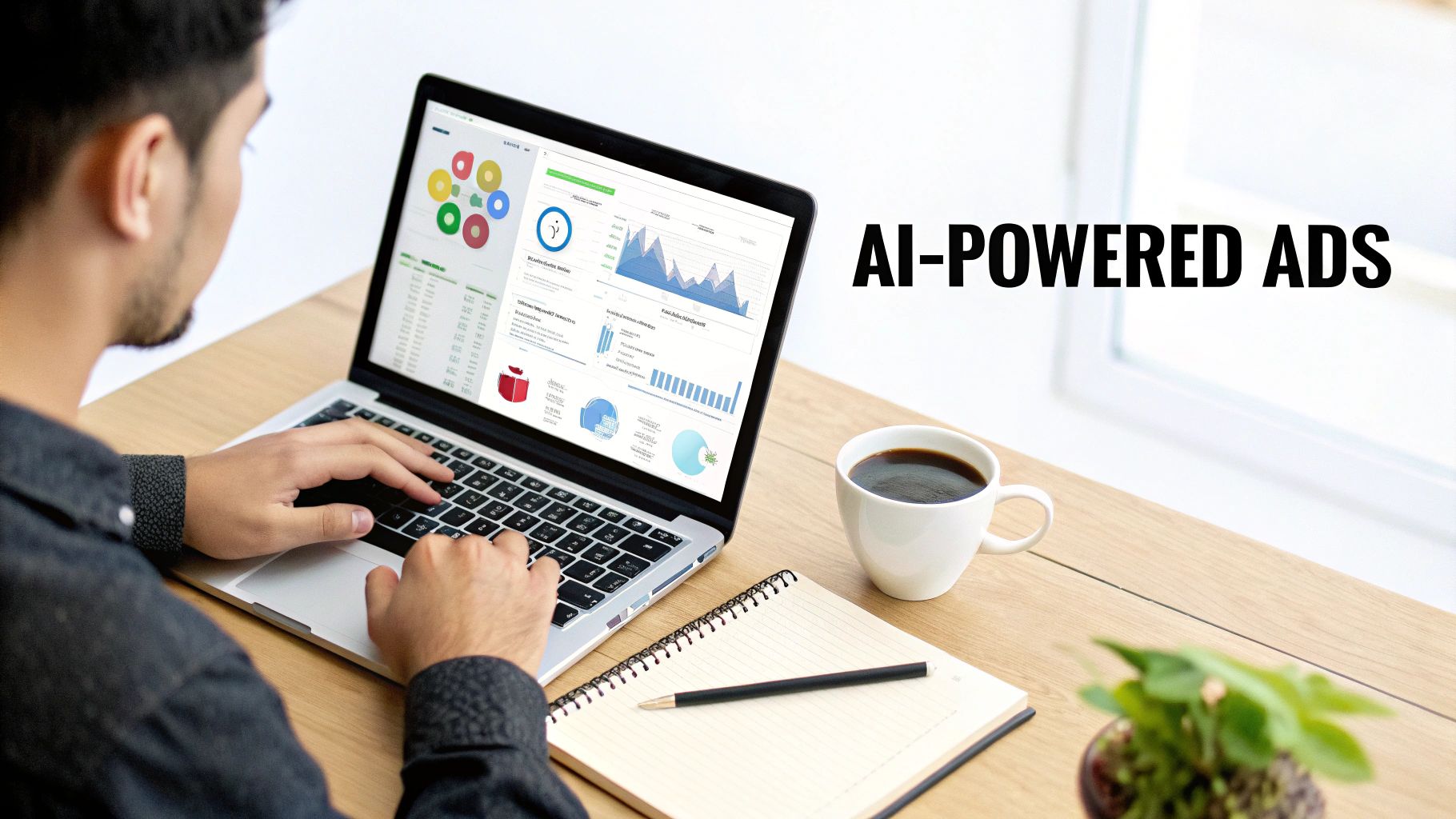
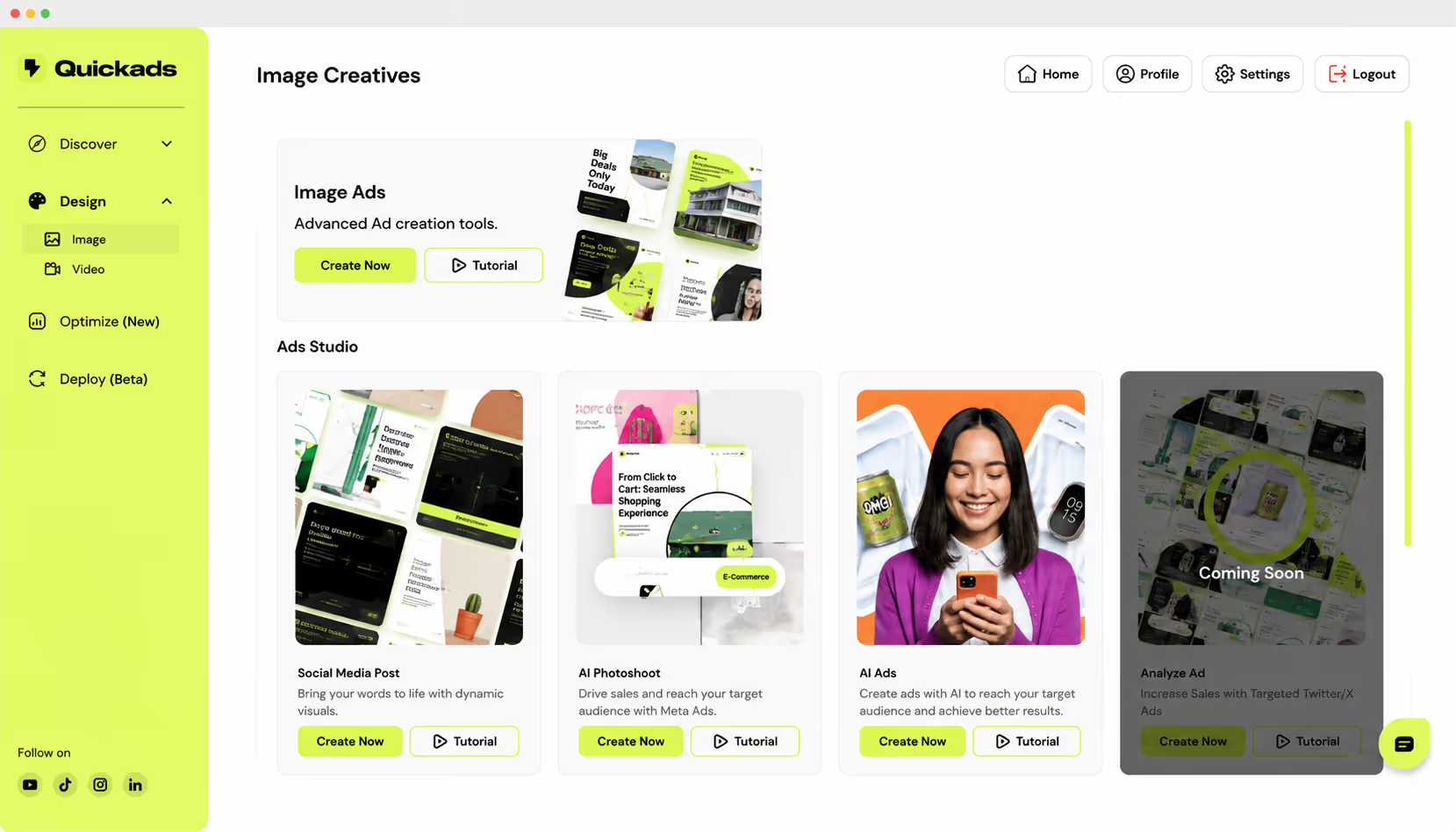
Platforms like Quickads.ai are built to be a command center for this new approach, pulling ad generation, analytics, and creative intelligence all into one place.
What This Means for Your Strategy
Think of this guide as your playbook for plugging these tools directly into your existing workflow. You’ll learn how to produce ad creatives that actually convert, put optimization on autopilot to boost your return on ad spend (ROAS), and dodge the common mistakes that trip people up when they first start with AI.
The goal isn't to replace human creativity but to augment it. AI handles the repetitive, data-heavy tasks, freeing up strategists to focus on brand narrative, market positioning, and innovative ideas that machines can't replicate.
By the time you're done here, you’ll have a clear, actionable plan to make AI a core part of your advertising efforts and start seeing a real difference in your results. For an even deeper look into the platform's mechanics, you can find comprehensive resources on Facebook Ads.
Getting Ad Creatives That Actually Convert
Alright, let's move past the theory and get our hands dirty. This is where the rubber meets the road—turning concepts into ad assets that actually drive sales and sign-ups. If you're still stuck in the old cycle of brainstorming, designing, and then just hoping something works, it's time for a change. That approach is simply too slow and expensive for today's ad environment.
Using AI for Facebook ads completely flips the script. Instead of guessing, you can rapidly generate a whole library of diverse creatives, all informed by what's already proven to work. It’s a systematic way to find your next winning ad.

This isn't just about moving faster, though. It's about being smarter. Tools like Quickads.ai are designed to analyze the massive Meta Ads Library, spotting the trends and patterns in top-performing campaigns. This gives your creative process a data-backed head start, which is a massive advantage.
Crafting High-Impact Image Ads
Believe it or not, static images are still the workhorses for a ton of successful Facebook campaigns. The catch? The bar for what's considered a "good" image is sky-high. Generic stock photos are a one-way ticket to getting ignored. Your visuals have to be good enough to stop the scroll, instantly get your message across, and feel authentic to your brand. Take the time to sharpen images so details stand out and your content looks crisp, polished, and professional.
This is where AI image generation really shines. Instead of digging through endless stock photo sites for a "close enough" image, you can create the exact visual you have in your head. The secret sauce is learning how to write a good prompt. A lazy prompt gets you a generic, forgettable image. A specific, detailed prompt gets you a powerful ad creative.
Think of building a prompt like giving directions to an artist. You need to be clear.
- Subject: Don't just say "a person using a laptop." Get specific. "A young female entrepreneur with curly brown hair, smiling confidently while working on a sleek laptop."
- Setting: Where are they? "In a bright, modern co-working spaces with large windows and lush green plants in the background."
- Style: What's the vibe? "Photorealistic, with warm and inviting lighting, a shallow depth of field, as if shot with a 50mm lens."
- Composition: How is it framed? "A medium shot, at eye-level, with the subject looking directly at the camera."
When you put all that together, you get a prompt that produces a unique, on-brand image you couldn't find anywhere else. For a much deeper dive into this, check out our guide on ad creative generation.
The real game-changer with AI isn't just making one perfect image. It’s about creating dozens of variations in minutes—different angles, diverse models, alternate color palettes—so you can A/B test your way to what truly connects with your audience.
Building Engaging Video Ads Without a Crew
We all know video is king on social media, but production has always been a massive bottleneck, especially for founders and smaller teams. AI is changing all of that. It’s now possible to create high-quality, engaging video ads without ever touching a camera or opening complex editing software.
This is particularly true for "faceless" videos. These are ads built with stock footage, animated text, screen recordings, and AI-generated voiceovers to tell a compelling story. They are incredibly fast to produce, easy to tweak, and surprisingly effective for everything from SaaS demos to e-commerce product features.
A great faceless video ad usually follows a simple, punchy formula:
- The Hook (0-3 seconds): Hit them with a bold claim, a relatable problem, or a visually arresting clip right away.
- Problem/Solution (4-9 seconds): State the pain point your audience feels, then introduce your product as the answer. Show, don't just tell.
- Benefits & Demo (10-13 seconds): Quickly run through the top 2-3 benefits and, if possible, show the product in action.
- Call to Action (14-15 seconds): End with a crystal-clear instruction. "Shop Now." "Learn More." Don't be vague.
With a tool like Quickads.ai, this entire process can be done in minutes. You plug in your key messages, and the AI handles the storyboarding, finds the visuals, adds the text overlays, and even generates a surprisingly realistic voiceover. This means you can create a custom video for every single product, feature, or audience segment you want to target.
Field-Tested AI Prompts for Ad Creatives
To make this even more practical, here are some copy-and-paste ready prompt examples. These are structured to give you high-quality outputs right away—just tweak them to fit your brand and industry.
These are copy-and-paste ready prompt examples for generating image and video content, showing you the exact inputs that lead to high-quality outputs.
Ad TypeIndustry ExampleEffective AI Prompt TemplateImage AdE-commerce (Skincare)"Photorealistic shot of a minimalist, gender-neutral skincare bottle made of frosted glass. The bottle is placed on a damp, slate surface next to a fresh green leaf. The lighting is soft and natural, creating a clean, high-end spa aesthetic."Image AdSaaS (Project Management)"Clean vector illustration of a diverse team collaborating around a digital kanban board. Use a vibrant but professional color palette of blues, greens, and corals. The style should be modern and flat, conveying efficiency and teamwork."Video ScriptService (Fitness Coach)"Generate a 15-second video script for a faceless ad. Hook: 'Stop doing endless crunches.' Problem: 'They aren’t giving you the results you want.' Solution: 'Here are 3 core exercises that actually work.' CTA: 'Download my free guide.'"
These prompts strike the right balance: they’re specific enough to guide the AI toward a great result but still leave a little room for it to work its magic. This is exactly what you need to generate a high volume of quality assets for testing.
Remember, understanding your market is everything. Globally, Facebook gives you access to 2.11 billion ad-eligible users. Tapping into even a slice of that market, where US penetration alone is 56.8%, requires a constant stream of creatives that resonate. This is a task that AI, trained on Meta's own data, is perfectly built for.
So, you’ve built a library of fantastic ad creatives. That's a huge win, but it’s really only half the job. Now comes the hard part: getting those assets to work for you in a way that doesn't just spend your budget but actually multiplies it. This is where AI moves beyond just making cool visuals and starts managing your entire campaign, automating the nitty-gritty work of finding the right person, at the right time, with the perfect ad.
The old-school approach of manually building dozens of hyper-specific ad sets based on niche interests? It's on its way out. Meta's own AI has become so incredibly good at finding customers that our job as marketers has fundamentally changed. Instead of spoon-feeding the algorithm exact audience parameters, our role is now to feed it a steady diet of high-quality creative and clear conversion goals. Then, we get out of the way and let it do the heavy lifting.
What's the Deal with Meta's Advantage+ Suite?
Meta has invested billions into its machine learning, and for advertisers, the result is the Advantage+ suite. These aren't just minor tweaks; they represent a complete shift in how you should be running campaigns. Think of it as having a tireless data scientist constantly poring over your results and making micro-adjustments for peak performance, 24/7.
You really need to get comfortable with two main components:
- Advantage+ Creative: This feature is a game-changer. You give it all your assets—your images, videos, headlines, and descriptions—and it dynamically mixes and matches them to create personalized ad variations for every single user. It learns which combinations resonate best and automatically pushes budget toward the winners, effectively ending the guesswork of manual A/B testing.
- Advantage+ Shopping Campaigns (ASC): This is the full-package deal, especially for e-commerce brands. You load it up with your creatives and product catalog, and the AI takes over almost everything else. It handles the targeting, placements, and budget allocation across Facebook, Instagram, Messenger—the whole ecosystem.
When you use a tool like Quickads.ai to generate a high volume of diverse creatives, you're essentially creating the perfect fuel for the Advantage+ engine. The more distinct angles, visuals, and copy points you provide, the more data it has to chew on, and the faster it can uncover those gold-standard, top-performing combinations.
Knowing When to Trust the AI (and When to Step In)
Letting an algorithm take the wheel can feel a bit unnerving at first, I get it. But the data doesn't lie: it works. For a direct-to-consumer (DTC) brand, an Advantage+ Shopping Campaign can be a pure discovery machine. It might find that a product you were marketing to young urban professionals is actually a massive hit with suburban empty-nesters—an audience you would have never thought to target on your own.
The system's power comes from its ability to move beyond rigid, pre-defined audiences. It couldn't care less about stated interests. It cares about one thing: finding users who exhibit behaviors that signal they're likely to convert.
Your job as a strategist is no longer about mastering the minutiae of audience targeting. It’s about becoming a master of creative strategy and setting clear business goals. You guide the AI by feeding it the right inputs and telling it precisely what a "win" looks like (e.g., purchases, qualified leads).
This doesn't mean you can just set it and forget it, though. Human oversight is still absolutely essential. A service-based business, for example, might use ASC to find new leads but will need to keep a close eye on the quality of those leads. If the AI is bringing in a ton of cheap form-fills that never turn into actual customers, you need to intervene. This could mean adjusting your campaign objective or refining your ad copy to better pre-qualify prospects before they click.
A Real-World Scenario for an E-commerce Brand
Let's make this tangible. Imagine you run an online store selling sustainable, handcrafted leather bags.
Here's how this AI-powered workflow would look in practice:
- Creative Generation: Using Quickads.ai, you create 20 distinct image ads that show your bags in various lifestyle contexts—a city commute, a weekend trip, a casual coffee shop meeting. You also generate 10 short video ads that zoom in on the craftsmanship and premium materials.
- Campaign Setup: You launch a single Advantage+ Shopping Campaign. Into this campaign, you upload all 30 creative assets, along with five different headlines and five primary text options you've written.
- Let the AI Work Its Magic: You set your daily budget and hit "Publish." Immediately, Meta's algorithm starts testing thousands of potential ad combinations across its network. It automatically begins shifting more of your budget toward the specific creative and audience pairings that are generating the most sales.
- Analyze and Iterate: A week later, you check your dashboard. The data clearly shows that videos highlighting the bag's interior pockets are driving a 30% higher ROAS than the general lifestyle images. This is gold. You now have a data-backed insight to inform your next move. You go back to Quickads.ai and create a new batch of assets focused entirely on product features and functionality.
This process creates a powerful feedback loop: generate, test, analyze, and iterate. And the best part? AI accelerates every single step. What would have taken a media buyer weeks of painstaking manual testing can now be done in just a few days, letting you scale your winning ads faster and more efficiently than ever before.
Using AI Insights to Analyze and Scale Performance
Getting your campaign live is just the first step. The real magic—and the real profit—happens when you dig into the performance data, figure out what's working, and scale it intelligently. This is where using AI for Facebook ads shifts from a simple creative tool to a genuine strategic partner, helping you read between the lines of your own data.
You can stop spending hours staring at the Ads Manager dashboard, trying to manually connect the dots between endless rows of metrics. AI-powered embedded analytics are built to surface the hidden patterns that are almost impossible for the human eye to catch. They're like a magnifying glass for your data, zeroing in on the subtle details that actually drive results.
This whole process is really a continuous loop: generate, test, and optimize.
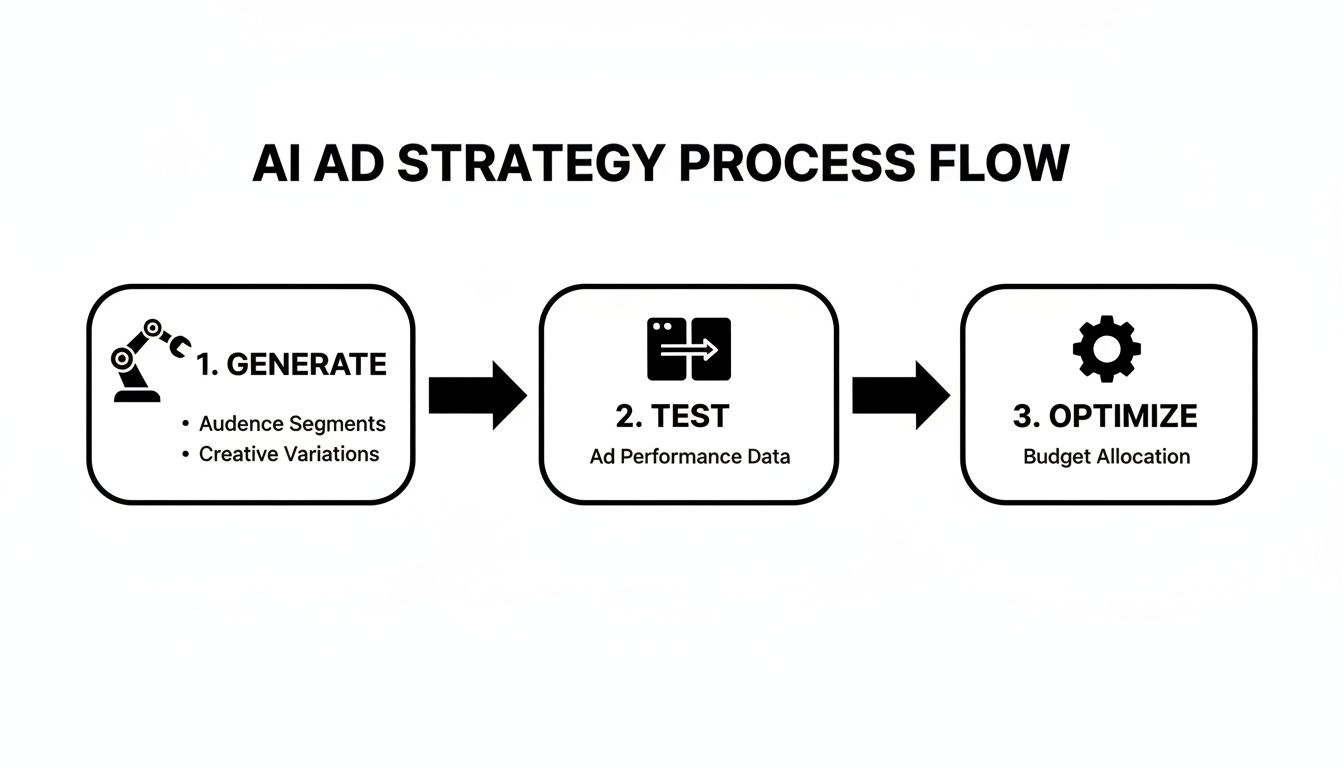
As you can see, the insights from one stage directly fuel the next. It’s all about creating a cycle of constant improvement.
Moving Beyond Basic Metrics
Sure, metrics like Click-Through Rate (CTR) and Cost Per Click (CPC) are important table stakes. But they only tell a fraction of the story. AI analytics dig much deeper to answer the critical "why" behind the numbers.
For example, imagine an AI tool sifting through thousands of your ad impressions and spotting something interesting: creatives featuring a specific shade of blue consistently get a 15% higher CTR with your key demographic on weekends. Or maybe it finds that ads with headlines phrased as a question see a 20% lower cost per acquisition. These are the kinds of granular, actionable insights that lead to smarter budget allocation and much better returns.
Another game-changer is predicting creative fatigue. An AI can monitor subtle shifts in engagement and performance to warn you that an ad is about to burn out before your Return on Ad Spend (ROAS) tanks. This gives you the chance to proactively swap in fresh creative from your AI-generated library and keep the momentum going.
The Continuous Feedback Loop Framework
The best way I've found to scale with AI is by building a systematic feedback loop. This approach transforms your advertising from a set of one-off campaigns into an intelligent, self-improving system.
Here’s how to put it into practice:
- Generate with AI: First, use a platform like Quickads.ai to churn out a high volume of diverse ad creatives. The key here is variety. Play with different visual styles, copy angles, and value propositions to create a wide testing pool.
- Test with Meta's AI: Next, launch these creatives within a Meta Advantage+ campaign. This lets Meta’s own algorithm do the heavy lifting of A/B testing, automatically finding the winning combinations of images, videos, and text for different parts of your audience.
- Analyze with AI Insights: Once the campaign has enough data, bring in an analytics tool to dissect the results. You're looking for patterns in the winning ads. What themes, colors, messaging, or formats are consistently coming out on top?
- Refine and Repeat: Finally, take what you've learned and feed it right back into your creative generation. If you found that short, punchy video hooks are crushing it, instruct your AI tool to make a new batch of ads following that exact formula.
This cycle ensures that every dollar spent makes your next campaign smarter and more effective.
By directly connecting creative generation to performance analysis, you stop guessing. You start building on what's proven to work. Each campaign becomes an experiment that makes the next one stronger.
Making Predictive Analytics Work for You
This entire system is fueled by predictive analytics. Essentially, AI models look at your historical campaign data to forecast future outcomes, which helps you make much sharper decisions on budget, creative direction, and scaling. It’s about anticipating which creative concepts have the highest probability of success before you even launch them.
If you want to go deeper on this, it's worth exploring the different ways AI predictive analytics boosts ad ROI. By building these forward-looking insights into your process, you shift from just reacting to past performance to proactively shaping future success. It's how you make sure every bit of your ad spend is working as hard as it possibly can.
Common AI Pitfalls and How to Avoid Them
Bringing AI for Facebook ads into your marketing mix feels like you've suddenly gained a superpower. But here’s the reality check: it’s not a magic button for instant campaign success. A lot of marketers jump in expecting perfect ads on day one, only to watch their campaigns fizzle out.
The issue is rarely the AI itself. It's almost always the strategy—or lack thereof—powering it. The biggest mistake I see is marketers treating AI like a set-it-and-forget-it vending machine instead of a highly skilled creative partner. Just flipping on an automated campaign and hoping for the best is a surefire way to burn through your ad budget.
AI needs guardrails. It needs your strategic oversight and a clear brand framework to do its best work. Without that human direction, you'll just end up with generic ads that don't connect with anyone.
The Danger of Vague Prompts
Want to get mediocre results from your AI tool? Give it lazy, generic inputs.
A prompt like "create an ad for my skincare brand" will give you exactly what you asked for: a bland, stock-photo-style image that looks like every other skincare ad in the feed. The AI has no context, no personality, and no specific goal to aim for.
You have to be obsessively specific. A great prompt is a detailed creative brief. It leaves very little room for the AI to guess what you want. Think about the difference between asking for "a picture of a dog" versus "a photorealistic shot of a golden retriever puppy playing in a sunny field, with a shallow depth of field."
The quality of your AI output is a direct reflection of the quality of your input. Treat every prompt as a creative brief you'd give to a human designer. The more detail you provide, the closer the result will be to your vision.
Before you write a single prompt, think about your unique selling points, your audience's pain points, and your brand's visual feel. Weave those details into every request to guide the AI toward creating something that feels authentically yours. This is how you go from making noise to making an impact.
Losing Your Brand Identity
Another trap is getting so caught up in the novelty of AI that you let it stray from your brand identity. It's incredibly easy to generate hundreds of creative variations, but if they don't align with your brand's voice, tone, and look, you're just creating chaos.
Inconsistency is a silent campaign killer. It confuses your audience and slowly chips away at the trust you've built.
To prevent this, I recommend creating a "brand constitution" for your AI. This is essentially a cheat sheet that outlines your core brand rules.
- Visual Style: Define your exact color palette (with hex codes), approved fonts, and the overall mood of your imagery. Are you bright and optimistic, dark and moody, or clean and minimalist?
- Brand Voice: What are your core messaging pillars? Are you witty, authoritative, empathetic, or playful? Give the AI examples of winning headlines and ad copy.
- Exclusion List: Clearly state what the AI should never do. List off-limit colors, forbidden words, or types of imagery that are completely off-brand.
By feeding these guidelines into your creative process, you build a consistent framework. This ensures that every single ad variation, no matter how many you generate, still feels like it came from your brand.
Forgetting the Human in the Loop
This last one is the most important. The single most critical mistake you can make is removing the "human-in-the-loop" and over-relying on automation.
AI is brilliant at executing tasks based on the data you give it. What it can't do is replicate human intuition, cultural awareness, or strategic judgment. It doesn’t understand the subtle market shifts or emotional triggers that actually convince someone to click "buy."
Your expertise is the strategic layer that makes the AI effective. You're the one who looks at the AI's output, interprets the performance data, and decides what to do next. The best results always come from a partnership: you guide the strategy, and the AI handles the heavy lifting of execution. Use it to supercharge your skills, not replace them.
Answering Your Questions About AI for Facebook Ads
Jumping into any new tech always brings up questions. When you start weaving AI into your Facebook ad strategy, a few common concerns tend to surface right away. Let's clear the air on those so you can move forward and get the most out of these tools.
Can AI Completely Replace a Human Media Buyer?
The short answer? Not a chance. Think of AI as an incredibly powerful assistant, but not a replacement for a smart human strategist.
AI is brilliant at chewing through massive amounts of data. It automates the grunt work—spitting out dozens of creative variations, tweaking budgets on the fly, and uncovering new audience segments you might have missed. But it's still a machine.
What AI lacks is that human touch: intuition, strategic foresight, and a real, nuanced feel for a brand's voice and soul. The winning formula is a partnership. A human strategist sets the direction, interprets what the AI finds, and makes the big-picture calls. The AI is your co-pilot, handling the heavy lifting so you can focus on the creative vision and overarching strategy.
How Much Should I Budget for AI Ads?
One of the best parts about using AI is that it's not just for the big players. You can get started at almost any budget. Your costs really boil down to two things: the AI tools themselves and your actual ad spend.
- Creative Tools: Platforms like Quickads.ai have made professional-level creative generation really accessible with affordable subscription plans. This opens the door for small businesses and even solo entrepreneurs.
- Ad Spend: When it comes to the campaigns, Meta’s own AI, especially Advantage+, is built to work well with budgets of all sizes. You can absolutely start with a small test budget of just $10–$20 a day to see how your AI-generated creatives perform.
That initial spend is all about gathering data and letting the algorithm learn. Once you see what's working, you can scale with confidence. The real magic is the improved return on investment (ROI) AI can deliver, which often makes the initial cost a no-brainer.
What Is the Best Way to A/B Test AI Creatives?
AI completely flips the script on A/B testing. Forget the old-school method of manually testing two or three ad variations against each other. Now, you can test dozens at once, and the best way to do it is by letting Meta's own tech do the work.
Just lean right into the Advantage+ Creative feature.
Here's the game plan: You feed all your AI-generated assets—every single image, video, headline, and line of copy—into one campaign. Advantage+ then acts like a master chef, automatically mixing and matching every element to discover the most potent combinations for different parts of your audience.
It's a dynamic process. The system automatically shifts more of your budget to the ads that are crushing it, all in real-time. This is miles more efficient than traditional A/B testing and gets you to your winning ads way faster.
Ready to stop guessing and start generating ads that actually convert? With Quickads.ai, you can create a high volume of data-backed image and video ads in minutes. See how our AI-powered platform can supercharge your creative workflow and boost your campaign performance. Start creating with Quickads.ai today!





Privacy is important to us, so you have the option of disabling certain types of storage that may not be necessary for the basic functioning of the website. Blocking categories may impact your experience on the website. View Our Privacy Policy


