
Advertising in ecommerce: A Practical Guide to Growth
Ecommerce advertising is how you get your online store in front of the right people. It’s all about using paid ads on the platforms your potential customers already use, turning your store from a hidden gem into a well-known destination.
Why Advertising Is Your Ecommerce Growth Engine
Let's be honest: in a massively crowded online world, having a great product is only half the battle.
In markets like Australia, where retail trade growth reflects shifting consumer confidence, knowing where your buyers spend time online is half the battle.
Imagine you’ve built a beautiful boutique, but it’s located on some quiet, undiscovered side street. No matter how amazing your products are, nobody will find you without some signs pointing them in the right direction. Strategic ecommerce advertising is that network of bright, clear signs guiding customers straight to your door.
For smaller stores just getting started, guides on digital advertising for small businesses are a great place to begin. The goal is simple but incredibly powerful: connect with the right person, with the right message, at the exact moment they’re ready to buy. For example, if you’re also using solutions like a shopify bundles app to create compelling product offers on your store, advertising can amplify the visibility of those bundled deals by showcasing them in search, social, and display placements.
Defining Your Core Advertising Channels
Effective advertising isn't about shouting from every rooftop; it's about being in the right places. Think of each channel like a different kind of fishing net. Some are for casting a wide net to see what you catch, while others are for precision targeting in very specific waters.
The real magic happens when you create a cohesive strategy where each channel works together. A customer might first see your brand in a cool Instagram ad, get curious, and then later be reminded to finish their purchase by a Google Shopping ad that pops up when they search for your product.
Below is a quick look at the main channels we'll be breaking down.
Key Ecommerce Advertising Channels at a Glance
This table gives you a bird's-eye view of the most effective channels, what they're good for, and where they typically fit into a broader strategy.
ChannelPrimary GoalBest ForPaid SocialDemand Generation & Brand AwarenessReaching new audiences, building community, and driving top-of-funnel interest.Paid SearchDemand CaptureGetting in front of customers with high purchase intent who are actively searching for your products.Shopping AdsDirect Sales & Product VisibilityShowcasing specific products with images and pricing directly in search results for ready-to-buy shoppers.Display & VideoRetargeting & Brand RecallKeeping your brand top-of-mind and bringing back visitors who have already shown interest.MarketplacesPoint-of-Sale ConversionReaching a massive, built-in audience of buyers on platforms like Amazon and Walmart.
This guide is your roadmap. We’ll walk through exactly how to build a smart, effective advertising plan that actually grows your business.
We’re going to cover how to:
- Grab attention on social media where people are scrolling and discovering new things.
- Meet intent on search engines where people are actively looking for what you sell.
- Bring back interested visitors who browsed but didn't buy anything the first time around.
Once you understand what makes each platform tick, you can put your budget where it will work hardest and turn your ad spend into a reliable engine for real growth. To further streamline your multi-channel selling workflow, consider tools that help you crosslist inventory across multiple marketplaces with ease — for example, platforms like Vendoo
that simplify multi-platform listing and inventory management.
Choosing Your Core Advertising Channels
Deciding where to spend your ad budget can feel like standing in a city square with a dozen roads branching out in every direction. The goal isn't to try and walk down every single one; it's about finding the most direct highways that lead straight to your ideal customers. It’s all about being strategic, not exhaustive.
This is where you plant your flag. You’re deciding where your brand will show up and how you'll talk to people when they see you. Each platform has its own vibe—some are like a bustling town market perfect for discovery, while others are more like a quiet library where people go with a specific mission. The trick is to match the channel's strength with your business goals.
The diagram below breaks down the fundamental flow of ecommerce. It shows how smart advertising gets the ball rolling, driving traffic that turns into sales and fuels real growth.
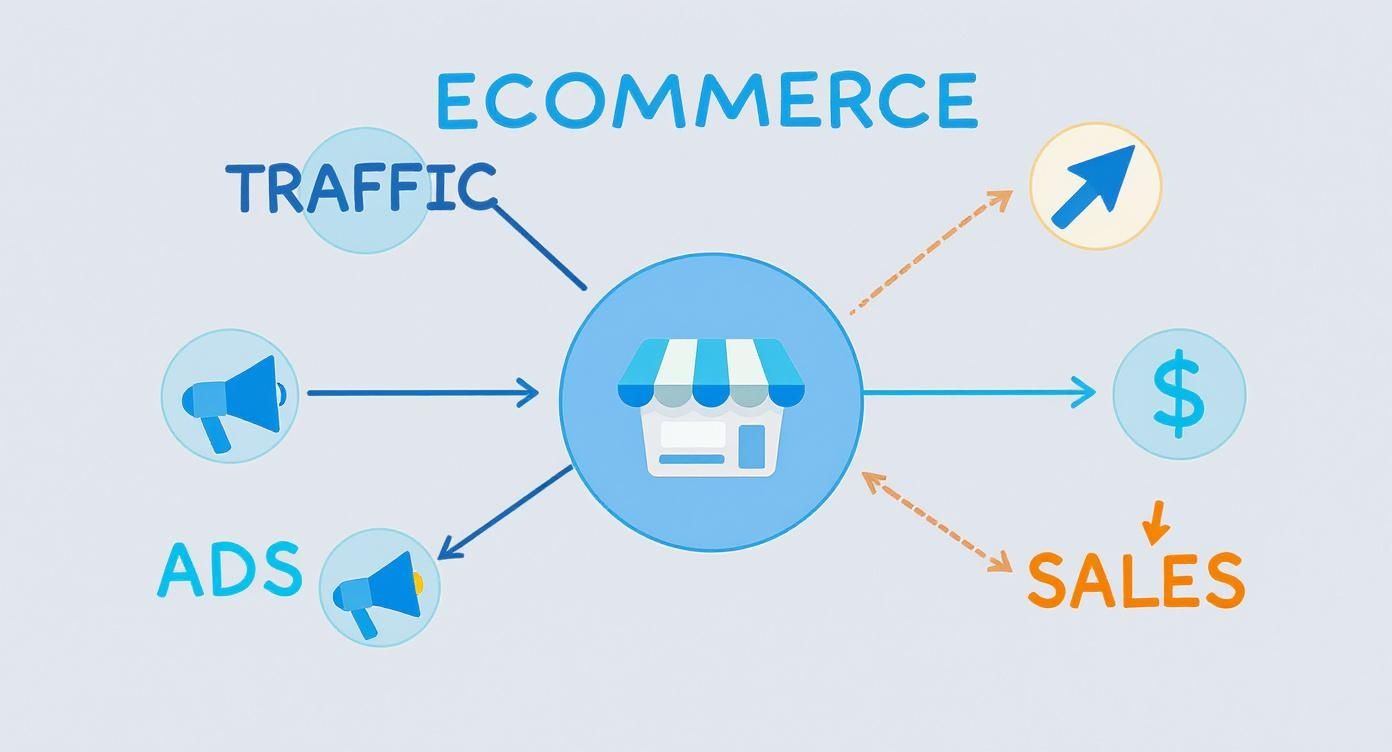
This visual drives home a core concept: well-placed ads are the starting line for a profitable customer journey. They turn eyeballs into revenue.
Paid Social for Demand Generation
Think of platforms like Meta (Facebook and Instagram) and TikTok as your brand’s digital storefront window. This is where you grab attention and create desire before someone even knows they need what you're selling. People are on these apps to scroll, connect, and kill time, which makes it the perfect place for discovery.
It works like this: someone isn't actively hunting for a new coffee maker while scrolling their Instagram feed. But if your stunning video ad pops up showing a sleek, fast-brewing machine, you've just planted a seed. That's demand generation in a nutshell—creating awareness and interest out of thin air.
These platforms are incredibly powerful because they know so much about their users, letting you target people based on interests, online behaviors, and demographics. The goal here is usually brand awareness and getting new people to your site. Success lives and dies by creative that's good enough to stop the scroll. Platforms like Flippa can also help you discover and evaluate established online businesses, giving you another avenue to reach audiences already interested in digital ventures.
Paid Search and Shopping for Demand Capture
If social media creates demand, Paid Search and Shopping ads are there to capture it. These channels, mostly run by Google, are like having an expert store clerk appear the second a customer asks, "Where can I find...?" When someone types "best waterproof running shoes" into Google, they have a problem and are actively looking for a product to solve it. This is high-intent traffic. For example, someone searching for dog food for small breed already knows what they need and is actively comparing options, making search and shopping ads especially effective for meeting that intent at the moment it matters most.
Your ad isn’t an interruption; it’s a solution. By showing up at the top of search results, you're directly answering a customer's question at the exact moment they ask it, which massively increases your chances of making a sale.
Paid Search ads are the text-based links you see at the top, while Shopping ads are the more visual product listings with images and prices. They are incredibly effective for driving sales because you’re connecting with people who are already in a buying mood. To get the full picture, check out our guide on e-commerce success by deploying the power of Google Ads.
Display Advertising for Retargeting
Ever looked at a product online, then suddenly started seeing ads for it everywhere you go? That’s display advertising—specifically, a tactic called retargeting. These are the visual banner and video ads you see on news sites, blogs, and just about any other website you visit.
In ecommerce, their main job is to remind and re-engage people who've already visited your site. For example, that person who added a pair of shoes to their cart but never checked out? They are the perfect audience for a retargeting ad. These ads are a gentle nudge, bringing your brand back to mind and encouraging them to finish the purchase. It’s not always the best for finding new customers, but it's vital for getting the most out of the traffic you already have.
Marketplace Ads for Point of Sale Dominance
Platforms like Amazon, Walmart, and Etsy aren't just places to sell; they're massive search engines in their own right. In fact, nearly 60% of all online product searches now start on Amazon, not Google. Running ads inside these marketplaces puts your product right in front of shoppers who are logged in, with their credit card saved, ready to buy.
Advertising here is less about telling your brand story and more about winning the "digital shelf." For sellers on marketplaces like Etsy, factoring in Etsy seller fees alongside ad spend is essential to ensure campaigns remain profitable after transaction, listing, and payment processing costs are applied. When someone searches for "yoga mat" on Amazon, sponsored product ads make sure your mat shows up at the very top, before all the organic results. In a crowded marketplace, this is how you get seen and capture customers at the very last step of their journey. Sponsored results are only one layer of it: Amazon's demand-side platform uses the same shopper data to retarget those browsers with display and video ads across the wider web, and sellers running both sides usually handle them through Amazon DSP management software rather than two separate consoles.
The right mix of these channels will always depend on your product, your audience, and your budget. A new fashion brand might go all-in on Instagram to build hype, while a store selling niche auto parts might find its best customers on Google Search. Most often, the winning strategy is a blended one, using each channel for what it does best.
Crafting Ad Creatives That Actually Convert
If your targeting and budget are the engine of your advertising, then your creative is the fuel. You can have the most powerful engine in the world, but without the right fuel, you're going nowhere. A perfectly targeted ad with a bland, uninspired creative will just sputter out.
The best advertising in ecommerce doesn't just show a product. It tells a story. It solves a problem. It creates an emotional hook that stops someone mid-scroll and makes them pay attention, especially in white label telemedicine, where trust, clarity, and proof of reliability are what make people take the next step. This is where art and science really have to work together.
You need visuals that look great, sure, but they also have to be psychologically persuasive. The goal is to get beyond a simple list of features and actually demonstrate the value your product brings into a customer's life. Think about it: instead of just showing a static picture of a blender, show a quick video of someone making a delicious, healthy smoothie in 30 seconds before rushing out the door. You’re not selling a machine; you’re selling a faster, healthier morning.
Building Your Creative Portfolio
Here's a hard truth: relying on a single ad creative is a recipe for disaster. People get hit with ad fatigue fast. See the same ad a few times, and their brain just starts filtering it out. A winning strategy means building a diverse portfolio of creatives you can rotate to keep things fresh and appeal to different types of customers.
Your portfolio should have a healthy mix of formats, each with its own job.
- Striking Static Images: High-quality photos are your foundation. We're talking clean, well-lit shots that make your product look its absolute best. These are perfect for carousel ads where you can show off multiple products or zoom in on different features of a single item.
- Engaging Short-Form Videos: Video is king for telling a story quickly. Use short, punchy clips (15-30 seconds) to show your product in action, feature a dramatic before-and-after, or create a mini-story that connects with your audience's goals.
- Authentic User-Generated Content (UGC): Nothing builds trust like seeing real customers use and love your product. UGC feels genuine and works as powerful social proof, showing potential buyers that people just like them are happy they bought from you.
Having this kind of variety means you've always got the right tool for the job, whether it's a polished image for an Instagram feed or a raw, authentic-looking video for a TikTok campaign.
Key Creative Formats and When to Use Them
Not all creatives are built the same, and the format you pick should match your campaign goal and the platform you're on. Let’s break down the heavy hitters in modern ecommerce advertising.
1. Product-Focused Creatives
These are your bread and butter. They put the product front and center, often on a clean, simple background to highlight its design and quality. This style is killer for retargeting campaigns—the person already knows your brand and just needs a crisp reminder of that specific item they were looking at.
2. Lifestyle and In-Context Creatives
This is where you show your product out in the wild. A backpack isn't just a bag; it's part of an epic mountain hike. A coffee mug isn't just ceramic; it's part of a quiet, cozy morning ritual. These ads sell the experience, which is perfect for top-of-funnel campaigns trying to attract new customers who have never heard of you. The same approach works well for niche perfumes, where advertisers often focus on mood, lifestyle, craftsmanship, and scent stories rather than simply listing fragrance notes or product specifications.
3. "Faceless" Video Content
This is a hugely popular style you've definitely seen. It focuses on the hands and the product, creating an almost ASMR-like vibe. Think of unboxing videos, product assembly, or quick demos where you never see the person's face. It feels personal and authentic without the cost or hassle of hiring actors, making it a brilliant way to produce engaging video ads on a budget.
The most powerful ad creatives make the customer the hero of the story. Your product is simply the tool that helps them achieve their goals, solve their problems, or live their desired lifestyle.
Ultimately, your creative strategy has to be built on a foundation of constant testing. Create variations of your best ads—tweak the headline, swap the visual, change the call-to-action—and let the data tell you what truly resonates. An ad that shows your product's value in a relatable way will almost always beat one that just talks about features. The same principle applies when promoting educational services such as e-commerce assignment help, where highlighting real student outcomes, timely assistance, and practical benefits is often more effective than simply listing service features.
Mastering Your Targeting and Ad Budget

Great advertising in ecommerce is all about precision, not just noise. Throwing a massive budget at a campaign without a clear aim is like trying to catch fish by casting a giant net in the middle of the ocean. You might snag something by chance, but you'll waste a ton of energy and money in the process. The real art is knowing exactly where to drop your line.
Think of it like being an expert archer. They don’t just sling arrows and hope for the best. They identify the target, account for the wind, and aim for the bullseye. In advertising, that's your targeting strategy. It’s the craft of finding and reaching your ideal customers so every dollar you spend has the best possible chance of hitting its mark.
Once you know who you're talking to, you can decide how much you're willing to pay to get their attention. This blend of sharp targeting and smart budgeting is what separates campaigns that fizzle out from those that drive real, profitable growth.
Reaching the Right People with Precision Targeting
Before you can make a sale, you have to find the people who actually want what you're selling. Today's ad platforms give us incredible tools to do just that, letting us move way beyond simple age and location data. This is where you build your audiences.
A solid targeting strategy is built in layers, with each one designed to reach customers at different points in their journey with your brand.
- Demographic Targeting: This is the foundation. It covers the basics like age, gender, location, language, and sometimes even income level. It's a solid starting point but is rarely specific enough on its own to get the job done.
- Behavioral & Interest Targeting: Now we're getting somewhere. Here, you can target people based on their online activities—the pages they like, the things they search for, and their recent buying habits. Selling high-end hiking boots? You can target people interested in national parks, specific outdoor brands, and fitness apps.
- Lookalike Audiences: This is easily one of the most powerful tools in an advertiser's arsenal. You upload a list of your best customers, and the platform’s algorithm finds brand-new people who share similar traits and online behaviors. It’s like creating a clone of your perfect customer.
- Retargeting: This is your low-hanging fruit. Retargeting lets you serve ads directly to people who've already interacted with your brand in some way. Maybe they visited your site, added a product to their cart, or watched one of your video ads. These are warm leads who often just need a little nudge to come back and finish their purchase.
By weaving these methods together, you create a complete plan to attract new shoppers while bringing interested ones back into the fold.
Translating Your Budget and Bidding Strategy
After you’ve zeroed in on your target audience, you need to decide how much you’re willing to spend to reach them. Budgeting and bidding can feel like a maze of acronyms at first, but the concepts are actually pretty simple. Your budget is the total amount you’ll spend, while your bidding strategy tells the ad platform how to spend it.
Think of it like an auction. You're telling the auctioneer (the ad platform) what you want to achieve, and it places bids on your behalf to win the best ad placements. Your strategy will change completely depending on your goal.
Your budget isn’t just a cost; it’s an investment in data. When you're starting, you aren't just paying for sales—you're paying to learn what works, who your best customers are, and how much it costs to acquire them.
These are the most common goals and metrics that will steer your spending:
- CPC (Cost Per Click): You pay each time someone clicks on your ad. This is a go-to strategy when your main goal is simply to drive traffic to your website or a specific landing page.
- CPM (Cost Per Mille): "Mille" is Latin for thousand. You pay a set price for every 1,000 times your ad is shown (an impression). This is perfect for brand awareness campaigns where you just want to get your name in front of as many relevant eyeballs as possible.
- ROAS (Return On Ad Spend): This is the holy grail for most ecommerce stores. You tell the platform your target ROAS—for example, "for every $1 I spend, I want $4 back in revenue"—and its algorithm will automatically adjust your bids to try and hit that number.
The right choice comes down to what you're trying to do. Launching a new product and need to build some buzz? A CPM strategy is a great fit. Have a proven winner and want to drive profitable sales? Optimizing for ROAS is the only way to go. You can start with a daily budget you're comfortable with—even $20-$30 per day is enough to start gathering the data you need to make smarter decisions and scale up.
Measuring Success and Optimizing for Growth
Launching an ad campaign without tracking is like trying to sail across the ocean without a compass. You’re moving, sure, but you have no idea if you’re actually heading in the right direction. This is where data becomes your north star, turning hopeful guesses into a clear, predictable path for growth.
You simply can't improve what you don't measure. By zeroing in on a few essential metrics, you can diagnose the health of your campaigns, start to understand how your customers think, and make smart adjustments that directly boost your bottom line. It’s the feedback loop that powers all successful advertising.
Your Core Ecommerce Advertising KPIs
Ad platforms will throw dozens of metrics at you, but you only need to master a handful of key performance indicators (KPIs) to get a clear picture of what’s really working. Think of these as the vital signs of your advertising efforts.
- Click-Through Rate (CTR): This is simple: out of everyone who saw your ad, how many actually clicked it? A high CTR means your creative and headline are compelling enough to grab attention and stop the scroll. A low CTR, on the other hand, is an early warning sign that your message just isn't landing.
- Conversion Rate (CVR): Of the people who clicked your ad, what percentage went on to complete your goal—usually, making a purchase? This metric tells you how effective your landing page and overall offer are. High clicks but low conversions often point to a disconnect between the promise of your ad and the reality of your website.
- Customer Acquisition Cost (CAC): This is the big one. How much, in total, did you have to spend on ads to get one new customer? You calculate this by dividing your total ad spend by the number of new customers you brought in. If your CAC is higher than what a customer typically spends with you, your business model isn't sustainable.
These three metrics work together to tell a complete story. A great CTR shows your ad is attractive, a strong CVR shows your offer is persuasive, and a low CAC shows your entire funnel is efficient and profitable. For growing retailers, eCommerce software development services can help improve storefront performance, checkout flows, system integrations, and platform scalability as traffic and transaction volumes increase.
Understanding Which Ads Get the Credit
As you start running ads across multiple channels, a common puzzle emerges: if a customer sees your ad on Instagram, then later clicks a Google Shopping ad to buy, which ad gets the credit? This is the core challenge of attribution.
To get a clearer picture of what truly drives conversions, marketers can use incrementality testing, which measures the conversions genuinely caused by your ads versus those that would have happened organically.
Attribution models are just the rules used to assign credit for a sale. A very common one is last-click attribution, where 100% of the credit goes to the very last touchpoint before the purchase. While simple, this model often overlooks the crucial role that earlier ads played in building awareness and trust. Digging into your platform's attribution settings helps you see a more complete picture of the entire customer journey.
Don't just optimize for the final click. Recognize that some ads are great at introducing your brand (the 'assist'), while others are designed to close the deal (the 'goal'). A healthy strategy needs both.
A Practical Workflow for Optimization
Data is completely useless without action. Real growth comes from a disciplined cycle of analyzing your performance, forming educated guesses (hypotheses), and actually testing your ideas. This is the optimization workflow that turns raw insights into better results.
This process isn't a one-time fix but a continuous loop.
1. Analyze the Data
Start by looking at your core KPIs. Where are the weak spots? Is there an ad with a fantastic CTR but a terrible conversion rate? That’s a huge clue—it tells you the ad is interesting, but the landing page isn't delivering on the promise.
2. Form a Hypothesis
Based on what you found, make an educated guess about how you could improve things. A good hypothesis is specific and measurable. For example: "I believe changing the video's first three seconds to a more dynamic hook will increase watch time and lift my CTR."
3. Run an A/B Test
This is where you test your hypothesis like a scientist. Create a duplicate of your original ad (Version A) and make just one single change to create Version B (like that new video hook). By running both at the same time to the same audience, you can see which one truly performs better without any guesswork involved.
This simple, repeatable process is the engine of all successful advertising in ecommerce. It replaces assumptions with certainty and allows you to methodically improve your campaigns over time, ensuring your ad spend works harder and smarter for you.
Using AI for Smarter Ecommerce Advertising
Artificial Intelligence has moved from sci-fi to a real, practical part of the ecommerce advertising toolkit. The best way to think of AI is as a super-powered assistant—one that can sift through enormous amounts of data, automate repetitive tasks, and spot patterns humans would likely miss.
It helps you create ad variations in a snap, discover hidden customer segments, and even manage your ad spend automatically. The outcome? A much more efficient advertising engine that lets you pull back from the tedious tasks and focus on your core business strategy.
Automating Creative and Audience Discovery
One of the first places you’ll feel AI’s impact is in making ad creative. Instead of spending days brainstorming and designing, modern AI tools can spit out dozens of different ad copy hooks, image concepts, and even short video ideas in minutes. This means you can test more and learn faster.
But it’s not just about speed. AI is also incredibly good at finding new people to sell to. Its algorithms can analyze your current customer data and identify new audiences who look and act just like your best buyers, going way beyond what you could ever do with manual targeting.
AI isn’t here to replace the strategist; it’s here to empower them. The best results come when human creativity guides the machine's analytical power, combining gut instinct with data-driven insights.
This completely changes the old workflow. You can move from clunky, one-on-one A/B tests to running huge, multi-variant tests that give you clear answers much quicker. If you want to dive deeper, you can find great info on improving campaigns with ecommerce ad intelligence.
The Role of AI in Campaign Optimization
AI’s job doesn’t stop once the ads are live. In fact, that’s where it really starts to shine. Most major ad platforms already have machine learning built into their bidding systems, meaning they can adjust your bids in real-time to get you the most clicks, sales, or whatever goal you’ve set.
- Predictive Analytics: AI can look at early data to forecast how a campaign might perform, helping you decide where to put your budget for the best return.
- Performance Optimization: It works 24/7, monitoring what’s working and what isn’t. If one ad or audience is outperforming another, it will automatically shift more of your budget there.
For anyone running campaigns on specific platforms, resources like A Modern Guide to AI Affiliate Writing for TikTok Shop show just how specialized these tools have become. When you fold AI into your process, you start making smarter decisions based on data, turning your ad spend into a more reliable way to grow your business.
Your Top Ecommerce Advertising Questions, Answered
Jumping into ecommerce ads always brings up a few big questions. Getting these sorted out from the get-go is the difference between building a smart, profitable strategy and just throwing money at the wall hoping something sticks. Let's clear up the most common ones.
How Much Should I Spend on Ads When I'm Just Starting?
Look, there’s no single "right" answer, but a solid rule of thumb is to set aside 5-10% of your total revenue for advertising. If you're brand new with zero revenue, don't sweat it. Think small and focused.
Start with a modest daily budget—even $20-$30 on one platform is enough to start collecting priceless data. Your initial goal isn't immediate profit; it's learning. Once you figure out what it costs to get a customer (your CAC) and you’re seeing a healthy return on ad spend (ROAS), then you can confidently start pouring more fuel on the fire.
Which Ad Platform is Best for a Beginner?
For most brands selling physical goods, Meta (that’s Facebook and Instagram) is the place to start. It’s built for visuals, which is perfect for showing off your products, and its targeting capabilities are second to none for finding people who don't know you exist yet.
The exception? If you sell something people are actively looking for—think "waterproof running shoes" or "organic dog food"—then Google Shopping ads are your golden ticket. They put your product right in front of someone who’s ready to buy. The trick is to pick one platform and really learn its ins and outs before you try to be everywhere at once.
How Long Does It Take to Actually See Results?
You'll get data on things like clicks and impressions almost instantly, but don't mistake that for real results. Getting to consistent, profitable sales requires a bit of patience.
Pretty much every ad platform has what’s called a "learning phase," which can last a week or even longer. This is when the algorithm is working hard behind the scenes, testing and learning who your best customers are.
Fight the urge to tinker with your campaigns every five minutes. Let the platform do its job for the first few days.
Plan on letting your ads run for at least 2-4 weeks before making any big decisions. This gives you enough solid data to see what’s working and what’s not. Think of this initial period as an investment in market intelligence.
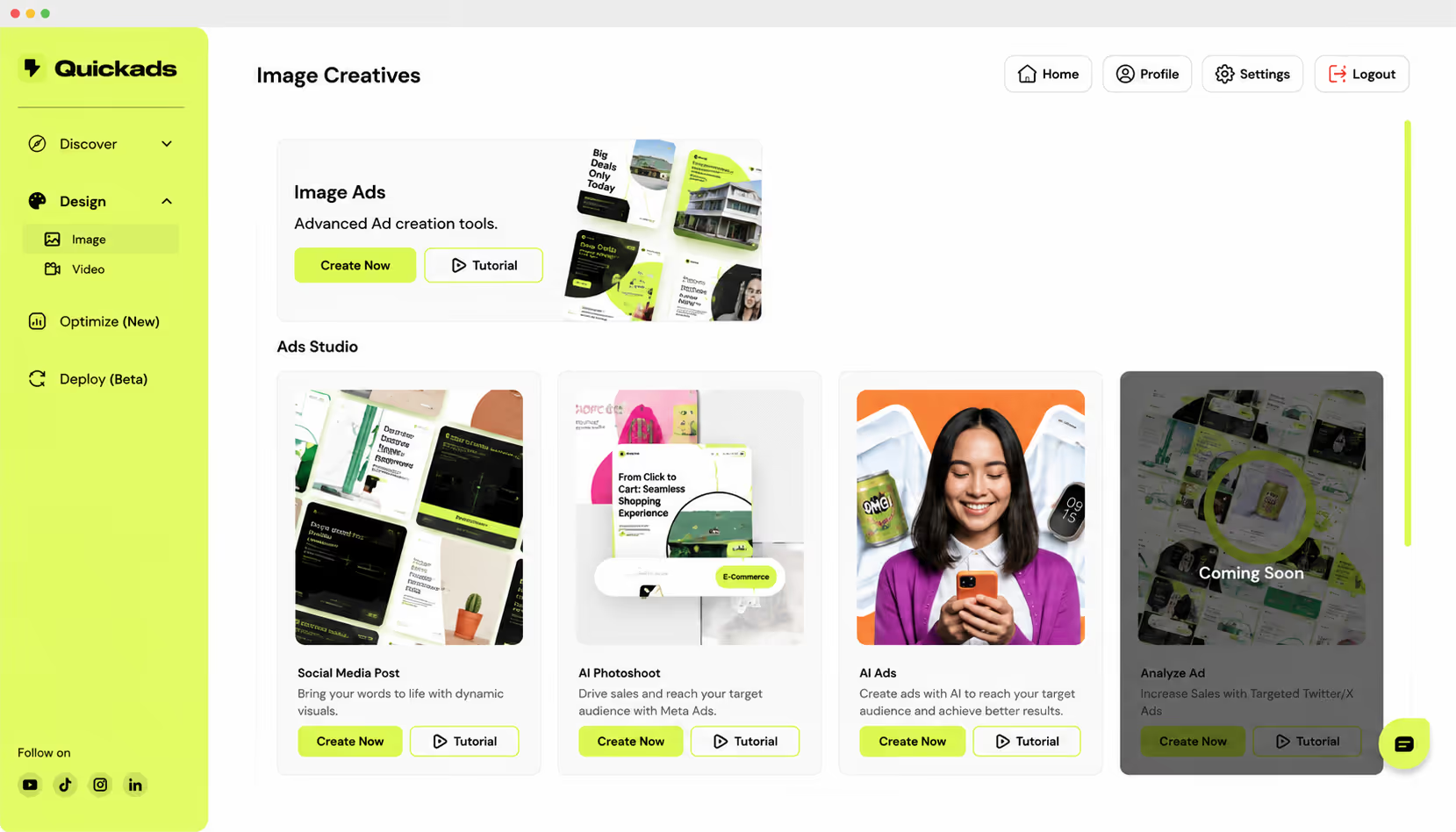
Ready to stop guessing and start building ads that actually convert? With quickads.ai, you can use AI to generate stunning image ads, video ads, and faceless shorts in minutes, all powered by real-world performance data. Create your first ad for free and see the difference.








Privacy is important to us, so you have the option of disabling certain types of storage that may not be necessary for the basic functioning of the website. Blocking categories may impact your experience on the website. View Our Privacy Policy


