
Advertising and Psychology: How advertising and psychology Shapes Your Choices

The link between advertising and psychology is all about understanding what makes people tick—and what makes them click. It's the science of figuring out how our behaviors, thought processes, and emotional responses shape our buying decisions. Advertisers lean on these psychological insights to craft messages that stick, build real trust, and nudge us toward taking action. It's the invisible engine running behind every ad you see.
The Invisible Hand Guiding Your Choices

Ever stood in a supermarket aisle, staring at two nearly identical products, and felt an unexplainable pull toward one? Maybe it was the warm, earthy packaging on a bag of coffee that just felt better than the competitor's bright, sterile design. Custom packaging plays a big role here, shaping those first impressions and subtly guiding choices. You might tell yourself you picked it for the quality or because you vaguely recall a clever ad, but the real decision was probably made before your conscious brain even had a chance to argue.
That subtle nudge is exactly where psychology and advertising meet. It’s a field dedicated to understanding the why behind what we want, need, and do. The best ads rarely just sell a product; they sell a feeling, a solution, or a new version of ourselves.
The Science Behind the Sale
At its core, this discipline is a blend of marketing goals and hard psychological science. Instead of just rattling off a list of features, smart advertisers tap into our deepest motivations. They build stories that connect with our built-in desires and the mental shortcuts we all use.
The aim is to make the journey from seeing an ad to making a purchase feel effortless, often by appealing to our subconscious. This is done by applying a few key concepts:
- Persuasion Principles: Think of these as the fundamental rules of influence. Things like scarcity ("limited time only!") or social proof ("everyone's buying it!") are powerful guides for our decision-making.
- Emotional Triggers: Marketers work to spark specific emotions—joy, fear, nostalgia, or ambition—to forge a strong, memorable bond with a brand.
- Cognitive Biases: These are the predictable quirks in human thinking. Advertisers can frame a product in a way that plays to these biases, making it seem far more appealing.
This isn't necessarily about sinister manipulation. It's about speaking the brain's native language. For instance, a study on color in marketing revealed that up to 90% of snap judgments about products can come down to color alone. That one stat shows just how much our gut feelings and subconscious cues drive our choices. Today, brands are taking it further by using QR codes generated with The QR Code Generator (TQRCG) on packaging, letting customers instantly learn about the product or company, turning a simple purchase into an engaging, entertaining experience that satisfies curiosity and builds connection.
The most effective advertising doesn't just present information; it creates an experience. It works by understanding that consumers don't always make logical choices—they make choices that feel right.
Throughout this guide, we'll pull back the curtain on the specific tactics that make this connection so powerful. We’ll look at everything from the pioneers who first tied psychology to profit to the modern A/B testing that can pinpoint the impact of changing a single word. You'll walk away with a clear understanding of the invisible forces that shape commerce—and you’ll be a smarter consumer and a more effective marketer for it.
Unlocking The Core Principles Of Persuasion
At the very core of effective advertising are a handful of ideas that explain how people are nudged to say "yes." These aren't just random tricks; they're predictable patterns in human behavior, famously documented by psychologist Dr. Robert Cialdini. His research uncovered six universal principles of persuasion that we all use as mental shortcuts to make decisions.
Think of these principles as the unspoken rules of engagement between a brand and a customer. When an advertiser truly gets them, they can create messages that connect on a much deeper, more intuitive level. It’s all about aligning what you're asking for with the way our brains are already wired to think and act.
The average person is absolutely swamped with ads. Back in the 1970s, you might have seen around 500 ads a day. Today? That number has exploded to an estimated 5,000. This non-stop noise has trained us to develop defenses like "banner blindness," where a staggering 86% of digital ads are completely ignored. Cialdini's principles provide a way to cut through that clutter by tapping into basic human drivers. You can discover more insights about the psychology of advertising to see just how big of an impact these ideas can have.
To make this crystal clear, let's break down each of Cialdini's six principles and see how they show up in the ads we see every day.
Cialdini's Principles Of Persuasion In Advertising
PrincipleExplanationAdvertising ExampleReciprocityPeople feel a strong social obligation to give something back after they've received something for free.A skincare brand offering a free sample. You feel a subtle psychological pull to "return the favor" by buying the full-size product.ScarcityWhen something is limited or rare, we perceive it as more valuable and desirable. It triggers our fear of missing out.An e-commerce site using a countdown timer for a sale with the message, "Offer ends in 02:00:00!"AuthorityWe tend to trust and follow the advice of credible experts or figures of authority.A toothpaste ad featuring a dentist in a white coat recommending the product for its cavity-fighting benefits.ConsistencyHumans have an innate desire to be consistent with our past actions and commitments, even small ones.A charity asking you to sign a simple online petition. Later, they follow up with a request for a small donation, which you're more likely to give.LikingWe are far more likely to say "yes" to people and brands we know, like, and find relatable.A brand using a popular, down-to-earth celebrity as a spokesperson, making the brand feel more like a trusted friend.Social ProofIn moments of uncertainty, we look to the actions and behaviors of others to guide our own choices.A software company's homepage proudly stating, "Join over 10 million users who trust us to get the job done."
These principles aren't about manipulation; they're about understanding the natural ways people think and make choices. When used thoughtfully, they help brands build genuine connections and make their value clear. Let's dig a little deeper into each one.
Reciprocity: The Urge To Give Back
The principle of Reciprocity is built on a simple social contract: when someone does something nice for you, you feel a powerful, almost automatic urge to do something nice for them in return. In the world of advertising, this often looks like freebies, valuable content, or helpful tools.
A software company offering a free, no-strings-attached trial is a classic example. By giving you real value upfront, they create a subtle sense of indebtedness. That little psychological nudge makes you more likely to reciprocate by becoming a paying customer down the road.
Scarcity: The Fear Of Missing Out
Scarcity taps directly into our deep-seated fear of loss, often called FOMO (Fear Of Missing Out). When we believe something is in short supply or only available for a limited time, our brain automatically assigns it more value. This is the engine that drives "limited-edition" drops, flash sales, and those ticking countdown timers on shopping sites.
Booking websites are masters of this. Ever see a message like, "Only 2 rooms left at this price!"? That’s scarcity in action. It triggers a sense of urgency, compelling you to act now rather than risk losing out. It effectively short-circuits our careful, deliberate thinking by highlighting what we stand to lose.
"The way to love anything is to realize that it might be lost." - G.K. Chesterton. Advertisers use scarcity to make you feel this potential loss before it ever happens, driving immediate action.
Authority: Trusting The Experts
As a general rule, people follow the lead of credible, knowledgeable experts. The principle of Authority is all about using signals of expertise to build trust and confidence. This can be as direct as a doctor recommending a certain medication or as subtle as an industry award proudly displayed on a company’s homepage.
These symbols of authority serve as a mental shortcut. They reassure us that we're making a smart decision, saving us the cognitive energy of doing all the research ourselves. It makes the choice feel safer and more certain.
Consistency: The Power Of Small Commitments
We all have a deep-seated need to be—and to appear—consistent with what we've already said or done. The Consistency principle is why advertisers often start by asking for a very small commitment before moving on to a bigger one.
For example, a brand might first ask you to simply "like" their page or sign a petition for a cause they support. Once you've made that small, public commitment, you are psychologically wired to be more open to a larger request later, like making a purchase, because you want to remain consistent with your stated values. This is often called the "foot-in-the-door" technique.
Liking: The Influence Of Friendship
It's just human nature: we are far more likely to be persuaded by people and brands we actually like. The Liking principle works through several factors, including:
- Similarity: We like people who are like us.
- Compliments: We like people who praise us.
- Attractiveness: We tend to associate positive traits with good-looking people.
Advertisers use relatable spokespeople or create brand personalities that mirror their target audience’s values and lifestyle. When a brand's message makes us feel seen and understood, we develop a positive feeling toward it. This warmth makes us more receptive because the interaction feels less like a sales pitch and more like getting advice from a friend. This vital link between advertising and psychology is a cornerstone of modern brand-building.
Social Proof: Following The Crowd
When we're unsure what to do, we instinctively look to others to see what they're doing. This is Social Proof, and it's one of the most powerful psychological forces in advertising. Customer reviews, testimonials, user counts ("Join 10 million happy users!"), and celebrity endorsements are all forms of social proof.
Seeing that other people have already made a choice validates it for us and reduces our perceived risk. It essentially tells our brain, "Hey, if it worked for all of them, it will probably work for me, too."
The Pioneers Who Turned Psychology Into Profit
The persuasive tricks in modern ads might feel new, but their roots run surprisingly deep. Long before anyone was A/B testing creative, a handful of forward-thinkers figured out that the best way to sell something wasn't to talk about its features. It was to tap into the deep-seated desires of the person you're selling to.
They completely changed the game, turning advertising from a simple public notice into a powerful tool of human psychology. Instead of asking, "What does our product do?" they started asking, "How does our product make people feel?" That single question laid the foundation for everything we do today.
John B. Watson and The Science of Behavior
John B. Watson, a key figure in this shift, was a psychologist who believed human behavior could be predicted and, more importantly, controlled. He argued that inner thoughts were messy and irrelevant; what really mattered were observable actions and the things that triggered them. He took this theory, known as behaviorism, straight from the lab and into the ad agency.
Watson’s idea was simple but powerful: create ads that trigger a specific emotional response—like fear, love, or rage—and you could condition people to associate those feelings with your product. When he brought this thinking to the ad world in 1913, he moved the industry away from just informing people and toward actively shaping their behavior. The financial results were staggering, with ad revenues jumping by an incredible 498% between 1925 and 1928 alone. You can dive deeper into the early history of psychological advertising to see just how radical these ideas were at the time.
He focused his new approach on three core emotional triggers:
- Love: Ads that connect a product to romance, family, and deep affection.
- Fear: Campaigns that show the negative outcomes of not using a product.
- Rage: Messages that tap into people's frustrations to frame a product as the solution.
This was a massive departure from the logical, text-heavy ads that were common back then. Watson taught advertisers to stop selling a physical object and start selling an emotional outcome.
Edward Bernays and Engineering Consent
While Watson was focused on what people did, another pioneer was digging into the subconscious. Edward Bernays, Sigmund Freud's own nephew, took his uncle's theories about our hidden drives and applied them directly to public relations and advertising. He was convinced that if you could figure out what people secretly wanted, you could persuade them to do almost anything.
Bernays didn’t consider this simple salesmanship. He called it "the engineering of consent." His philosophy was that by tying products to the deep, often irrational, hopes and dreams of the public, you could steer mass opinion and even create entirely new consumer habits from scratch.
“The conscious and intelligent manipulation of the organized habits and opinions of the masses is an important element in democratic society.” - Edward Bernays, Propaganda (1928)
His most famous—and controversial—campaign is the perfect example of this in action.
Case Study: The Torches of Freedom
Back in the 1920s, it was taboo for women to smoke in public. The American Tobacco Company saw a huge untapped market and hired Bernays to tear down that social wall for their Lucky Strike cigarettes. But instead of running a typical ad campaign, Bernays staged a powerful symbolic moment.
He consulted a psychoanalyst who confirmed that cigarettes were seen as a symbol of male power. So, Bernays hired a group of stylish socialites to march in New York's 1929 Easter Sunday Parade. At the perfect moment, they all dramatically lit up cigarettes, which he had already told the press to call their "torches of freedom." The act masterfully tied smoking to the women's suffrage movement and the idea of female empowerment.
The story became a media sensation. By linking cigarettes to rebellion, independence, and equality, Bernays didn't just sell a product—he fundamentally reshaped a cultural norm. This campaign is a masterclass in the intersection of advertising and psychology, proving you can sell an idea far more effectively than you can sell an object.
The Brain's Hidden Shortcuts: How Cognitive Biases Shape Your Choices
While the persuasion principles we've discussed are deliberate strategies, cognitive biases are a different beast altogether. Think of them less as a playbook and more as the brain's quirky, built-in operating system—full of automatic shortcuts we all rely on. These aren't character flaws; they're essential mental shortcuts, or heuristics, that keep us from being paralyzed by the thousands of tiny decisions we face every day.
Our brains are wired for speed, not always for perfect accuracy. This is where advertising and psychology really intersect. Advertisers know that our thinking follows predictable patterns, and they design campaigns that tap right into them. By framing information in just the right way, they can make a product feel more valuable, more urgent, or simply more right, all by playing on the shortcuts your brain takes by default.
This isn't about deception with false information. It's about presenting true information in a way your brain is already predisposed to accept. Let's pull back the curtain on a few of the most powerful biases you'll see in ads every single day.
The Anchoring Effect: Why the First Number You See Matters Most
Have you ever walked into a store, seen a ridiculously expensive item first, and then suddenly felt like everything else was a bargain? That’s the Anchoring Effect at work. Our brains have a funny habit of latching onto the very first piece of information we receive—the "anchor"—and using it as the benchmark for all future judgments.
A high-end retailer might place a $1,200 trench coat right by the entrance. You’d never buy it, but that price is now lodged in your mind. A few racks over, a stylish jacket for $300 suddenly feels incredibly reasonable, even if you’d normally consider that a splurge. The first price anchored your perception of value. It's the same principle you run into when learning chess; staking out the center with your first few moves anchors how every move afterward gets judged, by both players.
Marketers put this to use all the time:
- The "Was/Now" Pricing Trick: Showing a high original price next to the sale price ("Was $99, Now Only $49!") makes the $49 feel like a steal. The anchor is the $99.
- Tiered Pricing Strategy: Software companies often show their most expensive "Enterprise" plan first. After seeing that, the cheaper tiers look much more affordable and sensible for an individual or small business.
The Bandwagon Effect: We All Want to Be on the Winning Team
At our core, we're social creatures. We have a deep-seated need to belong, which often leads us to adopt beliefs or behaviors simply because everyone else is. This is the Bandwagon Effect, and it’s a goldmine for advertisers looking to build unstoppable momentum.
This bias is a simple, effective shortcut. If millions of people are using a certain app or wearing a specific brand, our brain concludes, "It must be good." It saves us the time and mental energy of doing all the research ourselves.
This is basically social proof on steroids. When an ad says, "Join over 20 million users who love our app," it’s doing more than just showing a testimonial. It’s creating a sense of an unstoppable movement and hinting that you're about to be left behind if you don't jump on board.
Look for phrases like "our best-seller," "customer favorite," or "the fastest-growing network." They're all designed to create a feeling of overwhelming consensus, making you feel safer and more confident about joining the crowd.
Loss Aversion: Why We Fear Losing More Than We Value Gaining
Here's a fascinating quirk of human psychology: the sting of a loss feels roughly twice as powerful as the pleasure of an equivalent gain. This is Loss Aversion. We are fundamentally wired to protect what we have.
Don't confuse this with scarcity. Scarcity is about a limited supply of something you don't have. Loss aversion is about the threat of having something taken away that you feel you already possess, even if only temporarily.
Here's how marketers trigger this powerful bias:
- The Free Trial Countdown: When your trial is about to expire, the messaging shifts. It's not just "Upgrade to keep using," but "Don't lose your playlists!" The thought of losing what you've built feels far worse than the initial joy of getting it for free.
- The Abandoned Cart Nudge: Those emails saying, "Your items are waiting, but they're selling fast!" frame the situation as a potential loss. You've already mentally "claimed" those items, and the idea of someone else snagging them creates urgency.
- Limited-Time Bonus Offers: A deal that includes an extra gift "if you order in the next hour" makes you feel like you'll actively lose that bonus value if you wait. It's no longer just a purchase; it's a choice to avoid a loss.
Once you know what to look for, you'll start seeing these cognitive shortcuts everywhere. Recognizing them is the first step toward making more conscious, deliberate choices—and separating a product's real value from the clever psychological frame it's presented in.
Applying Psychology To Your Advertising Strategy
Knowing the theories is one thing, but actually turning those psychological insights into a winning ad campaign? That’s where the real work begins. It’s about moving from abstract concepts to a concrete, structured plan that puts your customer's mindset front and center. This isn't just about being clever; it's about being deliberate.
The whole process starts way before you even think about writing ad copy. The foundation of a psychologically-driven strategy is a deep, almost obsessive understanding of who you're talking to. I'm not just talking about demographics like age and location. We need to go deeper into psychographics—their values, attitudes, and what makes them tick.
Building Your Psychological Persona
Forget the basic customer profile. You need to build a true psychological persona. This means digging into the internal drivers behind their choices. What do they genuinely care about? What are their deepest anxieties or biggest dreams? Once you have those answers, you can pick the psychological triggers that will actually connect with them on an emotional level.
- Goal: Build Trust. Let's say you're a financial services firm. Trust is everything. This is where you lean heavily on the Authority principle. Your ads need to showcase expert endorsements, industry awards, or hard data that makes people feel secure and confident in your credibility.
- Goal: Drive Sales. Now imagine you're an e-commerce brand with a flash sale. The mission is to get people to act now. This is primetime for Scarcity and Loss Aversion. You’ll want to use things like countdown timers, low stock alerts, and language that makes it clear this is an opportunity they’re about to miss out on.
This flowchart shows how you can layer these cognitive biases to guide someone from initial interest to a final decision.
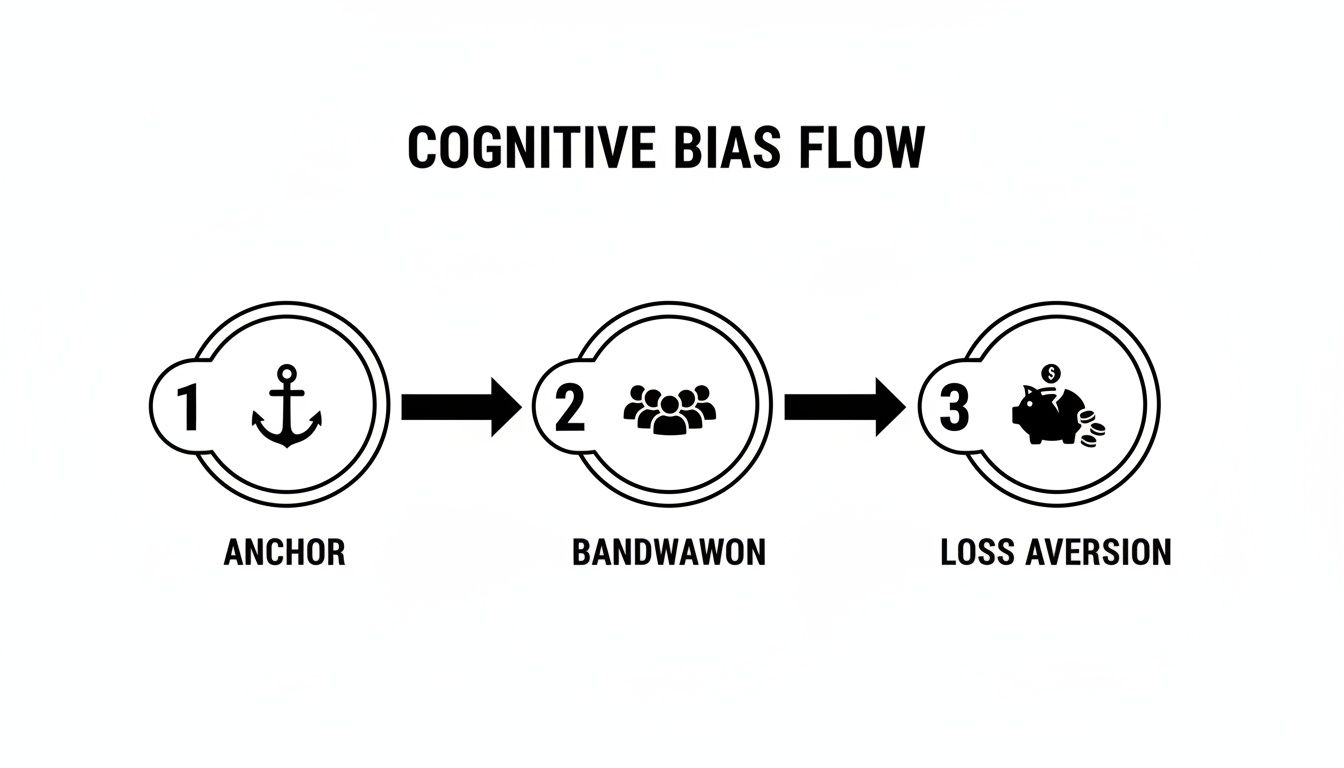
As you can see, you can start with an anchor to set their perception of value, use the bandwagon effect to show everyone else is on board, and then use loss aversion to create the urgency needed to close the deal.
Testing and Refining Your Approach
Using psychological principles isn't a "one and done" deal. The only way to know for sure if your strategy is hitting the mark is to test it relentlessly. This is where A/B testing becomes your best friend, letting you see exactly how these psychological tactics perform in the real world.
The point of testing isn't just to find the winning ad. It’s to understand why it won. Every test should be a lesson about what makes your audience tick.
For instance, you could run two versions of an ad for the same product. Version A might lean on social proof ("Join 50,000 happy customers"), while Version B goes for scarcity ("Only 100 spots left!"). By running them at the same time, you'll get clear data on which trigger drives more conversions for that specific offer. A crucial part of this process involves implementing conversion rate optimization best practices to ensure your tests are meaningful and your user journey is seamless.
Here’s a simple framework to get you started with testing these ideas systematically.
Framework For Psychological A/B Testing
This table outlines how you can create structured tests for different psychological principles and what to measure to determine a winner.
Principle to TestHypothesis ExampleA/B Test VariationPrimary Metric to TrackSocial Proof"Including customer testimonials will increase add-to-carts."A: Ad with a product shot.B: Ad with the same shot plus a customer quote.Add-to-Cart RateScarcity"A countdown timer will boost final checkout completions."A: "Sale Ends Soon" copy.B: "Sale Ends In 01:23:45" dynamic timer.Checkout Conversion RateAuthority"Featuring an expert's logo will improve lead quality."A: Standard lead form.B: Lead form with "As Seen In Forbes" logo.Lead-to-Customer RateLoss Aversion"Framing the discount as a loss will increase clicks."A: "Get 20% off."B: "Don't lose your 20% discount."Click-Through Rate (CTR)
By following a structured testing process, you gather invaluable data on what truly motivates your audience.
As you run these experiments, keep a close eye on a few key metrics:
- Click-Through Rate (CTR): Which headline or image actually stops the scroll?
- Conversion Rate: Which psychological angle is best at getting someone to sign up or buy?
- Cost Per Acquisition (CPA): Which approach brings in new customers most efficiently?
This constant cycle of hypothesizing, testing, and refining is what elevates your advertising from pure guesswork to a repeatable science. To see how you can put all this into practice, check out our guide on the https://www.quickads.ai/blog/make-an-ad-secrets-to-creating-ads-that-work and start building campaigns that truly connect.
The Ethical Tightrope of Psychological Advertising
Knowing how psychology influences advertising is a bit like having a superpower. But with great power comes great responsibility. There’s a fine, often blurry, line between ethical persuasion and outright manipulation.
What’s the difference? Persuasion is all about helping people make informed choices that genuinely fit their needs. Manipulation, on the other hand, preys on our vulnerabilities to push a decision that might not be in our best interest at all.
The real distinction lies in the intent. Ethical marketers use these principles to clearly communicate value and build lasting trust. Manipulative tactics are designed to spark urgency, anxiety, or confusion, nudging people into actions they might later regret.
Where Persuasion Becomes Manipulation
So, where does a helpful nudge cross the line into a harmful shove? A classic (and pretty infamous) example is Edward Bernays' "Torches of Freedom" campaign. Back then, it was taboo for women to smoke in public. Bernays, hired by Lucky Strike, staged a protest where he had fashionable suffragettes light up cigarettes during a New York City parade, framing the act as a symbol of women's liberation.
He tipped off reporters, the story went national, and suddenly, lighting up was seen as a bold statement of independence. Sales of Lucky Strikes to women shot up by over 200% in key markets. This campaign didn't just sell a product; it sold an idea by tying a dangerous habit to a powerful movement. It deliberately exploited a deep desire for equality to create a new, unhealthy social norm. You can dig deeper into the history of advertising psychology and its impact to see more examples like this.
The most important ethical question every marketer should ask is this: Does my ad empower someone to make a better choice, or does it just pressure them into making my choice?
Modern Manipulation: Dark Patterns
Today, this ethical tightrope is most obvious online in the form of "dark patterns." These are tricky user interface designs specifically made to fool you into doing things you didn't intend to, like signing up for a subscription you can't cancel or sharing more data than you realize.
You’ve probably run into them before. Common dark patterns include:
- Roach Motel: This is when it's incredibly easy to get into a situation (like signing up for a free trial) but almost impossible to get out. The cancellation button is buried five menus deep, or you have to call customer service and wait on hold for an hour.
- Confirmshaming: This tactic uses guilt to get you to act. The button to opt-in says something great, while the decline option is framed with shame-inducing language like, "No thanks, I'd rather pay full price."
- Hidden Costs: You get all the way to the final checkout screen, only to be hit with surprise shipping fees, taxes, or other charges that weren't mentioned earlier. The design banks on you being too invested to back out now.
Staying on the right side of the line requires a solid ethical compass, particularly when your ads reach diverse groups of people. Understanding the ethical considerations for adapting video content across cultures is a great place to start.
At the end of the day, building a brand that lasts is about respecting your customers and being transparent. The powerful tools of psychology should be used to build genuine connections, not to set traps.
Frequently Asked Questions
The more you learn about the psychology behind advertising, the more questions tend to pop up. It's only natural to start wondering how these principles affect you personally and where this all is heading.
Let's dig into some of the most common questions people have. We'll cover everything from building a defense against these tactics to figuring out which psychological triggers pack the biggest punch in today's market.
Can You Become Immune To Psychological Advertising?
Not completely, but you can definitely build up a strong resistance. The key is developing what you might call “advertising literacy.”
When you learn to spot the techniques advertisers use—like scarcity (“only 2 left!”), social proof, or loss aversion—you can recognize them as they happen. That awareness gives you a critical moment to pause and think before you act.
It’s a bit like learning how a magic trick works. You can still admire the showmanship, but the illusion loses its power over you. You start judging a product on its actual value, not just the clever psychological nudge pushing you to buy.
What Is The Most Powerful Psychological Principle In Advertising Today?
It always depends on the context, but if you had to pick one, social proof is probably the most powerful force in advertising right now. We're flooded with options, so we naturally look for signals from other people to guide our choices. This is the engine behind customer reviews, user-generated content, and influencer marketing.
Think about it: a staggering 93% of shoppers report that online reviews impact their buying decisions. That number says it all. We trust the experiences of others to help us make better, safer choices. It's the modern-day equivalent of asking a friend for a recommendation, but on a global scale.
In a world of endless options, the most reassuring signal is seeing that someone else has already made the choice you're considering—and is happy with it. Social proof cuts through the noise like nothing else.
How Is AI Changing The Future Of Psychological Advertising?
Artificial intelligence is cranking the dials on advertising and psychology way up, mostly through hyper-personalization and predictive analytics. AI can sift through massive troves of data to figure out an individual’s habits, tastes, and even their current emotional state.
This means ads can be tailored to resonate with you on a deeply personal level. Picture an ad that adjusts its visuals, words, and call-to-action in real-time based on what you’ve recently browsed or what AI infers about your personality. Instead of targeting broad groups, AI makes it possible to advertise to a "segment of one."
Ready to create ads that truly connect with your audience? quickads.ai uses the power of AI to generate stunning image and video ads tailored to your specific goals. Stop guessing and start creating with data-driven insights. Create your first high-performing ad today at quickads.ai.







Privacy is important to us, so you have the option of disabling certain types of storage that may not be necessary for the basic functioning of the website. Blocking categories may impact your experience on the website. View Our Privacy Policy


