
Selling Used Solar Panels in 2026: Resale Channels, Condition Grades, and How to Vet a Buyer

If a pallet of used solar panels is offered to you as "Grade B," it is worth knowing that Grade B is not a standard. No organization issues it, very few sellers can point to an audit behind it, and two suppliers can put that same label on pallets that have almost nothing in common. That is the first thing to understand about the second-hand module market, and it accounts for most of the bad trades that happen in it.
The market is real, and it grows for a boring reason: modules outlive the projects they were installed on. A review by the National Renewable Energy Laboratory that pooled more than 11,000 reported degradation rates found median degradation for crystalline silicon modules in the 0.5 to 0.6 percent per year range. Run that out over twelve years and a healthy panel is still producing north of 90 percent of nameplate. Plenty of arrays come down well before that, pulled for a repower, a site sale, a roof replacement, or an inverter refresh that made the original layout inconvenient, and in those cases the glass is generally fine. What changed was the economics of the site.
So there is supply, there is demand, and in between there is a market with almost no shared vocabulary. What follows covers the labels, the three resale channels, how to verify condition and rated output, what happens to the warranty, and how to check out the party on the other side.
Surplus, Used, Decommissioned, End-of-Life: Four Words That Are Not Interchangeable
Sellers and buyers use these four terms loosely, and the loose usage is where a lot of price disagreement starts.
Surplus panels are new, unused modules that never got installed, coming from cancelled projects, over-ordering, distributor overstock, or a mid-build design change. They have never been energized and usually still carry original packaging and paperwork.
Used panels are modules that were installed and operated, then removed while still functional. Age and operating history vary enormously inside that one word, which is why it is nearly useless on its own.
Decommissioned panels are modules removed as part of a formal system shutdown or repower, usually commercial or utility-scale, where an entire array comes down at once. The distinguishing feature is not the condition of the panel. It is the volume, and the fact that there is a project record behind it.
End-of-life panels have reached the end of their useful service through age, damage, or failed testing, and are headed for material recovery rather than reuse. At that point the conversation stops being about resale price and becomes one about recycling cost and documentation.
A decommissioned panel is not automatically end-of-life. Treating the two as synonyms is how functional inventory ends up being paid to dispose of.
The Three Resale Channels, and When Each One Actually Fits
There are three ways used modules change hands. Each one trades a different thing away.
A marketplace is a platform where sellers list inventory and buyers browse or bid, with the platform handling discovery and sometimes escrow but never taking ownership of the goods. That covers B2B industry exchanges as well as general auction and surplus-listing sites. You keep control of pricing and reach more buyers, and you also keep the work: photographs, specifications, test data, questions from people who never buy, packaging, freight, and the risk that a listing sits for months.
A direct buyer purchases the equipment outright for its own account, to resell into the secondary market, to refurbish, or to recycle. You give up some upside compared with a well-run listing and you get a firm price, a defined pickup, and one counterparty to hold responsible. For large lots on a deadline, that trade is usually worth making.
A broker matches a seller with a buyer for a commission or a margin, without holding inventory. A good broker earns the fee by knowing who is actually buying this month, at what price, for which destination. A weak one forwards your photographs to the same handful of people you could have emailed yourself.
The rough rule of thumb works out like this. Small quantities of desirable, well-documented modules do well on a marketplace. Large decommission lots with a hard site-clearance date do better with a direct buyer. Odd or hard-to-move inventory is where a broker with a real contact list earns their money.
Whichever channel you pick, price is quoted per watt rather than per panel, so rated output matters more than unit count. Used modules clear at a steep discount to new equipment, and the gap widens with age, cosmetic damage, an obsolete form factor, or a manufacturer that has gone under.
Condition Grades: Useful Shorthand, Not a Certification
Grade A, B, and C language got borrowed from solar cell manufacturing, where it has a fairly specific meaning at the cell level: Grade A cells are free of visible defects with electrical output inside specification, Grade B cells carry cosmetic flaws such as slight bends or color variation while still meeting electrical spec, and Grade C cells are visibly defective or out of spec.
Applied to whole used modules, the same letters mean whatever the seller wants them to mean, with no governing body behind them and, in most cases, no audit either. In common trade usage a Grade A module is cosmetically clean and tests at or near rated output, a Grade B module has cosmetic damage or measurably reduced output but remains serviceable, and a Grade C module is broken, badly degraded, or sold for parts and materials.
This gap is not a niche complaint. In its 2025 status report on module recycling, IEA-PVPS Task 12 states that limited regulations or standards exist for the testing, certification, and labelling of refurbished PV modules, and notes that reuse has been carried out largely by independent private companies without support from the original manufacturers. When an international research program says the labelling framework does not exist, a letter grade in a listing is an opening position rather than evidence.
So ask what the grade is based on. If the answer is a test procedure with a written report behind it, the grade is worth something. If the answer is a visual sort carried out on the warehouse floor, price the lot accordingly.
Flash Tests and Wp Verification: What the Numbers Prove
Watt-peak, written Wp, is the module's rated direct-current power output under Standard Test Conditions: irradiance of 1,000 watts per square meter, cell temperature of 25 degrees Celsius, air mass 1.5. It is the nameplate number, and it is a laboratory reference point rather than anything you will see on a roof.
A flash test is the measurement that produces it. The module gets a calibrated pulse of simulated sunlight lasting a few milliseconds while the equipment sweeps the current-voltage curve, and the report gives measured maximum power, open-circuit voltage, short-circuit current, and usually fill factor. Those methods sit inside the international design-qualification standard for terrestrial PV modules, IEC 61215-1.
Four things make a flash test report useful.
Sample size and identification. Which modules were tested, by serial number, and how many out of the total lot. A report covering six panels out of two thousand tells you about six panels.
Measured power against nameplate, expressed as a percentage of rated Wp. This is the single most useful number in the transaction.
Test date. A report from four years ago describes a module that has since been removed, stacked, freighted, and stored.
Who performed it. Seller-run testing is not worthless, but for a large lot the cost of a third-party sample test is small against the value at risk.
Cross-check the result against the module's age. If a fifteen-year-old panel is reported at 99 percent of nameplate, something is wrong with either the test, the paperwork, or the story about the age. Degradation is slow, but it is not zero.
Inspecting a Pallet Before Money Moves
Documentation gets you to the shortlist, and physical inspection closes the deal, so for any meaningful quantity it is worth sending somebody or hiring somebody local.
Start with the nameplate label on the back. Confirm manufacturer, model, rated Wp, certification marks, and a legible serial number that matches the manifest. Modules with missing or illegible labels are much harder to resell downstream, whatever their condition. Then work through the module itself.
Glass. Cracks, chips, and impact marks, including hairline cracks that only show up at an angle in good light.
Backsheet. Cracking, chalking, bubbling, delamination, and burn marks. Backsheet failure is a safety problem rather than a cosmetic one, and it is the defect most often skipped in a fast visual sort.
Junction box and cables. The box firmly attached and sealed, potting intact, connectors and leads not cracked, brittle, or mismatched.
Frame and corrosion. Bent frames, corroded corners, and missing grounding hardware say something about how the array came down.
Cell appearance. Snail trails, discoloration, hot-spot burn marks, and browning of the encapsulant point to internal problems.
Beyond a visual pass, three tests are worth commissioning on larger lots: electroluminescence imaging, which reveals micro-cracks and inactive cell areas no visual inspection will show; insulation resistance and wet leakage testing, which checks whether the module is electrically safe in wet conditions; and a flash test on a sensible sample. The French reuse facility described in the IEA-PVPS report runs electroluminescence, power, and insulation testing in sequence, which is a reasonable model to copy at smaller scale. Look at the packing while you are there, since panels stacked flat without spacers or corner protection arrive with new damage.
Warranty, Documentation, and Who Carries the Risk
The most common misunderstanding on decommissioned commercial systems is the warranty, so start there. Two usually apply to a module. The product warranty covers manufacturing defects and workmanship, typically ten to twelve years on older equipment and longer on recent product. The performance warranty covers output against a declining curve, commonly guaranteeing around 80 percent of rated output at year 25.
Whether either survives a resale depends entirely on the manufacturer's own terms, and the default answer for used equipment is not encouraging. Many warranties run to the original purchaser at the original installation site, so removing the module voids them outright. Some manufacturers permit transfer to a subsequent owner of the same system, which covers a site sale but not a resale of loose panels. A few allow transfer with written notice and a fee. And a fair share of the modules moving through the secondary market were made by companies that no longer exist.
So never quote a used panel as "still under warranty" without the manufacturer's document in front of you and the transfer clause read. Ask for the original commissioning paperwork, the system owner's identity, and the installation date, and if the transfer terms are unclear, price the lot as though there is no warranty.
The regulatory side is easy to miss on the sell side as well. The United States Environmental Protection Agency states that federal solid and hazardous waste rules apply to solar panels when they are discarded, and that some panels test as hazardous waste while others do not, even within the same model from the same manufacturer, depending on the toxicity characteristic leaching procedure. Resale is a different pathway from disposal, but the moment part of a lot is classified as waste rather than product, the handling, transport, and record-keeping obligations change, and state rules add their own layer on top.
Selling a Commercial Decommission as a Single Lot
Large decommissions do not behave like small ones, and the difference is not simply quantity. A 4,000-module removal has a site-clearance date, a crane schedule, a contractor sitting idle if the pallets do not move, and an asset owner who wants one line on the closeout report rather than eleven months of listings. Marketplace economics tend to stop working at that scale. What matters instead is a firm price, a confirmed pickup window, and documentation at the end.
This is where the direct-buyer channel does its real work, and a small number of specialist operators cover it end to end. The Solar Recycling Company is one of them: it buys used solar panels, inverters, and battery storage out of commercial and utility-scale decommissions, moving what still has life into the secondary market rather than treating the whole array as scrap. Its published process is the sequence to expect from any serious lot buyer. You submit the equipment details and photographs covering type, quantity, condition, and location, you receive an initial estimate setting out the scope and the material recovery potential, and only then do you prepare and dispatch the panels to the facility. The company states a typical minimum of around 100 panels and says plainly that it does not usually handle small residential projects, which is more useful than it sounds. If you want to sell used solar panels off a single rooftop, this is the wrong channel and you should be looking at a marketplace listing instead.
The structural point buried in that model is worth pulling out, because it is the thing most sellers get wrong. A single decommission produces two very different piles: modules that still test well and have resale value, and modules that are cracked, delaminated, or simply too old to move, which have recycling cost attached to them. An operator that only resells will cherry-pick the first pile and leave you holding the second. An operator that only recycles will quote you scrap value on the working modules because reuse is not what its facility is set up to do. The buyer worth dealing with on a full array is the one that refurbishes what works and recycles what does not, under one contract, because that is the only arrangement where somebody has an incentive to sort your inventory honestly.
Two things are worth borrowing from that model when you evaluate any bulk buyer.
Ask for the estimate to separate resale value from recycling cost. Any real decommission lot splits into modules worth reselling and modules headed for material recovery, and those two streams have opposite signs on the invoice. A blended number makes it impossible to check whether you are being paid fairly for the good pallets.
Ask what documentation comes back at closeout. The certificate covering what was recycled, the chain-of-custody record, and the weight tickets are what ends the project for an asset owner. A buyer who cannot describe that package beforehand will improvise it afterwards.
Vetting the Counterparty
The equipment can check out perfectly and the deal can still go badly, so run the same diligence on the party as on the pallets, starting with the legal entity and how long it has operated. Search the registered company name rather than only the brand.
Ask where the material physically goes. A buyer that can name the receiving facility and the downstream vendors taking recovered glass, aluminum, copper, and silicon is describing a real operation, and vagueness here is the strongest warning sign in this market.
Check certifications against the issuing body rather than the website. Responsible-recycling certifications are granted to specific facilities and they expire, so ask for the dated certificate, confirm the address matches the site handling your material, and verify it against the standard administrator's own record.
Agree the payment structure in writing before pickup, whether that is payment on collection, payment on receipt and inspection, or net thirty, and ask for two references on comparable volume. A testimonial published on a website does not count for this purpose. What you want is two contacts who have moved a similar quantity and will take a phone call.
If you are the buyer rather than the seller, add one more question: what happens if the delivered lot does not match the test report. A supplier who has thought about it will describe a return path or a price adjustment.
Where the Surplus Actually Sits
Secondary supply tracks installed capacity, plus age, plus whatever is forcing a repower, which concentrates United States inventory in the big utility-scale markets. Texas has overtaken California in utility-scale solar generation according to federal electricity data reported in early 2026, with Florida, North Carolina, Arizona, and Nevada behind them. Early-2010s fleets in those states are now old enough that inverter replacement and land-lease renewals make repowering attractive, and repowering is what puts thousands of working modules onto pallets at once. Europe is the other significant source, driven by early German, Italian, and Spanish installations reaching end of contract and by producer take-back obligations under the WEEE Directive. The IEA-PVPS report cited earlier projects roughly 4 million tonnes of end-of-life PV material globally by 2030 under one scenario, rising above 200 million tonnes cumulatively by 2050.
Demand sits with off-grid and emerging markets where price per watt matters more than warranty coverage, and with domestic buyers doing repairs and array extensions who need modules matching an existing string. That second group is quietly good news for a decommission seller, since matching an obsolete model is worth a premium to someone with a partly damaged array.
Using Quickads.ai to Market Tested Solar Panels
Finding a buyer starts with a credible listing. Once you have separated reusable panels from units headed for recycling, use the flash-test results, model numbers, quantities, condition notes, and pickup location to explain exactly what is on offer. Clear photos of the modules, labels, and pallets help buyers judge the lot before arranging an inspection.
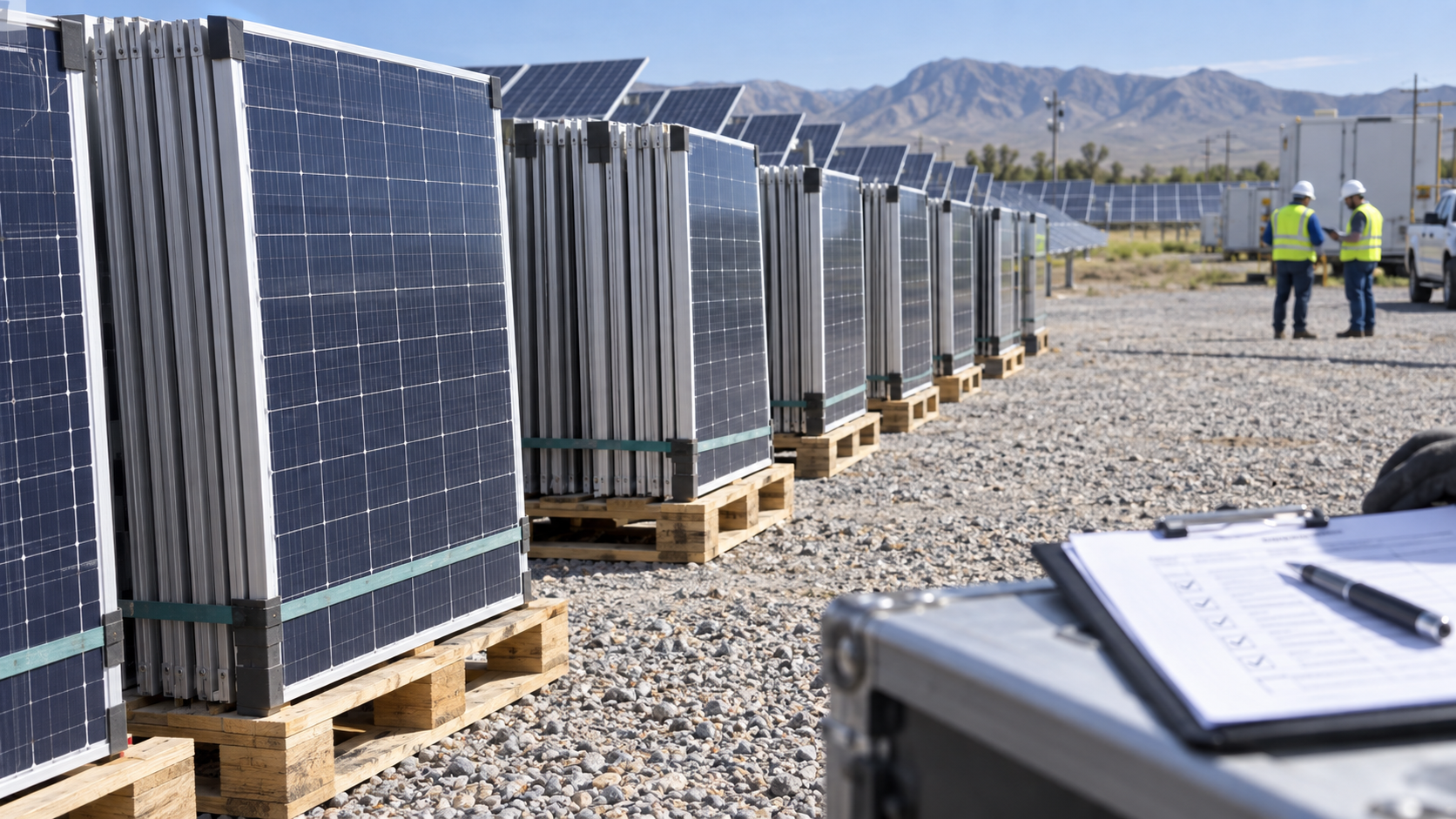
Quickads.ai can help turn those verified inventory details and photographs into ad creatives for channels such as Facebook and Instagram. This is particularly useful when a seller is using a marketplace or direct-sales approach and needs to put a well-documented lot in front of potential buyers. The advertising itself does not establish the condition or value of the modules, so measured wattage, testing dates, model numbers, and condition claims should always come from the seller's records.
About Quickads.ai
Quickads.ai is an AI-powered advertising platform designed to help businesses create and adapt ad creatives from their existing product information and visual assets. In the context of used solar panels, it can support the marketing side of the resale process by turning verified inventory information and product photos into promotional content for potential buyers. That makes it a useful complement to the testing, documentation, and buyer-vetting steps covered above, rather than a replacement for them.
For example, a seller with a documented lot of tested modules could use Quickads.ai to create different ads highlighting the available quantity, panel models, tested output, condition, and collection location. Those ads can help generate buyer interest, while the underlying test reports, inventory records, inspection terms, and counterparty checks remain the basis for deciding whether a transaction is appropriate.
What to Do First
- Classify the inventory properly, because surplus, used, decommissioned, and end-of-life each set a different channel and a different price.
- Pick the channel against your real constraint. Deadline and volume point to a direct buyer, time and desirable stock to a marketplace, unusual inventory to a broker.
- Get flash-test data on a real sample, with serial numbers, dates, and measured power as a percentage of nameplate.
- Inspect physically, then add electroluminescence and wet leakage testing on anything large enough to justify it.
- Read the warranty transfer clause instead of assuming coverage travels with the panel.
- Vet the counterparty on entity, facility, downstream destinations, certifications, payment terms, and references.
None of this is especially complicated. It is work that gets skipped, usually because the decommission timeline is tight and the panels feel like the least urgent thing on site. The sellers who get paid properly are generally the ones who spent a week on documentation and testing before they started making calls.









Privacy is important to us, so you have the option of disabling certain types of storage that may not be necessary for the basic functioning of the website. Blocking categories may impact your experience on the website. View Our Privacy Policy


