
How Personalization Improves Online Shopping
Online shopping has given consumers more choices than ever. A shopper can compare dozens of products, visit several stores, read reviews, and complete a purchase without leaving home. While this convenience has helped eCommerce grow, it has also created a new problem: too much choice.
Customers do not necessarily want to browse hundreds of products to find the one that fits their needs. They expect online stores to make shopping easier, faster, and more relevant.
This is where personalization can make a significant difference.
eCommerce personalization involves adapting parts of the shopping experience based on information such as customer behavior, interests, previous purchases, location, or preferences. Instead of presenting every visitor with the same store experience, businesses can help shoppers discover products and information that are more useful to them.
Done well, personalization can improve product discovery, reduce friction, strengthen customer relationships, and make the overall shopping experience more convenient. However, successful personalization is not simply about collecting more customer data. It is about using relevant information responsibly to create genuine value for the shopper.
What Does Personalization Mean in eCommerce?
Personalization can take many forms.
A returning customer might see recommendations based on products they previously purchased. Another visitor could receive suggestions related to the category they have been browsing. A clothing store might highlight products suited to a shopper's preferred size or style, while a retailer could send an email reminding a customer about an item they viewed earlier.
Common examples include:
- Personalized product recommendations
- Recently viewed product sections
- Customized email campaigns
- Relevant promotions and offers
- Location-based content
- Personalized search results
- Product suggestions based on browsing history
- Replenishment reminders
- Recommendations based on previous purchases
- Customized homepage content
The goal is not to create an entirely different website for every visitor. Instead, personalization should remove unnecessary steps between the customer and the products or information they are most likely to need.
Why Online Shoppers Expect More Relevant Experiences
Traditional physical stores naturally offer some level of personalization.
A regular customer might be recognized by an employee. A salesperson can ask what someone is looking for and recommend products accordingly. Customers can explain their needs and receive immediate guidance.
Most eCommerce stores do not have this natural human interaction.
A visitor may arrive on a homepage containing hundreds or thousands of products. Without guidance, the customer has to search, filter, compare, and evaluate everything independently.
Personalization can help recreate some of the convenience of an attentive salesperson.
If someone repeatedly browses running shoes, for example, showing relevant footwear, accessories, or recently viewed products may be more useful than presenting unrelated categories. The shopper spends less time searching and can focus on evaluating products that actually interest them.
This shift from a generic storefront toward a more relevant experience can make online shopping feel considerably easier.
Make Product Discovery Easier
Product discovery is one of the biggest opportunities for personalization.
Large online stores often carry extensive catalogs. More inventory gives shoppers additional options, but it can also create decision fatigue.
Imagine visiting an online fashion store with 20,000 products. Technically, the selection is impressive. Practically, very few customers want to browse thousands of items.
Personalized recommendations can narrow that selection.
A store can use signals such as browsing activity, past purchases, selected categories, saved products, and stated preferences to suggest a smaller group of relevant products.
For example, a customer who regularly browses men's running clothing could receive recommendations for new running shorts, lightweight shirts, or related accessories instead of generic fashion products.
The customer still controls the buying decision. Personalization simply helps reduce the amount of irrelevant information surrounding that decision.
Improve the Quality of Product Recommendations
Recommendation sections have become common across eCommerce websites, but simply displaying recommendations does not mean they are useful.
Poor recommendations can create additional noise.
If someone purchases a laptop, immediately recommending five more laptops may not be particularly helpful. Depending on the situation, suggesting a laptop sleeve, docking station, external monitor, or other compatible accessory could make more sense.
Effective recommendation systems should consider context rather than relying only on broad product categories.
Stores can improve recommendations by considering factors such as:
- What the customer recently viewed
- What they have purchased before
- Which products are commonly purchased together
- Which categories receive the most attention
- Whether the purchase is likely to be recurring
- Price ranges the shopper commonly explores
- Products added to wish lists or saved for later
“Customers do not need more recommendations; they need better ones. Using browsing patterns, preferences, and past purchases can help narrow the choices that actually matter,” says Ethan Richardson, CMO of Exquisite Timepieces.
Recommendations should support the customer's shopping journey instead of simply creating another place to promote products.
Create More Relevant Homepages
A homepage is often designed to serve everyone at once.
That can make it difficult to decide which products, categories, and promotions deserve the most attention. Personalization provides an alternative.
A first-time visitor might see popular categories, best sellers, and information about the brand. A returning customer could see recently viewed products, recommendations, or updates from categories they previously explored.
Consider an online store selling products for men, women, and children. If a returning shopper consistently purchases children's products, prioritizing relevant categories could save them several clicks during future visits.
This does not mean hiding the rest of the store. The full navigation can remain available while the most relevant content receives greater visibility.
Small adjustments like these can make a website feel more useful without completely changing its design.
Make Search More Helpful
Site search is particularly important for stores with large catalogs.
Customers using search often have stronger intent because they already know roughly what they want. A poor search experience can therefore create unnecessary friction at an important stage of the customer journey. Personalization can improve search by considering the customer's previous interactions.
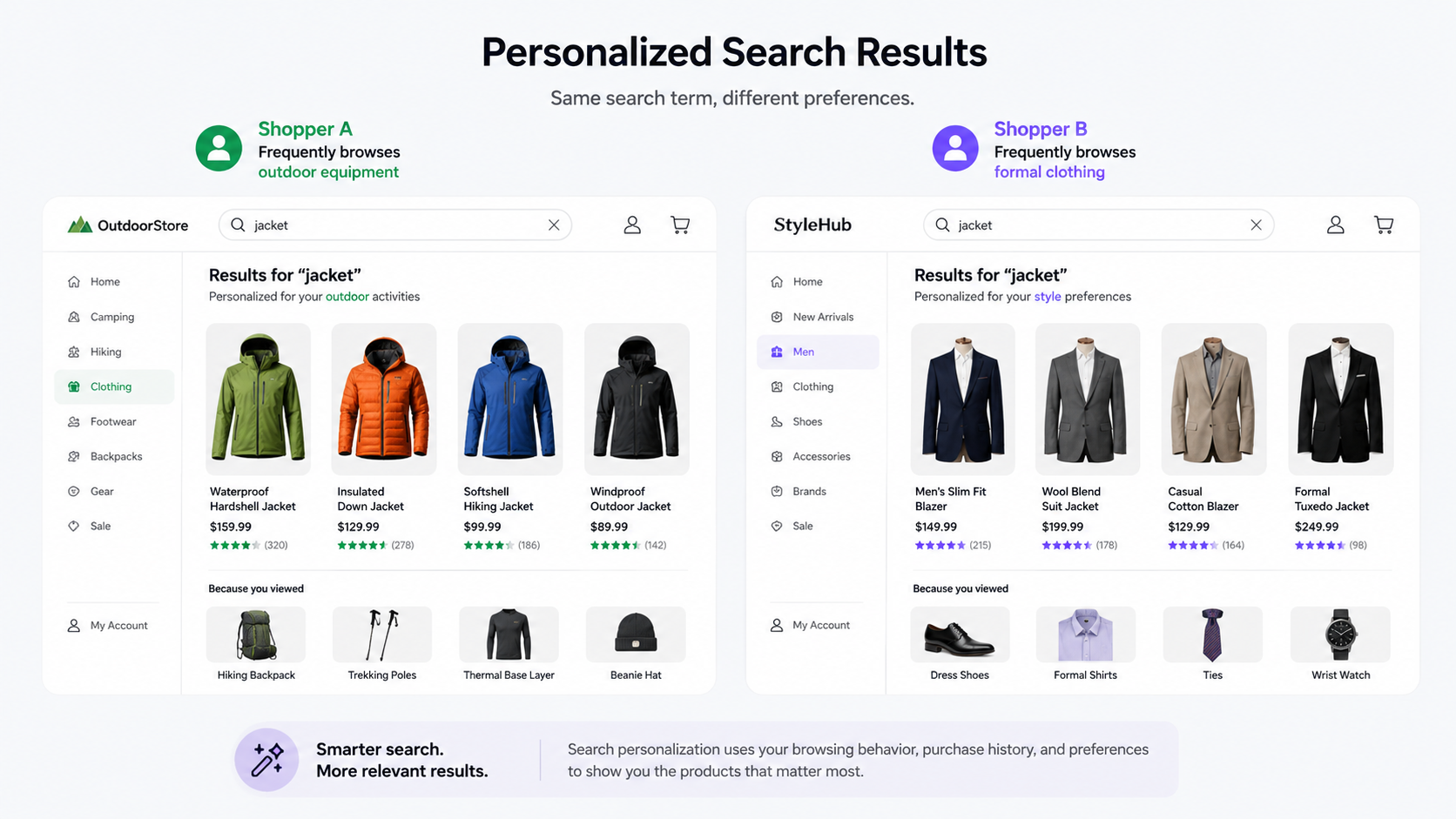
Two shoppers searching for "jacket," for example, may have very different interests. One may frequently browse outdoor equipment, while another mostly explores formal clothing. Search results can account for those preferences while still displaying a broad selection.
Search can also incorporate factors such as previous categories viewed, purchase history, preferred brands, common sizes, price preferences, availability, and customer location.
“Browsing and search behavior reveal a lot about customer intent. Using those signals to prioritize relevant products can make the path from discovery to purchase much shorter,” says David Finberg, CEO of Peaks Digital Marketing.
The purpose should remain simple: help customers reach relevant products with fewer searches and filters.
Reduce Friction Throughout the Customer Journey
Personalization is often associated with marketing, but some of its most valuable applications involve convenience.
Returning shoppers should not always have to start from zero.
Stores can remember useful preferences such as shipping locations, sizes, favorite categories, wish lists, or communication settings when customers have chosen to provide that information.
For example, a returning customer might benefit from seeing previously selected sizes, recently viewed products, saved items, preferred delivery options, or reorder options for frequently purchased products.
Each improvement may seem small individually. Together, they can remove multiple points of friction from the buying journey.
The best personalization often feels less like advertising and more like good customer service.
Help Customers Find Complementary Products
Personalization can also improve cross-selling when recommendations are genuinely useful.
Suppose a customer adds a camera to their cart. Relevant recommendations might include a compatible memory card, protective case, spare battery, or tripod.
These suggestions can benefit both the store and the shopper. The business has an opportunity to increase average order value, while the customer may discover something they genuinely need.
However, relevance is critical.
Stores should avoid filling every page with aggressive upsells. Too many recommendations can distract shoppers from completing their original purchase.
A useful question for retailers is: Does this suggestion make the customer's purchase more complete or convenient?
If the answer is yes, the recommendation has a clear purpose.
Improve Email Marketing
Personalization does not have to stop when a shopper leaves the website.
Email remains an important channel for many eCommerce brands, but generic campaigns can quickly become repetitive. Sending every subscriber the same products and promotions ignores the different reasons people interact with a store.
Segmentation and behavioral data can make email communication more relevant.
A business might send different messages to first-time customers, frequent buyers, customers who have not purchased recently, shoppers interested in specific categories, or customers who purchased products that require replenishment.
For instance, a skincare retailer could remind a previous customer when a regularly used product may be running low. A fashion retailer could highlight new arrivals in a category the customer frequently browses.
Timing and relevance matter more than simply increasing email frequency.
Make Promotions More Meaningful
Constant discounting can train customers to wait for the next sale. Personalization allows businesses to be more selective about how promotions are used.
Instead of giving every visitor the same offer, retailers can consider where someone is in the customer journey.
A new customer might receive an introductory incentive. A loyal customer could receive early access to a new collection. Another shopper might receive an offer connected to a category they regularly purchase from.
Personalized promotions can also avoid frustrating situations.
For example, promoting a discount on a product immediately after someone bought it at full price may create a negative experience. Better customer data and campaign segmentation can reduce these poorly timed interactions.
The objective is not necessarily to offer more discounts. It is to make promotions more relevant when they are used.
Support Customer Retention

Personalization becomes particularly valuable after the first purchase.
Customer acquisition is only one part of building a successful eCommerce business. Stores also need reasons for customers to return.
Purchase history can help businesses understand what existing customers may need next.
A pet supply store could make it easy to reorder frequently purchased food. A beauty retailer could suggest products that complement a customer's previous purchases. A fashion business could highlight new products from brands or categories the shopper already likes.
Convenience can become an important reason to return. When customers know that a store makes it easy to find relevant products, repeat purchases require less effort.
Use Personalization Across Different Channels
Customers rarely interact with an eCommerce brand through only one channel.
Someone might discover a product through social media, browse it on a phone, receive an email later, and eventually complete the purchase on a laptop.
A fragmented experience can result in repetitive or irrelevant messaging.
For example, continuing to advertise a product heavily after the customer has already purchased it can make a brand's marketing feel disconnected.
A more coordinated approach uses customer information to create consistency across website recommendations, email campaigns, loyalty programs, customer service interactions, mobile experiences, and advertising audiences.
“Personalization should continue after checkout. Relevant order updates and post-purchase communication can make the entire customer experience feel more connected,” says Greg McRoberts, Founder and CMO at Verde Fulfillment USA.
Customers should not have to repeatedly communicate the same preferences every time they interact with the business.
Personalization Can Improve Customer Service
Customer service is another area where personalization can improve the experience.
When a customer contacts support, having relevant context can save time. Support teams may be able to see recent orders, delivery status, previous conversations, or products associated with the account.
Instead of asking the customer to explain everything again, the representative can begin with a clearer understanding of the situation.
Personalization can also support proactive communication.
If an order is delayed, notifying the affected customer before they contact support may prevent frustration. If a commonly purchased product becomes available again, customers who expressed interest could be informed.
These interactions show that personalization goes beyond recommendations and marketing. It can also improve practical parts of the customer relationship.
Give Customers More Control Over Their Preferences
Not every personalization decision needs to happen automatically.
One of the simplest approaches is to ask customers what they prefer.
Stores can allow shoppers to choose:
- Product interests
- Preferred categories
- Clothing sizes
- Favorite brands
- Communication frequency
- Email topics
- Notification preferences
This type of information can be particularly valuable because customers provide it intentionally.
It also gives shoppers more control over how the store communicates with them.
A customer who only wants emails about new product releases, for example, should not need to receive every promotional campaign. Respecting that preference can create a better long-term relationship than maximizing the number of messages sent.
Avoid Making Personalization Feel Intrusive
There is an important difference between helpful personalization and uncomfortable personalization.
Customers may appreciate a website remembering an item they viewed yesterday. They may react differently if a business appears to know information they never knowingly shared.
Transparency matters.
Retailers should clearly explain what information they collect, why it is collected, and how it is used. Businesses also need to follow applicable privacy and data protection requirements. From an experience perspective, stores should collect information because it has a clear purpose.
More data does not automatically create better personalization.
In many cases, a relatively small amount of high-quality information, such as purchase history, browsing activity, and voluntarily selected preferences, can create useful experiences without excessive data collection.
Trust should be treated as part of the personalization strategy, not as an afterthought.
Start With Simple Personalization
Personalization does not need to begin with a complex technology project.
Smaller eCommerce businesses can start with straightforward features that solve obvious customer problems.
Useful starting points include showing recently viewed products, recommending complementary products, segmenting emails by customer interests, remembering customer preferences, making repeat purchases easier, and sending relevant replenishment reminders.
Businesses can then measure how customers respond before introducing more advanced personalization.
Testing is important because assumptions about customer preferences are not always correct. A recommendation strategy that works for one retailer may perform differently for another.
Stores should measure whether personalization improves meaningful outcomes such as product discovery, conversion, repeat purchases, engagement, and customer satisfaction.
Keep the Customer at the Center
It is easy to approach personalization primarily as a way to increase sales.
Commercial results matter, but personalization becomes more sustainable when it starts with the customer experience.
Before introducing a personalized feature, retailers should ask:
- Does this save the customer time?
- Does it make product discovery easier?
- Is the recommendation genuinely relevant?
- Does it remove unnecessary steps?
- Is the customer likely to understand why they are seeing it?
- Does the customer have appropriate control over their information?
If personalization only benefits the retailer, shoppers are likely to recognize it as another sales tactic.
When it benefits both sides, it becomes part of a better shopping experience.
The Future of Personalized Online Shopping
Personalization will likely become increasingly sophisticated as eCommerce technology develops.
Stores are gaining better tools for understanding customer intent, organizing large product catalogs, improving search, and creating recommendations in real time. Artificial intelligence can also help businesses analyze behavioral patterns and identify relevant products across large amounts of information.
However, more advanced technology does not change the basic goal.
Customers want shopping to be easy. They want to find relevant products without searching endlessly. They want businesses to remember useful preferences without becoming intrusive. They want recommendations that make sense and communication that arrives at the right time. The retailers that use personalization effectively will therefore be those that focus less on showing customers everything they know and more on quietly making the shopping journey easier.
Conclusion
Personalization can transform online shopping from a generic browsing experience into a more relevant and convenient customer journey.
It can help shoppers discover products faster, receive better recommendations, navigate large catalogs, find useful complementary products, and avoid irrelevant marketing. It can also strengthen customer retention by making repeat purchases and ongoing interactions easier.
The key is balance. Businesses should not personalize simply because technology makes it possible. Every personalized interaction should have a clear purpose and provide something useful to the customer. Privacy, transparency, and customer control should remain central to the strategy.
The most effective personalization may not even feel like personalization. It simply feels like a store that understands what the customer needs, removes unnecessary friction, and makes buying the right product a little easier. In a crowded eCommerce market, that convenience can become a meaningful competitive advantage.








Privacy is important to us, so you have the option of disabling certain types of storage that may not be necessary for the basic functioning of the website. Blocking categories may impact your experience on the website. View Our Privacy Policy


