
Hard Drive Shredding Explained: How the Machines Work and What the Standards Require
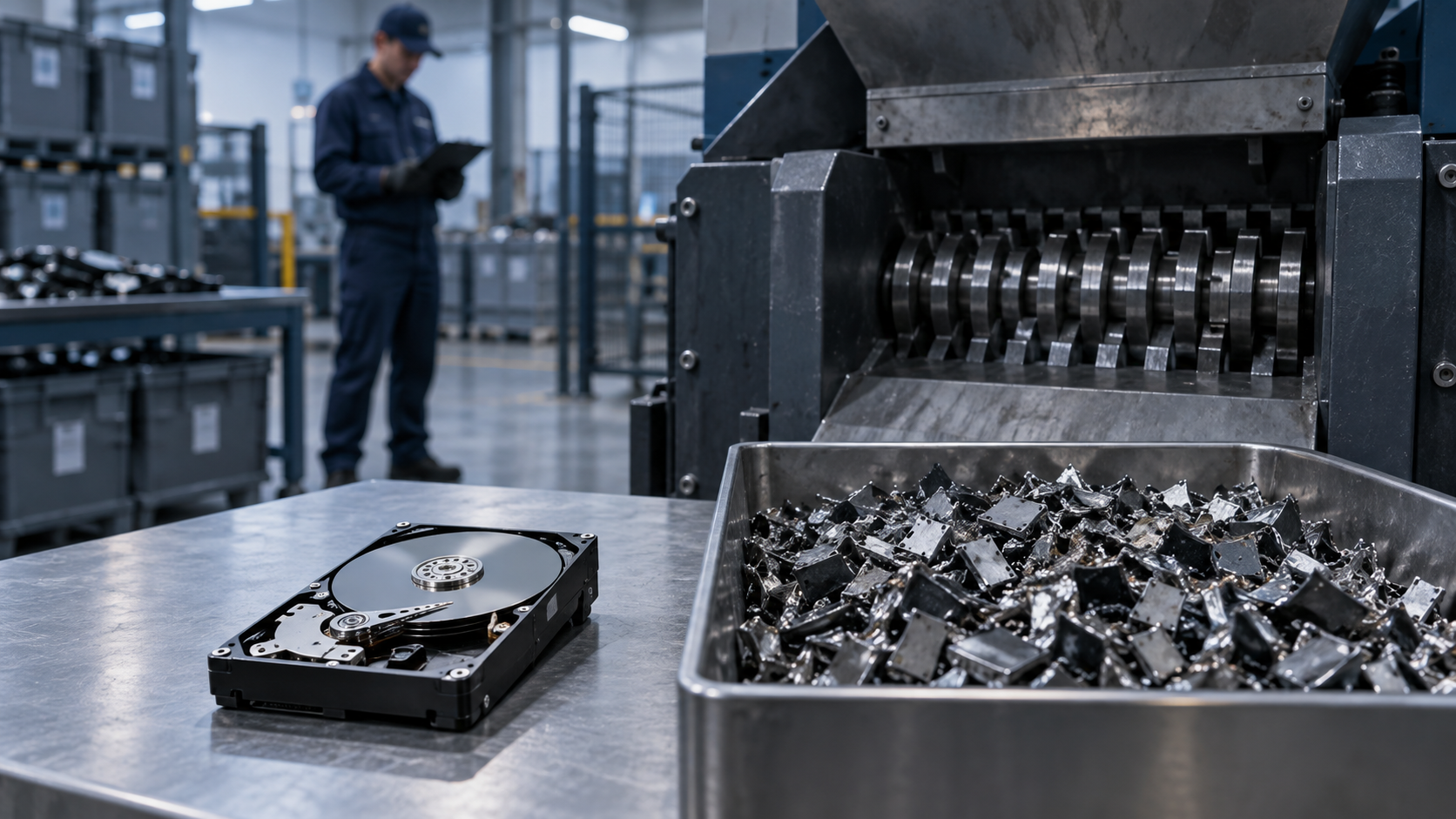
Is hard drive shredding just putting a disk through a big industrial mincer? Essentially yes, and the interesting part is everything the industry has built around that simple mechanical fact: a defined maximum particle size, a witnessed process, a serial-numbered record, and a downstream route for the resulting metal and plastic.
That surrounding machinery matters because the shred itself is the easy bit. Any competent operator can reduce a drive to fragments. What auditors, regulators, and insurers actually ask for is proof that a specific drive, identified by serial number, was reduced to a specific size, on a specific date, by a named person, and that the debris went somewhere legitimate afterwards. Get the paperwork wrong, and you have destroyed an asset without discharging the obligation that made you destroy it.
This is a look at the physical process, the standards that govern it, and the compliance regimes it satisfies.
What Shredding Actually Does to a Drive
A commercial hard drive shredder is a low-speed, high-torque machine. Two counter-rotating shafts carry rows of hardened steel cutters that hook into the drive casing and pull it down between them. The drive does not slice cleanly. It buckles, the casing tears open, the aluminum or glass platters crack, and the whole assembly is dragged through the cutting gap in pieces.
Underneath the shafts sits a screen or grate. Fragments that are still too large cannot pass through it and get carried back up for another pass. That screen, not the cutters, is what actually determines output size. When a vendor quotes you a particle size, they are quoting the screen aperture.
Glass platters, common in 2.5-inch drives, behave differently from aluminum. They shatter rather than deform, which produces a lot of small shards and a fair amount of dust. Solid-state drives behave differently again, and that difference is the single most important technical point in this whole subject.
Standards bodies describe the outcome rather than the machine. The federal guideline most of the industry works from is NIST Special Publication 800-88, and the current edition is Revision 2, finalized on September 26, 2025, which formally supersedes the 2014 Revision 1 that a great many vendor pages still cite. Revision 2 keeps the three familiar categories: Clear, Purge, and Destroy. Destroy covers techniques that "render target data recovery infeasible using state-of-the-art laboratory techniques," with the media left unusable for storage afterwards. Note that second condition. Destruction is judged against two tests rather than one, which is why a drive that has merely been drilled through or bent in a press does not qualify.
Particle Size Is Not One Number
Here is the claim you should push back on: "we shred to NIST-compliant particle size." There is no such thing, and the current revision makes that harder to fudge than the old one did.
NIST SP 800-88 has never published a particle dimension for magnetic hard drives. Revision 1 at least carried measurable thresholds for paper, a 1 mm by 5 mm cross cut and a 3/32 inch disintegrator screen, which is probably where some of the loose "NIST particle size" talk came from in the first place. Revision 2 drops those numbers. It names the destructive techniques (disintegrate, incinerate, melt, pulverize, shred) without attaching a measurable threshold to any of them, and it points readers toward the technology-specific standards, IEEE 2883 in particular, on the reasoning that sanitization techniques change faster than a federal guideline can be reissued.
So the current federal guideline defines Destroy purely as an outcome. For a hard number on drives, you have to look somewhere else entirely.
Magnetic Platters Versus NAND Packages
The reason one number cannot cover both is physical. On a magnetic platter, data is spread continuously across the recording surface. Break the platter into pieces and each piece carries only a smear of a fragmented file system. Recovering anything useful requires a laboratory, a working spindle, and a great deal of luck.
Flash is not like that. An SSD stores data in discrete NAND packages, and a single intact package can hold a meaningful, addressable quantity of data on its own. A shred that leaves whole chips sitting in the debris has not destroyed the data. It has merely detached the chips from their controller, and chip-off recovery is an established forensic technique with commercial tooling behind it.
The NSA treats these as two different problems and publishes two different equipment lists to prove it. Its Evaluated Products Lists include a separate EPL for Hard Disk Drive Destruction Devices, a separate EPL for Solid State Disintegrators, and a separate EPL for Magnetic Degaussers. A machine approved for one is not thereby approved for another. The published NSA/CSS requirements document for solid-state disintegrators sets the target plainly: the device must reduce a solid-state storage device to a maximum edge size of two millimeters or less, and the same threshold is applied to phones, USB drives, memory cards, and circuit boards.
Two millimeters is a genuinely small particle. It is a different class of machine from a drive shredder; it runs slower, and it costs more per unit processed. If a quote treats SSDs and spinning disks as the same line item at the same price, that is worth a question.
Where the Graded Security Levels Come From
Most of the tiered particle-size language circulating in the ITAD market descends from DIN 66399, the German standard that was subsequently taken up internationally as ISO/IEC 21964, "Information technology, Destruction of data carriers." It grades data carriers into seven security levels. The lower levels are descriptive (the device is rendered inoperable, damaged, or deformed) and the upper levels are quantified by maximum particle surface area, tightening from a couple of thousand square millimeters at the mid-range down to single digits at the top level intended for classified material.
That scale is useful, and it is also where the marketing gets loose. "Military grade shredding" is not a defined term. It usually means either the NSA two-millimeter threshold, the top ISO security level, or nothing at all. Ask which one, in writing.
On-Site Mobile Shredding Versus an Off-Site Plant
Both approaches are legitimate, and the useful comparison is not which one is safer in the abstract but where each one tends to fail.
On-site shredding means a truck with a shredder mounted in the back arrives at your loading dock. Drives are fed in while your staff watches, usually through a camera feed to a monitor on the side of the vehicle. Nothing containing data leaves the site intact.
What you get:
- The custody window shrinks to almost nothing. Media never travels in a readable state.
- Witnessing is direct. Someone from your team can physically observe the destruction and sign for it.
- The audit story is simple, which matters when the auditor is not technical.
What you give up:
- Throughput. A mobile unit is size-constrained and slower than plant equipment.
- Particle size. Truck-mounted shredders generally produce coarser output than a fixed plant line, and very few can hit the two-millimeter solid-state threshold on their own.
- Downstream separation still happens somewhere else, so the material leaves your site anyway, just in shredded form.
Off-site means the media travels, sealed in locked containers on tracked transport, to a fixed facility. The plant has larger primary shredders, often a second-stage disintegrator or granulator for flash, and the material separation lines sitting in the same building.
What you get: better particle sizes, higher volume, and a shorter physical chain between destruction and recycling. What you give up: a custody window during transit, and a witness step that depends on video or an escorted visit rather than standing next to the machine.
For most commercial data, either is defensible. For classified or highly regulated material, the deciding factor is usually whether the operator can hit the required particle size at all, and mobile units often cannot.
Verification and the Certificate
A shred with no record is an expensive way to create scrap metal. NIST SP 800-88 is explicit that documentation is part of sanitization, and Revision 2 expanded the field list on the certificate of media sanitization considerably. It now covers manufacturer, model, serial number, the organization's own property number, media type, media source, the sanitization method, the specific technique, the tool used and its version, and the verification method, plus the name, title, date, location, contact details, and signature of whoever performed the verification.
Tool and version is the newer field worth noticing. It means the certificate is supposed to identify the machine, not merely assert that something happened.
Serial number is the field that separates a real certificate from a receipt. If the document says "42 hard drives destroyed," it proves nothing about your 42 drives. If it lists each serial and you can reconcile that list against the asset register you handed over at pickup, you have something an auditor can actually test.
Three things to check on any certificate before you sign off on it:
- Every item is listed individually by serial number, not summarized by count or weight.
- The destruction method and the achieved particle size or security level are stated, per item or per batch.
- The date, the location, and the named operator are on the document, and they match the pickup record.
Reconciliation is where projects usually go wrong. Drives get pulled for warranty returns, staged in a different room, or left in a chassis that nobody opened. The gap shows up months later as a serial on your register with no matching line on any certificate, and by then nobody remembers where it went.
Where the Shredded Material Goes, and How the Chain Closes
Shredding turns one problem into another. A tonne of destroyed drives is a mixed stream of aluminum castings, steel covers, printed circuit boards carrying gold and copper, rare earth magnets from the voice coil actuator, and a fraction of plastic and glass. Those fractions have real commodity value, and they also carry real environmental liability if they end up on the wrong ship.
This is why the certification question is not separate from the security question. The US Environmental Protection Agency points buyers toward third-party certified recyclers under R2 and e-Stewards, describing them as programs built on standards that "maximize reuse and recycling, minimize exposure to human health or the environment, ensure safe management of materials by downstream handlers, and require destruction of all data on used electronics." The phrase to notice is downstream handlers. Certification reaches past the building you toured. It covers the vendors that building sells its output to, and in turn the vendors those vendors sell to.
Closing that loop is a service, and the operators who sell it well build the record into the workflow instead of bolting it on afterwards. Big Data Supply is one of the ITAD companies selling hard drive shredding services on that basis, offering hard drive destruction either on site by mobile truck or at its own R2v3 and RIOS certified facility, aligned to NIST 800-88 media sanitization guidance, with a Certificate of Destruction that lists every drive by serial number and the method used, and a documented chain of custody running from collection through to the recycling of the shredded material. Working drives pulled out before shredding can be routed to buyback instead, which offsets part of the disposal cost on a large decommissioning job. The company describes its downstream as one hundred percent zero landfill and states that it operates in over one hundred countries; those are its own published claims rather than independently audited industry figures, and they are worth reading as such.
The generalizable point is the one to take away from it. A compliant operation can answer three questions without hesitating: which machine destroyed this serial number, to what particle size, and which downstream vendor took the resulting fractions. If a provider can answer the first two and goes vague on the third, the compliance chain has a hole in it.
Where Erasure Still Beats Shredding
Shredding is not always the right call, and treating it as the default destroys value for no security gain.
The Purge category in Revision 2 covers physical or logical techniques that make recovery of the target data infeasible using state-of-the-art laboratory techniques while preserving the media in a potentially reusable state. For a drive you intend to resell, redeploy, or return under lease, Purge is usually the correct answer.
The method depends entirely on the media:
- Magnetic hard drives and tape can be degaussed, which collapses the magnetic domains and takes the servo tracks with them. The drive is dead afterwards, so degaussing is destruction of the device even though it is not shredding.
- Magnetic drives can also be overwritten, and this is where the old procurement boilerplate has aged badly. Revision 2 does not bless the multi-pass ritual. It observes that historical Department of Defense specifications ranged anywhere from a single pass up to thirty-nine, steers organizations toward purge or destroy techniques where stronger assurance is required, and warns that repeated overwriting should be avoided on media with overprovisioning, SSDs being the obvious case. If a contract still specifies DoD 5220.22-M by name, it is citing a routine that current federal guidance has moved past.
- SSDs and flash cannot be degaussed at all. There is no magnetic domain to disturb. They need the manufacturer's own commands, ATA Secure Erase or NVMe Format, or cryptographic erase where the drive was encrypted from first use and the key is destroyed.
A verified erase leaves you with a working asset that still has resale value, while a shred leaves you with a certificate and a bin of scrap. Both are compliant outcomes if the documentation is in order. Only one of them puts money back against the cost of the project, which is why most well-run programs triage the inventory at intake instead of sending everything to the same hopper.
Which Compliance Regimes Physical Destruction Satisfies
Here is the thing that surprises people: almost none of the major regimes name shredding as a required method. They mandate an outcome and a record, and shredding is one accepted way of getting there.
- HIPAA. The Security Rule requires policies for the final disposition of electronic protected health information and the media it sits on. Destruction is an accepted route, and the documentation is what demonstrates the safeguard was applied.
- Gramm-Leach-Bliley and the FACTA Disposal Rule. Both require reasonable measures to prevent unauthorized access to consumer information during disposal. Destruction of the media is explicitly among them.
- PCI DSS. Requires cardholder data on electronic media to be rendered unrecoverable when it is no longer needed for business or legal reasons.
- FISMA and CUI handling. Federal systems and contractors work directly to the NIST SP 800-88 categories, which is why the Clear, Purge, and Destroy vocabulary shows up in so many contracts. Worth checking whether yours still reference Revision 1.
- FERPA. Education records carry disposal obligations that destruction satisfies.
- GDPR and UK GDPR. Storage limitation and integrity obligations mean personal data has to be erased or destroyed when its purpose ends, and the accountability principle means you have to be able to evidence it.
- Sarbanes-Oxley and SEC record rules. These cut both ways. They also require retention, so destruction has to be scheduled against a retention policy, not run ahead of it.
The practical consequence is that your compliance position rests on the certificate and the reconciliation, not on the shredder. Two providers can produce identical debris and only one of them can defend it.
Quickads: Create Ads for Secure Destruction Services
A data-destruction provider has to explain more than a machine. Prospective customers need to see what happens to their drives, how each asset is tracked, and what proof they receive afterwards. A useful ad could pair a real image of the shredding process with a specific, verifiable message about chain of custody and documentation, without claiming that one particle size satisfies every standard.
Quickads can help secure destruction companies turn these service details into visual ad concepts. You can use it to create image and video creatives that highlight the shredding process, chain of custody, documentation, and other verifiable aspects of your service. This makes it easier to communicate what customers can expect before, during, and after destruction.
Use Quickads to create ads that clearly present your secure destruction process while keeping every security and compliance claim accurate and supported by your actual service.

Key Takeaways
- The screen aperture, not the cutters, sets the particle size. When a vendor quotes a size, they are quoting the screen.
- There is no single compliant particle size. Magnetic platters and NAND packages are different problems, and the NSA maintains separate evaluated product lists for the machines that handle each.
- "NIST-compliant particle size" is a marketing phrase, not a specification. Revision 2 of SP 800-88, current since September 2025, defines Destroy purely as an outcome and dropped even the paper dimensions that Revision 1 carried, deferring technique detail to standards such as IEEE 2883.
- On-site shredding shortens the custody window; off-site plants generally shred finer and sit closer to the recycling line. Choose on the basis of what the data actually requires.
- The certificate carries the compliance weight. Serial-level listing, stated method, named operator, and a clean reconciliation against your asset register.
- Ask where the shredded fractions go. Certification covers downstream handlers, and a provider who cannot name that chain has an unproven one.
- Shred only what should be shredded. Verified erasure under NIST Purge keeps resale value on assets that do not need destroying, and it funds part of the work.









Privacy is important to us, so you have the option of disabling certain types of storage that may not be necessary for the basic functioning of the website. Blocking categories may impact your experience on the website. View Our Privacy Policy


