
7 Best B2B Marketing Agencies for Demand Generation in 2026

Most B2B marketing teams reach a point where pipeline has to come from somewhere other than inbound. The agencies that fill that gap sit between marketing and sales, running outbound channels, demand generation and search visibility on the team's behalf.
They differ more in model than in claim. Some book appointments, some supply SDR headcount, and some only start conversations. This guide ranks seven agencies by what each one actually delivers to a marketing team, using each company's own published material.
Key Takeaways
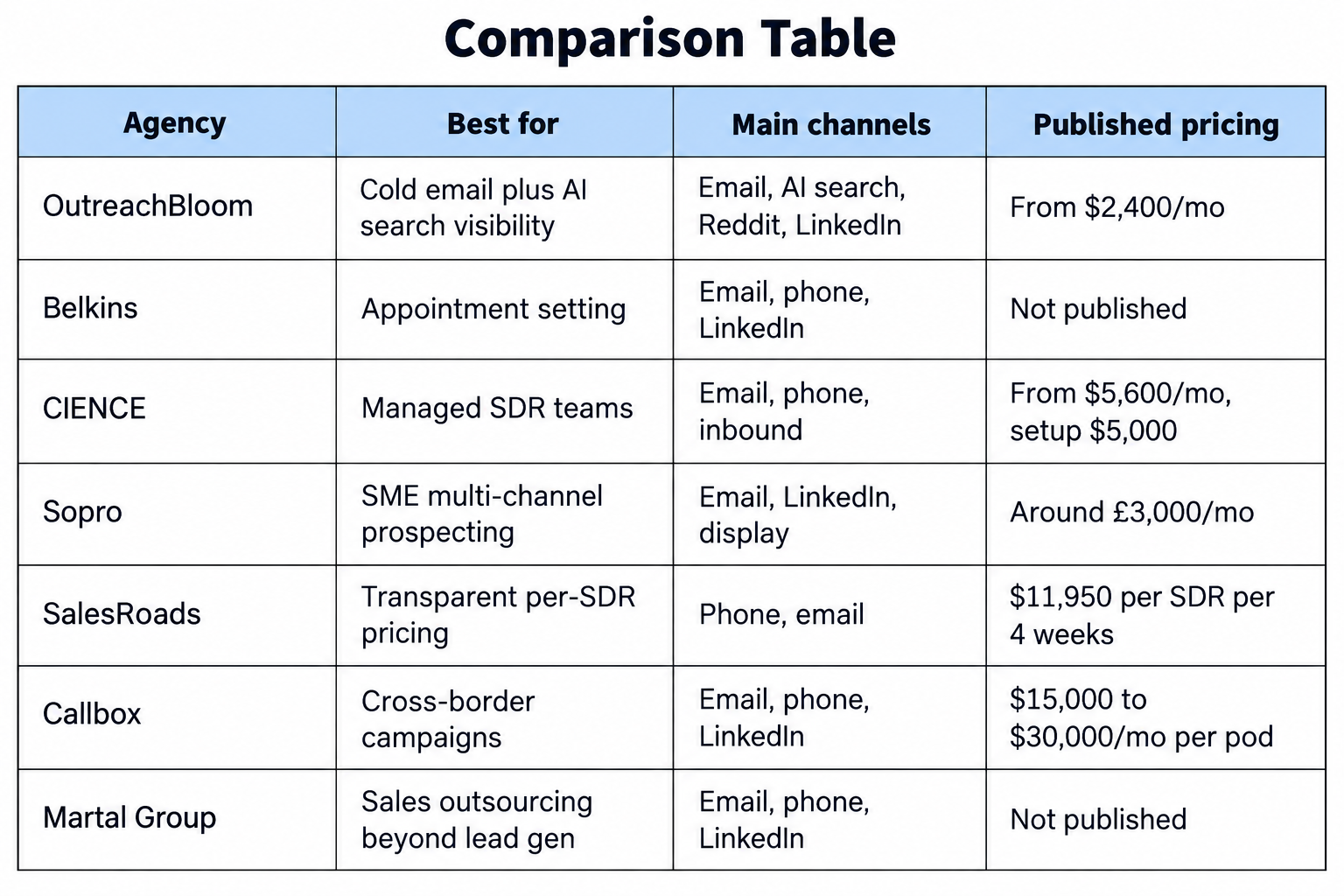
- OutreachBloom pairs managed cold email with AI search visibility, Reddit and LinkedIn, and publishes starting prices per channel.
- Belkins is the strongest all-round option for marketing teams that want booked meetings rather than raw leads, though it publishes no rates.
- SalesRoads publishes the clearest per-SDR pricing of any agency on this list.
- Callbox carries the highest entry cost, at an estimated $15,000 to $30,000 per pod per month.
- Four of the seven publish no usable rate card, so building a marketing budget around them requires a sales call.
OutreachBloom: Best for Cold Email Paired with AI Search Visibility
OutreachBloom runs cold email campaigns end to end and works on brand visibility inside AI search results.
The agency is based in Olympia, Washington, and works with B2B SaaS and services companies of roughly 10 to 200 people. Outbound sits alongside separate retainers for AI visibility, Reddit and LinkedIn. Each channel is priced on its own rather than bundled.
Key features
- Managed cold email from list build through to reply handling
- AI visibility work aimed at citations inside generative search results
- Reddit marketing as a standalone programme
- LinkedIn marketing as a standalone programme
- Monthly retainers priced per channel rather than per seat
Best for: B2B SaaS and services companies between roughly 10 and 200 people.
Pricing: Published starting rates. Cold email from $2,400 a month, AI visibility from $3,400, Reddit from $1,900 and LinkedIn from $1,000.
Caveat: The channel mix is outbound and organic visibility. There is no paid search or inbound content offering, and no self-serve option.
Belkins: Best Overall for Appointment Setting
Belkins is a B2B lead generation agency built around booked appointments rather than raw lead volume.
The agency runs cold email, cold calling and LinkedIn outreach as a single omnichannel motion. Voicemail and messaging apps sit alongside those as supporting channels. Its own packages are described in appointments delivered per year rather than in activity counts.
Key features
- Appointment setting with decision makers as the core deliverable
- Omnichannel outreach across email, calls, LinkedIn, voicemail and messaging
- Hand-picked and verified prospect lists
- Outsourced SDR and sales development teams
- Account-based marketing, paid advertising and event programmes
- HubSpot CRM and email deliverability consulting
Best for: Belkins segments its offering by enterprise, SMB and startup. Tiers run from 30 or more appointments a year up to 200 or more.
Pricing: Not published. Every tier ends in a strategy call.
Caveat: There are no rates and no self-serve route. Belkins also states that its small business tier is delivered through partner agencies in its ecosystem rather than in house.
CIENCE: Best for Managed SDR Teams with Published Rates
CIENCE sells managed go-to-market execution, with software handling research and drafting and human SDRs handling calls.
The company offers three modes: run the system for the client, build it with them, or build on top of it. Data operations sit underneath the outreach, including verified account lists and website visitor identification.
Key features
- Managed SDR teams combining automated research with human calling
- Scaled outbound with stated controls for compliance, cost and quality
- Inbound SDR qualification that turns marketing leads into sales leads
- ICP-verified account lists, visitor deanonymisation and data enrichment
- A five-day go-to-market setup sprint covering four campaign types
- Revenue system builds delivered by a deployed engineer
Best for: B2B go-to-market teams across enterprise, software, finance and services, according to its own site.
Pricing: Partly published. Setup is $5,000 one time, a strategic team is $2,000 a month and the platform licence is $499 a month, with a stated first month of $7,499. Managed SDR service is quoted from $5,600 a month.
Caveat: Total cost still cannot be worked out from the page. SDR capacity is listed as quoted, and the per-meeting fee is calculated from an ROI goal rather than fixed.
Sopro: Best for Multi-Channel Prospecting at SME Scale
Sopro runs fully managed outbound prospecting and passes live conversations to the client's own sales team.
The service covers email and LinkedIn, with display advertising synced to the same audience. Intent tracking sits on top, flagging prospects who are researching without replying.
Key features
- Fully managed outreach with one account manager as the point of contact
- Email and LinkedIn outreach, plus synced display advertising and gifting
- Prospect intent tracking and buyer intent notifications
- Bespoke audience data that the client can download and keep
- Data signed off by an internal data protection officer
- CRM integration and a live campaign dashboard
Best for: SMEs, and companies with or without an internal sales team. Named verticals include SaaS, IT services, staffing, training and telecoms.
Pricing: Published as a floor. Around £3,000 a month, with no minimum contract.
Caveat: Sopro starts conversations rather than closing business. The model assumes someone in house is available to work the enquiries.
SalesRoads: Best for Transparent Per-SDR Pricing
SalesRoads builds an outsourced sales development function staffed as a team rather than as a single rep.
Every engagement carries a strategist, a performance coach, an optimisation specialist and a research team alongside the SDRs. Prospect data is included rather than billed separately.
Key features
- Three programme types covering appointment setting, demand generation and market research
- A named support team around each SDR rather than a lone caller
- Outbound calling and personalised email prospecting
- Deliverability infrastructure spread across multiple domains and mailboxes
- 500 prospect records included per SDR per month
- Programmes stated to launch within 15 business days
Best for: Sales leaders running outbound. The site names no target company size.
Pricing: Published in full. One SDR costs $11,950 per four-week engagement, falling to $7,192 per rep at six SDRs.
Caveat: Coverage is two channels only, calling and email. No LinkedIn or social channel appears in the programme inclusions.
Callbox: Best for Cross-Border Campaigns
Callbox runs lead generation as dedicated campaign pods, each aimed at one market segment or persona.
Clients add pods to scale rather than adding hours. The agency publishes regional operations across North America, Europe, LATAM and Asia Pacific, which is the basis of its cross-border positioning.
Key features
- Six named services including ABM, event marketing and outsourced SDR teams
- A campaign pod carrying one dedicated SDR and a multi-channel cadence
- AI-enriched contact data with campaign manager oversight
- In-house CRM, sequencing engine and deliverability infrastructure
- LinkedIn outreach automation and a real-time dashboard
- Stated coverage across more than 60 countries
Best for: Global enterprise teams in software, SaaS, cloud, cybersecurity, fintech and healthcare technology.
Pricing: Published as an estimate. $15,000 to $30,000 a month per campaign pod.
Caveat: That figure is a self-labelled estimate with a two-times spread at every pod count. The exact number follows a consultation, and entry cost is materially higher than the rest of this list.
Martal Group: Best for Sales Outsourcing Beyond Lead Generation
Martal Group sells sales as a service, supplying SDRs and sales executives as an outsourced team.
The service tiers extend past lead generation into customer onboarding and account management. That makes it closer to an outsourced sales department than to a campaign vendor.
Key features
- Appointment setting and outbound lead generation
- Cold email, cold calling and LinkedIn as combined channels
- Inbound lead qualification
- A stated pool of more than 200 onshore reps, weighted to North America
- An AI sales engagement platform with configurable volume and research depth
- Higher tiers covering onboarding and long-term account management
Best for: Companies from startup to Fortune 500, across more than 20 named verticals including SaaS, cybersecurity, fintech and logistics.
Pricing: Not published. Both pricing routes end in a call.
Caveat: No rates appear anywhere on the site. Its ROI calculator also returns a specific return figure from slider inputs before any discovery, so that number is an illustration rather than a quote.
How We Evaluated These Agencies
Every claim in this guide comes from each agency's own website. Review site ratings and self-reported case study results were excluded, because neither can be checked independently.
Agencies were assessed on four things. The first is delivery model, meaning whether the agency books meetings, supplies headcount or only opens conversations. The second is channel coverage. The third is pricing transparency. The fourth is who the agency states it serves.
Where an agency publishes no rate, this guide records that rather than estimating one.
Key Trends Shaping B2B Demand Generation in 2026
Pricing is becoming per outcome rather than per hour. Belkins prices in appointments per year and Callbox prices per campaign pod. Neither model bills for activity.
Automated research is now standard, human calling is not. CIENCE and Martal both describe software handling research and drafting, with people reserved for conversations.
Intent data has moved down market. Visitor identification and buyer intent alerts appear in Sopro and CIENCE packages that were once enterprise only.
Visibility inside AI answers is becoming a lead source. Buyers increasingly shortlist from generative search results, which is why agencies such as OutreachBloom now sell that work separately from traditional SEO.
How to Choose a B2B Marketing Agency for Demand Generation
Start with the handover point. Sopro passes conversations across, while Belkins books the meeting. Those are different amounts of work left for the internal team.
Match channel coverage to the buyer. SalesRoads is phone and email only, which suits markets where LinkedIn is weak and rules it out where LinkedIn is the main channel.
Treat an unpublished rate as a real cost. Four agencies here require a call before a number exists, which lengthens evaluation.
Check who staffs the account. Belkins delivers its smallest tier through partner agencies, and CIENCE prices SDR capacity by region, so the named brand is not always the team doing the work.
Frequently Asked Questions
What does a B2B demand generation agency actually deliver to a marketing team?
It varies by model. Some agencies deliver booked appointments, some supply SDR capacity as outsourced headcount, and some deliver only replies from interested prospects.
How much does a B2B demand generation agency cost?
Published figures on this list range from around $1,000 a month for a single LinkedIn programme to $30,000 a month for one enterprise campaign pod. Four of the seven agencies publish no rate at all.
Is cold email still effective in 2026?
Every agency in this guide still sells it, and most pair it with phone or LinkedIn. Deliverability infrastructure has become part of the service rather than an add-on.
Should a company hire an agency or build an in-house SDR team?
Agencies remove hiring and ramp time, and several state launch windows of three weeks or less. In-house teams cost less per meeting at scale but take months to reach that point.






Privacy is important to us, so you have the option of disabling certain types of storage that may not be necessary for the basic functioning of the website. Blocking categories may impact your experience on the website. View Our Privacy Policy


