
Why AI Image Generators Are Becoming Important for Multi-Brand Content Operations

When it comes to scaling visual content across multiple brands, the old way of doing things simply does not hold up anymore. I have been in content operations long enough to remember when every campaign image meant briefing a designer, waiting days for a first draft, running approval loops, and then doing it all over again the moment the brief changed. Multiply that by three brands, five product lines, and a dozen markets, and you start to understand why content teams hit walls they cannot seem to break through.
That is the real pain point nobody talks about honestly in marketing blogs. It is not just about speed. It is about the exhausting coordination tax that comes with producing brand-consistent visuals at volume. And it is exactly why an ai image generator has moved from a nice-to-have experiment to an operational necessity for teams managing more than one brand at a time.
How Visual Content Demands Have Changed
From my experience working with mid-size content teams, the shift happened gradually and then all at once. Social platforms now demand fresh visuals almost daily. Email campaigns need custom graphics per segment. Landing pages require variant images for A/B testing. And each brand in a portfolio has its own tone, color language, and audience expectation.
The traditional model stock libraries plus a design team plus an external agency for overflow was already under pressure before AI tools entered the picture, as research from the Content Marketing Institute consistently shows teams are being asked to produce more content with the same or fewer resources."
What I found when I started testing ai image generator tools seriously was that the gap between "good enough for internal use" and "ready for production" had narrowed dramatically. Tools like Higgsfield are producing outputs that brand managers are actually approving without heavy revision cycles, which would have been unthinkable even eighteen months ago.
The Multi-Brand Problem Specifically
Running a single brand through AI image workflows is relatively straightforward. The complexity multiplies when you add a second or third brand into the mix, and here is why.
Each brand brings its own visual identity system specific color palettes, preferred imagery styles, subject matter restrictions, and audience sensitivities. An ai image generator that works beautifully for a lifestyle brand might produce outputs that feel tonally wrong for a B2B software brand sitting in the same portfolio. Without thoughtful prompt architecture and workflow design, teams end up with AI-generated images that are technically polished but brand-inconsistent.
My team noticed this problem early. We were generating images quickly but spending just as much time in review correcting brand drift as we had previously spent waiting on design. The tool itself was not the issue the process around it was.
The answer was building brand-specific prompt libraries and style guides that fed into our ai image generator workflows. Once we had those in place, output quality and brand consistency improved significantly, In practice, teams often use an AI image generation tool to convert structured prompts intoreliable visual outputs, making it easier to expand content production without losing consistency, and the actual time savings started to materialize.
What Higgsfield Brings to This Use Case
I want to be specific here because vague tool recommendations are not useful to anyone trying to make a real operational decision.
Higgsfield has become a go-to option in our stack for a few concrete reasons. The model handles stylistic consistency across a prompt set better than most alternatives I tested. When you are running a campaign that needs fifteen image variants with a shared visual language, that consistency matters enormously. Other ai image generator tools I evaluated tended to drift stylistically across a batch, requiring more manual curation.
The interface also supports the kind of iterative prompting that multi-brand work demands. You are not just generating one image and moving on. You are building a visual direction, testing variations, and narrowing toward something that fits a specific brand context. Higgsfield's workflow accommodates that iteration loop without feeling cumbersome.
For teams managing visual content at scale, the ability to move quickly between brand contexts different style references, different tonal targets without losing quality in the handoff is genuinely valuable. That is something I have come to look for specifically when evaluating any ai image generator for production use.
Workflow Comparison: Traditional vs. AI-Assisted
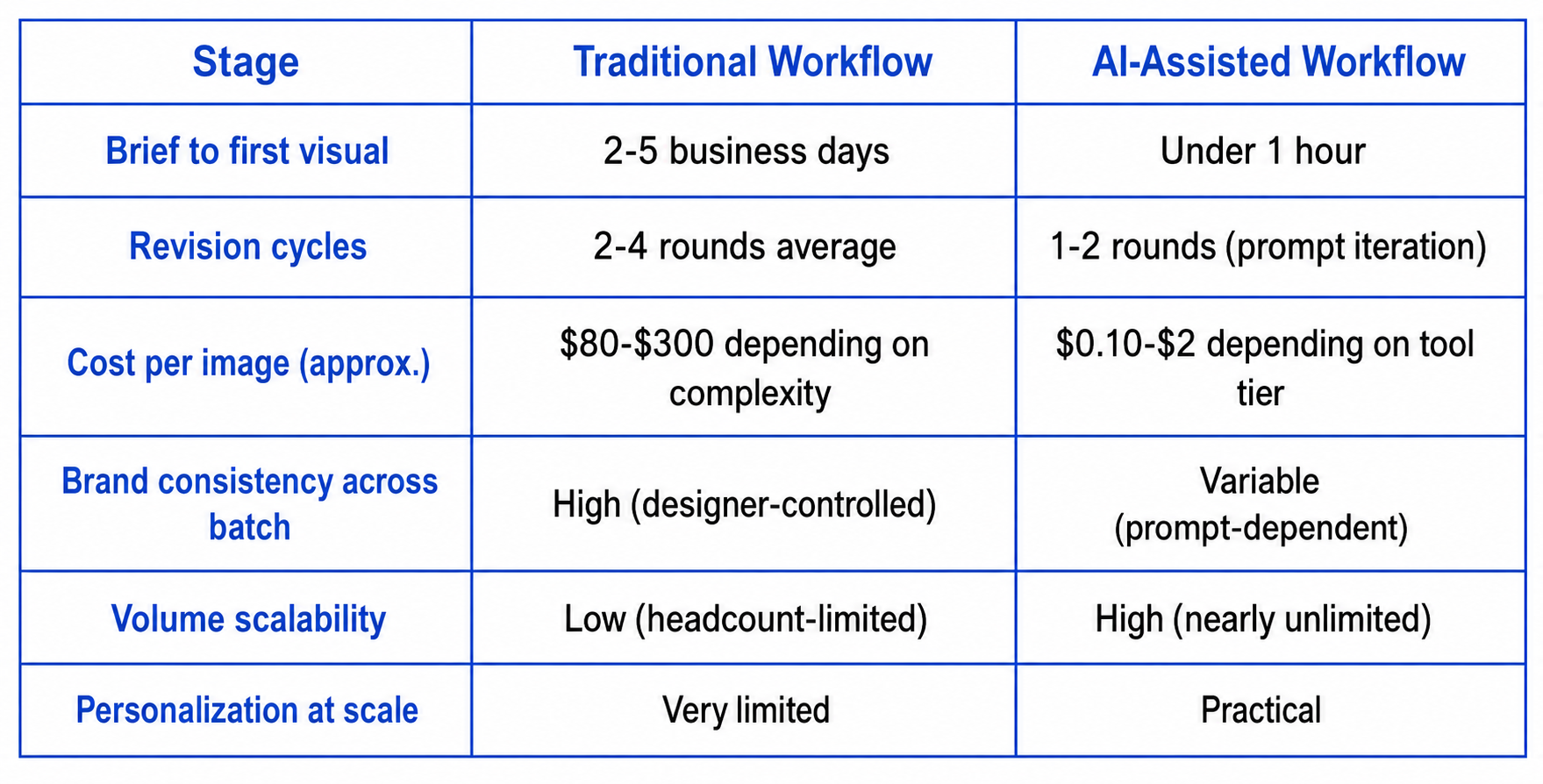
The table above reflects my own operational experience and conversations with content leads at comparable organizations. The cost figures are approximate and vary significantly by agency rates and tool pricing, but the directional story is consistent: AI-assisted workflows are dramatically more scalable, with brand consistency as the key variable to manage.
Practical Applications Across Brand Portfolios
Here is how the actual use cases break down for teams I have talked to or worked with directly.
Campaign creative at volume. A brand running eight to twelve paid social campaigns per quarter needs hundreds of image variants. Manually producing that volume is not realistic for most in-house teams. An ai image generator running on a structured prompt system can produce testable variants faster than any design queue.
Localization and market adaptation. Global brands need images that feel native to different cultural contexts. AI tools can adapt visual content backgrounds, settings, contextual details across markets in a way that would require significant budget if done through traditional means.
Product visualization. For e-commerce brands in a portfolio, showing products in varied lifestyle contexts used to mean expensive photo shoots. AI image generation has changed that calculus entirely for certain product categories. For teams testing several visual directions before production, an AI picture maker can provide additional product-image concepts without another shoot.
Content testing infrastructure. Brands running serious conversion optimization programs need image variants at a rate that design teams simply cannot sustain. AI-generated imagery has become the only practical way to feed a high-velocity testing program. As these use cases expand, organizations often Hire AI Developer specialists to build tailored AI solutions that connect image generation with content management systems, marketing automation platforms, and internal approval workflows.
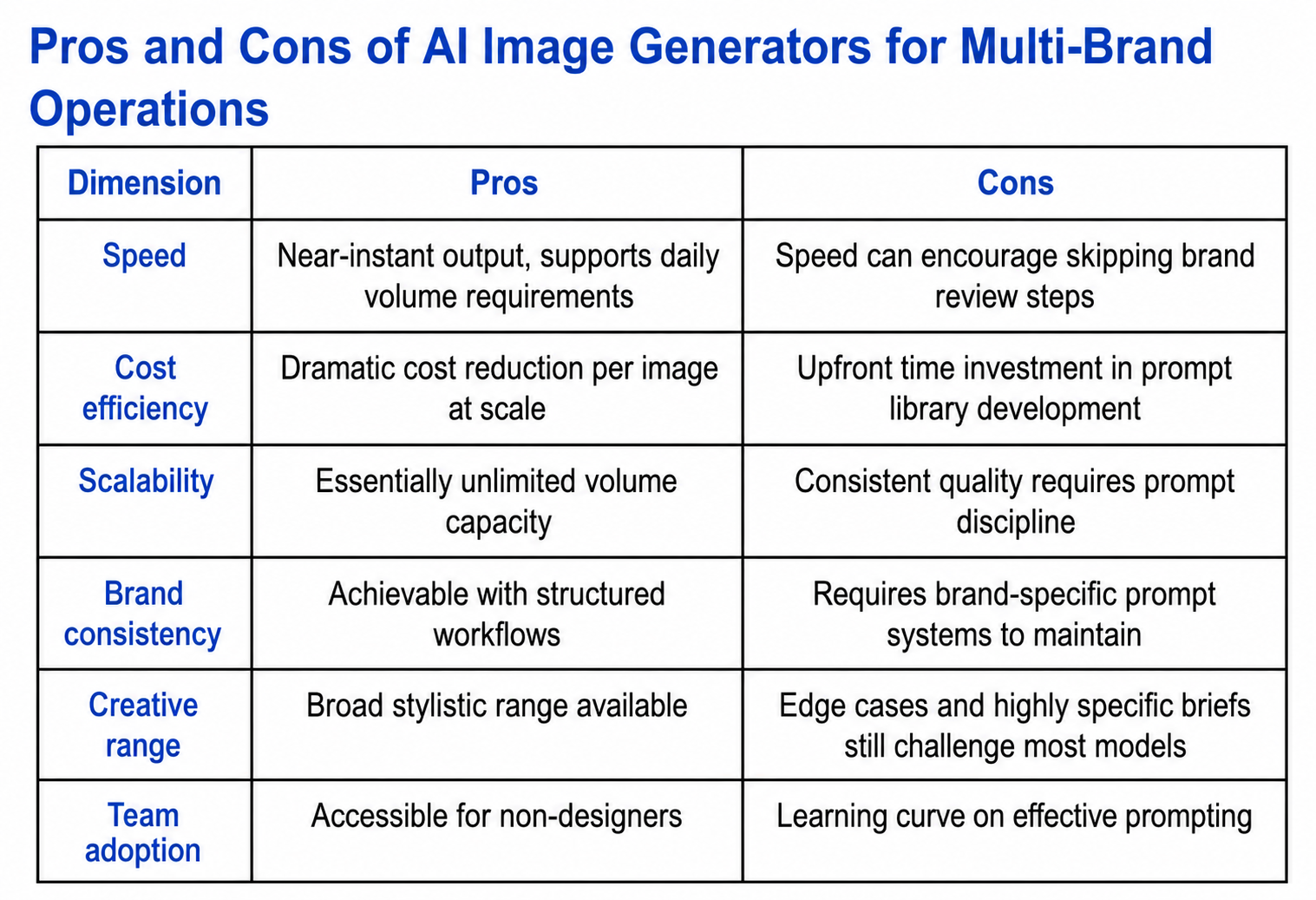
Pros and Cons of AI Image Generators for Multi-Brand Operations
What to Look for When Choosing an AI Image Generator for Multi-Brand Work
Not all tools are equal when your use case is specifically multi-brand content operations. From my experience evaluating several options, here are the factors that actually matter.
Style consistency within a session or batch. Some ai image generator tools drift noticeably across a set of images even with identical prompts. For brand work, that drift is a real problem. Test this specifically before committing to a tool.
Prompt control and iteration support. You need to be able to refine outputs quickly. Tools that require you to re-enter full prompts for minor adjustments slow down the workflow considerably.
Output resolution and format flexibility. Brand content ends up in many different formats and sizes. Make sure the tool produces outputs that meet your actual production requirements without significant post-processing.
Usage rights clarity. For commercial brand work, usage rights need to be explicitly clear. Read the terms carefully before using any ai image generator for client-facing or published content.
Higgsfield addresses most of these concerns directly, which is part of why it has earned a place in my recommendation shortlist for teams doing serious multi-brand work.
Which Option Better Suits Your Business Needs?
If you are running a single brand with moderate content volume, almost any established ai image generator will serve you reasonably well. The efficiency gains are real and accessible without much workflow investment.
If you are managing multiple brands with distinct visual identities, the answer is more nuanced. You need a tool that supports the kind of stylistic control and iteration speed that multi-brand work demands. You also need to invest in building brand-specific prompt infrastructure no tool substitutes for that groundwork.
For enterprise content operations managing five or more brands, the ROI on building a proper AI image workflow is substantial. The teams I have seen do this well treat it as a content operations system, not just a collection of tool subscriptions.
Final Thoughts
AI image generation is not going to replace creative strategy, and it is not going to eliminate the need for thoughtful brand management. What it is going to do and is already doing for teams that have adopted it seriously is remove the volume ceiling that previously limited what in-house content operations could produce.
The brands that figure out how to combine strong prompt discipline, solid brand guidelines, and capable tools like Higgsfield are going to have a real operational advantage over the next several years. The gap between teams that have built these workflows and those that have not is going to widen as content volume expectations continue to increase.
If you are in charge of content operations for a multi-brand portfolio and you have not yet built a structured AI image workflow, that is the place to start. Not with a single tool test, but with a genuine system design exercise that maps your brand requirements to workflow capabilities. The tools are ready. The question is whether your operation is ready to use them well.
Keep reading:
- How to Build a Prompt Library for Brand-Consistent AI Image Generation
- Content Operations at Scale: What High-Volume Teams Do Differently
- AI Tools for Marketing Teams: A Practical Evaluation Framework
- Visual Brand Guidelines in the Age of Generative AI
- How to Run an AI Image Workflow Audit for Your Content Team







A privacidade é importante para nós, então você tem a opção de desativar certos tipos de armazenamento que podem não ser necessários para o funcionamento básico do site. O bloqueio de categorias pode afetar sua experiência no site. Mais informações


