
Why 91% of Businesses Now Use AI, But Only a Third See Real ROI
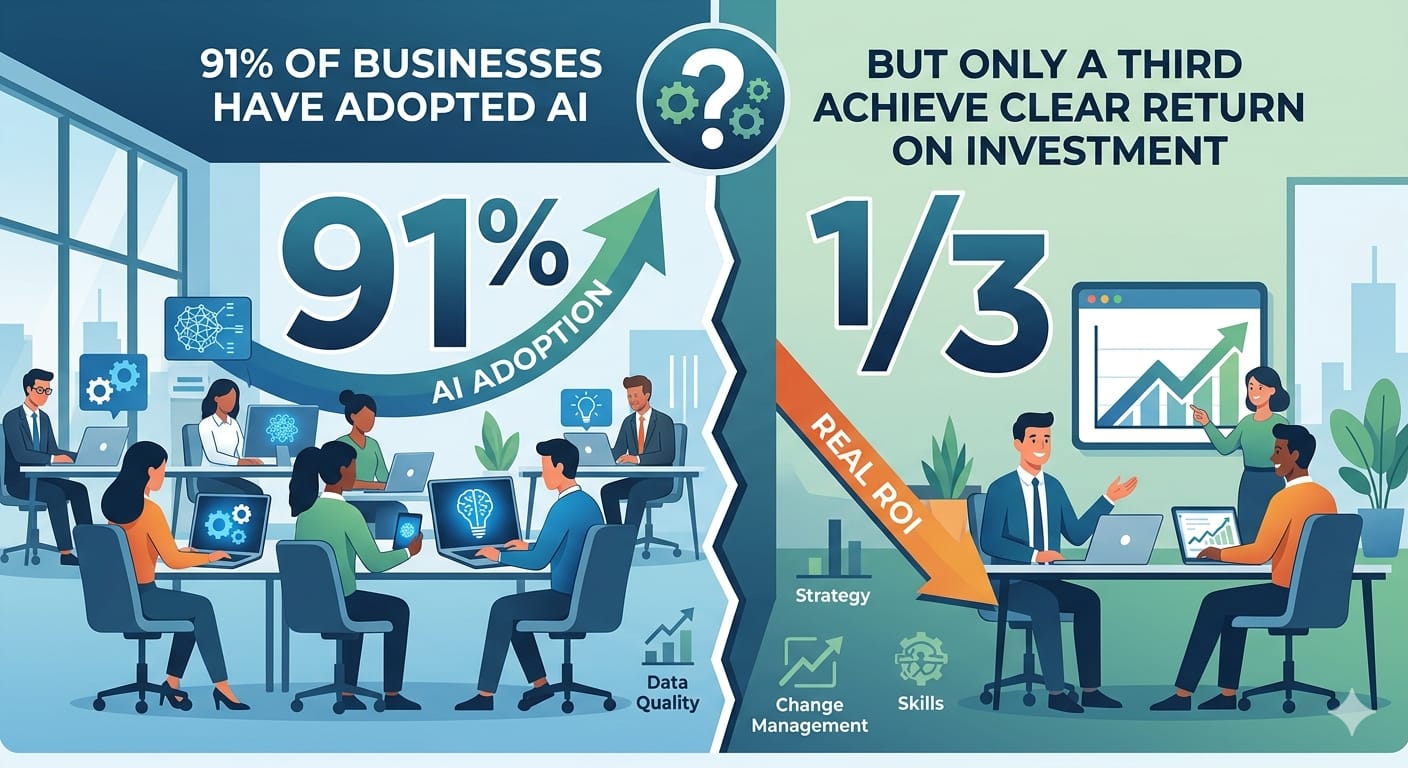
Artificial intelligence has moved from being an experimental technology to a core part of modern business operations. Today, around 91% of companies report that they are actively using AI in some form, whether in marketing, customer service, operations, or data analysis. Yet despite this rapid adoption, only about one-third of businesses are seeing meaningful return on investment.
This gap between adoption and real business impact reveals a deeper issue: most organizations are using AI, but very few are using it strategically. Many modern companies are combining AI tools like Texti AI to streamline workflows, but still struggle to connect usage with measurable business outcomes.
In this article, we will break down why this disconnect exists, what businesses are getting wrong, and how companies can finally turn AI from a cost center into a profit driver.
The AI Boom: Why Everyone Is Adopting It
AI adoption has exploded for one simple reason: it promises efficiency at scale.
Businesses are using AI to:
- Automate repetitive tasks
- Generate content and marketing materials
- Improve customer support through chatbots
- Analyze large datasets for decision-making using AI for data analysis
- Personalize user experiences
For many companies, especially in competitive industries, ignoring AI is no longer an option. Tools are widely available, relatively affordable, and easy to integrate into existing workflows.
This is especially true in the context of AI for business, where companies are constantly looking for ways to reduce operational costs while increasing output.
However, adoption alone does not guarantee success. Many organizations overcome this challenge by working with the best AI consulting company to identify high-impact use cases, integrate AI into core business processes, and build an implementation strategy aligned with measurable business outcomes.
The ROI Problem: Why Most Companies Fail to Benefit
Even though AI usage is widespread, ROI remains limited. The main reason is not the technology itself, but how it is implemented.
1. AI is used without clear objectives
Many businesses adopt artificial intelligence because it is trending, not because they have defined problems to solve.
For example:
- Using AI tools for marketing without a clear conversion strategy
- Deploying chatbots without improving customer journey design
- Automating content without SEO or audience targeting
Without clear KPIs, AI becomes a tool that produces output, but not outcomes.
2. Lack of integration into core workflows
AI often exists as a separate layer rather than being integrated into business systems.
Companies treat it as:
- A content tool
- A chatbot tool
- A data tool
Instead of embedding it into:
- Sales pipelines
- Customer experience systems
- Decision-making processes
- Supply chain optimization
This disconnect reduces its overall impact. One practical path is to connect AI directly to revenue workflows: by deploying agent-native systems that interface with ZoomInfo, solutions like GTM AI can operationalize prospecting, enrichment, and outreach through one API, making it easier to attribute actions to pipeline and real ROI. Aligning AI with sales pipelines and customer systems is exactly the kind of operational fix that revops as a service is built to.
3. Poor data quality
AI is only as strong as the data it learns from.
Many businesses struggle with:
- Incomplete datasets
- Outdated customer information
- Fragmented data across platforms
- Lack of structured data systems
As a result, AI outputs become generic or inaccurate, limiting their usefulness. For finance teams, that means cleaning up the ledger first, and a QuickBooks reporting tool makes gaps and miscoded transactions easy to spot.
Rationale: the subsection says AI is only as good as the data behind it. Ledger hygiene is the finance version of that point.
4. Over-reliance on automation
Another major mistake is assuming AI can fully replace human decision-making.
In reality, AI works best as:
- A support system
- A decision-enhancement tool
- A productivity accelerator
Not a fully independent strategist.
Businesses that over-automate often lose personalization, brand voice, and strategic direction.
The Difference Between AI Adoption and AI Strategy
The key issue is that most companies are focused on adoption, not strategy.
AI adoption means:
- Using AI tools
- Automating tasks
- Experimenting with features
AI strategy means:
- Aligning AI with business goals
- Measuring performance impact
- Integrating AI into workflows
- Continuously optimizing results
This difference is exactly why some companies see massive ROI while others see almost none.
Where AI Actually Delivers ROI
Companies that succeed with AI tend to focus on high-impact areas rather than general usage.
1. Marketing and content optimization
AI is highly effective when used for:
- Content ideation
- SEO optimization
- Audience segmentation
- Performance analysis
But only when combined with strategy and human editing.
2. Customer experience enhancement
Businesses seeing strong ROI often use AI to:
- Predict customer behavior
- Provide instant support
- Personalize recommendations
- Reduce response time
This directly impacts retention and revenue.
3. Operational efficiency
AI-driven automation in operations can:
- Reduce manual workload
- Improve supply chain accuracy
- Optimize scheduling and logistics
This is where cost savings become significant. Pairing AI with an ERP like Enerpize ensures those efficiency gains are reflected in invoicing, inventory, and financial reporting in real time.
4. Decision intelligence
Advanced companies use AI not just for automation, but for decision support:
- Forecasting demand
- Risk analysis
- Financial modeling
- Market trend prediction
This leads to better strategic decisions at the leadership level.
Why Most Businesses Struggle With “AI for Business”
Even though “AI for business” is one of the most searched and discussed concepts today, many companies misunderstand what it actually means.
They assume it means:
- Buying tools
- Automating tasks
- Reducing headcount
But in reality, it means:
- Redesigning workflows around intelligence
- Combining human + machine decision-making
- Building systems that continuously learn and improve
Without this mindset shift, AI becomes just another software expense.
The Role of Human Oversight in AI ROI
One of the most overlooked factors in AI success is human involvement.
High-performing organizations always include:
- Human review of AI outputs
- Strategic oversight of automation
- Continuous performance monitoring
- Feedback loops to improve accuracy
This ensures that AI does not drift away from business goals.
Common Mistakes That Kill AI ROI
Here are the most critical mistakes companies make:
- Using AI without training teams properly
- Expecting instant results without optimization
- Not connecting AI tools to business KPIs
- Ignoring data governance
- Treating AI as a one-time implementation instead of an evolving system
Avoiding these mistakes alone can significantly improve ROI.
How Businesses Can Close the AI ROI Gap
To move from adoption to real results, companies need a structured approach.
Step 1: Define business outcomes first
Start with clear goals such as:
- Increase conversion rate
- Reduce operational costs
- Improve customer retention
Step 2: Map AI to specific workflows
Identify exactly where AI fits:
- Marketing
- Sales
- Support
- Operations
Step 3: Combine AI with human expertise
Do not replace humans—enhance them.
Step 4: Measure everything
Track:
- ROI per AI tool
- Time saved
- Revenue impact
- Customer satisfaction changes
Step 5: Continuously optimize
AI systems improve over time only if they are refined regularly.
The Future of AI in Business
AI is not slowing down, it is evolving into a core business infrastructure layer.
In the near future:
- Every business process will have AI integration
- Decision-making will become AI-assisted
- Competitive advantage will depend on AI maturity, not AI usage
The companies that win will not be those that use the most AI tools, but those that use AI most effectively.
Conclusion
The fact that 91% of businesses are using AI shows how fast the technology has been adopted. However, the reality that only a third see real ROI highlights a critical gap between usage and strategy.
AI is not a magic solution; it is a force multiplier. When used correctly, it can transform productivity, efficiency, and profitability. But without clear goals, integration, and human oversight, it becomes just another underperforming tool.
The future of competitive advantage lies not in whether companies use AI, but in how intelligently they apply it in real business environments, especially in the growing field of AI for business transformation.








A privacidade é importante para nós, então você tem a opção de desativar certos tipos de armazenamento que podem não ser necessários para o funcionamento básico do site. O bloqueio de categorias pode afetar sua experiência no site. Mais informações


