
How Sustainable Fashion D2C Brands Are Using AI Ads to Win on Meta in 2026

Back in autumn I was managing Meta for a bamboo basics brand and hit a wall I have seen with sustainable apparel accounts more times than I can count. One creative. A lifestyle shot of a folded white tee on a wooden surface, copy about ethically made fabric, vague sustainability messaging. Eleven weeks. The ROAS held at 1.8 the whole time. Frequency had climbed to 3.8 by week nine, which is embarrassing in retrospect. You end up irritating the same audience at a 1.8 return and calling it a campaign.
The fabric, as it turns out, was not the problem. Bamboo viscose contains a bio-agent called bamboo kun that inhibits odour-causing bacteria at the fibre level. Not through chemical treatment. The bacteriostatic behaviour is intrinsic to the viscose fibre itself, confirmed in peer-reviewed textile research including work published in ACS Applied Bio Materials. On top of that, the micro-gap cross-section of bamboo fibre moves moisture away from skin faster than cotton does. And the round, smooth fibre structure means a 70% bamboo viscose / 30% cotton tee at 5.3 oz/yd2 feels softer than cotton of equivalent weight.
Three separate, scientifically verifiable reasons to buy. And we were advertising none of them.
Why Creative Budgets Keep Getting Wasted
Meta CPMs for fashion brands have been rising for two years running. WordStream's Facebook Ads industry benchmarks put apparel CPMs well above the platform average, and competition for purchase-intent audiences has pushed costs higher for smaller D2C accounts that can't negotiate placement. Sustainable fashion brands are bidding against mid-market players with more creative volume and better testing infrastructure.
The creative refresh cycle has not kept pace. One product shoot, 20 to 30 assets, two to three weeks to produce, then three or four weeks of reasonable performance before frequency kills the results. Start over. For a bamboo product with three distinct ad angles, that is a structural mismatch. Most of what the product can offer never gets in front of an audience.
And bamboo is specifically hard to advertise visually because the best properties are invisible. You cannot photograph bamboo kun. Shooting a micro-gap fibre cross-section in a way that makes someone stop scrolling is not a realistic ask. The 5.3 oz/yd2 fabric weight that makes the garment feel substantial? A sensation. Not a visual. So you are always one creative behind what the product actually delivers.
What AI Creative Tools Actually Change
The operational shift is specific: AI creative platforms take one product photograph and turn it into 60 to 100 testable variants in 48 to 72 hours. Copy variants, background swaps, short-form video assembled from product stills. The cost is $300 to $800 per month rather than $3,000 to $8,000 per shoot.

Having 60 variants in market means actually testing the distinct bamboo claims in parallel. Meta's algorithm finds who responds to which angle. You shift budget toward what is working. That is the full loop.
Bamboo as a Case Study: Three Angles, One Product
For a brand selling 70% bamboo viscose / 30% cotton tees at 5.3 oz/yd2 (roughly 179 gsm), there are three genuinely distinct creative hooks worth testing:
- Feel-first: "Softer than the cotton tees already in your drawer" — buyers browsing everyday basics, not particularly interested in the supply chain story, just whether the product is nice to wear
- Function: "Wears all day without the smell" — commuters, professionals, anyone who runs warm. Bamboo kun does the work here, though you don't need to name it in the ad copy itself
- Fabric story: "Bamboo kun: the reason this tee doesn't need washing after every wear" — the buyer who wants actual specifics rather than vague sustainability language, and will read the product page before buying
These reach different people with different motivations. Running one creative at all three simultaneously means the softness buyer probably finds you. The others mostly don't.
Accounts that properly split this testing report CPAs 20 to 35% below their previous benchmarks within four to six weeks. That range is honest about variation — it depends heavily on how creative-fatigue-constrained the account was beforehand. But the direction is consistent.
The Retention Story Nobody Talks About
Most of the conversation around AI creative focuses on cutting acquisition costs. Fair enough. But in the accounts I have run over the past year, post-purchase is where the higher-leverage application sits.
A customer who bought a bamboo tee because a softness ad converted them is a different kind of retention target. They know the feel. What they probably don't know is that bamboo kun is still inhibiting bacterial growth in the fibre right now, in their wardrobe, which is why the tee smells fine on the fifth wear. That is new information about something they own. Useful, not a pitch.
Brands selling men's bamboo t-shirts that build post-purchase creative from real product properties see repeat purchase rates 15 to 20% above static email alone, a pattern consistent with Klaviyo's ecommerce retention benchmarks showing segmented retargeting sequences outperforming broadcast email for apparel. Not because the creative is clever. Because customers are learning accurate things about their fabric across a sequence rather than all at once.
The bamboo story has more than one chapter. The 70/30 blend, the care side (cold wash, air dry, holds shape through repeated washes), the bamboo kun mechanism. Spreading those across a retention sequence is practically free when AI creative lowers the per-variant production cost. Which means there is no reason not to.
Retargeting by Behaviour, Not Just by Visit
Standard retargeting fires at everyone who visited the product page. But that group includes the person who spent four seconds and left, the person who added to cart and got distracted by something else, and the person who read the full bamboo fibre description twice and still hasn't bought.
Those are not the same problem. Brands can use user behavior insights to understand how visitors interact with their products and create more relevant retargeting experiences.
The four-minutes-on-page person has a specific objection. Probably price, or unfamiliarity with bamboo in the wash. Showing them creative that addresses durability and care, "cold wash, air dry, 179 gsm construction that holds its structure," is a different conversation than showing the hero shot they already scrolled past twice.
Segment libraries, 10 to 15 variants per audience behaviour bucket, sound like more overhead than they are. You build them once and mostly maintain after that.
When It Makes Things Worse
AI-generated images that look generated destroy trust with sustainable fashion buyers. This audience notices. A synthetic hand model, a background that doesn't quite resolve, an obviously AI face — these read as inauthentic, which is the specific signal you cannot afford when the whole product proposition is "genuinely better materials, honestly made."
Skip AI creative for:
- Hero product shots where photography quality is a brand credibility signal
- Texture and hand-feel content where showing the physical fabric matters
- Any format that requires real people wearing real products convincingly
Use AI creative for: copy variants on real product images, background swaps, short-form video assembled from existing photo assets, and testing new claim angles before committing to a full shoot," says Brian Lim, founder of iHeartRaves and INTO THE AM. That last use case tends to pay for the tool within the first month. As fashion brands increasingly adopt AI, sustainable materials, and digital marketing strategies, the industry also needs professionals with strong creative and business skills. Students interested in building careers in fashion can explore the top fashion schools in the world, where programs combine design, technology, sustainability, fashion business, and industry experience.
Questions I Keep Getting Asked
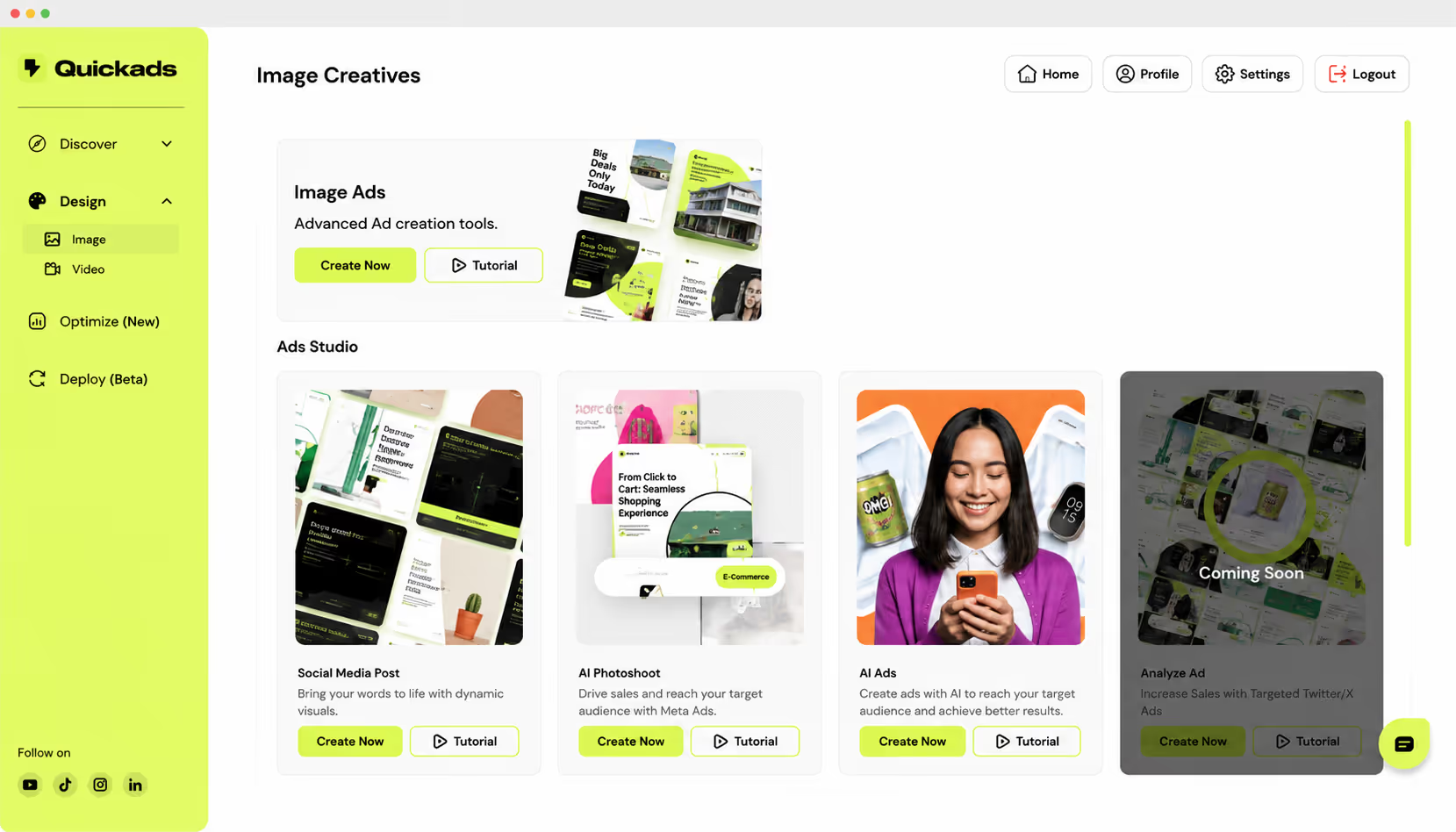
Which tools are actually worth it? For copy and image variations: QuickAds and AdCreative.ai are the ones I see working consistently. For short-form video from stills: Creatify. Start with one use case. Not five platforms simultaneously.
How long before ROAS improves? Four to six weeks minimum. Day 14 of a 60-variant launch is noise. The algorithm needs a full test cycle before you can read signal from volume.
Is AI creative a trust problem for eco-conscious buyers? Only if the claims are wrong. Bamboo kun is a real bio-agent with real bacteriostatic behaviour. The 5.3 oz/yd2 spec is a product fact. Claims that are accurate and verifiable are fine in AI creative. Overstated claims are the risk, whether the copy was written by software or a person.
Do sustainable brands outperform conventional apparel with AI creative? Directionally, yes. More testable angles means the algorithm finds its audience faster. A single-note product gets less from variant volume than a multi-property one does. Bamboo fabric has enough distinct properties that the variant volume advantage actually has somewhere to go.
Close the Tab When You're Done
AI creative tools are not the interesting part of this. The interesting part is that bamboo and natural-fabric brands have been underselling products with multiple genuine, verifiable advantages because the economics of creative testing were broken. One shoot, one angle, one audience that got it, and a larger audience that never heard the right message.
The economics changed. The product properties were already there.








A privacidade é importante para nós, então você tem a opção de desativar certos tipos de armazenamento que podem não ser necessários para o funcionamento básico do site. O bloqueio de categorias pode afetar sua experiência no site. Mais informações


