
Why Everyone From Solo Creators to Fortune 500 Brands Is Betting Big on AI Video
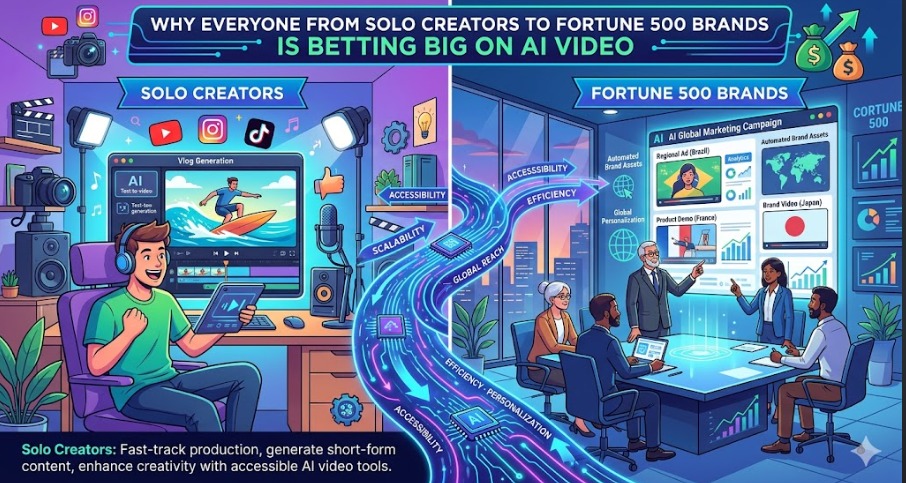
Walk into any digital marketing meeting today and you'll hear the same frustration repeated in different ways: we need more video, we don't have enough time, and our budget isn't growing anytime soon.
It's a tension that has quietly defined the content industry for years. Video is the undisputed king of online engagement studies consistently show it generates more shares, longer watch times, and higher conversion rates than any other format. Yet producing it well has always demanded resources that most businesses and independent creators simply don't have.
That tension is finally breaking. And the force doing the breaking is artificial intelligence.
Video Was Always Too Expensive to Scale, Until Now
Think about what goes into producing a single marketing video. You need a concept, a script, a visual direction, footage (either shot fresh or sourced from stock libraries), music that fits the mood without violating licensing terms, a voiceover if needed, text overlays, color correction, and a final cut optimized for whichever platform you're publishing on.
Even a modest two-minute video can take a skilled editor two full days to produce. Multiply that by the volume of content modern digital presence demands weekly posts, platform-specific formats, seasonal campaigns, A/B test variants and you start to understand why so many brands either burn out their creative teams or settle for content that doesn't reflect how good their product actually is.
The AI video generator changes that math entirely.
These tools don't just speed up editing they collapse the entire production pipeline. A founder can describe their product in plain language, upload a few images, and walk away with a professionally structured video complete with transitions, music, pacing, and captions. A marketing team can generate a dozen campaign variants in the time it previously took to finalize one, creating more opportunities for AI agents for personalized outreach to deliver tailored messaging at scale. A content creator working alone can produce at the volume that once required a full production house behind them.
This isn't about cutting corners. It's about redirecting human energy toward the decisions that actually require human judgment the strategy, the story, the soul of the content while letting AI handle the mechanical execution.
The Short-Form Content Crisis No One Talks About
Here's something the engagement metrics don't show: the quiet exhaustion behind the reels, the shorts, the TikToks that populate your feed every single day.
"Short-form video has become the dominant language of social media. Platforms reward it with algorithmic priority. Audiences have trained themselves to prefer it. Brands that master it build loyal communities faster than any other channel" says Brian Lim, founder of iHeartRaves & INTO THE AM
But the hidden cost of that dominance is brutal.
Staying relevant in short-form means publishing constantly. It means understanding the specific visual grammar of each platform — the hook within the first two seconds, the caption placement for muted viewers, the aspect ratio, the trending audio, the cut rhythm that keeps thumbs from scrolling. It means iterating quickly based on what performs and what doesn't, then starting the whole process again the next morning.
For most creators and marketing teams, that pace is unsustainable without help.
The AI reels maker was essentially built as an answer to that exact problem. Rather than treating short-form video as a simpler version of long-form content, the best AI reels tools were designed from the ground up around platform-native behavior. They understand that a reel isn't just a trimmed clip — it's a format with its own architecture. They auto-detect the most engaging moments in raw footage, apply platform-specific formatting, generate captions in the creator's voice, and produce ready-to-publish content that feels native rather than templated.
The result is that individual creators can now maintain a consistent, high-quality posting schedule without sacrificing their mental health to the algorithm. And brands can stay culturally present without dedicating a full-time employee solely to reels production.
What Separates Good AI Video From Generic AI Video
Not all AI-generated video is created equal and that distinction matters enormously.
The tools that produce genuinely impressive results share a few things in common. First, they prioritize structure over speed. A fast video that confuses the viewer is worthless. The best AI video generators understand narrative arc, even in short formats they know a product demo needs a problem before it shows a solution, that a brand story needs an emotional anchor, that a tutorial needs clear progression.
Second, they give creators meaningful control rather than hiding everything behind automation. The difference between a tool that spits out a video and one that actually serves creativity is the ability to guide, adjust, and refine. The AI should be taking direction, not dictating it.
Third and this is where the best tools genuinely separate themselves they adapt. They learn what performs for a specific brand voice, a specific audience, a specific niche. An AI video generator that produces the same visual style for a luxury skincare brand and a streetwear label isn't actually intelligent. It's just fast. Genuine intelligence in these tools shows up in their ability to differentiate, personalize, and evolve.
The Industries Being Quietly Transformed
The adoption of AI video tools isn't uniform across industries but the breadth of sectors it's touching is wider than most people realize.
E-commerce has been one of the earliest and most enthusiastic adopters. Product videos increase purchase confidence dramatically, and AI allows retailers to generate video for every SKU in their catalog rather than just their hero products. The result is a richer shopping experience at a fraction of the previous cost.
Education and e-learning is another space where AI video has found immediate traction. Educators who built careers on text-based courses are now producing video modules without ever touching traditional editing software. Explainer videos that once required motion graphics studios can now be generated from a well-written script and a clear visual concept.
Real estate has embraced AI video for property walkthroughs and neighborhood overviews. Healthcare is using it for patient education content. Nonprofits — historically priced out of professional video production are now telling their impact stories with visual quality that rivals organizations with ten times their budget.
The through-line in every case is the same: AI video tools are unlocking a format that was previously gatekept by cost and technical complexity.
Authenticity in the Age of Artificial Intelligence
There's a legitimate concern sitting underneath all of this excitement, and it deserves honest engagement rather than dismissal.
If AI can generate video at scale, with minimal human involvement, what happens to authenticity? What happens to the connection between a creator and their audience when the creative process is increasingly automated? And how does a viewer know what was made with genuine human intention versus what was assembled by an algorithm?
These questions don't have clean answers yet. But they point toward something important: the brands and creators who will thrive in the AI video era aren't the ones who automate everything. They're the ones who use automation strategically who deploy an AI reels maker for the high-volume, format-driven content while investing their own time and perspective into the content that genuinely requires a human voice.
The technology is powerful enough to produce content. Only a person can produce meaning.
Transparency will also play an increasingly important role. Audiences are becoming more sophisticated about identifying AI-generated content, and the creators who label it honestly — who say "we used AI tools in the production of this video" are likely to build more durable trust than those who obscure it.
Looking Forward: Where This Goes Next
The current generation of AI video tools is impressive. What's coming next is harder to fully conceptualize.
Real-time video generation where finished content is produced live, as events unfold is already in early development. Hyper-personalization at scale, where a single campaign generates thousands of individualized video variants tailored to specific viewer segments, is approaching commercial viability. AI systems that learn a creator's style deeply enough to produce genuinely distinctive content, rather than statistically average content, are beginning to emerge from research into products.
The AI video generator of two years from now will make today's tools look like early smartphones functional, impressive for their time, but primitive compared to what followed.
For creators and businesses sitting on the fence about adopting these tools: the window for early-mover advantage is still open, but it won't stay open indefinitely. The brands that figure out how to integrate AI video into their workflows now thoughtfully, creatively, with a clear sense of what the technology should and shouldn't handle are building capabilities that will compound significantly as the tools improve.
The Bottom Line
Video has always been the most powerful storytelling medium available to brands and creators. For most of history, accessing that power required resources that most people didn't have.
AI has changed that. Not perfectly, not without complications, and not without raising questions that the industry is still working through. But fundamentally and irreversibly.
The gap between having something worth saying and having the tools to say it visually beautifully, at scale, across every platform has never been smaller. What you do with that gap is the only question left worth asking.







La confidentialité est importante pour nous. Vous avez donc la possibilité de désactiver certains types de stockage qui peuvent ne pas être nécessaires au fonctionnement de base du site Web. Le blocage des catégories peut avoir un impact sur votre expérience sur le site Web. Plus d'informations


