
How We Translated a 40-Page Campaign Brief Across 7 Languages Without Guessing Which AI to Trust
The real problem with multilingual ad campaigns is not the translation. It is the uncertainty.
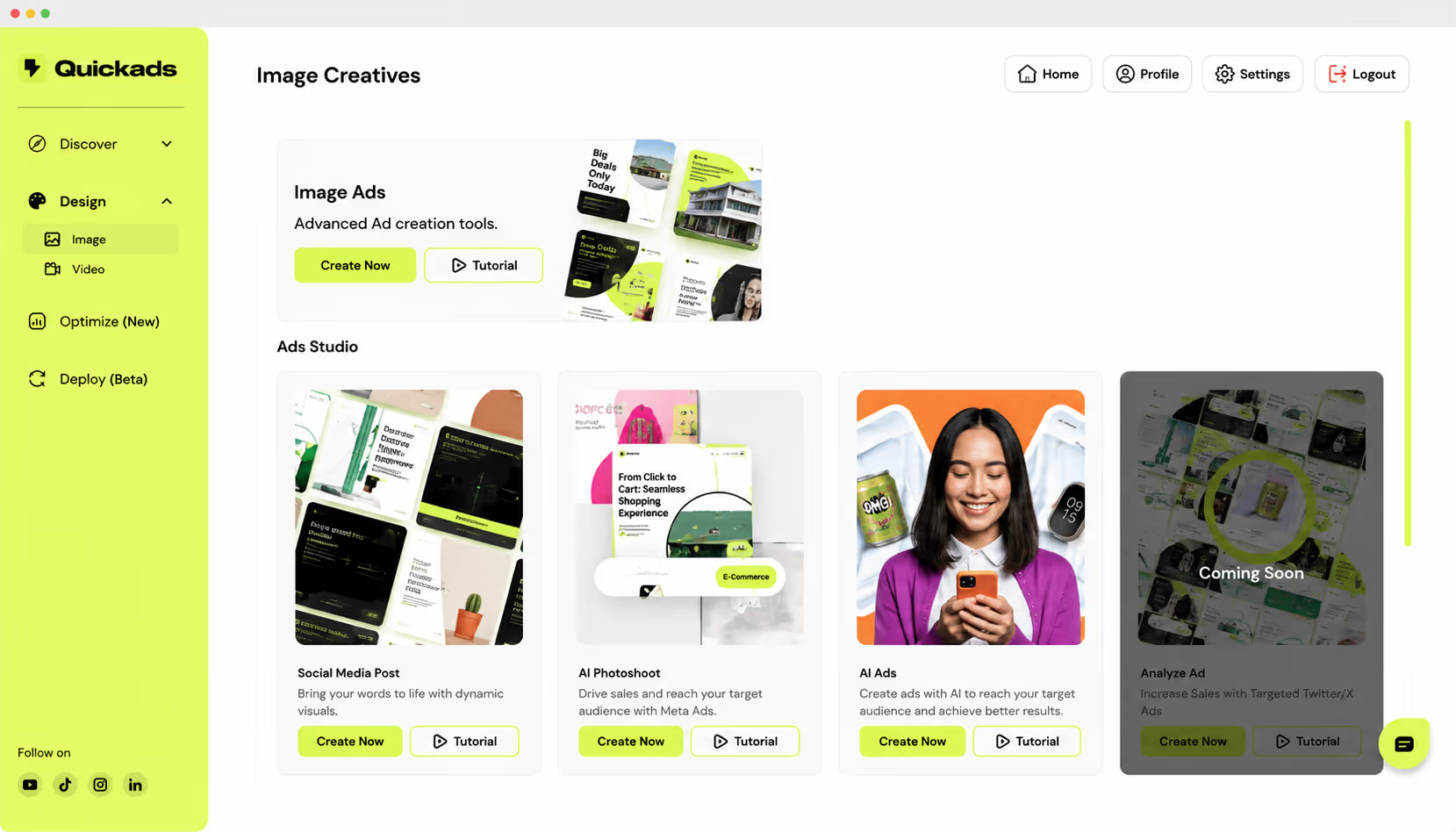
Performance marketers running campaigns across multiple markets already know the creative workflow. They use tools like Quickads to generate multilingual ad variations fast. The ads go live. The copy looks right.
Then the ROAS data comes in, and one market underperforms. It almost never shows up as a translation error in the report. It shows up as a click-through drop, a conversion gap, or an engagement rate that is 30% below the English baseline.
A 2025 Nimdzi report found that brands skipping proper localization of slogans and core messaging lose up to 25% in engagement and conversion rates. That number rarely surfaces in campaign post-mortems, because the error is invisible until it compounds.
Most teams do not have a translation problem. They have a certainty problem. They are not sure which AI output to trust, so they pick one and hope. This article documents what we did when that stopped being good enough.
The 40-page brief: what we were working with
We were preparing a campaign launch for a client entering seven new markets simultaneously: German, French, Spanish, Italian, Polish, Brazilian Portuguese, and Japanese. The brief ran 40 pages. It included legal disclaimers, product descriptions, ad headlines, video scripts, and call-to-action variants.
Each language had a different risk profile. German required precise legal language. Japanese required formal register across all variants. Polish is morphologically complex enough that single AI models routinely produce output that looks plausible but contains register drift that native speakers catch immediately.
We could not send all 40 pages to a human translator for seven languages without a six-week turnaround. We also could not afford to pick a single AI model and ship it without verification. The client was spending real media budget behind this. A mistranslated CTA was not an inconvenience. It was a ROAS problem.
What happened when we ran the brief through single AI models

We ran a test before committing to a workflow. We took the same 500-word product description and ran it through three separate AI models for German and Japanese.
Here is what we found:
- Model A produced fluent German output but shifted the legal disclaimer from passive to active voice, changing the implied liability.
- Model B handled the Japanese formal register correctly in the product description but hallucinated a product feature in the fourth paragraph that was not in the source text.
- Model C produced the most readable output overall but introduced a tone inconsistency between the headline and the body copy in French that would have undermined the brand voice.
None of these failures were obvious without a native reviewer. AccuraCast's testing of multilingual performance campaigns shows that localised product content outperforms direct single-model translations by 20 to 35%. The gap is not in fluency. It is in precision. Machine translation of product titles and ad copy often misses context.
We needed a process that would surface disagreements between models before we committed to an output. Not a human review of every segment. A structural check.
The workflow we built: running models in parallel and surfacing disagreements
We broke the brief into content type segments using a structured marketing campaign tracker, including legal language, product descriptions, ad headlines, and CTA variants. Each type had a different acceptable error threshold.. Legal language required the highest certainty. Ad headlines could tolerate more stylistic variation.
The workflow had four steps:
- Segment the source document by content type and assign a certainty threshold to each category.
- Run each segment through multiple AI models simultaneously and capture all outputs.
- Compare outputs and flag any segment where models produced meaningfully different results. Disagreement was the signal, not a problem to hide.
- For segments with high disagreement or high-stakes content, escalate to a human reviewer with all model outputs visible.
The key insight was that disagreement between models is diagnostic. When two models agree and a third diverges, the majority output is almost always the more reliable one. When all three diverge, that segment needs a human. We stopped thinking about translation as a binary pass-fail and started treating it as a signal-to-noise problem. Documenting those decisions in an AI wiki can give the team a searchable record of approved terminology, review rules, and exceptions for future campaigns.
The outcome: what changed when we stopped guessing
The workflow described above is now automated. We use can AI translator, which compares the outputs of 22 AI models and selects the translation that most of them agree on. That mechanism does the disagreement-surfacing step structurally, without requiring manual comparison across tools.
For the 40-page campaign brief:
- Average translation time per language dropped from two days to under four hours, including the escalation review for flagged segments.
- Critical errors, defined as outputs that would have changed the legal meaning or product claim, were reduced to under 2% of all segments.
- All seven language variants passed native speaker review without structural revision requests. Style edits were made, but no segment required a full retranslation.
The moment you treat model disagreement as a quality signal rather than a nuisance, the translation workflow becomes a risk management system. That is the shift that changes what you can ship with confidence. -- Ofer Tirosh, CEO of Tomedes
What this means for performance marketers running multilingual campaigns
If you are using an AI ad platform to generate multilingual creative at scale, the creative generation is probably not your bottleneck. The bottleneck is confidence in the output. Teams slow down at the review stage, or they skip it and absorb the conversion loss downstream.
The workflow above addresses that bottleneck structurally. Instead of asking which model to trust, you ask which segments have enough model disagreement to warrant a second look. That is a much faster question to answer, and it concentrates human review exactly where it is needed.
For teams already using Quickads for international advertising across multiple markets, pairing fast AI-generated creative with a structured translation verification layer is the most direct path to closing the ROAS gap between your best-performing language and your worst.
The creative does not fail because the design is wrong. It fails because a word in the third line means something different in Polish than it does in English. That is a solvable problem, and the solution is not more human translators. It is a smarter process for knowing when to use them.
For a deeper look at building multilingual campaign strategy that compounds ROAS across markets, the frameworks apply well beyond translation and into localisation of every campaign element, including visual assets, CTAs, and landing page copy.








La confidentialité est importante pour nous. Vous avez donc la possibilité de désactiver certains types de stockage qui peuvent ne pas être nécessaires au fonctionnement de base du site Web. Le blocage des catégories peut avoir un impact sur votre expérience sur le site Web. Plus d'informations


