
Checkout Optimization: 9 Techniques to Reduce Cart Abandonment
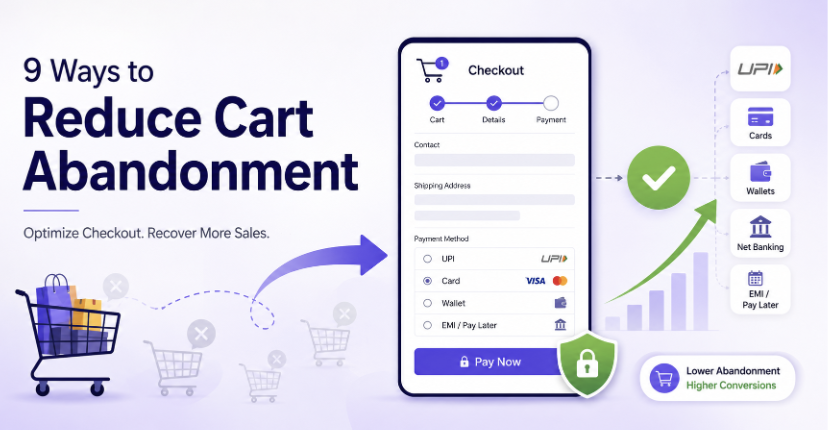
Roughly 7 in 10 online shoppers fill a cart and walk away. Across multiple studies, the average documented cart abandonment rate sits at around 70%, and on mobile it climbs even higher. For most businesses, this represents one of the largest sources of lost revenue and much of it can be recovered without increasing acquisition spend.
The good news is that abandonment is rarely about pricing or lack of purchase intent. More often, it is the result of friction during checkout. Research suggests that ecommerce businesses can significantly improve conversions through better checkout design and payment experiences alone.
This guide breaks down nine checkout optimization techniques that help reduce cart abandonment and improve checkout conversion rates.
TL;DR
- Cart abandonment averages around 70% across ecommerce websites.
- Unexpected costs, long forms, payment failures, and forced account creation are among the biggest abandonment drivers.
- Simplifying checkout and reducing friction can significantly improve conversions.
- One-click checkout, guest checkout, and mobile optimization are among the highest-impact improvements.
- Payment success rates are just as important as checkout design when optimizing conversions.
Why Shoppers Abandon Carts at Checkout
Before improving checkout performance, it helps to understand why customers leave.
The most commonly cited reasons for cart abandonment include:
- Unexpected extra costs such as shipping, taxes, or fees
- Being forced to create an account before purchasing
- Long or complicated checkout forms
- Missing payment options
- Payment failures or transaction timeouts
- Concerns about payment security
Notice that most of these issues are operational rather than motivational. The shopper already intended to buy. The checkout experience introduced friction.
Mobile commerce continues to grow, making mobile checkout optimization essential. Businesses investing in online jewelry store development should prioritize a seamless mobile experience, as customers often browse product catalogs, compare high-value items, and complete purchases on their smartphones. A fast, intuitive, and mobile-friendly checkout reduces friction, builds trust, and encourages shoppers to complete their purchases.
Many ecommerce checkouts still contain more than 20 form elements when a streamlined checkout often requires far fewer. Every additional step creates another opportunity for drop-off," Michael Salvaggio, founder of SEO Brand.
9 Checkout Optimization Techniques That Reduce Cart Abandonment
1. Shorten the Checkout Form
Every field you remove improves the likelihood of completion.
Collect only the information required to process the order and shipment. Use auto-fill wherever possible and replace multiple fields with single fields when practical.
For example:
- Use a single full-name field
- Auto-detect city and state from PIN code
- Enable address auto-completion
- Default billing address to shipping address
The goal is to make checkout feel effortless.
2. Offer Guest Checkout
Forced account creation remains one of the most common reasons shoppers abandon a purchase.
"Allow customers to complete their purchase as guests and offer account creation after checkout. This preserves convenience while still creating opportunities for customer retention" says Alex Tkacovs, founder of 94n Digital.
A completed order is more valuable than a forced registration.
3. Show All Costs Upfront
Unexpected costs are consistently the biggest abandonment trigger.
Display:
- Shipping charges
- Taxes
- Handling fees
- Delivery charges
as early as possible in the buying journey.
When customers understand the final amount before entering checkout, they are less likely to abandon the purchase.
4. Add One-Click Checkout for Returning Customers
Returning customers should not have to repeat the same checkout process every time.
One-click checkout solutions securely store payment and address information using tokenization, allowing repeat shoppers to complete purchases significantly faster.
Benefits include:
- Reduced checkout time
- Fewer form fields
- Faster repeat purchases
- Improved conversion rates
"For businesses with high repeat purchase behavior, this can be one of the most impactful checkout optimizations,"" says Michael Salvaggio, founder of SEO Brand. While enterprise SEO services help drive qualified traffic that increases repeat purchases and long-term revenue growth.
5. Offer Multiple Payment Methods
A missing payment option can result in immediate abandonment.
In India, customers expect flexibility, including:
- UPI
- Credit cards
- Debit cards
- Net banking
- Wallets
- EMI options
- Buy Now Pay Later services
Offering a broad range of payment methods ensures customers can complete transactions using their preferred option. The same principle applies to lending and financing products: teams researching how to create money lending app need to think carefully about repayment flows, payment reminders, transaction status, and user trust from the beginning.
6. Improve Payment Success Rates
A beautifully designed checkout is ineffective if transactions fail.
Payment success rates directly affect revenue because every failed transaction represents a customer who was ready to pay. A unified commerce ecosystem can help teams connect storefront, product, and checkout systems before friction reaches the payment stage.
Businesses should focus on:
- Reliable payment infrastructure
- Smart routing
- Retry mechanisms
- High gateway uptime
- Real-time transaction monitoring
Even small improvements in payment success rates can translate into meaningful revenue gains.
7. Design for Mobile First
Mobile commerce continues to grow, making mobile checkout optimization essential.
Key improvements include:
- Large tap targets
- Mobile-friendly form fields
- Numeric keyboards for OTP and card inputs
- Fast page loading
- UPI intent flows that open payment apps directly
Test the complete payment journey on real devices, not just desktop browsers.
8. Simplify Repeat and Subscription Payments
For recurring purchases, asking customers to manually pay each cycle introduces unnecessary friction.
Automated recurring payment solutions help businesses:
- Reduce missed payments
- Improve retention
- Eliminate repeat checkout steps
- Create a smoother customer experience
This is particularly valuable for subscriptions, memberships, and recurring services.
Vertical SaaS businesses can further reduce friction by consolidating checkout, tokenization, and recurring billing within a unified payments framework. Providers such as Xplor Pay or Rainforest Pay help streamline recurring payments and support a consistent customer experience.
9. Recover Abandoned Carts
Even optimized checkouts lose some customers.
A structured cart recovery strategy can recover a meaningful percentage of abandoned purchases.
Best practices include:
- Sending reminders within one hour
- Using email and WhatsApp cart recovery
- Including a direct link back to checkout
- Pre-filling customer information where possible
The faster the recovery attempt, the higher the likelihood of conversion.
Quick Reference: Friction vs Fix
Abandonment Cause
Checkout Optimization Fix
Unexpected costs
Show shipping, taxes, and fees early
Forced account creation
Enable guest checkout
Long forms
Reduce fields and use auto-fill
Slow checkout
Use one-click checkout
Missing payment methods
Offer multiple payment options
Payment failures
Improve payment success rates
Mobile friction
Design mobile-first experiences
Repeat-purchase drop-off
Enable recurring payment options
How to Measure Checkout Optimization Success
Track the following metrics before and after making changes:
Cart Abandonment Rate
The percentage of shoppers who add items to a cart but do not complete the purchase.
Checkout Completion Rate
The percentage of users who start checkout and successfully complete payment.
Payment Success Rate
Approved transactions divided by attempted transactions.
Average Checkout Time
The time required to move from cart to confirmation page.
Prepaid Share
The percentage of prepaid orders compared to total orders.
Measure one change at a time whenever possible and use A/B testing to understand what truly improves performance.
Conclusion
Cart abandonment is not an unavoidable cost of ecommerce—it is one of the biggest opportunities for growth.
By shortening forms, offering guest checkout, displaying costs upfront, supporting multiple payment methods, improving payment success rates, and optimizing for mobile users, businesses can remove friction and improve conversions.
Small improvements across the checkout journey compound quickly. When applied consistently, checkout optimization can turn lost opportunities into measurable revenue growth.
FAQs
What is a good cart abandonment rate?
Cart abandonment rates vary by industry, but the ecommerce average is generally around 70%. Rates significantly below that benchmark are considered strong.
Does one-click checkout reduce cart abandonment?
Yes. By reducing the number of steps required to complete a purchase, one-click checkout removes friction and improves conversion rates, particularly for returning customers.
What is the biggest cause of cart abandonment?
Unexpected costs such as shipping fees, taxes, and additional charges remain the most commonly cited reason shoppers abandon their carts.
How important are payment options?
Very important. Customers often have strong payment preferences, and a missing payment method can lead to immediate abandonment.
When should cart recovery messages be sent?
The first recovery message is most effective when sent within the first hour after abandonment.
Why does payment success rate matter?
A failed payment is effectively a lost sale. Improving payment success rates directly increases revenue without requiring additional traffic.








La confidentialité est importante pour nous. Vous avez donc la possibilité de désactiver certains types de stockage qui peuvent ne pas être nécessaires au fonctionnement de base du site Web. Le blocage des catégories peut avoir un impact sur votre expérience sur le site Web. Plus d'informations


