 V/S
V/S
Penji caps concurrency. We ship volume.
Penji caps you at two active workstreams for $995 a month. We ship 1,200+ ad creatives a week.
V/SPenji caps you at two active workstreams for $995 a month. We ship 1,200+ ad creatives a week.
Penji is a flat-rate design subscription with unlimited requests, published from $995 a month. Quickads sells performance creative as a service: intelligence, strategy, production, influencer marketing and campaign management. The deciding difference is what gets metered. Penji meters how many projects run at once. Quickads meters output.

Entry price
Software from $299/mo; managed from $5,000/mo
$995/mo (Marketing & Ads), published
Published weekly output
1,200+ creatives a week
None published; 2 to 4 active workstreams
Creative intelligence
Computer-vision models trained on 32M+ ads
No ad performance reporting published
Creative strategy
Quickads owns angles and concepts
Locked at $995; 'Light planning support' at $1,995
Campaign management
Included: media buying and optimization
Not in the published scope
Commitment
6-month minimum on the productized plan
No contracts, cancel anytime, 30-day guarantee
Penji is good at what it sells. Three prices sit on a public page with no quote gate. The scope list runs to over 120+ design services and names the exclusions. Designers are full-time employees across 20+ countries, an Art Director sits on every tier, and standard design comes back in a business day.
Quickads covers five links with one team: creative intelligence, creative strategy, creative production, influencer marketing at scale and campaign management. Computer-vision models trained on 32M+ ads read the account, strategists set the angle, and the batch ships at 1,200+ creatives a week on a 5 to 7 day cycle. Software from $299/mo, managed from $5,000/mo.
Ad performance reporting
You find out which creative earned its impressions before you brief the next round.
Ad-account data read into every batch
None published on any Penji page
Creative analysis model
Pattern evidence replaces taste arguments when you pick what to make more of.
Computer vision trained on 32M+ ads
None published
Iteration on winners
Spend compounds behind proven angles instead of restarting every month.
Winners re-cut into the next batch
Brief-in, asset-out queue
Who decides the angle
Your marketer stops being the bottleneck on every new concept.
Quickads strategists own it
You write the briefs (Creative Access)
Strategy on the entry plan
Strategy at the price you actually buy at, not two tiers up.
Included in the managed pod
Strategic planning locked on the $995 plan
Ad copy, hooks and scripts
Copy and visual get built as one idea rather than sourced separately.
Written in-house with the creative
Excluded: 'We don't do... Content writing'
Static ad creative
Both deliver here. Static design is table stakes for either vendor.
Yes, at batch volume
Yes, across 120+ design services
Video and motion on the entry plan
Short-form video is most of paid social now, so an entry-tier lock costs you formats.
Included
Locked on the $995 Marketing & Ads plan
Catalog and SKU volume creative
Large retail catalogs get covered without a per-SKU design ticket.
Enriched Catalog for hundreds of SKUs
No catalog or SKU-feed item published
Claims-safe creative for regulated categories
Supplements, skincare, health and finance ads clear review without a rebuild.
Claims-Safe Volume Creative product
No claims-review process published
Influencer creative at scale
UGC-style assets come from the same partner as the studio work.
In scope as a named service line
Not in the published scope
Published weekly volume
You can size a media test against a number instead of an allowance.
1,200+ creatives a week
No monthly volume figure published
Capacity model
Filing more requests does not move a concurrency ceiling.
Weekly output commitment
2 to 4 concurrent workstreams
Unit of the published speed promise
Different units. Penji times one project, Quickads times a whole batch of concepts and variants, so this is not a head-to-head speed race.
Per batch: 5 to 7 days for the round
Per project: 1 business day (pages conflict)
Time-sensitive work
Launch dates and offer windows are the whole job in paid media.
Built for paid-social cadence
ToS §4.1: avoid time-sensitive projects
Entry price
Penji is cheaper to start; Quickads self-serve is cheaper still if you drive it.
Software from $299/mo
$995/mo (Marketing & Ads)
Top managed tier
Similar money, different purchase: a design pod versus the full creative chain.
Managed from $5,000/mo
Creative Team from $4,500/mo
Price visible without a call
Penji wins here. You can budget straight off the page.
Software pricing published
All three tiers published, no quote gate
Media buying
One team owns what runs and what it costs to run it.
Campaign management included in scope
Not in the published scope
Budget pacing and optimization
Creative and spend decisions stop living with two different vendors.
Managed alongside the creative
Not published
1
Their limit
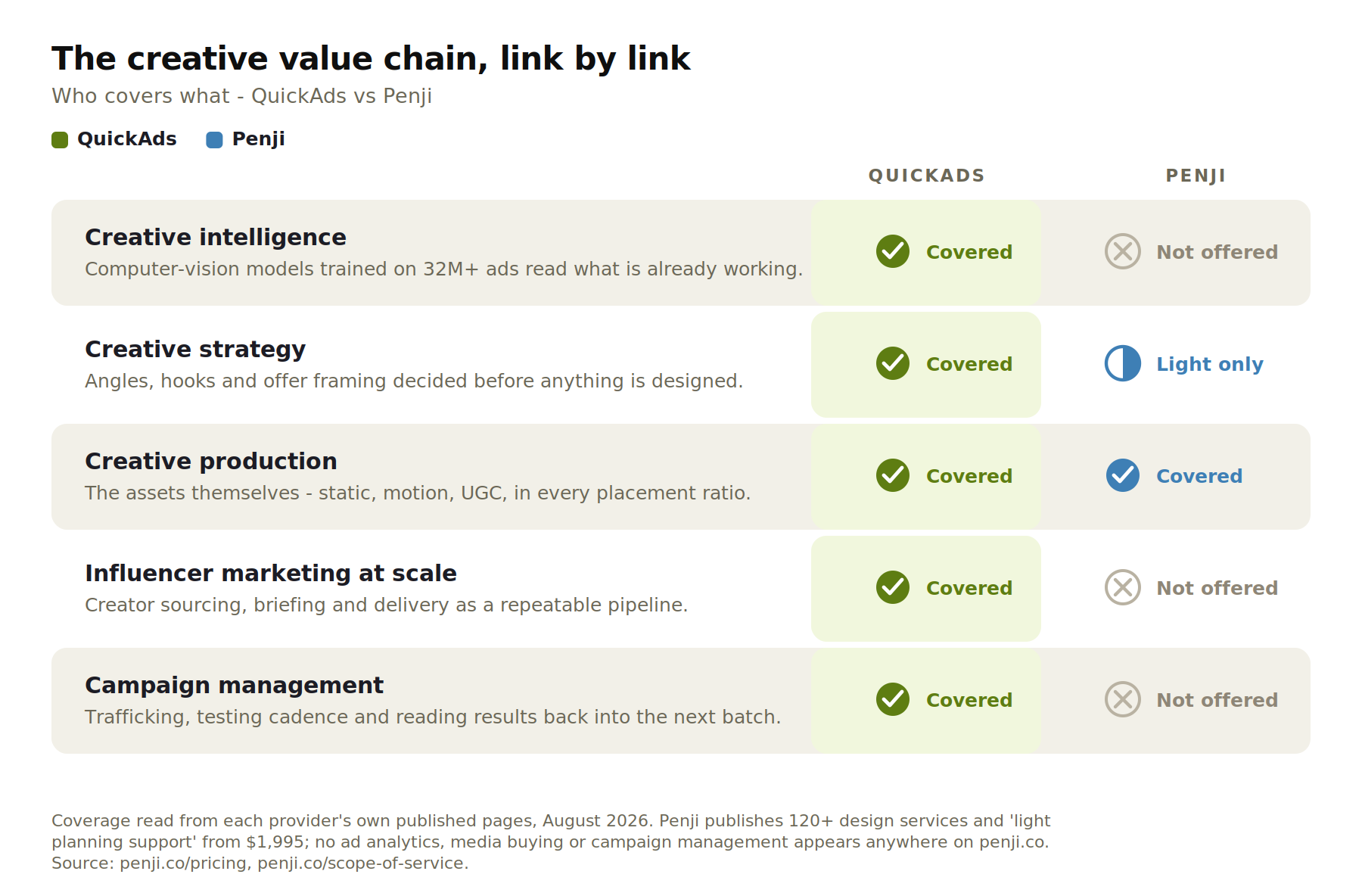
Penji covers one link, and covers it broadly. Production: "Over 120+ design services covered!" across advertisements, branding, social, print, illustration and UX, with video and motion sold through the plan sheet. The other four links are absent from Penji's published offer. No ad performance reporting appears on its pricing, homepage, how-it-works, agencies or scope pages. "Strategic planning" is locked on the $995 plan and reads "Light planning support" at $1,995. Media buying and influencer production appear nowhere in the published scope, and copywriting is an explicit exclusion.
QuickAds advantage
Quickads covers all five links: creative intelligence, creative strategy, creative production, influencer marketing at scale, and campaign management. That is the whole loop, under one contract. Ad data goes in, computer-vision models trained on 32M+ ads and a human strategist decide what to make next, production ships the batch inside 5 to 7 days, and the campaign team runs the spend behind it. The operating line is "AI handles form, humans own substance." Buy it as software from $299 a month, or as a managed pod from $5,000.
You stop stitching four vendors together to get one working creative loop.
2
Their limit
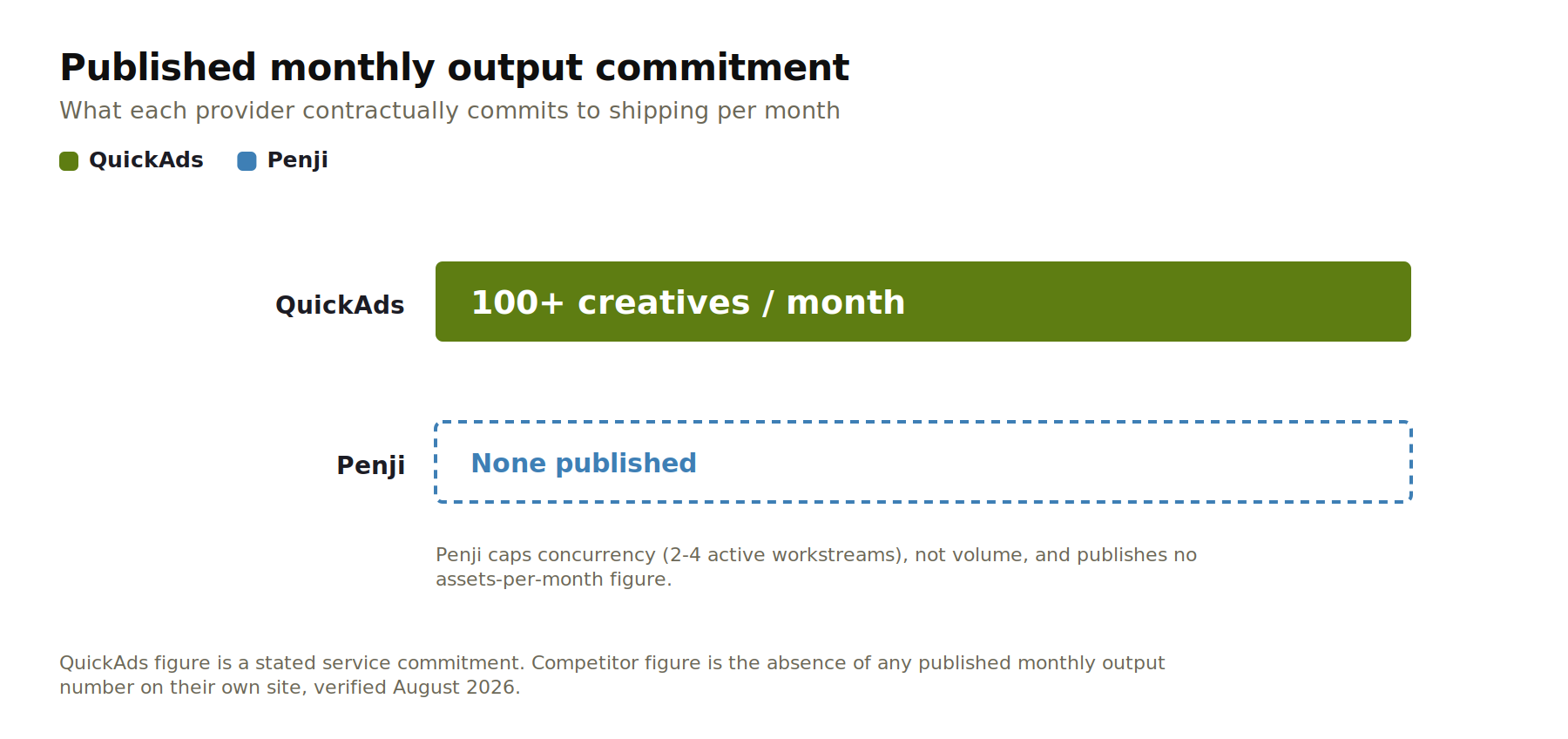
Penji sells unlimited requests, not a volume. Terms of Service §4.1 states: "While we accept unlimited requests and revisions, our output volume depends on many factors, namely on the total request volume and complexity," and adds "we suggest you do not use our Services for time-sensitive projects." Nothing on penji.co publishes an assets-per-month number, a variants-per-concept number, or a concepts-per-week number, and no SLA, penalty or service credit for a missed turnaround is published either. So the volume of ad creative arriving in a given month is not something the published terms let you plan.
QuickAds advantage
Quickads publishes the number. 1,200+ creatives a week, with each batch turning around in 5 to 7 days. That is a capacity commitment rather than a request allowance, which is the unit a paid-media buyer actually plans against: how many concepts and variants land in the account this month, and when. Volume at that level is what makes a real creative test possible, because a handful of assets a month cannot tell you which angle is working. It runs at roughly half the cost of building the same capacity in-house.
Your media plan gets a number to build on instead of a queue position.
3
Their limit
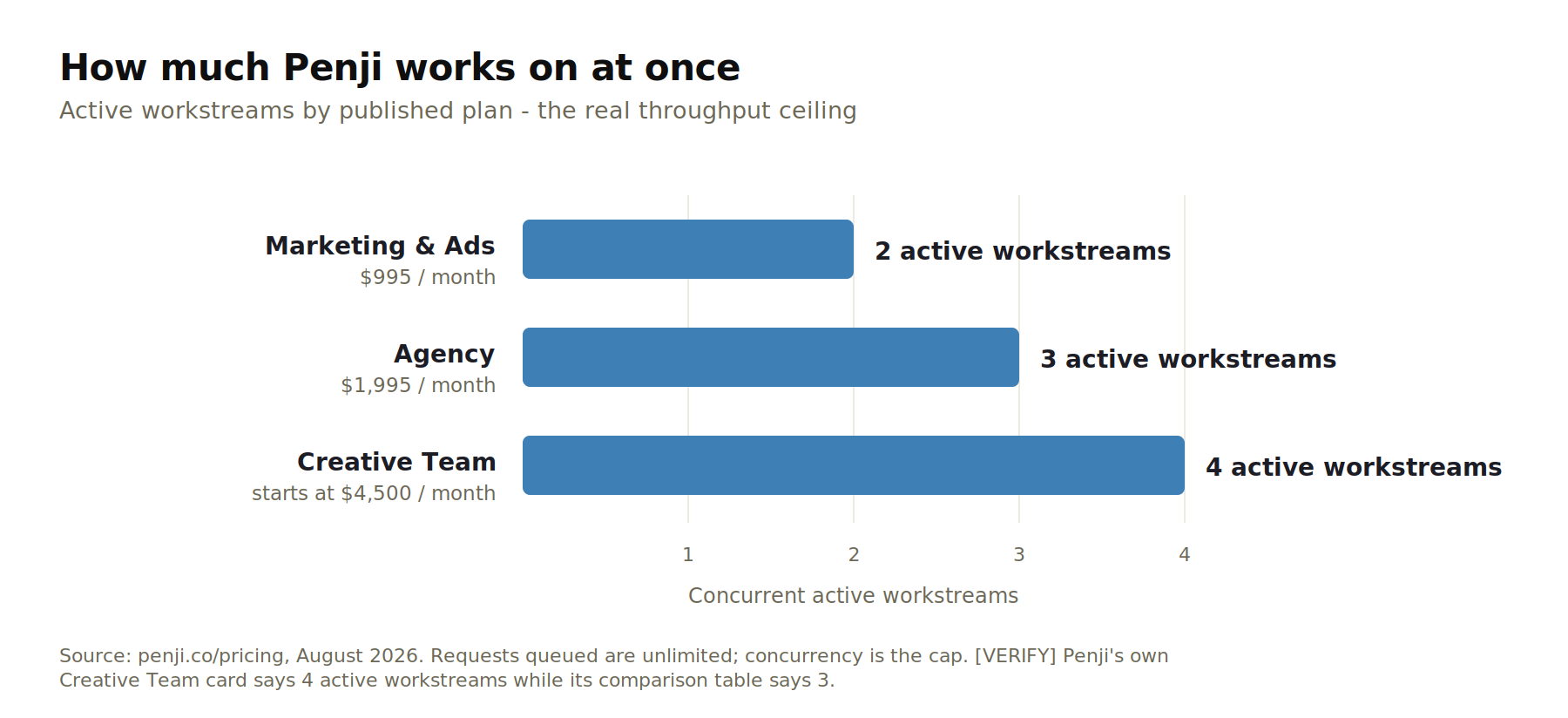
Penji's throughput is capped by how many projects run at once: "2 active workstreams" at $995 and "3 active workstreams" at $1,995. At $4,500 the pricing page contradicts itself, showing "4 active workstreams" on the plan card and "3 active workstreams" in the comparison table on the same page (as published on penji.co/pricing, 12 August 2026). The pricing FAQ is explicit about the mechanic: "You can queue as many projects as you want — no limits. We actively work on 2 at a time." Queue depth is unlimited. Parallel capacity is two to four.
QuickAds advantage
Quickads sizes capacity to the ad account, not to a seat count. The commitment is 1,200+ creatives a week across concepts and their variants, delivered in batches on a 5 to 7 day cycle, with strategy and ad data attached to every round. There is no active-project counter to manage and no queue to reorder, because the unit being bought is weekly output rather than concurrent slots. For catalog-heavy advertisers, Enriched Catalog handles hundreds of SKUs. For regulated categories, Claims-Safe Volume Creative carries the review load.
Going from 10 assets a month to 100 stops being a plan upgrade you have to buy your way into.
Choose Penji if design is the job. A logo, packaging, a pitch deck and steady brand design belong in a design queue. The buyer it fits is a marketing manager at a single-brand business with occasional ad creative, an in-house strategist and a designer's worth of work each week.
Choose Quickads if paid media is the job: real spend, 1,200+ creatives a week rather than a handful, and the angle decided for you. BAU design goes to Penji, paid-social volume goes to Quickads.
Penji is a flat-rate creative subscription run by Waterfront Media, LLC. Clients queue unlimited design requests through Penji's own platform, and a set number run at once, with published pricing at $995, $1,995 and $4,500 a month. Penji describes itself as "Like a full-service creative agency, at a fraction of the cost," covering "Over 120+ design services" delivered by full-time employed designers across 20+ countries.
Penji publishes a four-step process. You fill out a form describing the design need and can create multiple projects to form a queue. Penji's AI matches each project to a designer. You leave revisions with a point-and-click tool directly on the design. You download high-res files including source files, and the next project in the queue starts the same day. Your plan tier decides how many run in parallel.
Penji publishes no per-month figure. The published limit is concurrency, not volume: 2 active workstreams on the $995 plan and 3 on the $1,995 plan, with the $4,500 tier shown as 4 on the plan card and 3 in the comparison table on the same page. Requests are unlimited, but no assets-per-month, variants-per-concept or concepts-per-week number appears anywhere on penji.co. Quickads publishes 1,200+ creatives a week.
It depends on the job. For brand and business-as-usual design work, Penji is strong and its published scope is hard to beat at $995 a month. If the work is paid-social ad creative at volume, a Penji alternative that also covers creative intelligence, strategy and campaign management fits better. Quickads is built for that case, with 1,200+ creatives a week on a 5 to 7 day batch turnaround.
Penji publishes three monthly prices: $995 for Marketing & Ads, $1,995 for Agency, and $4,500 for Creative Team, which the pricing comparison table lists as "Starts at $4,500 /month." A billing toggle offers quarterly at 15% off and yearly at 20% off, but those discounted totals are calculated in the browser and are not published as text, so no annual dollar figure exists on the page.
Not on the lower plans. Penji's pricing FAQ answers directly: "Not guaranteed, but you can request a favorite through your Project Manager and we'll assign them as often as possible. For a fully dedicated, locked-in designer — that's Creative Team." The $995 card lists "Best Assigned Creatives," the $1,995 card lists "Same Assigned Creatives," and a locked-in designer sits at the $4,500 tier.
The Core Difference

You get a fast video. The angle is still your problem.
Creatify turns a product URL into a finished short-form video fast — script, AI avatar, voiceover, 75+ languages, and a batch mode for variations. But it starts after the hard question: deciding what to make. Its ad intelligence and competitor tracking sit on higher plans, and its focus is short-form video, not static or image ads.
You see the whole market. Then you build the ad.
QuickAds discovers what is already winning across five ad platforms, scores every creative on hook, message, quality, and performance before you spend, then builds the ad — image, video, or UGC — and publishes it in one click. One platform for the whole loop. No gaps.
The Bottom Line
How Each One Works
URLAI avatar videoExport adDiscoverScoreCreatePublish