 V/S
V/S
99designs picks one. We ship many.
99designs ends a contest with one winner. We ship 1,200+ ad creatives a week, then do it again.
V/S99designs ends a contest with one winner. We ship 1,200+ ad creatives a week, then do it again.
Quickads sells performance creative as a service, covering intelligence, strategy, production, influencer marketing and campaign management. 99designs sells crowdsourced design contests: freelance designers compete on a fixed-price brief and one design wins. The deciding difference is volume. A contest ends with a single file. Quickads ships 1,200+ creatives a week.

What you're buying
Performance creative, end to end
Freelance graphic design, per project
Weekly output
1,200+ creatives a week
No published monthly allowance
Turnaround
5 to 7 days
No committed delivery SLA published
Video and motion
Included in production
Animated GIF banner ads only
Ad performance data
Models trained on 32M+ ads
Not offered
Entry price
Software $299/mo; managed $5,000/mo
Banner contest US$49; logo contest US$249
99designs is owned by Vista. Its contest model does something no studio can: for one fixed price, designers who have never met submit competing concepts side by side. A banner contest starts at US$49, a logo at US$249, both under a 60-day money-back guarantee with full copyright on completion. Seven category groups, from identity to packaging and book covers.
Quickads holds five links at once: creative intelligence, strategy, production, influencer marketing and campaign management. Computer-vision models trained on 32M+ ads read the category before anyone writes a brief, and a human strategist signs the angle off. Batches land every 5 to 7 days, 1,200+ creatives a week. Self-serve runs $299 a month; the managed pod starts at $5,000.
Ad performance analysis
Your next batch is briefed by what already worked, not by taste.
Computer vision trained on 32M+ ads
No performance layer on any published page
Learning from live spend
Patterns come from money actually spent, not from a mood board.
$200M+ in ad spend managed
No ad account access or reporting
Feedback loop into batch two
You stop paying to re-learn the same lesson every quarter.
Built into the workflow
Contest ends when files are handed over
Who writes the brief
The hardest part of ad creative stops being your homework.
Quickads strategists, with you
You do - the process starts with your brief
Angle and messaging development
Someone is accountable for what the ad says, not just how it looks.
Included in the service
Not a published service
Test design across variants
You learn which hook worked instead of which design you liked.
Planned as a variant matrix
Concepts compete, one wins
Static ad creative
Both cover statics; only one covers them at paid-social volume.
Yes, at volume
Yes, by contest or 1-to-1 hire
Video and motion for paid social
Feed placements that need motion do not need a second vendor.
Yes, part of production
No video or motion category published
Creator and UGC content
Creator-led angles ship in the same batch as the statics.
Influencer marketing at scale
Not offered
Brand, print and packaging design
Be honest about it: for a logo or packaging, buy from them.
Not our focus
Seven category groups, deep coverage
Iterating on a winning ad
The winner becomes the starting point instead of the end point.
Core of the workflow
No contractual revision allowance published
Weekly output commitment
You can plan a media calendar against a number.
1,200+ creatives a week
None published
Turnaround
Creative cadence keeps up with how fast paid social fatigues.
5 to 7 days
No committed delivery SLA published
Scaling to 100 assets a month
Scaling volume does not multiply your vendor admin.
What the model is built for
Means running many paid contests at once
Who is on the work
Knowledge of your ad account accumulates instead of resetting.
Standing pod of AI agents plus experts
Whoever enters that contest
Entry price
Small one-off jobs are cheaper there; sustained volume is not.
Software from $299/mo
Banner ad contest from US$49
Managed engagement
You know the annual number before you commit.
From $5,000/mo, 6-month minimum term
No published managed retainer pricing
Spend-linked plan
Creative budget scales with media budget, not with headcount.
5% of ad spend, $5,000/mo minimum
Pay-per-contest only
Risk on a first purchase
Their guarantee is real; try a contest before you commit to one.
Self-serve platform from $299/mo
60-day money-back guarantee, full copyright
Media buying and trafficking
Assets land in the ad account instead of in a shared drive.
Included in managed plans
Not offered
1
Their limit
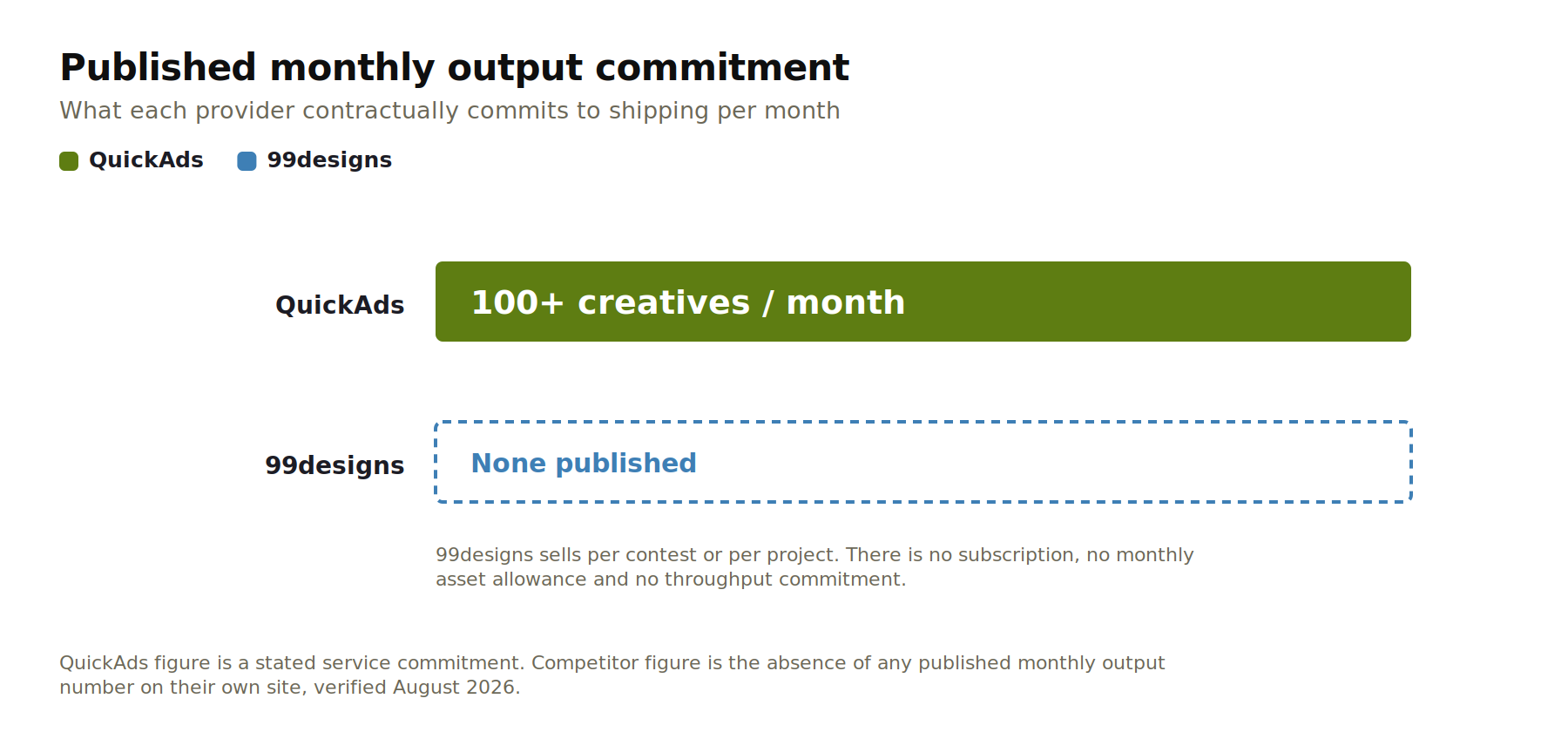
99designs covers one link of the chain: production. The published process starts with the brief you write, designers submit against it, you pick a winner, and files arrive with full copyright, all yours (99designs, how it works). No creative strategy service appears anywhere on the site. No ad performance measurement appears on the categories, pricing, how-it-works or Pro pages. Nothing connects the output to Meta, TikTok or Google, so trafficking and spend stay entirely with you. That is not a flaw in the marketplace. It is what a marketplace is.
QuickAds advantage
Quickads covers all five links: creative intelligence, creative strategy, creative production, influencer marketing at scale, and campaign management. Computer-vision models trained on 32M+ ads inform the brief instead of waiting for you to write it. Strategists set the angle. Production ships 1,200+ creatives a week on a 5 to 7 day turnaround. Campaign management puts the work into the ad account and reads what came back, so batch two is built on evidence from batch one rather than on preference. AI handles form, humans own substance. See what Quickads runs end to end.
You stop being the strategist, the project manager and the analyst between four vendors.
2
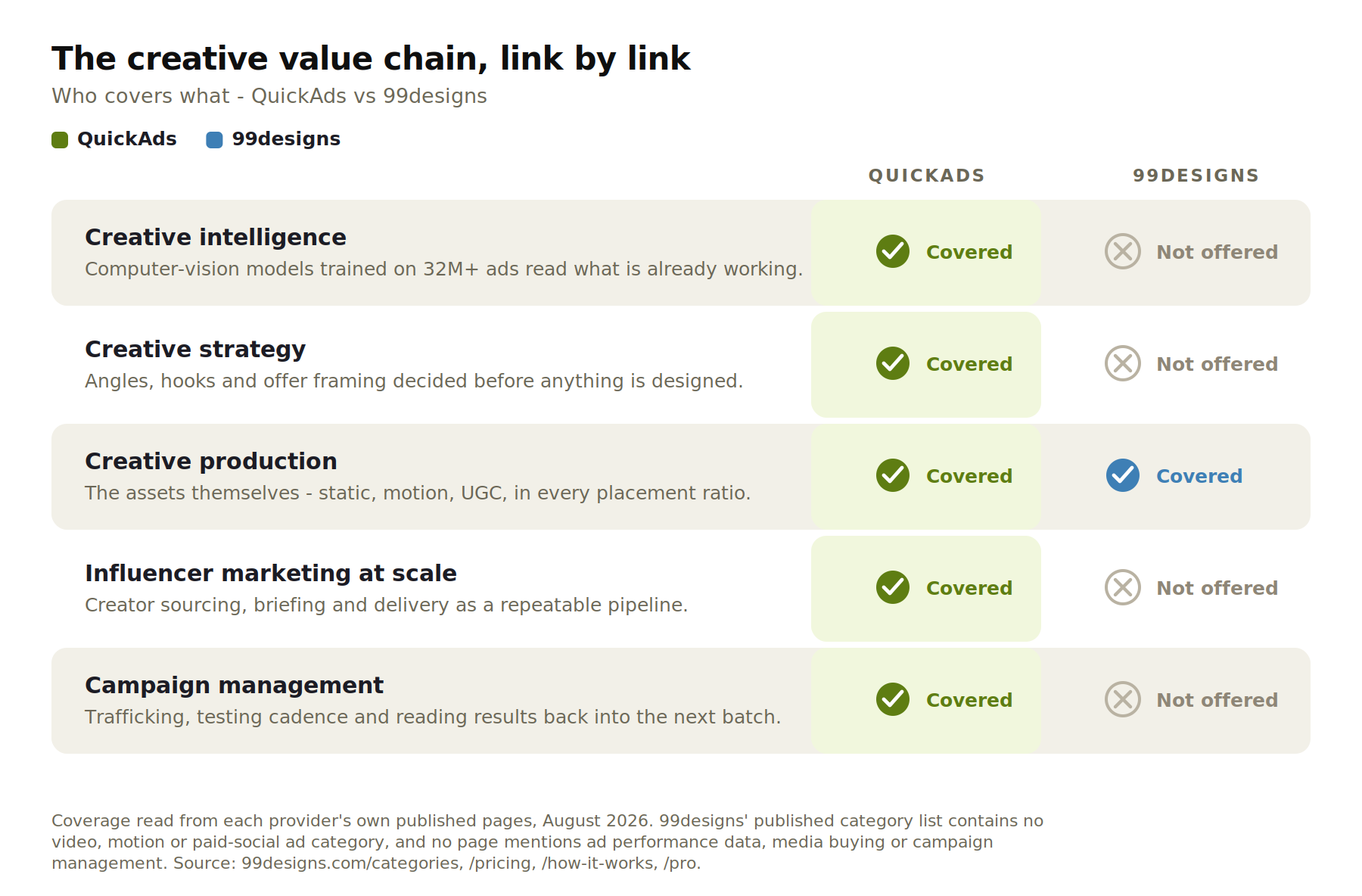
Their limit
99designs publishes no monthly output commitment. There is no subscription, no asset allowance and no throughput number anywhere on its pricing page or homepage; the only recurring construct on the site is 99designs Pro, a $500 annual membership for tooling and support that explicitly does not include design work (99designs Pro). Volume is bounded by the package you buy for one brief, concurrency is however many contests you choose to pay for at once, and a second batch means launching and paying for a second contest.
QuickAds advantage
Quickads commits to 1,200+ creatives a week on a 5 to 7 day turnaround, and the whole service is built around that number. Paid social burns creative fast, and you cannot learn much from three assets. The self-serve platform starts at $299/mo, the managed pod at $5,000/mo, and the productised plan runs at 5% of ad spend with a $5,000/mo minimum on a 6-month term. Roughly half the cost of building the same capacity in-house. None of it depends on which freelancer happens to be free this week. See Quickads pricing.
Creative volume becomes a line on the plan rather than a purchase you re-argue every month.
3
Their limit
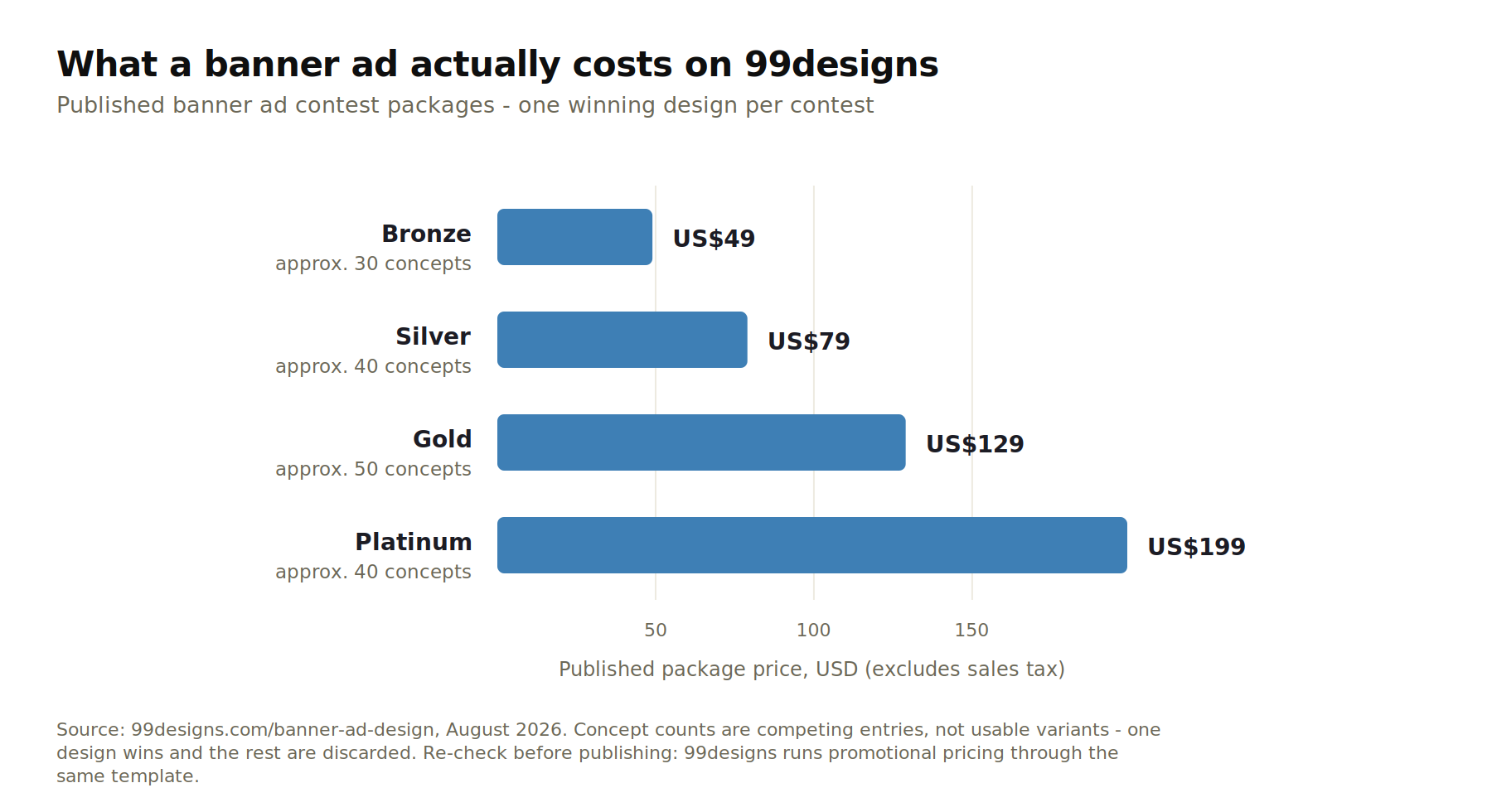
Banner ad contests are priced Bronze US$49, Silver US$79, Gold US$129 and Platinum US$199, with approximately 30, 40, 50 and 40 design concepts respectively (99designs banner ad design). One design wins. The rest are competing entries rather than a coordinated test matrix, and 99designs notes that if a contest is refunded you are not legally entitled to use any of the designs submitted. Concept count and usable variant count are different numbers, and only the second one reaches an ad account.
QuickAds advantage
Quickads builds variants as a matrix, not a competition. One angle becomes many executions across hooks, formats and placements, all of them yours to run, all of them tagged so the next batch knows which hook held attention. That is why the unit we quote is 1,200+ creatives a week rather than concepts per brief. Static, video and motion, and creator-led content come out of the same pod on the same 5 to 7 day turnaround, which is the part a per-contest purchase cannot reach.
You buy running variants instead of a shortlist you have to pick one thing from.
Brand assets bought once go to 99designs. Ad creative bought every week goes to Quickads. Plenty of teams run both, from separate budget lines.
99designs is right for a founder or brand manager buying one identity project: a logo, packaging, a book cover. Pay once, see many directions, own the copyright. Go to Quickads when the buy repeats weekly, when feeds need motion as well as static, and when someone has to own the angle.
99designs is a crowdsourced graphic design marketplace, founded in 2008 and owned by Vista. Businesses either run a fixed-price design contest that many freelance designers compete in, or hire a single designer directly for a quoted project. Its published categories are static design work: logo and identity, web and app, business and advertising, clothing and merchandise, art and illustration, packaging and label, and book and magazine. Copyright transfers to the client on completion.
Two paths, both paid per project. In a contest you write a brief and pay a fixed package price up front, the designer community submits competing concepts, you select one winner, then work with that designer to refine and finalise the files. In a 1-to-1 project you review portfolios across what 99designs calls design experts in over 90 skill sets, request quotes, and release payment on completion. There is no subscription in either path.
For brand and print design bought occasionally, yes. Seeing 30 to 50 independent concepts for one fixed price is a genuinely good way to explore a visual direction you have not settled on, and the 60-day money-back guarantee on contests limits the downside. For ad creative at volume the case is harder: no monthly output commitment, no published video or motion category, and no ad performance layer informing the next batch.
Prices are per project and scoped by category. Banner ad contests are US$49 Bronze, US$79 Silver, US$129 Gold and US$199 Platinum. Logo design contests are US$249, US$399, US$799 and US$1,050 on the logo pricing page, and social media packs start from $399. 99designs Pro is a separate $500 annual membership covering tooling and support only, with design work quoted or priced per contest on top. 1-to-1 projects publish no rate card.
99designs publishes no numeric revision allowance. Revisions before selection happen inside the contest rounds, and after you pick a winner you work with that designer to refine and finalise the design. Beyond that there is no contractual revision count on any published page, so agree scope with the designer before choosing them.
Yes. 99designs has operated since 2008, is owned by Vista, and reports on its own about page more than one million creative projects completed and more than $300m earned by its creator community. Payment is secured up front and released on completion, logo and banner ad contests carry a 100% money-back guarantee within 60 days of payment with stated exceptions, and full copyright transfers to you when the work is done.
The Core Difference

You get a fast video. The angle is still your problem.
Creatify turns a product URL into a finished short-form video fast — script, AI avatar, voiceover, 75+ languages, and a batch mode for variations. But it starts after the hard question: deciding what to make. Its ad intelligence and competitor tracking sit on higher plans, and its focus is short-form video, not static or image ads.
You see the whole market. Then you build the ad.
QuickAds discovers what is already winning across five ad platforms, scores every creative on hook, message, quality, and performance before you spend, then builds the ad — image, video, or UGC — and publishes it in one click. One platform for the whole loop. No gaps.
The Bottom Line
How Each One Works
URLAI avatar videoExport adDiscoverScoreCreatePublish