The Performance Creative Agency Built For High-Growth Brands
A predictable concept cadence, placement-native formatting and perpetual creator rights, starting with a free first batch. No ROAS promises, from us or anyone.
First batch in days. No contract, no forced demo.
Claim your free test batch
Five creatives built for your product and your placements, in your hands in 7 days. No charge, no contract, no call required.
Takes 30 seconds. No credit card, no pitch deck.
32M+ Ads Library · 30K+ Happy Customers · 120+ Countries Served
Creative Built To Solve Friction, Not Just Look Good
Each one below is tagged with the objection or the placement it was built for.
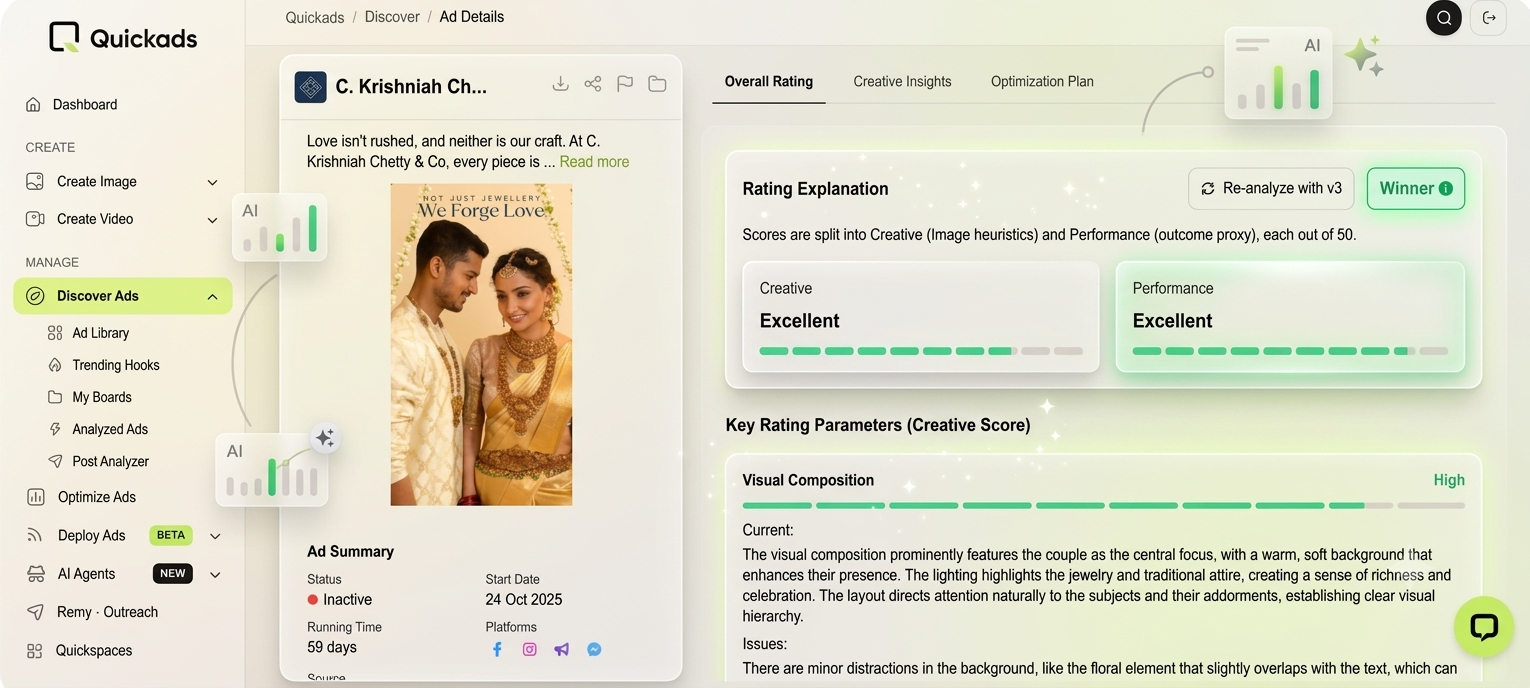
Offer-led statics that put the price objection in the first frame instead of burying it under a product shot.
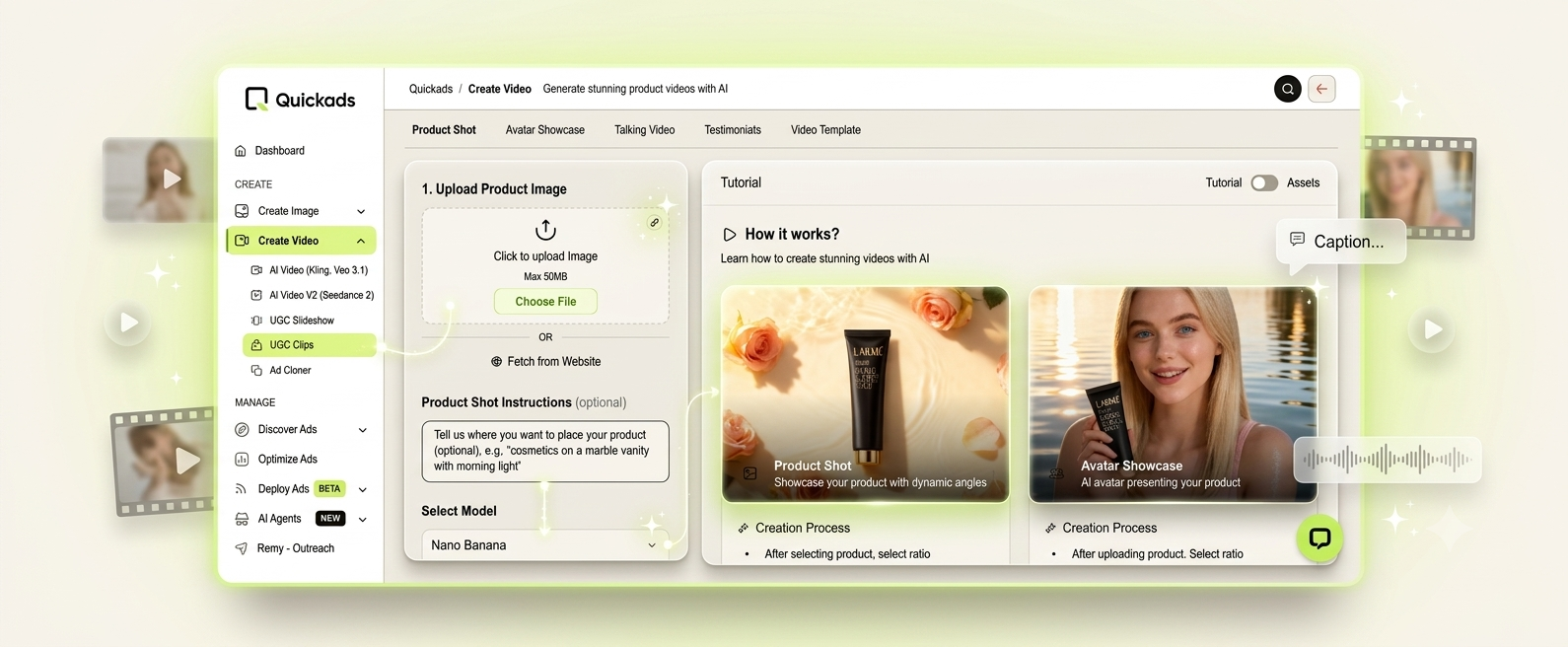
Scripted creator cuts built vertical first, with alternate hooks on the same shoot so a tired opener can be swapped.
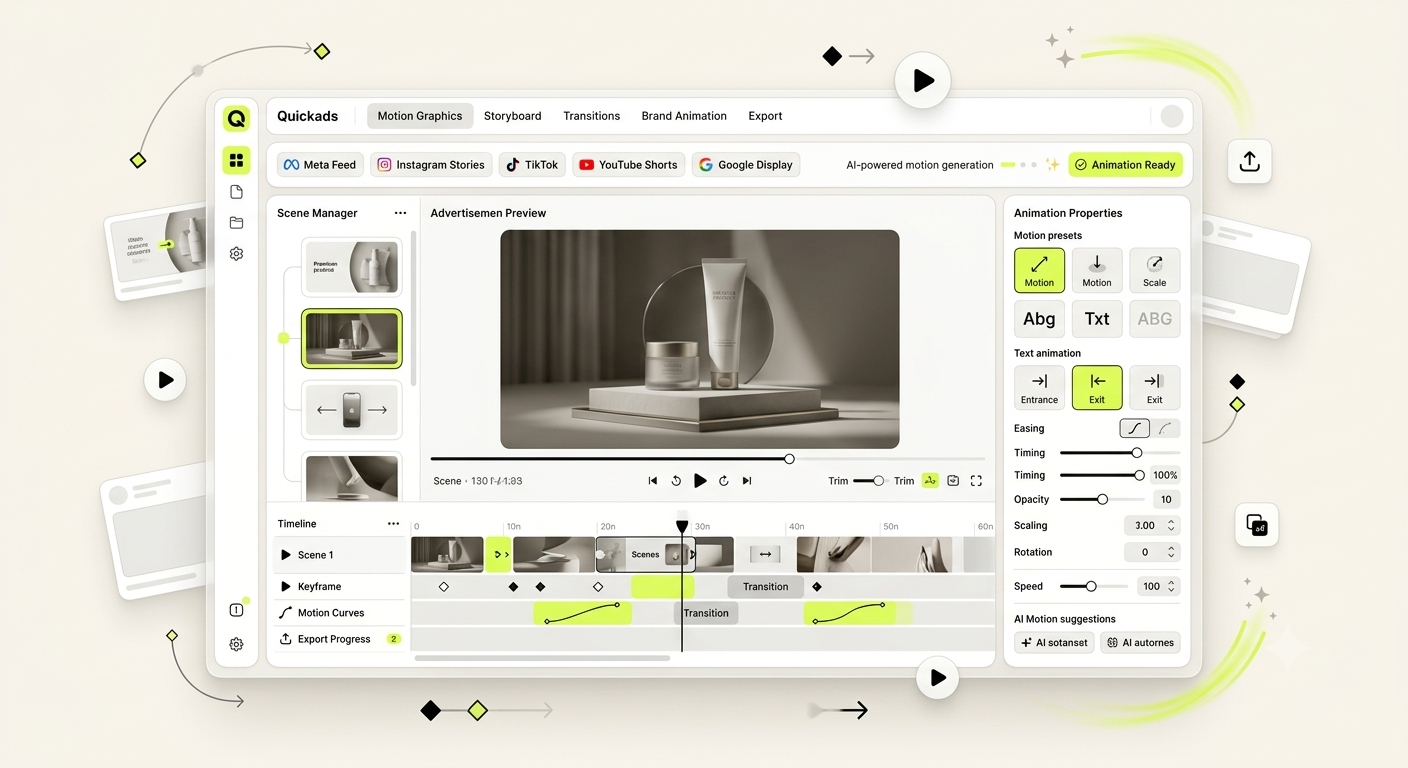
Motion cuts that show the setup actually happening, for products where a static cannot carry the explanation.
These are screens from our own product rather than a client reel, because client work needs their permission before it goes on a public page. Ask on a call and we will walk you through live examples in your category.
What A Performance Creative Agency Is, And Why Buyers Are Wary
If you read nothing else
- What is a performance creative agency?
- A partner that makes advertising judged on how it performs rather than how it looks. Concepts are briefed against objections and offers, produced at volume, and replaced when the account stops responding to them.
- Why is the category distrusted?
- Because the pitch is easy to fake. Anyone can promise a ROAS figure on a first call, and nobody can control the product, price, offer or market that figure actually depends on.
- So what should you buy on?
-
- Not a performance guarantee. If a number is promised before anyone has seen your account, it is a sales tactic.
- Buy on what a partner controls. Creatives delivered per week, turnaround, format coverage, a human brand check, perpetual creator licensing and a five to seven day delivery window. Those are the six things we put in writing.
We are one of the agencies in this category, so read this as an interested opinion. The questions in the next sections work equally well pointed at us.
The Two Kinds Of Promise On A Sales Call
One kind depends on things the agency cannot touch. The other does not.
- Cannot honestly be promised. A return on ad spend figure
- Cannot honestly be promised. A cost per acquisition target
- Cannot honestly be promised. Revenue or pipeline in a fixed window
- Cannot honestly be promised. A named percentage lift over your current creative
- Can be put in writing. 1200+ creatives delivered per week
- Can be put in writing. Turnaround from brief to finished asset
- Can be put in writing. Formats and placements covered
- Can be put in writing. A human brand check before anything ships
- Can be put in writing. Perpetual commercial creator licensing included
- Can be put in writing. A five to seven day delivery window per batch
Everything on the left depends on your product, price, offer and market far more than on the creative. Everything on the right is inside the agency's control, which is exactly why it can be committed to.
Seven Questions Worth Asking Any Agency
Including us. If an answer is vague, that is the answer.
How much of the volume is genuinely distinct?
Ask for two numbers, ours included: how many creatives arrive, and how many are separate ideas rather than recolours. Meta's own guidance warns that running many ads and ad sets means its system learns less about each, so raw volume alone is not the answer.
Meta learning-phase guidanceWho writes the brief?
If the answer is you, this is a production vendor with a strategy price tag. Ask to see an example brief before you sign, and ask who on their side reads your account.
What is the turnaround, per format?
A static and a scripted creator video are different jobs. One blended figure usually hides the slow one. Ask for both, and ask what a revision round adds.
How do you decide a test is over?
There is no industry-standard threshold. Published tools set the bar anywhere from 80% to 95% confidence, and Meta's own tooling surfaces different numbers again. Any agency calling winners without a stated rule is guessing.
Compare the published thresholds of Smartly, Marpipe and AppsFlyerWhat happens in month four?
The first month is the easy one, when every angle is still unused. Ask what the concept cadence looks like once the obvious angles are gone, because that is when the queue quietly returns.
Who holds the creator rights?
If creator content is in scope, get the licence in writing. Footage rights and the right to use a creator's own handle often expire on different schedules, which is how brands end up taking ads down.
What will you refuse to promise?
The most useful question on the list. An agency that will not name a limit has not thought about one. Ours is simple: we do not promise ROAS, CPA, revenue or pipeline.
Calculate Your Monthly Creative Velocity
Move the sliders to see a cadence in concepts and cuts. No currency, no forecasts.
Used only to size the cadence. We do not quote from this page.
These are delivery estimates for scoping a conversation, not a quote and not a prediction of results. A cut means a finished asset sized natively for one placement, so a single idea running at three ratios counts as three. Our overall output is 1200+ creatives a week; what lands in your account depends on the scope you agree.
The Four Pillars Of Our Creative Engine
None of the four are about how the ad looks.
01 · Angle first
Built around one objection
Every concept targets a single buyer friction point and answers it, so you can isolate which one was actually in the way. Concepts carrying four objections answer none.
02 · Made to be replaced
Nothing is precious
Assets are produced expecting most to be switched off. That changes how much is spent on any one of them, and how fast the next arrives.
03 · Distinct, not varied
Different ideas, not colourways
Distinct psychological hooks, never a colour swap dressed up as a test. Meta warns that many ads and ad sets means it learns less about each, so padding is counterproductive.
Meta creative diversification and learning-phase guidance04 · Placement-native
Cut per placement, not cropped
Feed, story and reel arrive as separate cuts with the subject held in frame, rather than one file squeezed into three shapes.
What We Control, And What We Do Not
The bottom band is where most agency promises live. We keep out of it.
This is not modesty. Creative moves the top of the funnel and nothing further down it. A partner who claims the bottom band is claiming credit for your pricing and your product.
Want the top band in writing before you commit?
Ask for it on the call. Creatives per week, turnaround per format, and what happens in month four.
Four Steps, And You Can Stop After The First
The first batch is free, so the decision comes after you see work.
STEP 01
Send what you are running now
Your site, brand kit, offer and the last month of creative. No audit deck, no discovery phase.
STEP 02
A strategist writes the angles
One objection per concept, mapped to what your buyers actually hesitate over rather than to a template.
STEP 03
The first batch arrives free
Finished statics, video and creator content, cut per placement, brand-checked by a person before handover.
STEP 04
You decide, then it goes weekly
If the work holds up, cadence starts. If it does not, you have lost a brief and kept the assets.
Free test batch
- Four items, every time
-
- One strategist-written angle brief, naming the objection each concept is built to answer.
- Three distinct visual concepts, not three variations of one.
- Full placement formats for each: 1:1 feed and 9:16 story or reel, cut natively.
- A human brand check, source file handover and perpetual commercial rights. Nothing expires and nothing has to be renewed.
The only claim we will make before you see work
The first batch is free and finished. Judge us on that rather than on anything promised on a call.
How The Options Differ On What They Commit To
| What you need | Quickads | Traditional brand agency | Media agency | Freelance roster |
|---|---|---|---|---|
| Creative volume committed per week | Yes | No | No | Partly |
| Briefs written for you | Yes | Yes | Partly | No |
| Built expecting replacement | Yes | No | Partly | Partly |
| Creator content in scope | Yes | Partly | No | No |
| Cut per placement, not cropped | Yes | Yes | No | Partly |
| Free work before you commit | Yes | No | No | No |
| States what it will not promise | Yes | Partly | No | Partly |
| Runs the media buying too | Optional | No | Yes | No |
| Turnaround per batch | 5–7 days | Varies | Varies | Varies |
| Perpetual creator rights included | Yes | Varies | No | Varies |
| Customer rating | 4.75 | Varies | Varies | Varies |
The media agency wins the media-buying row outright, and that is the point. If bid strategy and tracking are what is broken, buy that instead. We are the right purchase when the creative supply is the constraint.
The Questions Sceptical Buyers Ask Us
What is a performance creative agency?
A partner that produces advertising judged on how it performs rather than how it looks. In practice that means concepts briefed against a specific objection or offer, produced at enough volume that most can be switched off, and replaced on a regular cadence rather than kept for a season. A brand agency optimises for a campaign that lasts. A performance creative agency optimises for the next test.
Are performance creative agencies legit?
The category is real and so is the scepticism. The reason buyers ask this is that the pitch is easy to fake: anyone can promise a return figure on a first call, because nobody checks it against the product, price, offer and market that actually determine it. The way to separate them is to ask what the agency commits to contractually. If the answer is a performance number, be careful. If the answer is creatives per week, turnaround per format, and a stated rule for when a test ends, you are talking to someone who has thought about it.
Why will you not guarantee ROAS?
Because we do not control the things it depends on. Your price, your product, your offer, your landing page, your margin and your market all move a return figure more than the creative does. Creative moves attention at the top of the funnel. We can commit to producing more distinct attempts at that, faster, with a brand check on each one. Committing to a number further down the funnel would mean taking credit for decisions we do not make.
What do you commit to instead?
Six things, and all six are inside our control. The number of distinct concepts delivered per week. Turnaround from brief to finished asset, quoted per format rather than blended and inside a five to seven day window for a standard batch. The formats and placements covered, cut natively rather than cropped. A human brand check on every asset before it reaches you. Perpetual commercial rights on creator footage. And source file handover. Ask for those six on the call and hold us to them.
How is this different from a brand creative agency?
Mostly in how disposable the work is meant to be. A brand agency is hired to make a small number of things that have to be right, and that is genuinely a different craft. Performance creative assumes most of what ships will be turned off, which changes the economics of how much goes into any one asset and how fast the next one arrives. Plenty of brands buy both, and should.
Do you need access to my ad account?
Not to produce the work. It helps for strategy, because seeing which concepts already stalled saves us repeating them, but plenty of clients share exports instead and keep account access closed. If you want us running the media as well, then yes, and that is a separate conversation with its own scope.
What happens if the creative does not work?
You get new angles, quickly, which is the actual answer rather than a refund clause. This is why cadence matters more than any single batch: a partner delivering weekly can abandon a losing direction in days, while one delivering monthly has committed you to it for a month. What we will not do is pretend a losing concept was a winner because a dashboard showed a small difference between two small numbers.
Is there a minimum term?
The first batch has no term at all, and no contract to get it. Ongoing engagements are scoped per account and we will tell you the term before you commit rather than after. If a provider in this category will not state the term plainly on a first call, that is worth noticing, whoever it is.
Who owns the rights to creator content and UGC?
You retain perpetual commercial rights to every final asset we deliver. This is worth asking about specifically, because expiring permissions are common across this market and they tend to be buried rather than announced. It is normal for the licence to the footage and the right to run ads from a creator's own handle to sit on separate clocks, so a brand can find an ad has to come down while the file is still legally theirs. We write footage rights, handle permission, paid use, territory and duration into one document before anyone films, and whitelisting is stated as its own grant rather than assumed. Ask us for that document on the call.
No Guarantee. Just The Work, A Week Early.
Send one brief and judge the first batch. Nothing to sign, nothing to cancel.
First batch in days. No contract, no forced demo.