Video Ad Production at Scale, Made Simple
For teams who need video to move as fast as the feed does.
Strategy, real 2026 trends, and the production system to make enough on-brand video to actually test what works, not just ship what is next.
- Why, who, and what, answered in one preflight
- The 2026 shift, not the 2024 one
- A production model built to keep pace with the feed
01You have settled the why. The how is what is stuck
02Strategy locked first, production figured out later
03One hero film, nothing to learn from
04The interface eats the shot
The why is settled. The how isn't
Nobody needs convincing that video works anymore. Attention, trust, conversion, that argument ended years ago. What actually changed is the pace layer underneath it.
A video strategy written two years ago answers the same questions a good one answers today: why, who, and what. Those have not gotten harder. What broke is the assumption that answering them once, carefully, and shipping a handful of considered videos a quarter would be enough to compete. It is not, and the reason has nothing to do with strategy.
Three things moved.
Attention keeps compressing
The window to earn a second look keeps shrinking. A video that spends its first three seconds warming up has already lost the viewers who decide everything.
Every platform wants its own cut
A single master edit, resized after the fact, reads as an afterthought now. Native aspect ratio and native pacing are the entry fee, not a nice to have.
The visual bar rose for everyone
Competent footage got cheap to produce. That makes competent table stakes, not a differentiator. Distinctive and fast is the only thing left to compete on.
None of that is a strategy problem. It is a production problem wearing a strategy costume, and that is the subject of the next chapter.
Right strategy, wrong speed
Most video advice treats production, how you will actually make the thing, as the last question, something to solve once strategy is locked. That order made sense when a single video took weeks. It does not hold anymore.
The strategy questions are usually fine. Teams know roughly why they are making a video and who it is for. What breaks is the loop underneath: brief, make, ship, learn, repeat. If that loop takes a quarter, the testing every strategy claims to want never actually happens at the pace a feed rewards.
Even the more thorough video marketing guides quietly admit this. They will walk through a careful test-and-learn philosophy for a couple of chapters, then concede, almost in passing, that the cycle feels heavy given how production-heavy video is to make. Their fix is usually more people. Ours is different: make the loop cheap enough to run constantly, so testing stops being an event and starts being the default state.
Call it what it is. Production throughput, how fast one idea becomes many tested, native cuts, is the multiplier on every other decision in this guide. Strategy points the video. Throughput decides whether you get to find out if you were right before the moment passes.
Figures above are third-party industry benchmarks, not Quickads platform data. They are directional, not a guarantee for any one brand.
Why, who, and what, answered fast
The strategic groundwork still matters. It just does not need a chapter each. Run these three questions as a fast preflight before every brief, not a quarterly planning exercise.
Why: name the job, not the wish
Which funnel stage is this video actually working, and what single outcome would make it a win. "We should have video" is not a why. "Cut cost per lead on this offer" is.
Who: the person, not the segment
What does the human on the other end already believe, and what would make them stop scrolling. A demographic slice tells you reach. It does not tell you what to say.
What: the one true thing
Pick the single claim or moment this video needs to prove, not everything you could say about the product. One idea per video travels. Three ideas per video travels nowhere.
What's actually new in 2026
A lot of video advice still in circulation was written back when short-form was a rising trend, AI video was a novelty act, and the liveliest platform debate was what to call a certain app formerly known as Twitter. All three questions are settled now. Here is what actually changed.
Short-form kept winning, and got shorter still
Average video length keeps compressing, and short-form still ranks as the highest-ROI format marketers report. The floor for a watchable video is seconds now, not minutes.
Vertical became the default shoot
Vertical is no longer a resize applied after the fact. It is how the shot gets planned from the first frame, because it is where most of the watching now happens.
AI-native production went mainstream, unevenly
AI-made video now reaches comparable engagement to human-made footage for social clips and product demos. For brand films leaning on emotional nuance, human-led production still tends to win, which is exactly why most teams keep a human review step before anything ships.
Proof-style video kept climbing
Testimonial and case-study video usage has grown sharply and is now one of the fastest-growing formats brands report, because it earns trust in a feed that has learned to distrust everything else.
The figures above summarize external industry research on 2026 video marketing trends, not Quickads platform data.
Want the actual craft of directing AI video: shot type, model choice, prompt structure? That is a full guide on its own.
Read the AI Video Prompting Guide →Which format earns its spot
Six formats cover most of what a full-funnel strategy needs. Deploy formats based on the specific funnel objectives and performance KPIs established in your preflight, not on what looks most impressive in a reel of your own work.
Social shorts
Fast, trend-aware, built for the scroll. Usually the highest-reach format for pure brand awareness.
Brand story
Slower and more emotional, built to be remembered rather than acted on immediately.
Product demo
Shows the thing doing its job. Demonstration beats description, on screen as much as in copy.
Tutorial
Answers a question your audience already has, and quietly earns authority while it does.
UGC-style ad
First-person and low-polish, which reads as trustworthy even outside obviously UGC-friendly categories.
Testimonial or proof
Someone else saying it, which is worth more than any claim a brand can make about itself.
One note on UGC-style specifically, since it is the format enterprise teams hesitate on most. Low-polish does not mean off-guidelines. Run it through the same brand base, disclosure rules, and legal review as everything else you ship. Treat the style as a tone choice, not an excuse to skip the checks that already govern your other creative.
Design for the overlay, not just the frame
Vertical platforms draw their own interface on top of your video. Plan the shot around it, instead of finding out after it is live.
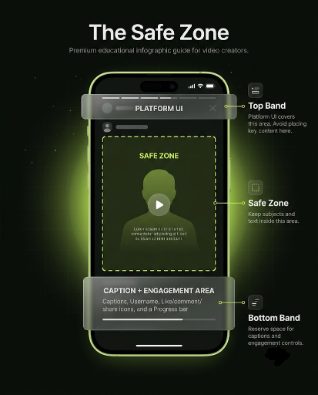
- Top band. Reserve roughly the top tenth of the frame. Platform chrome and status elements sit here, and anything you put there gets covered.
- Bottom band. Captions, usernames, and engagement icons usually claim the bottom fifth. A call to action placed here gets hidden behind a like button.
- The middle is yours. Frame the subject, the product, and any on-screen text inside that middle band, not just inside the video frame as a whole.
- Check it on-device, not just in the editor. Export and preview inside the actual app before calling a cut final. Editors do not render the platform's own overlay.
General platform design convention across major short-form apps, not a Quickads-specific measurement. Exact overlay position varies by platform and changes with app updates, so confirm against the current app before finalizing a cut.
The old build vs. the fast build
This is the chapter most video guides bury at the end, almost as an afterthought. It should not be. How you build decides whether the rest of this guide is theory or practice.
| Where it happens | The old build | The fast build |
|---|---|---|
| Concept to shot list | Days of pre-production meetings and a written treatment before anyone films anything. | A locked brand base and a brief, ready inside an hour. |
| One idea, many cuts | One shoot, one edit, manual recuts for every platform after the fact. | One reference asset, native variants generated per platform and aspect ratio. |
| Testing cadence | A handful of hero videos a quarter, judged mostly on gut feel. | Dozens of native cuts a month, ranked by what actually performs. |
| Who decides what ships | Whoever is loudest in the review meeting. | The brand base plus real test data, judgment applied at the end, not guessed at the start. |
| Resourcing to scale | More volume means more headcount or more agency retainer hours. | More volume means more generation. Team size does not have to grow with it. |
A comparison of operating models, not a benchmark against any named vendor.
Faster does not mean fewer eyes on it
Whatever review, legal, or compliance sign-off already gates your creative should gate this too. The shift is making more to review, and testing it faster, not skipping the review to get there.
- Review still happens before anything goes live. Same team, same standard, just judging more options at once instead of approving the only one you made.
- Someone signs off, and that is recorded. Keep the same paper trail you already keep for any other creative asset, who approved it and when.
- Legal and compliance get looped in earlier, not later. Faster production means earlier drafts to react to, not a late scramble before a launch date.
Where it runs, what you watch
Distribution decides who sees the work. Measurement decides whether you learn anything from it. Match the channel, the asset, and the metric to the funnel stage, not the other way around.
| Funnel stage | Native channels | Core asset type | Primary KPI | Platform focus |
|---|---|---|---|---|
| Awareness | YouTube Shorts, Reels, TikTok | Social shorts, broad identity stories | Reach, impressions, unique viewers | Centered for 9:16, clear of bottom UI overlays |
| Consideration | Website, blog, LinkedIn | Product demos, tutorials | Watch time, completion rate | Captioned by default, built for muted autoplay |
| Conversion | Paid social, landing pages | UGC-style ads, testimonials | Clicks, sign-ups, purchase intent | Clear call to action inside the final seconds |
| Loyalty | Newsletter, in-app, owned social | Feature walkthroughs, behind the scenes | Returning viewers, engagement | Longer-form, native to owned surfaces |
A reference map, not a rule. Adjust channels and KPIs to where your own audience actually is.
What changes when the loop gets fast
Not a case study, a pattern: what typically shifts for a team that moves from campaign-paced video to a continuous production loop.
- One hero video, judged in a single meeting
- Platform resizing done by hand, after the fact
- Results arrive after the budget is already spent
- The next brief starts from a blank page
- Many native cuts, ranked by what actually performs
- Every format generated on-brand from one locked base
- Results come back inside the same testing window
- The next brief starts from what just won
This describes a shift in operating model, not a promise of specific results for any one brand. Your numbers will depend on your category, audience, and starting point.
What the fast teams actually do
Nothing exotic. Five plain habits, repeated often enough to become the default instead of the exception.
- They brief in outcomes, not adjectives. A clear job for the video beats "make it pop" every time.
- They shoot once, cut many ways. One real reference asset, dozens of platform-native variants from it.
- They test the hook hardest. The first second decides the rest, so that is where the testing budget goes first.
- They let performance pick the next brief. Data feeds forward into what gets made next, not just backward into a report nobody rereads.
- They keep a human on final judgment. AI clears the floor of repetitive work. A person still decides what ships when the moment actually matters.
How fast is your video engine, really
Four questions on how fast ideas actually become tested video inside your team. Change an answer and watch the gauge move.
A self-check, not a validated benchmark. The weighting is intentionally simple.