
Scaling Creative Quality With AI:
A Playbook for Marketing Teams
The generative AI playbook for marketing teams that want sharper work, not just more of it.
No signup required to check your score.
Where the work quietly breaks
Four issues turned AI speed into a liability: the edge everyone bought, the average that ships itself, the trust your audience is quietly withdrawing, and the output metric hiding all of it. Run each tell on your own team.
The promise of AI was do more with less, and most teams delivered on the more. Output is up almost everywhere. What follows is the quieter cost of that win: four ways speed turned on the teams that leaned on it hardest. Open each tab, and check its tell against your own work in about five seconds.
Issue 01Speed arrived for everyone
You bought AI for an edge, and for a moment it was one. Then speed arrived for everyone at the same time, and the thing you paid for quietly turned into the price of entry.
When every competitor can spin up a campaign in an afternoon, being fast is table stakes, not a differentiator. The advantage you bought with AI got competed away the moment your rivals bought the same thing. Cost and time savings alone no longer separate you, because the whole market banked them at once.
The tell: if "we ship faster than we used to" is your strongest answer to why you, you are describing table stakes, not an edge.
Issue 02The average ships itself
Models are trained on the average of everything that came before, so a lazy prompt returns the average: competent, safe, and hard to tell apart from the next brand's. It reads as impressive for the first second, and that first second is the trap.
It looks finished, so it ships, and one more forgettable asset joins the scroll. The generic look is not a flaw in the tool. It comes from shipping the first output without judgment, from treating done as good. The model hands you the middle of the distribution unless a person pushes it somewhere specific and on-brand.
The tell: if your AI output could carry a competitor's logo without anyone noticing, you shipped the average.
Issue 03Audiences can tell
The average does not just underperform. It costs you trust, because people can feel when work is generic and when the human behind it has stepped out of the room. That feeling is now showing up in the numbers.
As AI made marketing floods every feed, audiences have grown quicker to discount it and quicker to penalize the brands leaning on it hardest. The backlash is not against AI itself. It is against work that hides the brand and the person behind it, and the penalty is getting sharper year over year.
The tell: if you would hesitate to caption a campaign "made with AI," your audience can probably already feel what you are not saying.
Issue 04You cannot see what you do not count
The old scoreboard counts outputs: assets shipped, campaigns launched, hours saved. When production gets cheap, that scoreboard goes blind, because it measures the part AI just made trivial and ignores the part that still decides whether the work lands.
If you only track how much you shipped, you cannot tell the winner from the noise, so you repeat both. Volume is not the constraint anymore. Knowing what worked, and doing more of it, is, and an output metric will never surface that on its own.
The tell: if you can name how many assets you shipped last quarter but not which single one worked, you are counting the wrong thing.
Give AI the commodity. Protect the signature.
A simple way to sort your creative pipeline by risk and volatility, so AI carries the high-volume commodity work and your team's judgment stays on the signature work that decides brand trust.
For mid-market and enterprise teams, the bottleneck is not a lack of ideas. It is the friction of scaling them across regions, channels and product lines without diluting the brand. Spreading AI evenly across that whole workflow thins your team's judgment exactly where it matters most.
Separate the pipeline by risk and scale instead. Commodity work is the high-volume, reversible execution that eats agency hours: resizes, variations, first drafts, format adaptations, motion banners, email graphics and multi-market versioning. Signature work is the core strategy, the emotional hooks and the brand guardrails that decide customer trust. Hand the first to AI. Keep a human on the second.
Two questions sort almost any task. How much does a mistake cost the brand (risk), and how often does the asset change or need new versions (volatility)? High risk with low volatility is signature work: give it care. Low risk with high volatility is commodity work: automate it. The map below shows where each kind lives.
Signature work
Core campaigns, brand manifesto, hero video. High-impact brand equity and strategy.
Keep humanGuardrailed scale
High-stakes assets made at volume. AI executes inside strict brand rules, a human signs off.
Assisted
Routine, stable work. AI drafts, a quick human check ships it.
Commodity work
Motion banners, email graphics, landing pages, omnichannel resizes, catalog and performance variations. High-volume creative scaling.
Automated via QuickadsRisk is how much a mistake costs the brand. Volatility is how often the asset changes or needs new versions.


The gap between average and signature is judgment, not effort.
Governance is the enterprise unlock
At scale, the risk is not slow production. It is off-brand work reaching public feeds. Lock the brand base once so every variation starts compliant, keep human sign-off on the signature tier, and let AI run the commodity tier inside those guardrails. Speed with guardrails, not speed instead of them.
What the better teams do differently
Where a fast team and a better team actually diverge across creative operations: brand voice, localization, governance and performance feedback. The tool is the same on both sides. The habits around it are not.
| Creative vector | The fast-only trap (legacy workflow) | The Quickads way |
|---|---|---|
| Brand voice and identity | Generic output that could carry a competitor's logo. | Brand bases keep every asset aligned to your style guide from the first output. |
| Localization and scale | Manual resizing and copy translation that delays launches by weeks. | Automated motion banners, email graphics, landing pages, catalog ads and multi-market variants, produced in minutes. |
| Creative governance | No oversight, so off-brand output can ship straight to public feeds. | Human sign-off reserved for the signature tier, guardrails on the rest. |
| Performance feedback | Production treated as a volume metric, counting assets shipped. | Signals from a 30M+ ad library feed winning variables back into the pipeline. |

Notice the pattern in both the table and the chart. Every better habit points the same way: away from raw production and toward knowing what is worth making and what actually worked. The tool is the same on both sides. The judgment around it is not.
From more to meaningful
The scoreboard shift from outputs to outcomes. Watch leading signals, not just assets shipped: which hook held attention, which variation earned the click, and route those learnings back into the next round.
This is the shift the whole industry is making, from measuring AI by outputs to measuring it by better outcomes. In practice that means watching leading signals, not just lagging ones: which hook held attention, which variation earned the click, which line the audience repeated back.
Captured and reused, those learnings are what turn a fast team into a better one. Volume without learning is just noise at scale. The winners are not the teams making the most. They are the teams that can tell the good from the good enough, and spend their speed on the difference.
Are you getting better, or just faster?
A two minute, four question maturity check with no email required. Answer honestly and see whether your team is compounding, getting there, or still just moving faster.
The content engine behind the better work
Quickads is performance creative as a service: one content engine that produces the full range your team ships, motion banners, lifestyle banners, email graphics, web pages, ads and other formats, plus creator marketing. It carries the commodity at volume so your team can spend its judgment on the signature. Every format pulls from your brand base, and everything is made to be tested, so you find what is genuinely good instead of guessing.
What makes that work is the engine underneath. Quickads owns an award-winning proprietary tool, so you are not locked into a single stack, paired with data from a 30M+ ad library and people trained on the best third-party tools. The result is built for flexibility, scale and a skillset advantage: almost no risk, and about half the cost of building the same capability in-house.
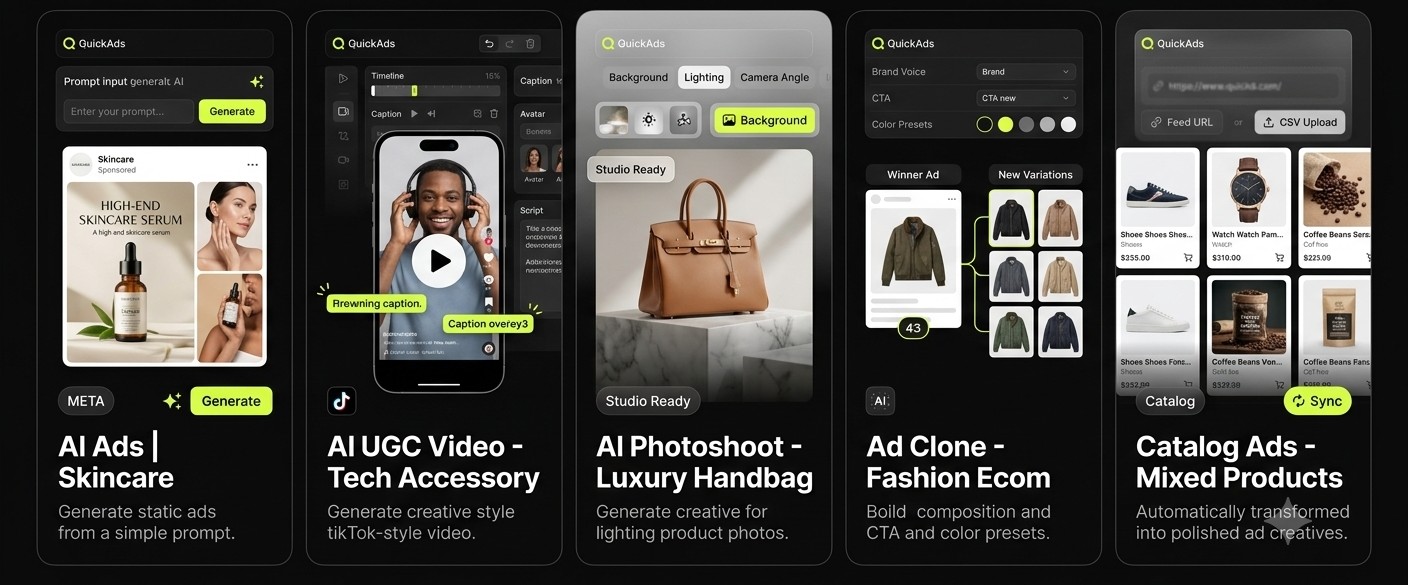
Just as important is what stays with you. Quickads does not replace your point of view or your final call. It clears the repetitive work off your team's plate so the taste, the story and the decision about what ships stay exactly where they belong, with people.
The habits that keep work sharp
Six habits that keep the work sharp when speed tempts you to skip them: decide before you prompt, generate wide and choose narrow, feed it your brand, and protect the signature.
- Decide before you prompt. Know what good looks like for this asset, then generate. AI is weak at goals and strong at options, so write the brief before the prompt.
- Generate wide, choose narrow. Make many variations, then cut hard. The value is in the choosing, not the making. Ten strong options and a ruthless edit beat one safe first draft.
- Feed it your brand. Give AI your voice, references, and rules so the output starts on-brand instead of generic. The more it knows, the less time you spend dragging work back to the brand.
- Keep a human on the signature. The core idea and the brand-defining work get a person's judgment, every single time. If a customer would remember it, a human signs off on it.
- Measure outcomes, not output. Track what performs, not how much you shipped, and route the winners into the next round. One learning captured beats a hundred assets shipped and forgotten.
- Protect time to think. Speed is only useful if the freed hours go into better bets, not more busywork. Book the thinking time before the calendar fills, or speed just buys more meetings.
Three moves for Monday
You do not need a reorg to shift from faster to better. You need three habits in motion this week.
Draw the line
List your team's recurring work and sort each task into commodity or signature. Hand the commodity pile to AI on purpose, not by accident.
Load your brand
Give your tools your voice, references and rules once, so every output starts on-brand instead of needing to be rescued in review.
Change the scoreboard
Pick one performance metric that matters and one learning to capture per campaign. Reward the outcome, not the output count.
Where these numbers come from
Where every figure in this guide comes from, third-party research and Quickads platform data alike, cited inline so you can check each one and validate it against your own results.
The third-party figures are directional benchmarks from published 2025 and 2026 research: Adobe's State of Marketing in an AI-Driven World, PwC and the ANA on marketing in the AI era, and Klaviyo's consumer trust research. Figures we attribute to the Quickads library come from our own platform data. Every benchmark here is mapped from that trusted enterprise research and our own platform data, so it describes where the industry is heading, not a guarantee for your team. Validate against your own data before you rely on it.
The questions we actually get
Why does AI marketing content all look the same?
Because models are trained on the average of everything that came before, so an unguided prompt returns the middle of the distribution: competent, safe, and hard to tell apart from the next brand's. It looks finished, so it ships. The fix is to feed AI a structured brand base and generate many variations, then use human judgment to pick and sharpen the few worth shipping.
Does using AI in marketing hurt brand trust?
It can, when the output looks generic or hides the human behind it. The consumer data is blunt: only about 7 percent of people say visible AI made marketing makes them trust a brand more, and the share who would trust a favorite brand less for heavy AI use roughly doubled in a year. The fix is not to avoid AI. It is to keep human judgment and real brand voice in the loop so the work still feels like you, and to be transparent where it counts.
If every competitor has the same AI tools, how do we stand out?
You stand out on the things the tool cannot do for you: taste, a distinct point of view, and a brand base that is genuinely yours. Tools are now evenly distributed. Judgment is not. Feed AI your brand, let it produce many variations, then use human judgment to pick and sharpen the ones worth shipping.
What should we let AI do, and what should stay human?
Give AI the commodity work: high volume, low risk, reversible tasks like resizes, variations, first drafts, and format adaptations. Keep humans on the signature work: the core idea, the brand voice, and the risky, memorable bets. Concentrate judgment where it changes the outcome instead of spreading it thin across everything.
How do we move fast without shipping generic work?
Define your brand base once (voice, look, rules), generate many on-brand variations from it, then test. Guardrails plus volume gives you speed and consistency at the same time. The generic look comes from shipping the first output without judgment, not from using AI at all.
Does better mean slower?
No. Better usually means fewer, sharper bets backed by more testing, not more meetings. Let AI carry the commodity work at full speed so your team spends its time on the decisions that move the brand. Done right, better and faster are the same motion.
Will AI replace my marketing or creative team?
Not the good ones. AI replaces tasks, not judgment. It absorbs the commodity work that used to eat your team's hours, which raises the value of the things it cannot do: taste, strategy, and the calls about what is worth making. The teams most at risk are the ones competing only on output speed, because that is exactly the part AI made cheap.
Speed is the floor. Build the better.
You already have speed. Point it at the work that matters, keep a human on the signature, and let Quickads carry the rest, across every format and at about half the cost of building it in-house. Its 30M+ ad library and on-brand generation keep the winners coming.
Ready to build the better?
Join 30,000+ brands. Setup takes 2 minutes.