Try Quickads free
For marketing and creative teams

Signal Over Noise

A field guide for AI-era marketing.

AI gave everyone the same speed, and the feed went flat. Discover how to build a locked brand base, beat creative fatigue, and scale ad creative that is unmistakably yours.

15 min read · By Quickads

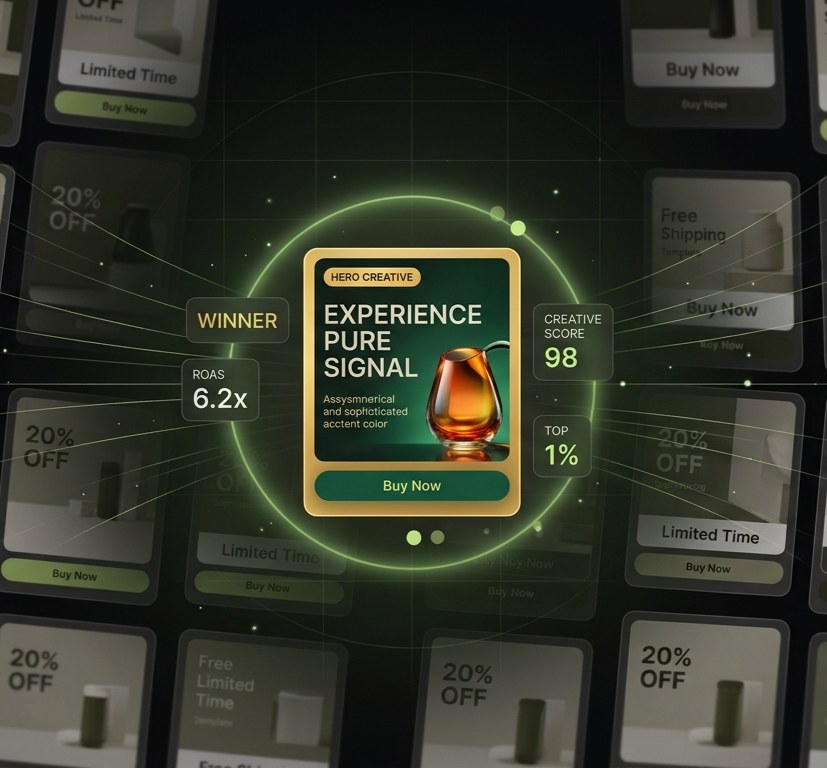
A wall of ad variations with the single distinctive, on-brand creative highlighted
Chapter 0101

How Generative AI Created Content Commoditization

The zero-marginal-cost trap: when generating an ad costs nothing, volume climbs toward infinity, and the value of any single generic ad drops to zero.

Adoption was almost instant. 71% of organizations now say they use generative AI regularly, and marketing and sales are the functions using it most (McKinsey). Among creative professionals, 86% already use it in their work (Adobe). Whatever edge the tools handed you, they handed it to your competitors on the same afternoon.

So your edge is no longer how fast you can hit publish. It is whether your audience actually recognizes your brand in the 1.5 seconds before they swipe away. That is a harder question, and most teams are still busy answering the old one.

If you lead marketing

Speed is table stakes

Fast is no longer a strategy, it is the baseline everyone shares. Your edge is deciding what is worth making and knowing when it actually worked.

If you lead creative

Taste did not get automated

The tools commoditized production, not judgment. Your sense of what makes the brand unmistakable is the part AI cannot copy, so spend your hours there.

When everyone can make anything, the scarce thing is not more. It is something only you could have made.
Chapter 0202

The Attention Trap: Why Speed Is No Longer an Edge

Speed was supposed to solve everything. Instead it produced more of the same, competing for less attention than ever.

Here is the trap. The tools made output cheap, so output exploded. But the person on the other end did not get more patient. Most digital ads now get less than 2.5 seconds of attention (Amplified Intelligence). Flooding that feed with more average creative does not buy attention. It burns budget faster.

Being fast and being seen are two different problems. AI solved the first one for everybody at once. The second one is still wide open, and it is where the real advantage now lives.

When speed collided with attention

Two curves define the AI era: the volume of content exploding upward, and the attention any single piece can hold falling toward zero. Where they cross, more speed stops helping.

CONSUMER ATTENTION ↓under 2.5s per ad, and fallingAI CONTENT VOLUME ↑15B+ AI images in 18 monthsThe collisionmore content, less attentionTHENNOW

Directional illustration of two documented trends, AI image volume rising (Everypixel) as measured attention per ad falls (Amplified Intelligence). The two lines are not plotted to a shared scale.

Adoption
86%
of creative professionals now use generative AI in their work.
Adobe, 2025
Volume
15B+
AI images made in gen AI's first 18 months, a mark photography took 149 years to reach.
Everypixel
Attention
2.5s
is more than 85% of digital ads ever get from a viewer.
Amplified Intelligence
Chapter 0303

A feed full of sameness

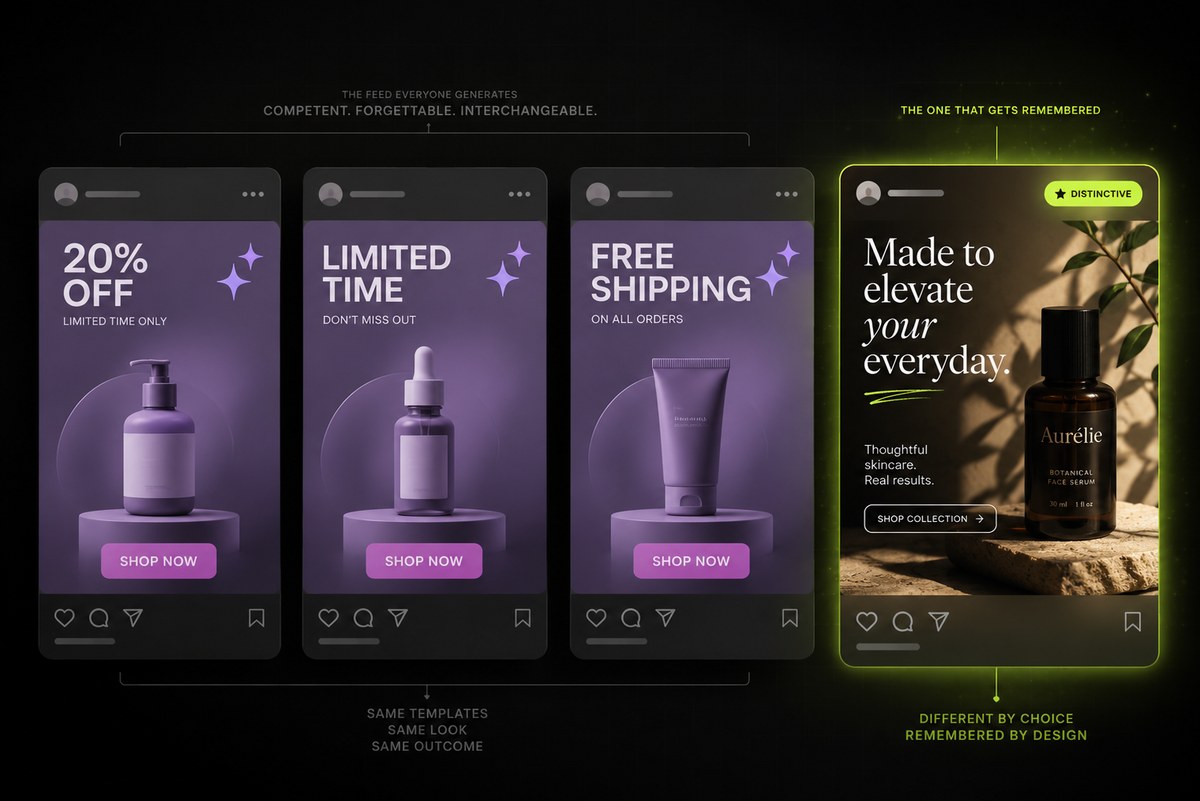
Purple gradients. Sparkle icons. The same three stock poses. When everyone prompts similar tools, the output converges on one averaged look.

The scale of it is hard to overstate. More than 15 billion AI images were generated in the technology's first 18 months, a number photography took about 149 years to reach, and there are already several times more AI images online than in the entire Shutterstock library (Everypixel). People can barely tell the difference anymore: a 2025 study found they identify AI images correctly only about a third of the time, worse than a coin flip (Communications of the ACM).

The result is a sea of competent, forgettable, interchangeable work. It was already true that 78% of brands could disappear tomorrow and most people would not care (Havas). AI did not cause that. It poured fuel on it. Sameness is now the default, and distinctiveness is the exception you have to choose on purpose.

A feed full of near-identical AI-generated ads, all blending into the same look

Creative shown is illustrative, built to make the point. The one that stands out is the only one starting from a real brand.

Chapter 0404

What Is Brand Signal in Marketing?

Signal is not just a louder voice. It is the instant recognition of your brand's visual DNA, your specific colors, layout, and product, even during a split-second scroll.

Start with an uncomfortable fact. Creative is the single biggest driver of whether advertising sells, responsible for close to half of the effect, far ahead of targeting (Nielsen and NCSolutions). Most marketers guess it is worth about a fifth. That gap is the opportunity: the teams that take creative seriously are competing on the lever that matters most, while everyone else fiddles with the settings.

The Creative-First Growth Engine

How much impact does each element have on a successful sale? Creative is the fuel and the foundation. Everything else is a multiplier or an optimization layered on top of it.

CREATIVE &DISTINCTIVENESS49%the fuel and the foundationYour moat: is the ad instantly yours?BRANDSTRENGTH21%the multiplierREACH14%TARGETING11%OPTIMIZATIONS, NOT DRIVERSRECENCY5%SUCCESSFULSALE+ compoundingrecognition

SourceNielsen and NCSolutions, Five Keys to Advertising Effectiveness, a meta-analysis of roughly 450 campaigns. Share of short-term sales lift by factor.

Distinctiveness is how creative gets remembered in the sliver of time you actually get. With strong distinctive brand assets, your colors, characters, logo, and layout, even a 1.5 second glance is enough to build memory, and the best-performing brand codes returned up to 3.5 times the attention-adjusted ROI of their generic equivalents (Amplified Intelligence). Signal is the whole combination: on brand, distinctive, and proven.

The ultimate test: if you strip the logo off your latest ad, does it look like a competitor could run it? If yes, you are not sending a signal. You are just adding to the noise floor.

Noise
Starting point
A blank prompt, whatever the model defaults to
The look
Interchangeable with the rest of the category
Volume
One safe idea, or a flood of near-duplicates
What gets kept
Whatever happened to launch
The payoff
Blends into the feed and is forgotten
Signal
Starting point
Your brand codes, locked once and reused
The look
Unmistakably yours in under two seconds
Volume
Many distinct angles, all on brand
What gets kept
Only what earns attention, proven by testing
The payoff
Compounds into recognition over time
Proof at a glance

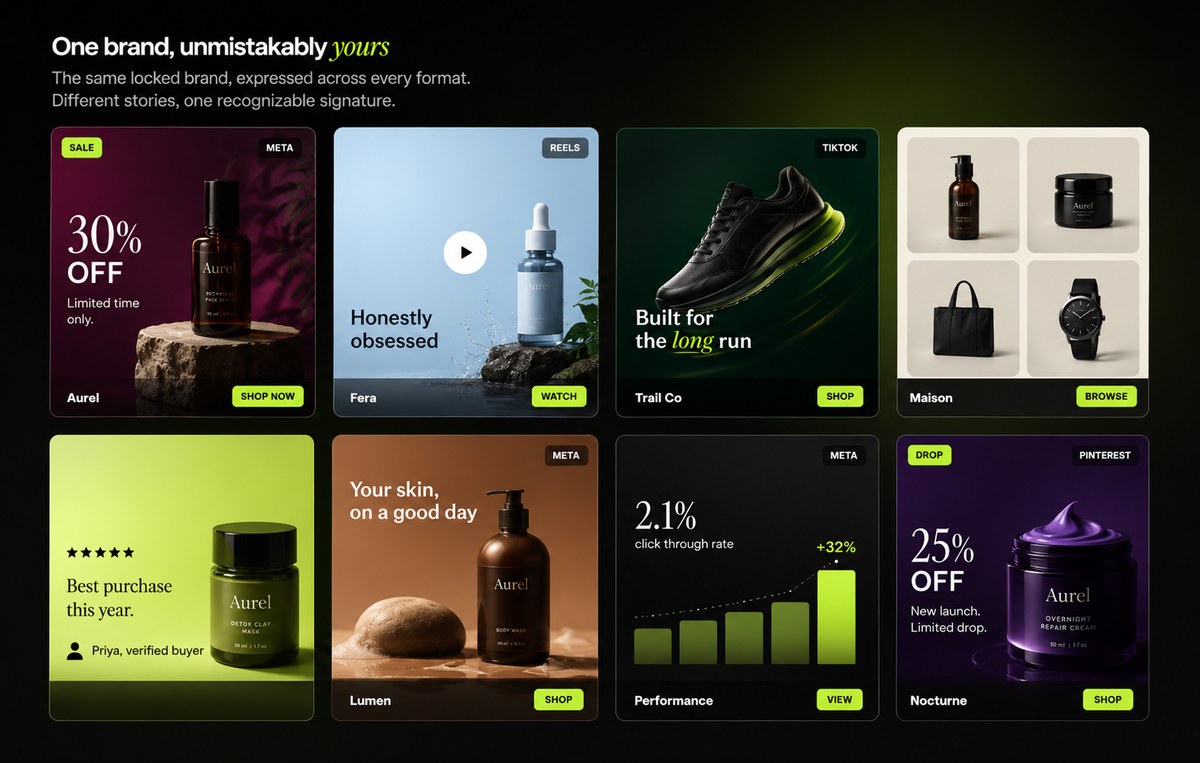
One brand, unmistakably yours

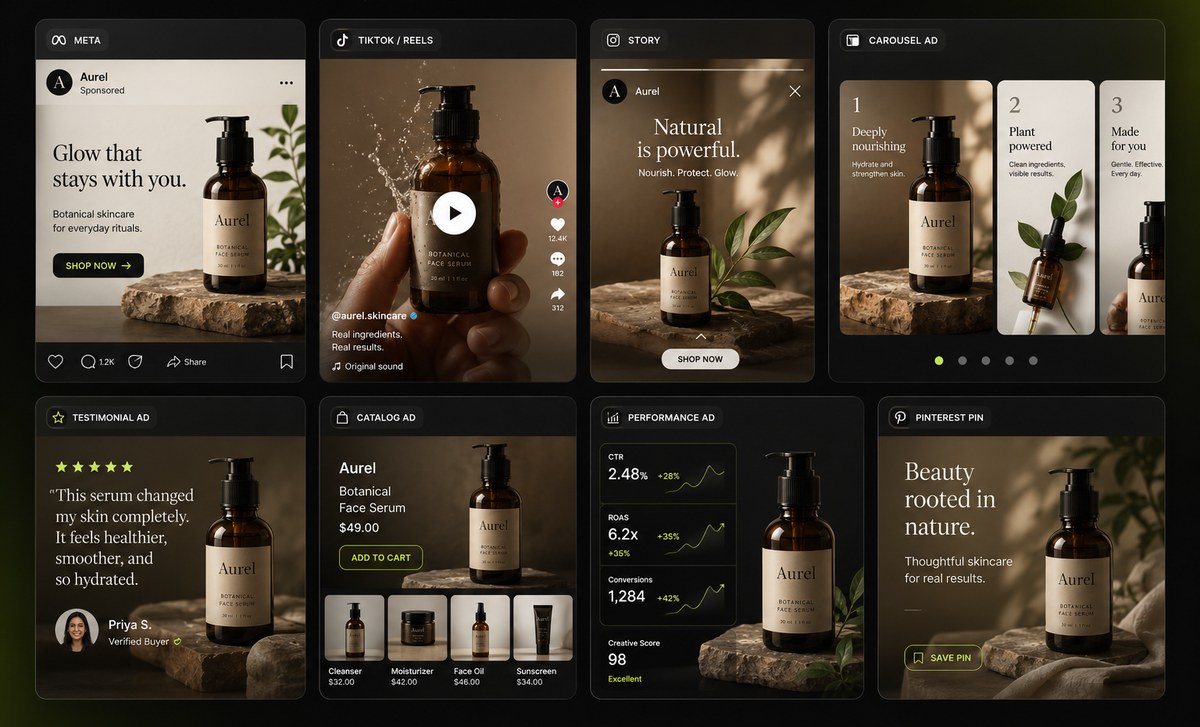
The same locked brand, expressed as a static ad, a video, a testimonial, a catalog, a product shot. Different formats, one recognizable signature.

One brand expressed across many formats, all sharing a recognizable signature

Creative shown is illustrative, built to demonstrate format range and a consistent on-brand look, not live campaign assets.

Chapter 0505

How to Use AI Without Losing Your Brand Identity

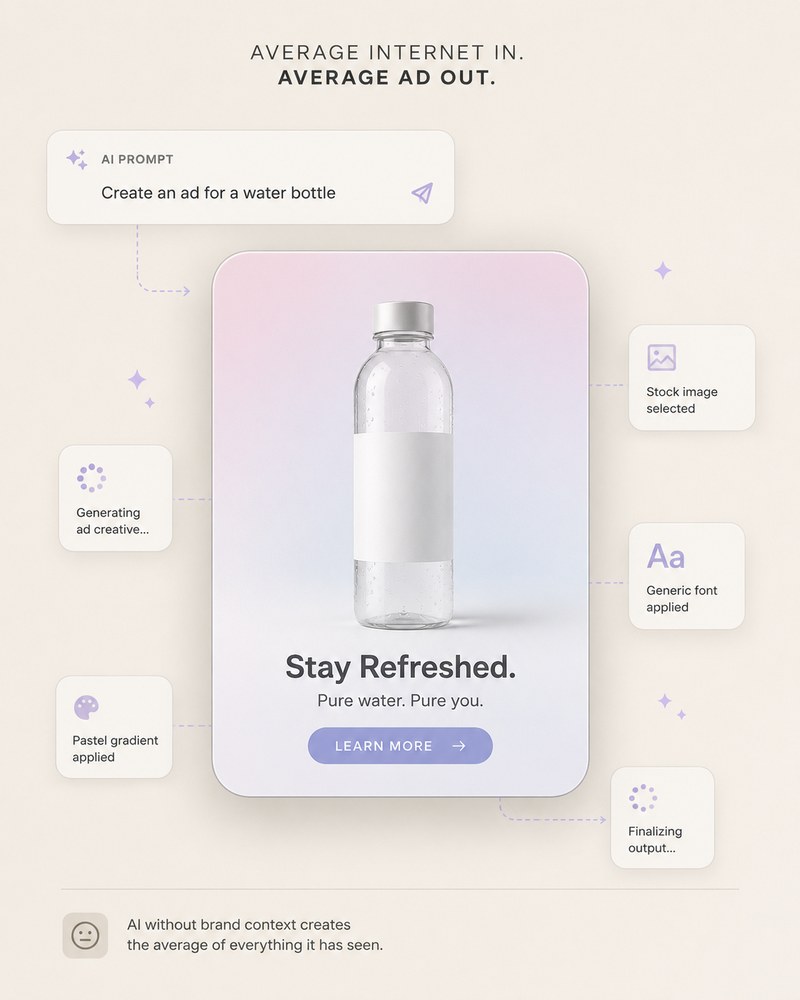
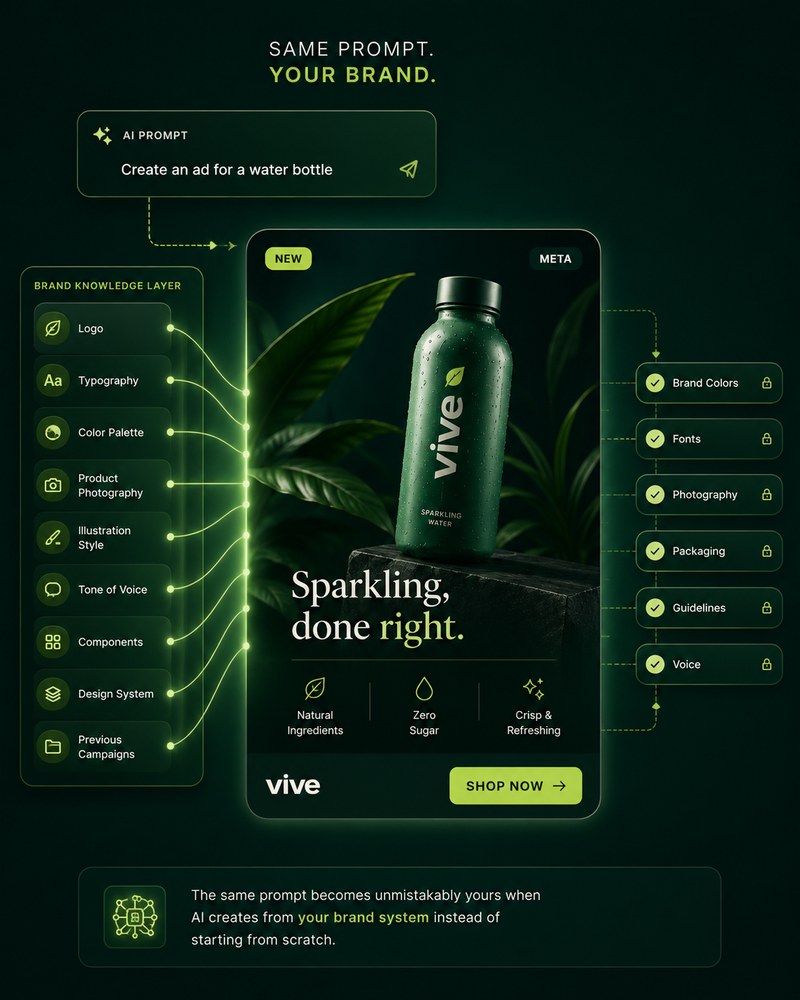
A blank prompt defaults to the average of the internet. That is why most AI ads look interchangeable.

The fix is not writing longer prompts. It is locking down your brand assets before you generate anything. By feeding your exact colors, fonts, and product photography into Quickads as a locked brand base, you set strict boundaries. The AI stops guessing what your brand looks like and starts building specifically for you.

That is the whole shift. Stop using AI to make generic things quickly. Use it to make your things, at a scale that used to be impossible, so distinctiveness stops being a luxury you ration and becomes the default you produce.

Blank prompt
A generic ad from a blank prompt: pastel, stock, could be any brand
A blank prompt in a generic tool returns the average of the internet: pastel gradient, stock bottle, a look any brand could run. Nothing here is yours.
Locked brand base
The same brief through a locked brand base: unmistakably one brand
The same brief through a locked brand base: your exact color, your real bottle, your type. Instantly one brand, and no one else.

Illustrative mockups of the same product brief. On the left, a generic AI default. On the right, the same brief constrained by a locked brand base.

If you lead marketing

Set the base, then let it run

Define the brand base and the win condition, then let the machine produce the volume. Your job is direction and an honest read of the results.

If you lead creative

Build the foundation once

You decide what on brand means, one time, done well. The base you build is what lets the team move fast without sliding into generic.

Chapter 0606

Distinctiveness compounds

A single distinctive ad is nice. A distinctive system is an asset that gets more valuable every time it runs.

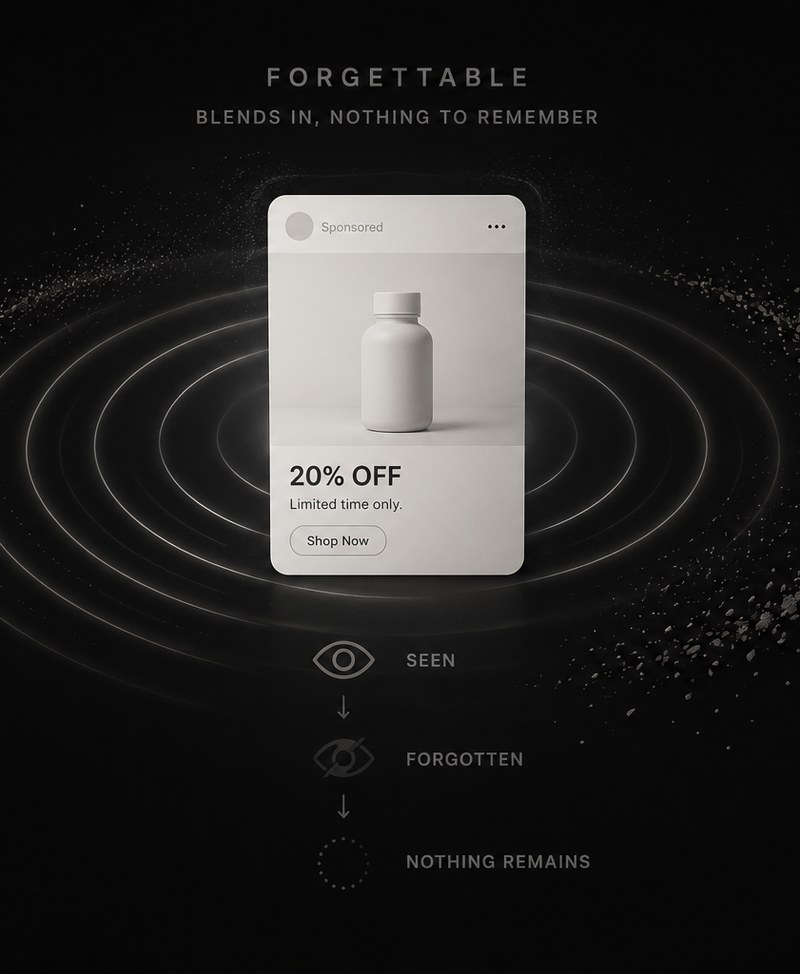
Forgettable
A forgettable, generic ad that blends into the feed
Blends in, nothing to remember
Generic creative resets recognition to zero every time it runs. The audience sees it, forgets it, and you start over on the next one.
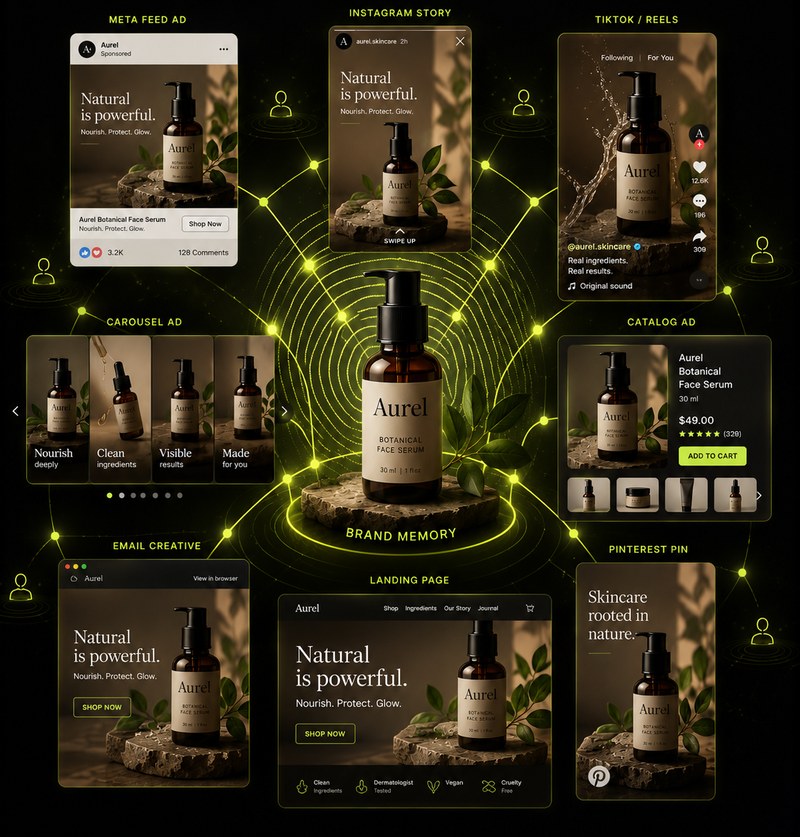
Unmistakable
A set of distinctive, consistent ads that build recognition across channels
MetaTikTokCatalogReels
Consistent, distinctive creative deposits into memory with every impression. The same codes, everywhere, compounding into a brand people recognize on sight.

It compounds over time. Every consistent, distinctive impression deposits into memory, so recognition grows instead of resetting to zero. Signal is not a campaign you run once. It is a balance that keeps paying interest.

Chapter 0707

How to Build an AI-Ready Brand Base

Do not throw away your brand book. Translate it. To scale creative without drifting into generic output, feed the machine three non-negotiable anchors.

1
Anchor

Visual guardrails

Lock your exact font files and hex codes, not a vague instruction like 'bold typography'. The generator works from your real type and color, so nothing drifts.

Feed your .OTF and .TTF files and exact hex values, not adjectives.
2
Anchor

Core product renders

Never let AI hallucinate your product. Provide clean 3D renders or transparent PNGs of your actual packaging as a locked layer the model cannot redraw.

Your real bottle, box, or device, dropped in as a fixed asset every time.
3
Anchor

A prompt vocabulary

Define what your brand is not. A short list of banned looks keeps every generation out of the generic defaults everyone else lands in.

No pastel gradients, no sparkle icons, no high-key studio lighting.
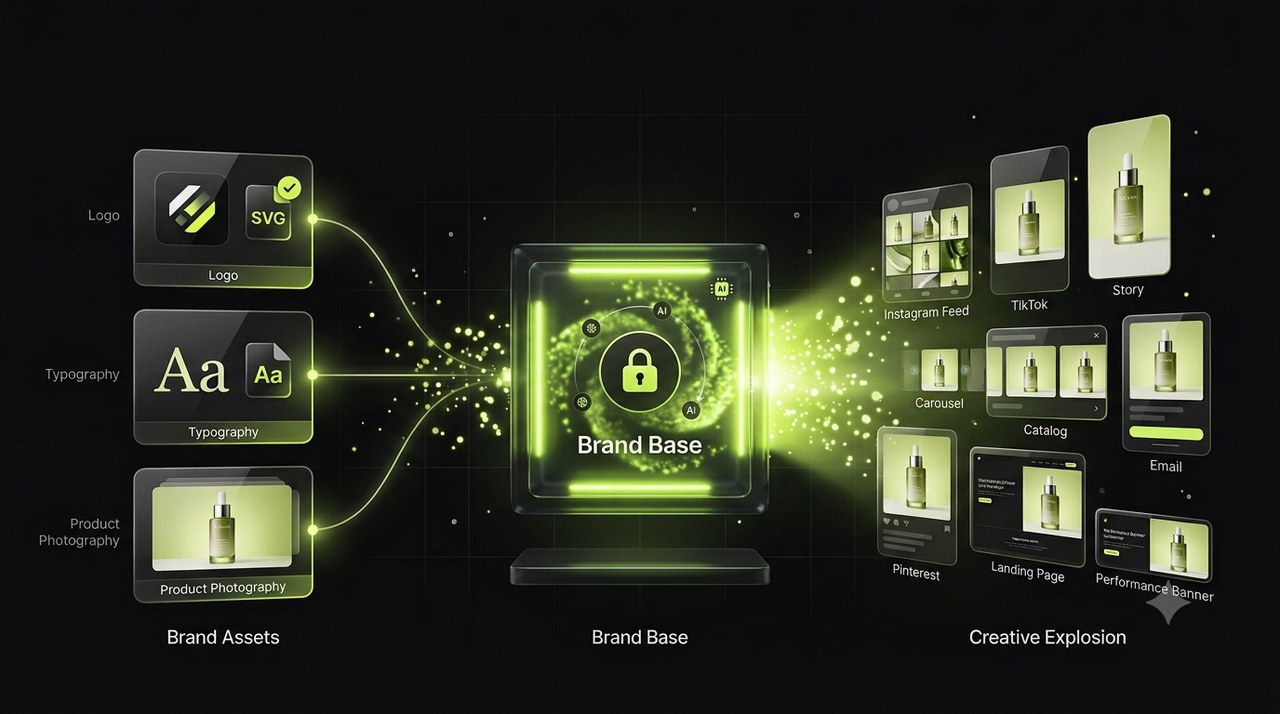
How the brand base works

Your assets go in once. They lock into a reusable base. Every generation comes out the other side on brand.

Your assets flow into a locked Quickads brand base, which outputs endless distinctive ads

For a mid-size or enterprise team, this is governance as much as speed. Lock the base once and every region, channel, and freelancer generates inside the same guardrails, so the brand holds together at volume instead of fragmenting across markets. The hours you used to spend policing consistency go back into the work.

Chapter 08 · Generative engine optimization08

How AI Search Engines Choose What to Cite

There is a second audience reading your creative now, and it does not scroll. AI answer engines like ChatGPT, Perplexity, and Google's AI Overviews crawl the web, synthesize an answer, and decide which brands to name.

Here is the part that matters. These systems, like people, can only credit what they recognize. A brand with a clear, consistent identity and information only it can produce is easy to associate with a category. A brand whose output is indistinguishable from the default internet noise gives them nothing to attach to, so they name someone else.

So the same discipline that wins the scroll wins the citation. Distinctive, consistent creative, plus proprietary signals like your own data and your own point of view, published in a clean and structured way a machine can read, are what make an answer engine reach for your brand instead of a generic source. This is generative engine optimization, and it is becoming a moat. Sameness does not just cost you attention. It costs you the citation.

An AI answer engine choosing which brands to cite from what it crawls
In practice

Signal, in practice

Two teams that stopped adding to the noise and built a system for consistent, tested creative.

★★★★★
We went from a handful of creatives a month to testing dozens, and the winners paid for themselves. Speed stopped being the constraint.
Ramji SundararajanPresident, Udemy
3.5×
more creative tested
68%
lower cost per asset
2.8×
return on ad spend
★★★★★
Our brand finally looks consistent across every channel, and we ship in a fraction of the time. It changed how the whole team works.
Vidya NatarajDirector, C. Krishniah Chetty & Co.
faster to launch
190%
more on-brand output
2.3×
engagement lift
Chapter 0909

How much signal are you sending?

Five questions on how distinctive and disciplined your creative really is. Change an answer and watch the meter move.

NOISESIGNAL50/ 100EMERGING SIGNAL
The logo test
If you cover your logo, does the ad still look like yours?
The AI starting point
Where does your team start when generating new ads?
Creative testing
How many genuinely different creative angles do you test a week?
Creative decisions
How do you decide which ad gets the media budget?
Visual consistency
Do your ads look cohesive across TikTok, Meta, and Google?

A self reflection aid, not a validated instrument. The weights are illustrative and meant to prompt a sharper conversation with your team, not to grade it.

Inside Quickads

Built to make signal

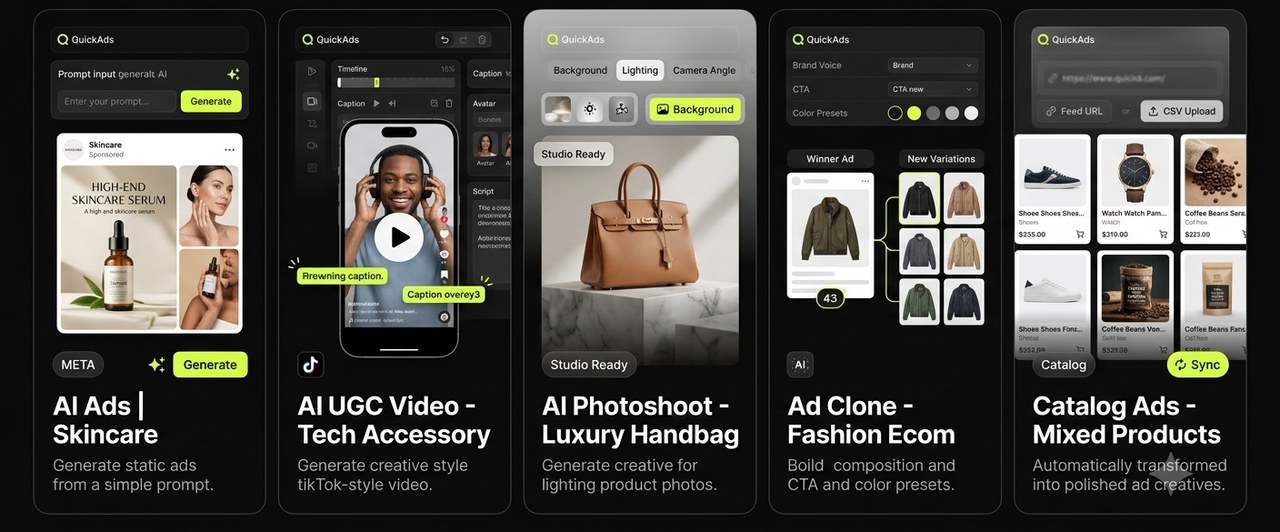
One locked brand base, five ways to turn it into distinctive, on-brand creative at volume, then test and keep what works.

The Quickads formats shown as a grid
01

AI ads

Scroll-stopping static and motion ads generated from your brand base, ready for paid social.

02

AI UGC video

Creator-style video with AI avatars, captions, and hooks, from one product, in minutes.

03

AI photoshoots

Studio-grade product photography on any background, no set and no camera required.

04

Ad clone

Point at a winning ad and rebuild its structure on brand, so you can test more angles fast.

05

Catalog ads

Feed your whole catalog and produce on-brand creative for every product at once.

Chapter 1010

The evidence behind this

Every claim in this guide maps to real research. Here is the noise the data documents, and the signal it points to.

The industry challengethe noiseThe data benchmarkThe strategic pivotthe signal
Content saturation15B+ AI images generated in 18 months (Everypixel)Lock your brand base so you stop feeding the category average.
Attention deficit85% of digital ads get under 2.5s of attention (Amplified Intelligence)Build distinctive brand assets that register in a 1.5 second scroll.
Misallocated budget49% of sales lift comes from creative, far ahead of targeting (Nielsen)Shift budget from endless targeting tweaks into rapid creative testing.
30,000+
brands build creative with Quickads.
30M+
ad creative in the Quickads library.
Every figure, sourced
McKinsey, The State of AI. 71% of organizations regularly use generative AI, with marketing and sales the leading functions applying it.
Adobe, creators survey (2025). 86% of creative professionals now use generative AI in their work.
Everypixel. More than 15 billion AI images were generated in generative AI's first 18 months, a mark photography took roughly 149 years to reach, and already several times the size of the Shutterstock library.
Communications of the ACM (2025). People correctly identify AI-generated images only about a third of the time, worse than a coin flip.
Amplified Intelligence (Prof. Karen Nelson-Field). 85% of digital ads receive under 2.5 seconds of attention. With distinctive brand assets, 1.5 seconds is enough to build memory, and the best-performing brand codes returned up to 3.5 times the attention-adjusted ROI of their generic equivalents.
Nielsen and NCSolutions, Five Keys to Advertising Effectiveness. Across roughly 450 campaigns, creative is the single largest driver of sales, close to half of the effect, well ahead of targeting.
Havas, Meaningful Brands (2025). 78% of brands could disappear tomorrow and consumers would not care.
The bottom line

The data is clear. You cannot out-publish the machine, and you cannot buy your way out of a flat feed with targeting tweaks alone. When speed is free, distinctiveness is the only true economic moat.

The two Quickads figures are our own platform numbers, and customer results are from named customers rather than a guarantee of yours. Public research is cited to its source; studies measure different markets and moments, so treat every benchmark as a direction to pressure-test against your own data.

FAQ

Common questions, straight answers

Why does AI make so much marketing look the same?

Because a model returns the most probable result, which is the average of everything it has seen. Without your own brand codes and a point of view, everyone prompting similar tools lands in the same place. Distinctiveness has to be added on purpose: your colors, voice, and product, used consistently.

What are distinctive brand assets, and why do they matter more now?

They are the colors, characters, logos, sounds, and layouts that make a brand recognizable without its name. They matter more in the AI era because attention is scarce, most digital ads get under 2.5 seconds, and research shows that with strong distinctive assets even a 1.5 second glance can build memory.

Isn't making more content the answer in the AI era?

Volume alone is no longer an advantage, because everyone has it. More than 15 billion AI images were made in the technology's first 18 months. The edge now is distinctive, on-brand content a person actually remembers, produced at volume, not generic content produced at volume.

Does creative really drive results more than targeting?

Yes. Nielsen and NCSolutions found creative is the single biggest driver of sales, close to half of the effect, well ahead of targeting. Most marketers underrate it, which is exactly why getting creative right is a real competitive edge.

How do we stay distinctive when we generate at scale?

Lock a brand base once, meaning your colors, voice, logo, and product, and generate every variation from it, as you can in Quickads. A fixed foundation is what keeps high volume on brand instead of drifting toward generic.

Does distinctive creative help us show up in AI search?

It helps. AI systems, like people, associate a brand with what is consistent and recognizable about it. A clear, repeated visual and verbal identity is a signal they can attach to you. Generic, interchangeable output gives them nothing to hold onto.

Ready when you are

Ready to Build Distinctive Creative at Scale?

Short on time to build all this? Send us three of your latest ads and we will score your signal and show you exactly where you are drifting into noise. No build required.