Book a call
For growth and creative leads

Two Teams, One Scoreboard:
Performance and Creatives Aligned

Getting marketing and creative on the same team

Stop throwing briefs over a wall. Produce on-brand creative across every format at scale, and get marketing and creative running on the same loop for higher CTR.

12 min readBy Quickads
Where marketing and creative stall
01The brief goes out, the result never comes back
You ship the creative, media buying takes it live, and the numbers stop there. Creative never learns which pieces worked, so the next brief is a guess dressed up as direction. Read this chapter →
02Nobody agreed what a win looks like
Two teams, one campaign, and two different definitions of success. One chases CTR, the other guards the brand, and the work drifts because nobody wrote down the number that actually decides it. Read this chapter →
03The brand lives in someone's head
The rules for what is on brand are real, but they live in one person's judgment, not a system. So every new format restarts the same debate and waits on the same approver. Read this chapter →
04You tested the execution, not the idea
You ran ten versions of one ad and called it testing. Fonts and crops moved, the underlying idea never did, so the data tells you which button color won, not which angle sells. Read this chapter →
01
Chapter 01 / The friction

All gas, no steering

The hard part was never making the work. It is everything around it: the brief, the back and forth, the point where marketing and creative quietly stop speaking the same language.

Performance channels are hungry. Media buyers want more variants across more formats, faster. Creative gets a quick message, ships the work, and often never hears which pieces did well. Two teams, same company, completely different picture of what is going on. AI made the making part fast, and that is where most teams get caught out. Speed on its own is not velocity. Velocity has a direction.

Marketing floors it and asks for more, creative ships it, and nobody stops to check that all that output points at the same goal. You move fast in the wrong direction, results stall, and everyone blames the tools. The tools were never the problem. The steering was. Underneath, it is almost never one big failure. It is four specific issues, and the rest of this guide takes them one at a time.

Marketing and creative working at separate desks split by a glowing divide Speed without steering
Issue 01 / The feedback gap

The brief goes out, the result never comes back

You ship the creative, media buying takes it live, and the numbers stop there. Creative never learns which pieces worked, so the next brief is a guess dressed up as direction.

Why it happens

Most teams are set up to send work in one direction. Growth writes a request, creative makes it, it goes live, and that is where the wire gets cut. The people who spent days on the work rarely see what happened to it. Numbers land in an ad account only the media buyer opens.

It is not that anyone is hiding results. It is that nobody owns the trip back. Reporting lives in one tool, the work lives in another, and the brief that started it all is buried in a thread from three weeks ago. By the time a designer asks how the last batch did, the answer is a shrug and a fresh request.

So the loop never closes. Each round starts from opinion instead of evidence, and the same near-misses get remade because nobody flagged them as near-misses. Output goes up, learning stays flat, and the team mistakes motion for progress.

What it costs you
01

Repeat mistakes. The same weak angle gets rebuilt next month because nobody marked it as a loser.

02

Learning stays luck. Wins arrive by accident instead of a pattern you can name and run again.

03

Trust erodes. Creative feels like a vending machine and growth feels unheard, so the two teams slowly stop leveling with each other.

The teams that compound are the ones where the designer sees the CTR by Friday. Once results reach the person who made the work, the next brief writes itself.
Quickads creative strategy team
What this looks like
The challenge

A growth lead ships twenty variations a month and cannot say which three carried the account. Creative asks how it went and gets a thumbs up and a new request.

What changed

Results get pinned back to each concept in one shared setup. The designer opens the same view as the buyer, sees which hook held attention, and the next round leads with it. Reviews get shorter because the debate is now about data, not taste.

Try this
  • Pick one weekly view both teams read, with results tied to the concept that produced them.
  • Tag every asset with the idea it tests, so a win is traceable to an angle, not a file name.
  • End each sprint by naming one winner and one loser out loud, then feed both into the next brief.

Want results to reach the people who make the work?

See the loop in Quickads
Issue 02 / No shared win

Nobody agreed what a win looks like

Two teams, one campaign, and two different definitions of success. One chases CTR, the other guards the brand, and the work drifts because nobody wrote down the number that actually decides it.

Why it happens

Everyone says they want the campaign to work. The trouble is that work means different things at different desks. The media buyer is judged on cost per result this week. The brand lead is judged on whether the company still looks like itself in a year. Both are right, and neither goal is written on the brief.

So the goal gets decided after the fact, by whoever speaks loudest in the review. One round optimizes for a punchy hook that dents the brand. The next swings back to something safe that nobody clicks. The work zigzags, and each team quietly concludes the other does not get it.

Without a number agreed up front, feedback becomes taste. Taste cannot be tested, so revisions pile up and the real question, what are we trying to move, stays unanswered while the calendar burns.

What it costs you
01

Endless revisions. With no agreed target, every draft is judged against a moving opinion instead of a fixed goal.

02

Whiplash creative. The work lurches between on-brand and high-performing because it is chasing two scoreboards at once.

03

Blurred accountability. When a campaign underperforms, nobody can say what it was even supposed to do, so nothing gets fixed.

34,812
brands run their creative on one shared brand setup in Quickads, so both teams build against the same goal instead of two.
What this looks like
The challenge

Growth wants lower cost per click, brand wants the logo treated with respect, and the brief lists neither. Three review rounds later, the campaign ships late and pleases nobody.

What changed

Before anything gets made, both teams agree the one metric this round is for and write it at the top of the brief. Every variation is then judged against that single number, so reviews stop being a tug of war and start being a read of the data.

Try this
  • Name the one metric a campaign is for before the brief goes out, and put it at the top of the brief.
  • Pair every performance target with one brand guardrail, so both goals are visible instead of fighting.
  • Kill any feedback that is not tied to the agreed number or a written guardrail.

Get both teams building against one goal.

Set up your brand base
Issue 03 / No brand system

The brand lives in someone's head

The rules for what is on brand are real, but they live in one person's judgment, not a system. So every new format restarts the same debate and waits on the same approver.

Why it happens

Most brands have a real point of view. The problem is where it is stored. The logo file is in one drive, the color codes in a slide from last year, the tone of voice in the head of the person who has been there longest. The brand works right up until that person is on leave.

When the rules are not written as a system, every new piece of work becomes a negotiation. Is this the right green? Can we say it that way? Does this feel like us? Those questions are answerable, but only by one or two people, so the work queues behind their calendar.

Scale makes it worse. A motion banner, an email graphic, a landing page, and a set of ads each need the same brand answers, and each asks them again from scratch. The brand becomes a bottleneck instead of a foundation, and consistency depends on who happened to review that day.

What it costs you
01

Everything waits on one person. Approval is a single point of failure, so output caps at whatever that person can review.

02

Drift across formats. Ads, email, and web slowly stop looking like the same brand because each was interpreted by a different hand.

03

Onboarding is painful. New team members and partners cannot get it right without a long apprenticeship in one person's taste.

When the brand isA person's judgmentA locked system
ApprovalsWait on one calendarBuilt in from the start
New formatsRestart the same debateInherit the same rules
ConsistencyDepends who reviewedThe default, every time
What this looks like
The challenge

A launch needs banners, email graphics, and a landing page in a week. All three sit in a queue behind the one person who can say whether they look right.

What changed

Logo, colors, fonts, and product shots get locked once into a shared brand setup. Every format is then generated from that base, so on-brand is the default instead of a review note. The approver spends their time on the few real judgment calls, not on catching the same mistakes again.

Try this
  • Lock logo, colors, fonts, and product shots into one shared brand setup everyone builds from.
  • Write the three rules you correct most often, so they stop being tribal knowledge.
  • Let the system handle the basics, and reserve human review for the calls that actually need taste.

Turn your brand from a bottleneck into a foundation.

Lock your brand once
Issue 04 / Testing the wrong thing

You tested the execution, not the idea

You ran ten versions of one ad and called it testing. Fonts and crops moved, the underlying idea never did, so the data tells you which button color won, not which angle sells.

Why it happens

Testing sounds rigorous, so teams do a lot of it. But most of what gets tested is surface. You try a blue button and a green one, a tighter crop, a punchier headline on the same promise. Real differences, sometimes, but all variations on a single idea nobody stopped to question.

It happens because executions are cheap to spin up and ideas are hard to write. Changing a color is a two-minute job. Framing a genuinely different angle, a new reason to care, a different person to speak to, takes thought and a willingness to be wrong. So teams optimize the thing that is easy to change and leave the thing that actually moves results untouched.

The result is a local maximum. You get very good at the best version of a mediocre idea, and you never find out that a different angle would have doubled it. The account plateaus, and the tests keep coming back with tiny, tidy, meaningless lifts.

What it costs you
01

Diminishing returns. You polish one idea to its ceiling while bigger swings sit untried.

02

False confidence. Clean win rates on tiny changes make the account feel optimized when it is only tidy.

03

Missed breakouts. The angle that would have changed the quarter never gets made because the roadmap is full of button tests.

18,640
proven ad angles in the Quickads reference library, so you can start from angles that already worked and spend your tests on ideas, not crops.
What this looks like
The challenge

A team runs a tidy testing program and cannot break past its plateau. Every test is a small variant of the same discount-led ad they have run for a year.

What changed

They separate the idea from the execution. Each round tests a spread of genuinely different angles first, cheaply, and only once one wins does the team pour production into making the best version of it. The account starts finding lifts that matter instead of lifts that round to zero.

Try this
  • Write three distinct angles before you make a single asset, and test those first.
  • Prove the idea on a small budget, then spend production only on the angle that wins.
  • Cap how many button-level variants you run until a fresh idea has earned its place.

Test ideas, not just executions.

Explore angles in Quickads
Chapter 06 / The loop

Five steps, run as a loop

Not a handoff. A loop that both teams live in, where every result feeds the next round of ideas. This is the shape that answers all four issues at once, and the fast teams keep coming back to it.

01

Spot the friction

Figure out where things actually break. Which briefs stall, and where the results never make it back to the people doing the work.

02

Generate

Spin up on-brand variations fast across every format from one locked brand setup, instead of starting each piece from a blank page.

03

Test

Put a lot of ideas in front of real people cheaply. Let the number you agreed on up front decide what gets budget.

04

Share results

Send what happened back to the people who made the work, so the next round starts from real data, not opinion.

05

Scale

Refresh the winners before they get tired, and run the same loop across every format, channel, and market.

One base, a whole content engine

One brand base. Every format.

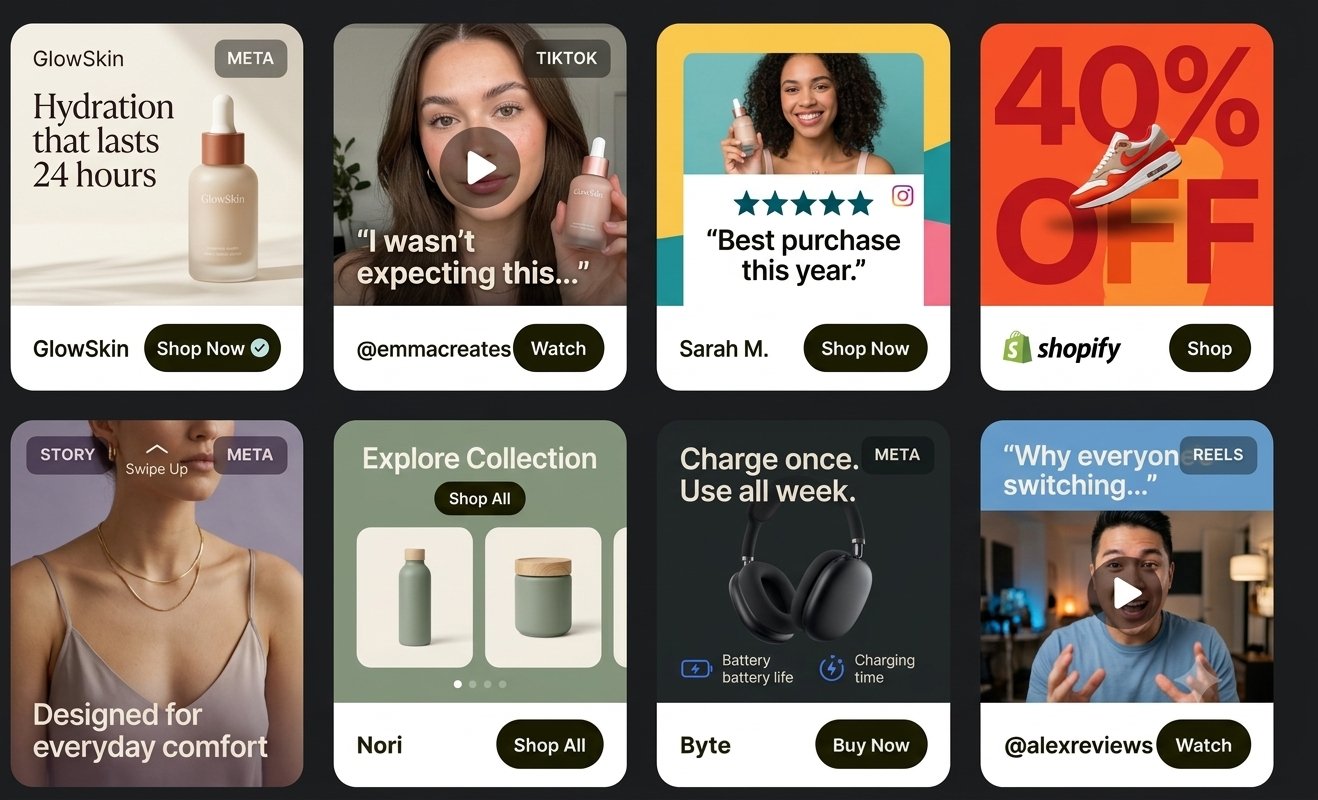
Same brand setup, run through the loop: motion banners, lifestyle banners, email graphics, web pages, ads, UGC, and more. All on brand, all from one setup, all ready to test.

Example Quickads creatives for one brand across static, UGC, testimonial, sale and catalog formats
07
Chapter 07 / What fast teams do

What the fast teams do differently

Put the four issues together and the fix is the same each time: stop running a chain of handoffs and start running one shared system. That single change closes the feedback gap, forces an agreed win, turns the brand into a foundation, and frees testing to chase ideas. Here is what it looks like in practice, based on patterns we see across brands using Quickads.

Where it gets stuckThe old wayThe fast way (with Quickads)
Feedback (Issue 01)Results stay in the ad accountNumbers go back to the people who made the work
Goals (Issue 02)Success decided in the reviewOne metric agreed before the brief goes out
Brand (Issue 03)Rules live in one person's headOne locked brand setup everyone builds from
Testing (Issue 04)Ten versions of one ideaA spread of real angles, tested cheaply first
Which hooks tend to win

When both teams can see results, a few patterns start to stand out. These are rough benchmarks, not promises, and worth testing against your own audience.

01
Problem and fix
100
02
Bold claim
88
03
Real customer
81
04
Product demo
74
05
Founder story
66
06
Discount-led
52

Read left to right: hooks that name a problem and resolve it tend to travel furthest, while discount-led openers fade fastest once the novelty goes. Test the idea behind the hook, not just its wording.

Chapter 08 / Legacy vs. velocity

From assembly line to system

The same two ways of working behind Issues 03 and 04, side by side. On one side, a slow handoff nobody can see into. On the other, a shared system that turns one brand setup into tested, multi-format creative.

Legacy
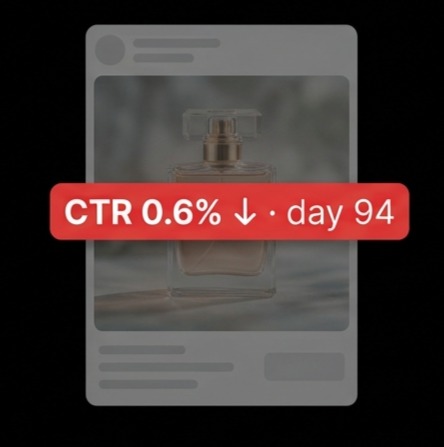
A generic legacy ad with a declining click-through rate

One idea in one person's head, made by hand, judged in the review, and never measured back. Every new format restarts the debate.

Velocity
On-brand ads for one product across Meta, TikTok and a catalog feed
MotionEmailWebAdsUGC

One brand base, many angles, every format. Tested cheaply, scaled on the winners, and measured back to the people who made it.

From teams using it

What it looks like when it clicks

Udemy logo
What stood out was the speed and precision. The team understood our tone and our learner audience, and built creative that actually converts across Meta, Google, and influencer channels. In a crowded edtech market, that makes a measurable difference.
Ramji SundararajanPresident, Udemy
3.5×
Increase in ad conversion rate
68%
Reduction in creative turnaround
2.8×
Growth in influencer campaign reach

C. Krishniah Chetty and Co. logo
Quickads helped us turn 150 years of craftsmanship into creative that performs on Meta and Google. What took our team weeks of shoots, edits, and approvals now ships in days, on brand and built for every format. We finally have a creative engine that moves at the speed of performance marketing, without losing the soul of the brand.
Vidya NatarajDirector, C. Krishniah Chetty & Co.
Faster creative production
190%
Increase in client retainer renewals
2.3×
Higher campaign engagement
09
Chapter 09 / Score your team

How fast is your team, really?

One quick score for how fast and how aligned your creative operation is. It looks at how much you test, whether both teams share the same goals, how quickly you ship, and how often you refresh. Answer four questions and see where you land.

64
out of 100 · Building
Lagging
Building
Compounding
04070100
Fresh ideas tested per week
Do both teams share the same goals?
Time from brief to live
How often you refresh
Inside Quickads

Performance creative, as a service

Quickads is a performance creative partner, not a single ad tool. One brand base feeds a whole content engine: motion banners, lifestyle banners, email graphics, web pages, ads, and creator marketing. We own an award-winning proprietary tool and our own data, and pair both with people trained across third-party tools, so you are never locked into one stack. That is how you get flexibility, scale, and skillset economies at roughly half the cost of hiring in-house, with almost no risk. Available as self-serve software or a fully managed service.

Motion banners

Feed-ready motion built from your brand base, sized for every placement.

Lifestyle banners

On-brand lifestyle scenes for display and social, without a photoshoot.

Email graphics

Header, hero, and promo graphics that match every other format.

Web pages

Landing pages and sections built from the same locked brand setup.

Ads & creator marketing

Static, UGC, and creator-led ads across Meta, Google, and beyond.

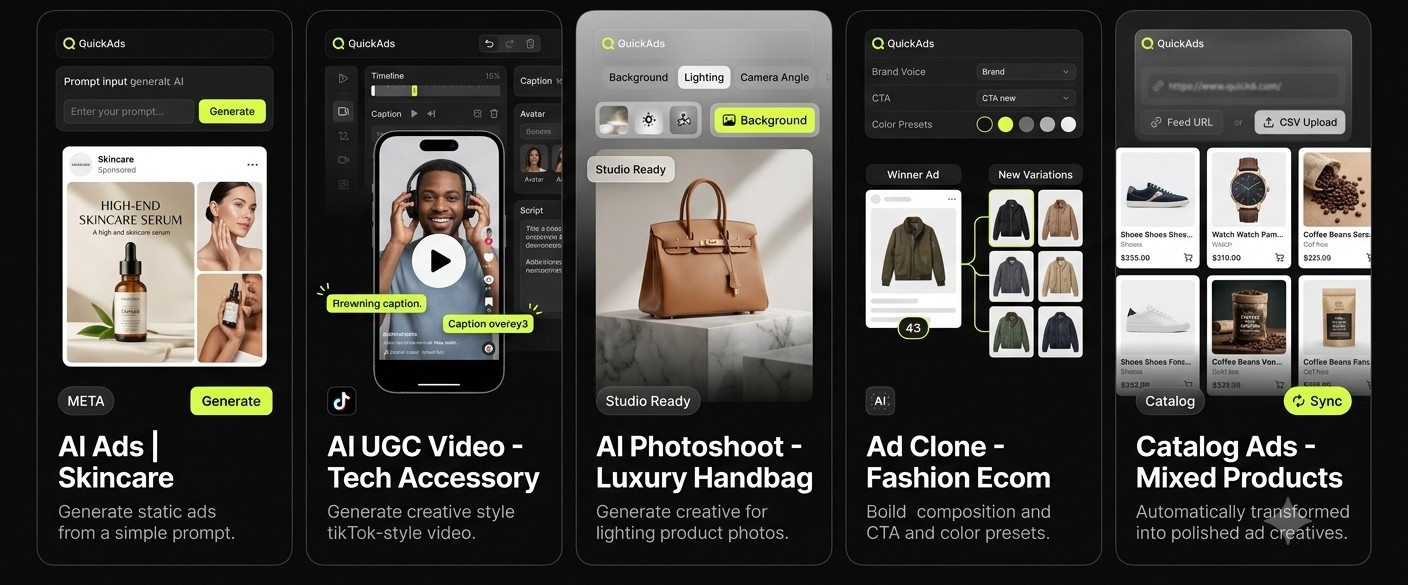
Quickads formats shown in the product
10
Chapter 10 / The habits

The habits that make it work

The loop only works if it runs on repeat, as one shared system instead of a chain of handoffs. Six habits the best teams stick to.

01

Lock your brand once

Set your logo, colors, fonts, and product shots once, and have every team build from that. On brand becomes the default, not a fight.

02

Test ideas, not one-offs

For each angle, make a spread across formats and test the idea, instead of one execution you happened to fall for.

03

Win the first three seconds

The opening decides most of it. Prove the hook on a small budget before you pour money into production.

04

Spend behind what works

Put the budget on the few pieces beating your control. Cut the rest quickly, and try not to get sentimental about them.

05

Send results back to creative

Show designers what actually performed. Once they can see it, the next brief basically writes itself.

06

Refresh before it gets stale

Watch for rising frequency and dropping CTR. Ship fresh versions before the dip, then start the loop again.

Chapter 11 / The numbers

Where these numbers come from

This guide draws on what we see across the brands that use Quickads to run high-volume creative: how they brief, test, and share results, and what that does to performance.

The specific figures shown in this guide are directional benchmarks, not guarantees. Treat them as a starting point and test them against your own audience and platform data before you rely on them.

34,812
brands building creative with Quickads
18,640
proven ad angles in the Quickads reference library
FAQ

The questions we actually get

Real ones, from growth and creative leads. Straight answers, no pitch.

How do you get marketing and creative on the same page?
Start with one thing everyone agrees on: what a win looks like. Pick the metric that matters before the brief goes out, have both teams build from the same brand setup, and make sure results get shared back to the people who made the work. Alignment is something you build into the workflow, not something you fix in a meeting.
Why do briefs fall apart once you are running performance ads?
Old-school briefs assume you are making a few careful ads. Performance marketing wants a steady stream of tests instead. Pile that volume onto a vague brief and a manual process, and it falls apart. The fix is not more revision rounds. It is generating from a locked brand setup so the basics are handled every time.
What is a creative operating model in plain terms?
It is just how your team turns an idea into a tested piece of creative: how you brief, make, test, and share what worked. Most teams have one by accident. The good ones make it deliberate and shared, so marketing and creative are running the same play instead of throwing work over a wall.
How do you actually measure creative velocity?
Look at how fast you go from idea to a tested result, how much you test, whether both teams share the same goals, and how often you refresh. The score earlier in this guide is a quick way to put a number on it.
Does AI replace the creative team?
No. It takes the grunt work off their plate so they can do the part that matters: deciding what to make, judging what is working, and scaling it. You still need people with taste. They just stop spending the day resizing the same asset.

You have got the speed. Add the steering

Fix the four issues, point marketing and creative at one goal, and let one brand base feed a whole content engine. Performance creative as a service, at roughly half the cost of in-house.