The Bar Doesn't Move: Leading a Creative Team in the Age of AI
Creative performance in the AI era
The production bottleneck is dead. The new constraint for mid-to-large brands is operational taste: turning human creative judgment into a scalable system.
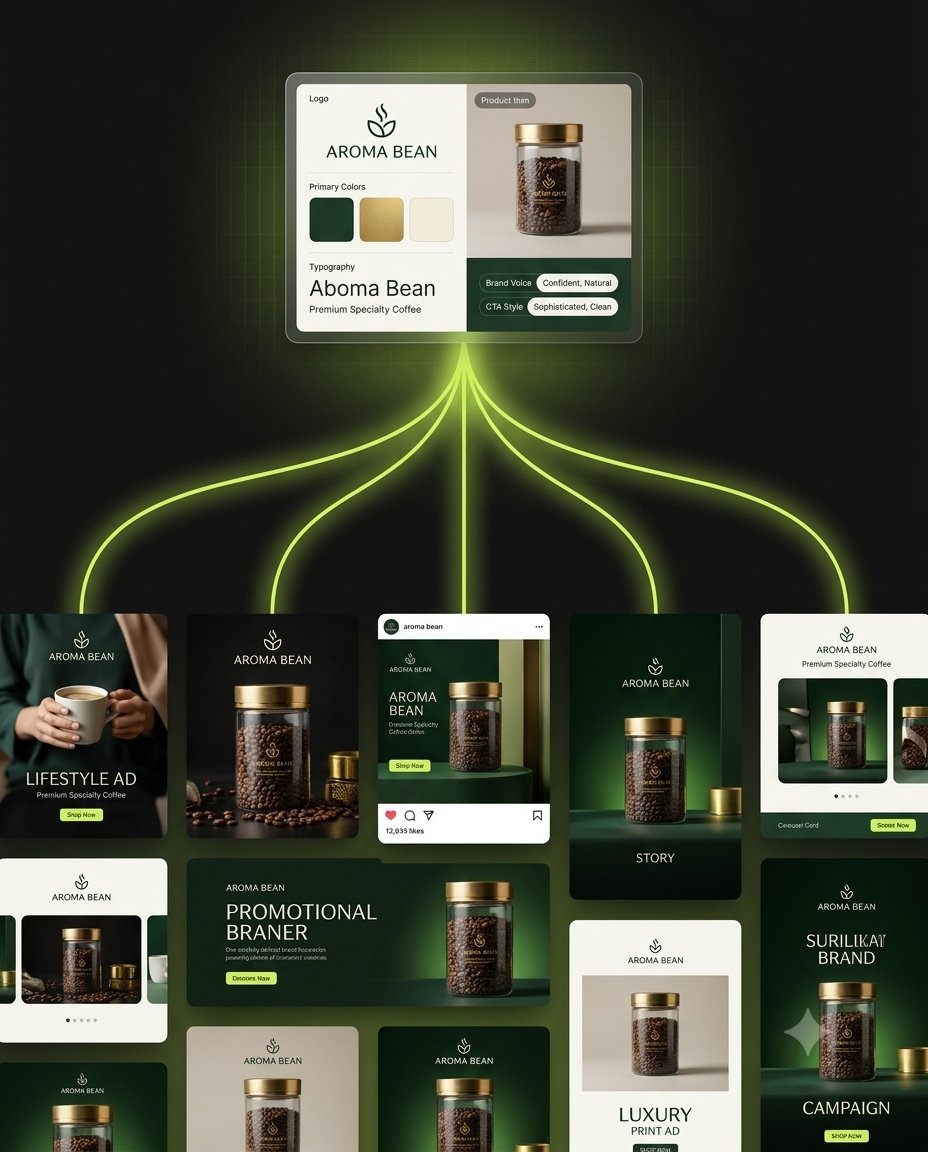
The tradeoff that no longer holds
Every growth leader knows the squeeze. More creative, more channels, shorter timelines, the same headcount. Something has to give, and for years the honest answer was quality.
You had two moves, and both cost you. Lower the bar: ship faster, accept that some of it is mediocre, and hope the algorithm sorts it out. Or protect the bar: do less, guard every asset, and watch a competitor out-test you while you polish. Speed or standards. Pick one.
That tradeoff was never a law. It was a symptom of how expensive production used to be. When every asset took a designer hours, or a shoot took days, volume and quality genuinely competed for one scarce resource: people's time. So the finished piece became the place quality got decided, because making the piece was the hard part.
AI changes the economics, not the standard. Production is no longer the scarce resource. A batch of on-brand variations is minutes of work, not days. So the old tradeoff quietly dissolved, and a sharper question took its place. When output is cheap, what actually decides whether it is any good?
The answer is the thing you were doing at the finish line all along. Judgment. Only now it has to move to the front, and it has to scale.
The bar was never a speed limit. It was a decision, and it is still yours to make.
Output is cheap. Taste is the tax.
When everyone can generate a hundred competent images before lunch, competent stops being an advantage. The scarce thing is knowing which of the hundred is actually good, and having the standard to reject the other ninety.
Look at where teams already are. Nearly nine in ten marketers now use AI in their daily work, so the ability to produce is no longer what separates anyone. It is table stakes. What people worry about is quality: accuracy and quality is the single biggest concern marketers report with AI, ahead of trust, skills, and job safety. Everyone got the engine. Almost no one is sure the output is good enough.
We see the same split inside our own data. Production quality across AI output is now nearly uniform. What separates a piece that performs from one that fades is rarely polish, it is judgment: whether the creative made deliberate choices about asset density, color, and type, or defaulted to the model's average. Competent is everywhere. Considered is rare.
That gap is the whole opportunity. The teams pulling ahead are not the ones generating the most. They are the ones who can look at a wall of AI output and say in seconds what ships and what does not, and who have made that judgment repeatable instead of trapped in one senior person's head. The work is shifting from making the thing to judging the thing. Taste is the new bottleneck, so taste is where a leader's leverage now lives.
Driven by the Quickads Intelligence Engine
We analyzed over 30 million high-performing social ads to reverse-engineer how scaling affects brand equity. The data is clear: mid-to-large marketing organizations do not fail because of poor AI generation. They fail because they lack an encoded Brand Anchor.
Your job moved from making to judging
If production is no longer where you add value, the role changes. The best growth and creative leaders in the AI era are not the fastest makers. They are the clearest judges, and they have built a system that applies their judgment at scale.
Concretely, that is a shift in where your hours go. Less time in the tool pushing pixels or writing the tenth variation yourself. More time defining what good means, encoding it so the team and the model both hit it, and making the call on what earns a place in market. McKinsey found the organizations getting real value from AI are about three times more likely to have fundamentally redesigned their workflows than to have bolted AI onto the old ones. The redesign is the point, not the tool.
We packaged that redesign into a repeatable loop, the Creative Judgment Framework (CJF). Four steps take a standard from one person's head to something a team and a model can both run.
The Creative Judgment Framework (CJF)
Four steps, run as a loop. Each cycle makes the standard sharper.
Lock the Brand Anchor
Encode your hard visual limits (hex codes, spatial padding, logo geometry) directly into your workspace. Guidelines in a PDF are dead weight. Guardrails have to live in the canvas.
Generate Generously
Deploy AI to widen your creative horizon in minutes, creating hundreds of layout variants from a single product file.
Ruthless Culling
Automate the repetitive eighty percent of production. Reserve your creative team for the final twenty percent: applying taste, checking market context, and making the ultimate call.
Deploy and Feed the Model
Ship directly to your channels, then connect performance data back into your prompt libraries so your automated floor rises with every active cycle.
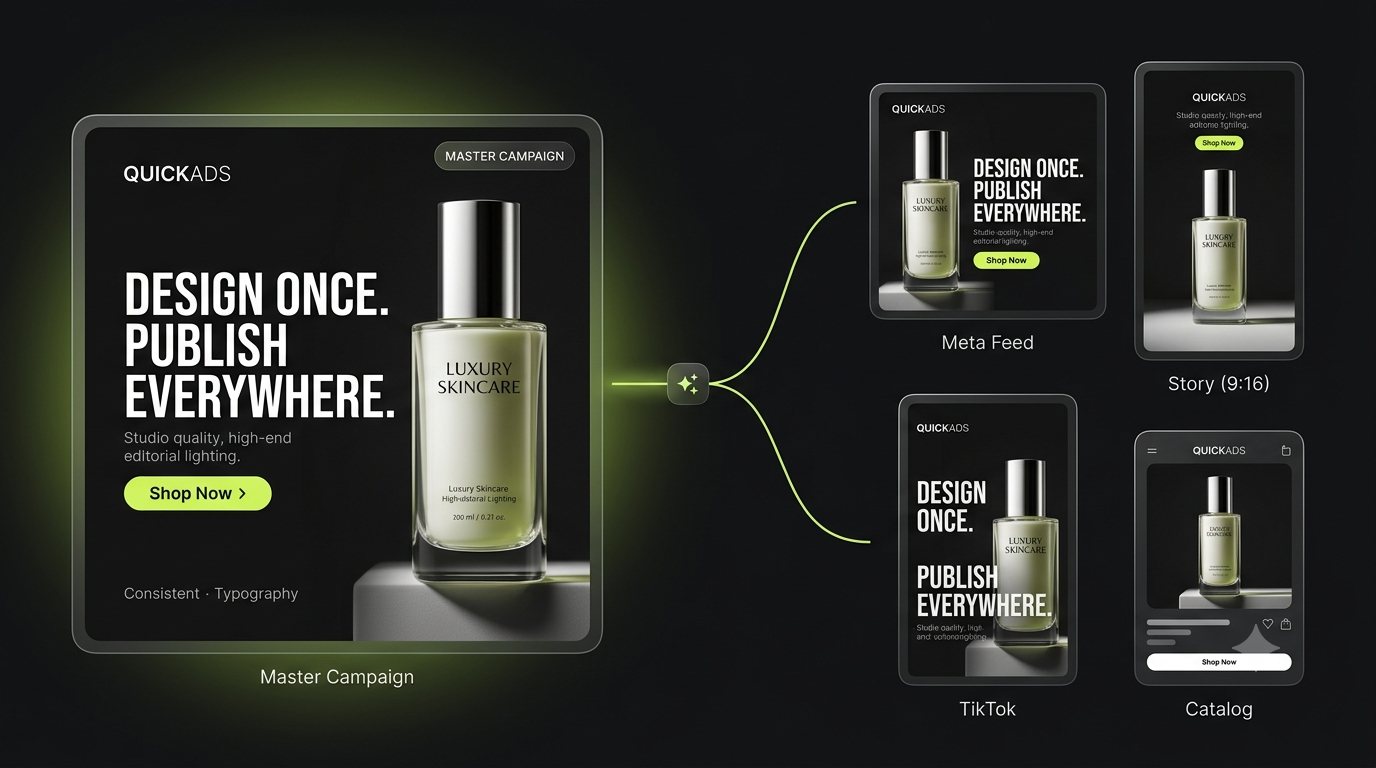
One brand base. Every format.
Encode the standard once and the same brand shows up sharp everywhere: the master campaign, the Meta feed unit, the story, the catalog tile. Same anchor, every placement, none of it starting from a blank canvas.
How high-velocity performance teams scale judgment
The managed-service route hands your creative to an agency that runs the AI on your behalf, on a retainer. The software route keeps the speed and full asset ownership inside your team. Here is how the AI-native model compares to legacy production, vector by vector.
| Operational vector | Legacy production model | The AI-native framework (Quickads) |
|---|---|---|
| Asset ideation and sprouting | Linear concepting. High overhead restricts creative exploration. | Multi-variant sprouting: hundreds of multi-format concepts mapped in 60 seconds. |
| Brand governance and drift | Variable manual interpretations of static PDFs. | Programmatic sandboxing: brand assets locked at the programmatic root level. |
| Resourcing and velocity | Human teams bogged down by manual versioning and file-swapping. | Asynchronous scale: AI-driven layout versioning frees creative staff for strategic direction. |
The through-line: decouple asset volume from headcount, and hold brand control at the root instead of policing it downstream.
Lowering the bar, or raising the floor
There are two ways to use AI creative. One lowers your bar. The other raises your floor, and lets you hold your ceiling.
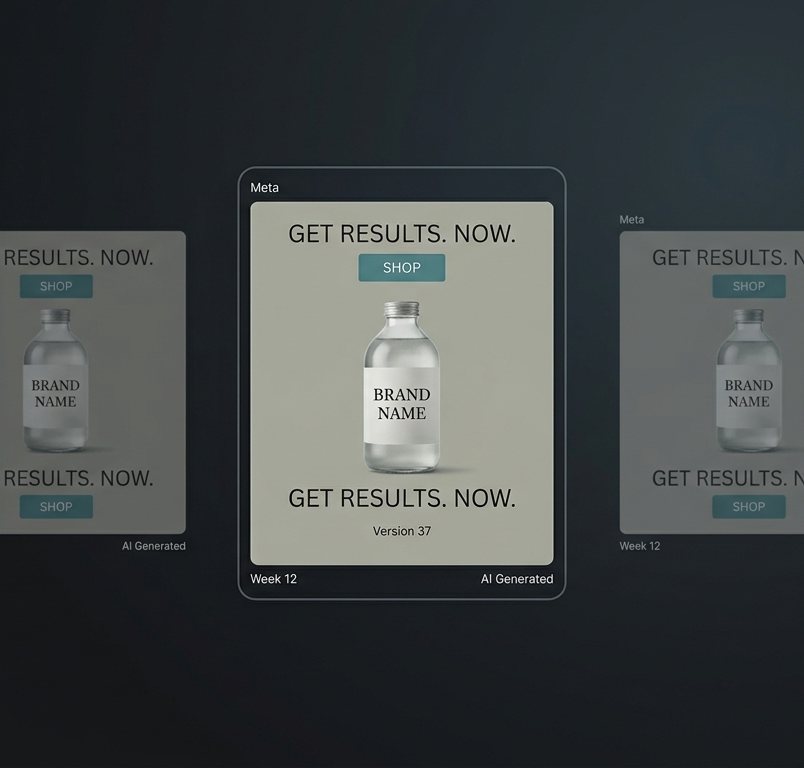

Is your bar holding as you scale?
Four questions. They are about where your standard lives and who does the judging, because that is what decides whether quality survives volume.
A self-reflection prompt, not a validated score. The weighting is deliberately simple.
Systematizing asset generation
The framework defines the standard. This is the production layer that executes it at volume. One locked brand becomes on-brand assets across every format, so judgment stays the only step that needs a human. This is how Quickads runs it, on frontier models with the brand baked in.
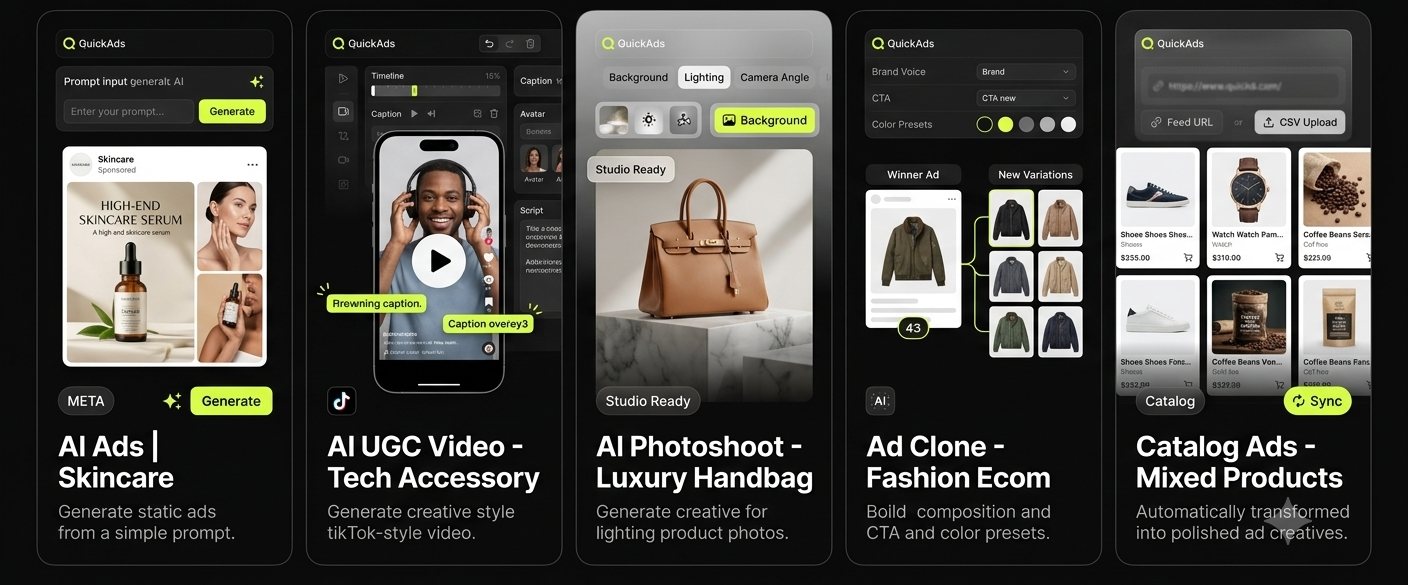
The pipelines draw on a library of 30M+ ads and are used by 30,000+ brands.
The 80/20 Creative Co-Pilot System
To hold institutional brand integrity across hundreds of automated variations, enterprise design teams split the work in two. Machines own the deterministic eighty percent. Humans own the heuristic twenty.
Deterministic Guardrails (the 80%)
Offload programmatic scaling, multi-format aspect-ratio conversion, and first-pass asset localization to your locked brand setup. This replaces static PDF style guides with active, programmatic canvas constraints.
Heuristic Judgment (the 20%)
Reserve your creative director's hours for the high-judgment work: contextualizing cultural alignment, approving edge-case aesthetics, and executing final creative sign-off.
Where these numbers come from
A guide about holding a high bar should hold one for its own claims. So here is the sourcing, plainly.
The adoption and concern figures come from named industry surveys: SurveyMonkey on daily AI use among marketers, Salesforce on quality as the top reported concern and on time freed for strategic work, and McKinsey on workflow redesign among AI high performers. Where a figure is an industry survey, we name the source. Where something is a directional pattern rather than a measured statistic, we say so. The two Quickads figures are product figures. The creative examples throughout are illustrative mockups, not case studies or performance claims.
The questions we actually get
Straight answers to what growth and creative leaders ask before they scale creative with AI.
What is the Creative Judgment System?
How do enterprise marketing teams maintain brand consistency across high-volume AI programmatic ad generation?
What is the impact of AI-native creative automation on agency retainers and cost-per-asset metrics?
Can you scale creative output with AI without lowering quality?
What does a creative or growth lead actually do in the AI era? Is AI replacing them?
Isn't high-volume AI creative just generic and low-performing?
How do you get a skeptical creative team to adopt AI?
Scale the output. Hold the bar.
Stop losing enterprise creative control to generic prompt engineering. Lock your brand guardrails into a single automated workspace, generate performance-ready variations in seconds, and keep your team focused on final creative judgment.
The Enterprise Foundation: Powered by frontier models trained on a proprietary repository of 30M+ high-performing ads.